Winter White Bedding: A Complete Styling and Buying Guide
White bedding isn't only for summer, and it doesn't have to create a cold, impersonal bedroom. The strongest winter white bedding schemes use white as a light-reflecting foundation, then add warmth through fabric, fill, proportion, and carefully chosen tonal layers.
The popular hotel-bed formula gets one thing right, namely the clean visual base. It gets less convincing when every layer is the same bright white, especially beside heavy winter duvets and smooth synthetic textures. A better approach treats the bed as a working textile system, one that looks composed in daylight, feels warm at night, fits a modern mattress, and survives regular laundering.
Redefining Winter White Bedding for Modern Bedrooms
White bedding has been labeled a summer choice for too long. In winter, a pale bed can counter darker walls, limited daylight, and visually heavy furniture, provided the textiles bring enough surface interest. The issue isn't white itself. The issue is a completely flat, high-contrast arrangement with no variation in tone or texture.
Current design coverage still treats crisp white sheets as timeless, but increasingly describes them as sterile when combined with bright, expressive duvets. Designers are moving toward subtle foundation shades such as soft melon, butter yellow, pale mint, cream, and warm ivory, often retaining just one white layer for contrast. This shift is documented in current bedding color guidance from Homes & Gardens.
Use white as the foundation
Start with white sheets if you want the bed to feel fresh and spacious, then soften the surrounding layers. A cream quilt over bright white percale creates definition without introducing a strong color block. An ivory duvet cover, oatmeal throw, or pale beige sham gives the eye somewhere to rest.
That approach also solves the familiar hotel-room problem. A bed can look luxurious in a showroom but stark in a lived-in home if every surface is uniformly white and perfectly smooth. Winter calls for visible relief: a napped weave, a raised waffle pattern, a stitched quilt, or a plush throw folded across the foot.
Stylist's rule: Keep the clean white base, but let at least one upper layer provide warmth through texture or a softened neutral tone.
Build for real life
A winter white bed should work for more than occasional photographs. Households with children, pets, frequent guests, or short-term rentals need washable constructions, durable seams, and layers that can be removed independently. A white quilt may be easier to refresh than a bulky comforter, while a separate throw lets you add seasonal comfort without laundering the entire bed as often.
The most successful palette usually combines bright white with warm white, cream, ivory, or natural beige. Add muted color only where it serves the room, such as a butter-yellow cushion against a dark wood headboard or a pale mint accent in a bedroom with cool painted walls. Winter white bedding feels refined when it behaves like a flexible neutral, not a strict decorating rule.
Choosing the Right Fabrics and Fills for Cold Weather
Warmth comes from construction, not from a white label or a thick-looking cover. A lofty comforter can hold insulating air efficiently, while a breathable sheet can move heat and moisture away from the sleeper. Buying the heaviest item available often creates a bed that feels warm at first and clammy later.
The Sleep Foundation's guidance on down-alternative comforters distinguishes between insulating fills and cotton-based bedding. Down and high-loft down-alternative comforters trap air and suit colder conditions. Cotton constructions wick heat and moisture but provide less insulation, which makes them useful for sleepers who overheat or for layered winter arrangements.
Compare the textile choices
| Material / Fill | Warmth Level | Breathability | Best For |
|---|---|---|---|
| Brushed cotton flannelette | High | Moderate to good | Cold sleepers who want a soft, warm sheet surface |
| Cotton percale | Light to moderate | High | Hot sleepers and winter layering systems |
| Waffle cotton | Moderate | Good | Tactile mid-layers that add texture without excessive weight |
| Down | High | Varies with construction | Sleepers seeking lofty insulation and a traditional feel |
| High-loft down alternative | High | Varies by fiber and shell | Easy-care households wanting substantial warmth |
| Cotton quilt | Moderate | Good | Layered beds, guest rooms, and transitional winter comfort |
Brushed cotton flannelette is the practical choice when the sheet itself needs to contribute noticeable warmth. Its soft, raised surface feels cosier than a smooth percale sheet, though it may feel too warm for sleepers who generate considerable heat. Percale works better as the breathable base beneath a warmer insert, particularly when the sleeper wants insulation without a sealed-in feeling.
Choose the fill around the sleeper
Use down or a high-loft down alternative when the room is genuinely cold and the sleeper tends to feel chilled. A down alternative can be the more convenient option for homes that prioritize machine care, allergy considerations, or consistent loft across repeated use. Traditional down offers a distinctive lightness, and this guide to down-fill comforters can help shoppers compare fill behavior before buying.
For a shared bed, choose a breathable cotton sheet and let the insert provide the insulation. Hot sleepers can use a lighter insert with a quilt or blanket on top, giving each person more control than one extremely heavy comforter. The cover matters too. Cotton or cotton-rich shells generally feel less clammy than a dense, non-breathable synthetic surface.
Don't overlook the hand of the fabric. Brushed cotton, waffle weave, and quilted cotton can all make white bedding feel warmer visually and physically, but only the fill and layering arrangement determine how much insulation the bed delivers.
Layering Textures and Tonal Palettes for Cozy Warmth
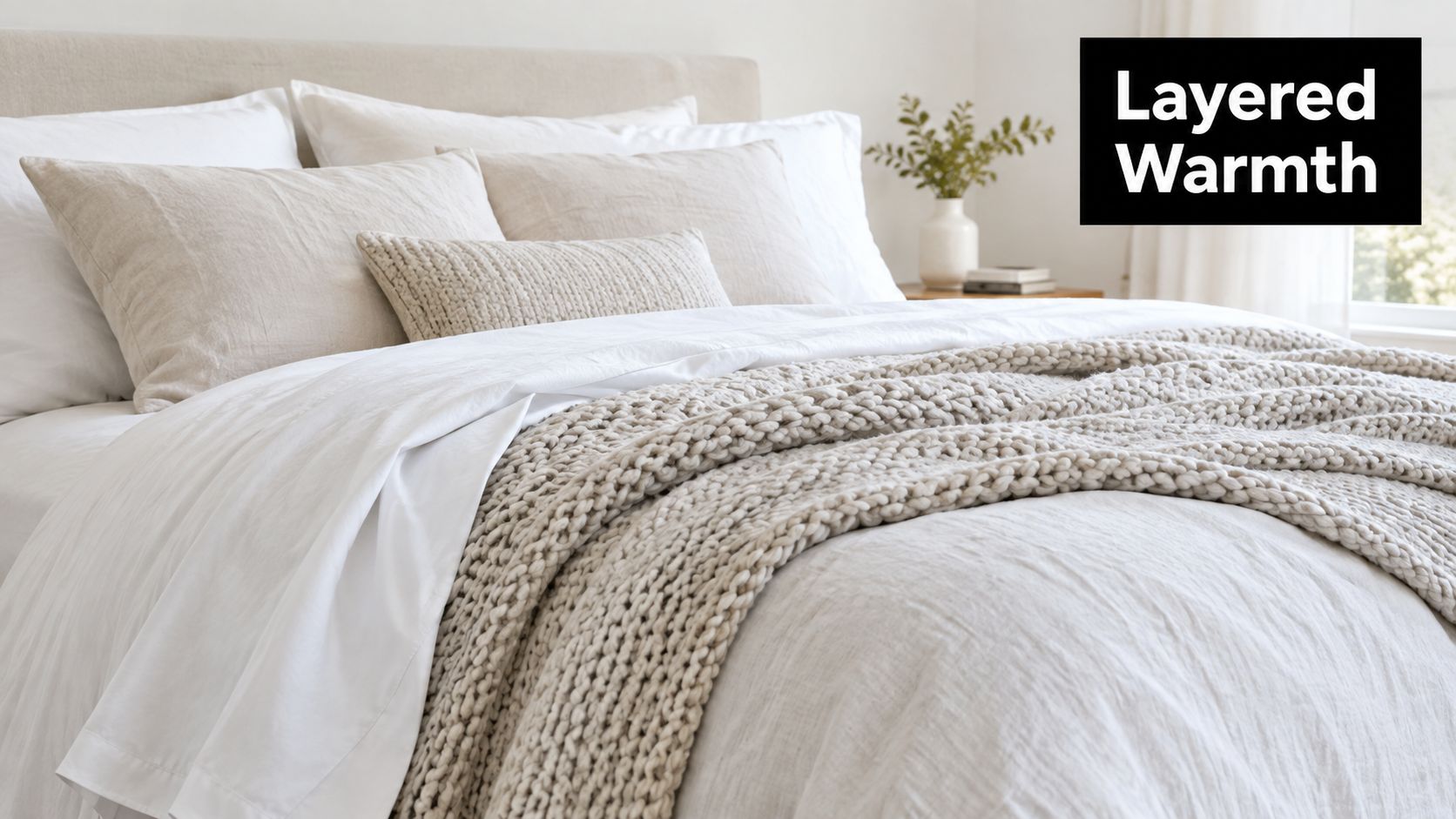
A beautiful winter white bed has a visual hierarchy. The sheet is quiet, the middle layer provides structure, and the top layer creates softness and volume. If every piece has the same shade and finish, the result looks unfinished. If every piece has a different pattern or pile, the bed becomes noisy.
Follow a practical layering sequence
- Begin with a breathable base. Use white cotton sheets as the clean, comfortable foundation. Choose brushed cotton for a colder room or percale when you need more airflow.
- Add a defined middle layer. Place a quilt, coverlet, or waffle-textured blanket over the sheets. Cream, ivory, or soft beige works especially well because it separates the bright base from the top layer without creating a harsh contrast.
- Finish with the insulating layer. Add the duvet or comforter so it remains visible rather than hiding it under an oversized decorative cover. Fold the upper edge back slightly if you want the sheet and quilt to show.
The guide to layering bedding offers a useful reference for arranging those pieces without making the bed appear bulky. Keep the heavier layer toward the center and fold a throw at the foot where it can add color, texture, and practical warmth.
Designers are emphasizing brushed cotton, waffle, shearling, boucle, and piped details, while warm off-whites, creams, and textured neutrals are replacing stark, plain white schemes. Ideal Home's 2026 bedding trend coverage reflects that move toward tactile layers and softer tonal palettes.
A small accent color can make the composition feel personal. Soft melon or butter yellow brings warmth without overpowering the white base. Pale mint suits a cooler room, while tobacco, camel, or natural wood accessories add depth to an otherwise pale arrangement.
The video below offers another visual reference for assembling layers and balancing the finished bed.
Keep the number of textures controlled. Pair a smooth sheet with a quilted middle layer and one nubby or plush accent. That combination feels rich because the surfaces contrast, not because the bed contains every available winter fabric.
Sizing Your Bedding for Deep Mattresses and Adjustable Bases
Poor fit makes expensive bedding look cheap. A fitted sheet that pulls away from the corners, a duvet that stops short at the sides, or a quilt strained across a thick mattress creates visible tension and accelerates wear at the seams.
Modern beds often combine a mattress with a topper, pillow-top construction, mattress protector, or adjustable foundation. Standard sheet assumptions fail when those layers are treated as invisible. Measure the complete sleeping surface from the support beneath the mattress to the highest point of the finished bed, including any topper and protector you leave in place.
Match the fitted sheet to the actual depth
Read the product's pocket-depth description, then compare it with your measured mattress rather than relying on the bed's advertised size. The fitted sheet should have enough extra fabric to wrap underneath without pulling hard at the corners. Elastic should sit below the mattress edge, not strain across the top surface.
Extra-deep pocket sheets are the sensible choice for pillow-top mattresses and layered guest beds. Look for all-around elastic or a reinforced elastic edge when the bed moves, especially if the mattress sits on an adjustable base. A sheet that fits generously can still look smooth, while a sheet that barely reaches the underside will repeatedly work loose.
Give the upper layers room to drape
The duvet cover and insert need enough width to reach the sides of the mattress with a relaxed fall. If the upper layer is too narrow, the sleeper pulls it toward the center during the night, exposing the sheet and making the bed look visually short. If it's too small in relation to a deep mattress, the sides can also rise rather than hang.
Oversized quilts and comforters create a more generous, upholstered appearance, but don't buy width alone. Check the finished dimensions, corner construction, and weight. An oversized top layer can become awkward on an adjustable base if it lacks enough flexibility to move with the frame.
Fit check: Make the bed with every layer in its real sleeping configuration, then raise and lower the adjustable base. The fitted sheet should stay anchored, and the upper layers should move without catching or dragging.
Use a mattress protector that doesn't add unexpected bulk, and check the fit again after laundering because some natural fibers can change shape. For rentals and family bedrooms, consistent sizing across replacement sheets simplifies turnover and prevents a single poorly fitted set from disrupting the entire bed.
Adapting the Hotel Aesthetic to Your Personal Style
The hotel bed works because white bedding makes a room feel larger, fresher, and more luxurious. Lighter bedding can visually expand a small bedroom and keep substantial winter layers from making the space feel crowded, a point discussed in Homes & Gardens' bedroom color guidance.
At home, though, copying a hotel room exactly can feel anonymous. Keep the white foundation and change the supporting materials, furniture, and accents to establish a stronger point of view.
A relaxed coastal room
Use white cotton sheets, an ivory quilt, and a loosely folded oatmeal throw. Add pale timber, woven baskets, and a faded blue or soft mint accent rather than a bright nautical stripe. The room stays airy, but the nubby throw and natural materials keep it from feeling clinical.
This arrangement suits a smaller room particularly well. Pale bedding reflects available light, while warm wood prevents the white from appearing cold against winter skies. Keep decorative pillows restrained so the bed remains easy to use.
A modern minimal bedroom
Choose crisp white sheets with a warm-white duvet cover and a structured quilt in pale stone. Add matte black hardware, a simple upholstered headboard, and one substantial throw with a clean edge. The contrast comes from silhouette and finish rather than multiple colors.
Piped details and precise quilting earn their place here. They give a white bed architectural definition without introducing visual clutter. A low-profile palette also lets artwork, a sculptural lamp, or a strong rug provide the room's character.
A layered traditional or organic room
Start with white sheets, then bring in an ivory or cream quilt, a boucle cushion, and a camel or muted melon throw. Warm wood, aged brass, and softly patterned curtains make the bed feel collected rather than staged. If the room already has strong wallpaper, keep the bedding mostly tonal and let the wall carry the pattern.
Textiles beyond the bed matter here. Curtains collect dust and household residue over time, so a practical commercial drapery cleaning guide for 2026 can help hospitality managers and homeowners plan care for the whole room, not just the linens.
The hotel aesthetic should be treated as a starting point, not a finish line. Use the white base for brightness and order, then let wood, metal, pattern, and tactile layers express how you want the bedroom to feel.
Washing and Whitening White Linens Without Damaging Fibers
White bedding doesn't stay bright through wishful thinking. Body oils and sweat gradually yellow fabric, especially when soil remains in the fibers before washing. Chlorine bleach can make that problem worse if residual oils are still present, and repeated exposure can weaken the textile.
A safer care routine starts with soil removal, not whitening. The white-sheet washing guidance from Ruho Living recommends oxygen bleach or hydrogen peroxide for whitening and reserves chlorine bleach for bleach-safe 100% cotton items used sparingly.
Use a repeatable wash routine
- Separate the white load. Wash white sheets, pillowcases, quilts, and duvet covers apart from colored items. This protects brightness and prevents dye transfer from darker winter blankets.
- Pre-treat the problem areas. Apply a suitable laundry detergent or pre-treatment to the center of the sheet, pillow edges, and other areas exposed to skin oils. Give the treatment time to loosen the soil before the main wash.
- Avoid an overloaded drum. Bedding needs room to move through water and detergent. Compressing a bulky comforter into a crowded machine leaves residue behind and makes thorough rinsing less likely.
- Choose oxygen-based whitening when appropriate. Oxygen bleach or hydrogen peroxide can brighten whites without the repeated fiber stress associated with aggressive chlorine use. Follow the product label and the textile care instructions.
- Reserve chlorine bleach carefully. Use it only when the item is bleach-safe 100% cotton and the fabric-care label permits it. Never treat chlorine bleach as the default solution for yellowing caused by unremoved body oils.
- Dry completely before storing. Residual dampness encourages musty odors and can make a fresh white set feel unclean. Dry according to the label, then store the bedding in a dry, ventilated place.
The practical goal isn't showroom perfection after every wash. It's to remove soil before it accumulates, avoid chemical overcorrection, and choose constructions that tolerate the frequency your household requires.
For homes with pets, children, or frequent guest turnover, keep a spare fitted sheet and pillowcase set available so you can change the high-contact pieces without immediately washing the entire bed. Hospitality teams can also separate decorative layers from sleeping layers, reducing unnecessary laundering of pieces that haven't contacted skin.
If a bedroom care plan also includes urgent household maintenance, Vanish Pest Control's same-day service resource may be useful as a separate operational reference. For the linens themselves, this guide to keeping white sheets white provides a practical companion to the washing routine.
Building Your Ultimate Winter Bedding Sanctuary
The right winter white bedding setup isn't a collection of pale products. It's a coordinated system with a breathable foundation, a properly fitted base, an insulating layer, and enough texture to make the bed feel inviting. Every piece should earn its space through comfort, fit, durability, or visual balance.
Bedding coverage increasingly treats winter styling as functional rather than purely decorative. Texture, layering, and the visibility of the duvet all contribute to the finished look, and white bedding guidance from Bed Linen Direct reinforces that the right construction can make a white bed practical for everyday use.
Use this buying checklist
- Start with fit: Measure the complete mattress setup, including toppers and protectors, before choosing fitted sheets.
- Choose the sheet for the sleeper: Use brushed cotton flannelette for a warmer surface or breathable cotton percale for people who overheat.
- Let the insert do the insulating: Choose down or a high-loft down alternative when the room and sleeper demand substantial warmth.
- Add a structured middle layer: A quilt or waffle blanket gives the bed shape and separates the white sheet from the uppermost layer.
- Soften the palette: Combine bright white with cream, ivory, warm beige, or a restrained seasonal accent.
- Buy for the laundry routine: Prioritize washable covers, durable stitching, and fabrics that suit the frequency of care your home requires.
- Check movement: On an adjustable base, test the fitted sheet and upper layers through the bed's full range of motion.
- Keep one layer easy to replace: A washable throw or quilt can refresh the appearance and provide warmth without disturbing the entire system.
The finished bed should feel generous rather than overfilled. White keeps the room visually open, while texture and tonal variation supply the warmth that a stark hotel formula lacks. That balance is what makes winter white bedding work in a family home, a rental, a guest room, or a carefully styled primary bedroom.
SouthShore Fine Linens offers oversized bedding, extra-deep pocket sheets, quilts, duvet covers, and textured seasonal layers designed for modern mattresses and everyday laundering. Visit SouthShore Fine Linens to choose a practical white foundation and build a warmer winter bed around it.