
Oversized Plush Comforter Guide: Size, Fill and Care
You bought it for the look. Three nights in, the plush comforter that photographed like a cloud stops short of the mattress on both sides, your partner has rolled the extra width into a burrito, and by 2 a.m. you're kicking it onto the floor because you're too warm.
None of that means the comforter is bad. It means it was chosen on the wrong criteria. Plush describes how the surface feels. Fit decides whether the thing stays on the bed until morning, and fill plus your own sleep temperature decide whether you sleep or sweat. Judge a comforter on fit and heat first, softness second, and the one you fall for will work in your bedroom.
Oversized Plush Comforter Sizes for Every Bed
Start with the mattress. A comforter label only means something next to the bed it's going on, and standard US footprints run from a 38 × 75 inch Twin to a 76 × 80 inch King.
| Bed size | Mattress W × L (in) | Width difference from King (in) |
|---|---|---|
| Twin | 38 × 75 | 38 narrower |
| Twin XL | 38 × 80 | 38 narrower |
| Full | 54 × 75 | 22 narrower |
| Queen | 60 × 80 | 16 narrower |
| King | 76 × 80 | Reference width |
| California King | 72 × 84 | 4 narrower, 4 longer than King |
The last column is where most purchases go wrong. A Twin sits 38 inches narrower than a King, so a comforter cut for one bed either drowns the other or leaves the far side bare. California King is its own trap: it trades 4 inches of width for 4 inches of length against a standard King, so a King comforter on a California King runs wide and short at the foot.
What oversized means in practice
Oversized means coverage beyond the footprint. Because fabric hangs down both sides, a workable comforter width is the mattress width plus twice whatever drop you want. An extra-wide King cut goes far past the 76-inch mattress, so each side reaches low on a deep mattress instead of stopping at the edge.
Deep mattresses and adjustable bases are where standard comforters fail in plain sight. On a mattress 14 inches deep or more, or on a base that articulates, a comforter matched to the footprint lifts at the head and exposes the sides. On a shared bed the failure is social: one sleeper pulls the extra width across and the other wakes up under a sheet.
More width and length fix both problems. A generous cut gives a fuller side drop on tall mattresses and leaves enough fabric to layer cleanly over sheets, quilts and blankets. No plush face compensates for a comforter that stops two inches short of the drop you wanted.
A live example of what oversized looks like in inches: in 2025, Sam's Club listed The Big Cozy Plush Comforter at 106 × 94 inches for $59.98, per Sam's Club's bedding listings. At 106 inches wide that's 30 inches wider than a King mattress and 46 inches wider than a Queen, and at 94 inches long it clears a King's 80-inch length by 14.
Before you order: measure the mattress width, length and depth, decide the drop you want, then buy whichever size clears those numbers. If a listing doesn't print finished dimensions in inches, move on. For the wide end of the range, our king comforter dimensions guide walks through the cuts that actually cover a deep mattress.
What Plush and Oversized Actually Mean in a Comforter
Two words do all the selling on the package, and neither one is a specification. Oversized describes coverage: how far the comforter extends past the mattress edges and foot. Plush describes the surface, whether that's a pile, a brushed finish or a faux-fur shell. A comforter can be both and still be wrong for your bed, your laundry room and your sleep temperature.
A comforter works more like a winter coat than a sheet. The warmth comes from air trapped inside the fill and held there by the shell, so a thin fill under a thick, soft face can look warm and sleep cold. Fill type sets most of the trade-offs:
- Down: high loft and the best warmth for its weight, at a premium price, and it rewards careful drying.
- Down alternative: fine synthetic microfiber, lighter in the hand, usually machine washable, and the easiest to find at a mid price.
- Wool: steady temperature regulation and a heavier hand, with fibers springy enough to resist clumping.
- Cotton: breathable and light, but it compresses sooner and reads flatter than the others.
The shell is where plushness lives
Microfiber gives a smooth, low-pile face that hides fill movement well. Brushed flannel cotton is brushed for extra softness and provides excellent warmth, which is why a flannel shell feels warmer than its weight suggests. Faux fur and sherpa push the pile further and sit heavier on the bed, which changes the drape as much as the feel.
The detail that decides whether a plush comforter holds up is fill weight, and it rarely gets printed in large type. Two comforters with an identical faux-fur face can carry very different amounts of fill, and the heavier one drapes better, insulates better and keeps its loft longer. A plush shell can hide a thin fill completely.
That split between a soft surface and the part doing the actual work shows up beyond bedding too: plush heating pads for soothing warmth pair a plush cover with an element that produces the heat. On a comforter label, read three things before the marketing copy: fill type, fill weight and shell fiber content, plus the finished dimensions. Softness against the skin is a preference. The label is the specification.
Warmth, Drape and Whether It Sleeps Too Hot
Plush gets marketed as cozy, and cozy gets read as warm. That assumption is worth questioning, because a plush surface predicts almost nothing about how a comforter will sleep.
The genuine benefits are real. Loft traps warm air, full coverage eliminates the cold strip along the mattress edge, and a drape that falls below the bed line blocks the draft that wakes light sleepers at 4 a.m. An oversized comforter also works as the visible top layer over a sheet, which is the look many buyers want.
What plushness can't tell you
Thermal performance depends on fill, fabric construction, coverage, sleepwear, room temperature and the sleeper. Bedding research published in 2025 tested systems spanning 1.06 to 5.71 clo of thermal insulation across different quilts, body-coverage levels, postures, clothing conditions and bedroom temperatures, which is a wide enough spread to make the point on its own (2025 bedding research from DTU).
That same work found that cooling bedding substantially improved perceived comfort and reduced how intense sleeping hot and night sweats felt, without improving objectively measured sleep. Both halves matter. A comforter can feel noticeably cooler and make you happier in bed without changing your sleep architecture, so treat "plush but breathable" as a trade-off you're managing, not a feature that overrides physics.
One more thing that surprises people: oversized dimensions increase body coverage, and more coverage feels warmer even when the fabric and fill are identical. If a comforter sleeps hot, the extra drop may be part of the reason.
| Situation | Better choice | Why it works |
|---|---|---|
| Sleeps hot or wakes with night sweats | Lighter fill with breathable shell, used as the top layer | Less trapped heat while the drape still adds coverage |
| Couple with different temperature preferences | Removable layer or two lighter layers | Each side adjusts without changing the whole bed |
| Variable climate, mild to cold seasons | Oversized comforter over a sheet and a light blanket | Layers come off as the room warms |
| Cold bedroom, sleeps cool | Higher-loft fill with full oversized drape | Traps more warm air with extra coverage |
| Deep mattress or adjustable base | Oversized length to keep the drop below the bed edge | Covers the sides without bunching |
The honest framing for a hot sleeper is lighter construction, partial layering, and a comforter you can throw off at 3 a.m. without wrecking the bed.
Shoppers who run warm can go further into the layer-by-layer approach with this guide to comforters for hot sleepers from The Sleep Consultant, which is a useful companion if the table above points you toward two lighter layers instead of one heavy one.
Oversized Plush Comforter Versus Down and Down Alternatives
Here's the rule before the table: buy the fill that satisfies the criterion you can't compromise on, whether that's warmth per ounce, machine washing, allergies, drape or longevity. Everything else is preference, and preference changes with the season.
Plush comforters are usually synthetic-filled, so that's the baseline for the comparison.
| Criterion | Plush comforter (synthetic fill) | Down | Down alternative |
|---|---|---|---|
| Warmth for its weight | Moderate to high, depends on loft | Highest for its weight | Moderate to high, close to down at similar loft |
| Machine washability | Usually yes, check label | Often needs gentle care or professional cleaning | Usually yes, check label |
| Allergy suitability | Synthetic, generally suited to allergy-prone sleepers | Can trigger reactions in some sleepers | Synthetic, generally suited |
| Drape on deep mattress | Strong, with plush shell and wide cut | Depends on shell and loft | Depends on shell and loft |
| Loft recovery over years | Can flatten with repeated heat | Strong when cared for and fully dried | Can flatten with repeated heat |
Where each one wins
Down takes the warmth-per-weight column and the longevity column, and it earns both only if the comforter is washed gently and dried until the center is fully dry. Skip that and the advantage disappears into clumps and odor.
Down alternative wins on practicality. A household with allergies, a washer large enough for a King comforter, and a preference for a lighter hand on the bed gets most of the loft without the care ritual. It's also the type you can replace without flinching.
The plush synthetic comforter wins on drape and care. A wide cut with a high-pile shell covers a deep mattress and hangs cleanly, and it survives a home laundry routine. If budget and easy care outrank peak warmth, this is the sensible answer, and there's more detail in this guide to down fill comforters if you're leaning the other way.
Price tracks fill weight, shell quality and construction, not fill type, so compare specifications before you compare tags. A cheap down comforter with thin fill loses to a well-built synthetic at the same money in every column above except warmth for its weight.
The useful part is that all five criteria are checkable on any label. Fill type, fill weight, shell fiber, finished dimensions and care instructions are printed on the product you're already holding.
Washing, Shedding and When to Replace It
An oversized plush comforter is the hardest piece of bedding in the house to launder well, and not because the fabric is delicate. It's the size. Extra width, length and loft mean more textile mass going through a drum, and the stress concentrates at seams, quilting lines, corner construction and the boundary between shell and fill.
Here's the routine in one view before the reasons behind it.
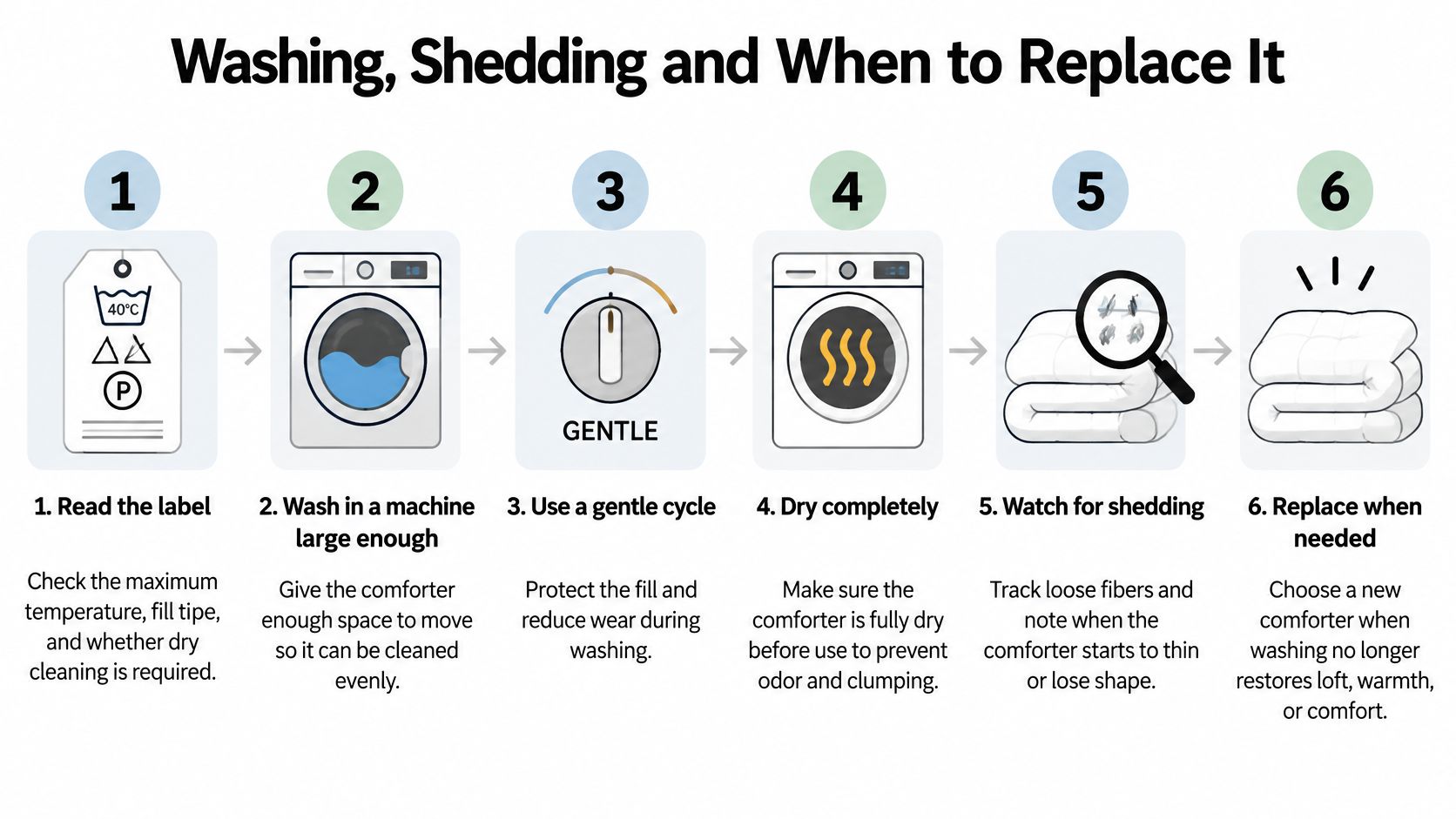
The wash routine, step by step
- Read the care label first. Check maximum temperature, fill type and whether dry cleaning is required. A dry-clean-only comforter is a different ownership commitment, so decide that before you buy, not after the first spill.
- Use a machine the comforter can move in. An overloaded drum is the main cause of clumping and seam stress. A 106-inch comforter needs a commercial-size machine or a laundromat trip; forcing it into a compact home washer leaves dry pockets and strains the quilting lines.
- Run a gentle cycle with mild detergent. Skip fabric softener, which coats fibers, cuts loft and leaves the fill feeling limp. Skip bleach for the same reason.
- Rinse fully. Detergent residue stiffens fill and dulls pile, and it's the reason a washed comforter sometimes feels rougher than it did new.
- Dry low and slow with clean dryer balls. High heat flattens pile even when the shell stays intact. Pull the comforter out hourly, break up clumps by hand, and push fill back into the corners.
- Confirm the middle and corners are dry before storage. Damp fill is where odor and mildew start, and a comforter stored slightly damp smells the moment it goes back on the bed.
If you want the wider version of this routine for sheets, quilts and shams, our guide to washing bedding covers the cycles and temperatures by fabric type.
Where oversized comforters actually fail
Watch four places after every wash: the seams, the quilting lines, the corners and the interface where shell meets fill. Repeated wet loading promotes fill shifting, clumping, seam distortion and incomplete drying, and those show up as cold patches long before anything looks damaged.
The specification worth asking for is finished dimensions after laundering, plus shell fiber content, fill composition and weight, quilting or baffling pattern, seam allowance, corner reinforcement and the manufacturer's maximum-care conditions. A comforter that starts at 106 inches and finishes at 101 has told you something about its filling and its stitching. Pile direction and surface brushing also affect perceived loft and compression recovery, so over-drying flattens fibers even when the structure is sound.
Here's the same process in motion if you'd rather watch the loading and drying sequence than read it.
Shedding, lint and what the evidence does and doesn't say
Plush synthetic surfaces shed, and most care advice skips the subject entirely. A 2025 pilot community-science study measured airborne microfibre deposition in homes and found bedrooms had the highest average rate among the sampled rooms at 2,893 fibres per square metre per day, against 1,960 fibres per square metre per day across all indoor spaces (Frontiers in Built Environment).
That number does not establish that plush comforters caused those fibers, and it doesn't prove a health effect. Anyone telling you a plush comforter is toxic is going beyond what the evidence supports.
What the finding does justify is better habits. Clean the lint filter every dry cycle. Keep heat low to reduce the friction that breaks fibers loose. Give the comforter a washable duvet cover as a barrier so the plush surface isn't the wear layer. And separate visible lint from airborne microfibres, because the first is a washing and drying problem and the second is a ventilation and filtration one.
OEKO-TEX certification doesn't answer this question either. It addresses the substances in the textile, not durability or shedding.
When to replace it
Replace the comforter when the pile goes bald or shiny in the area where you sleep, when lumps don't redistribute after a full low-heat dry, when seams split or a corner loses its fill, when odor survives a wash and a complete dry, or when the finished size has shrunk enough that it no longer covers the mattress it was bought for.
Fluff the comforter daily while it's on the bed. Thirty seconds of shaking redistributes fill and delays most of the failure modes above.
Choose Your Size and Certification Before You Buy
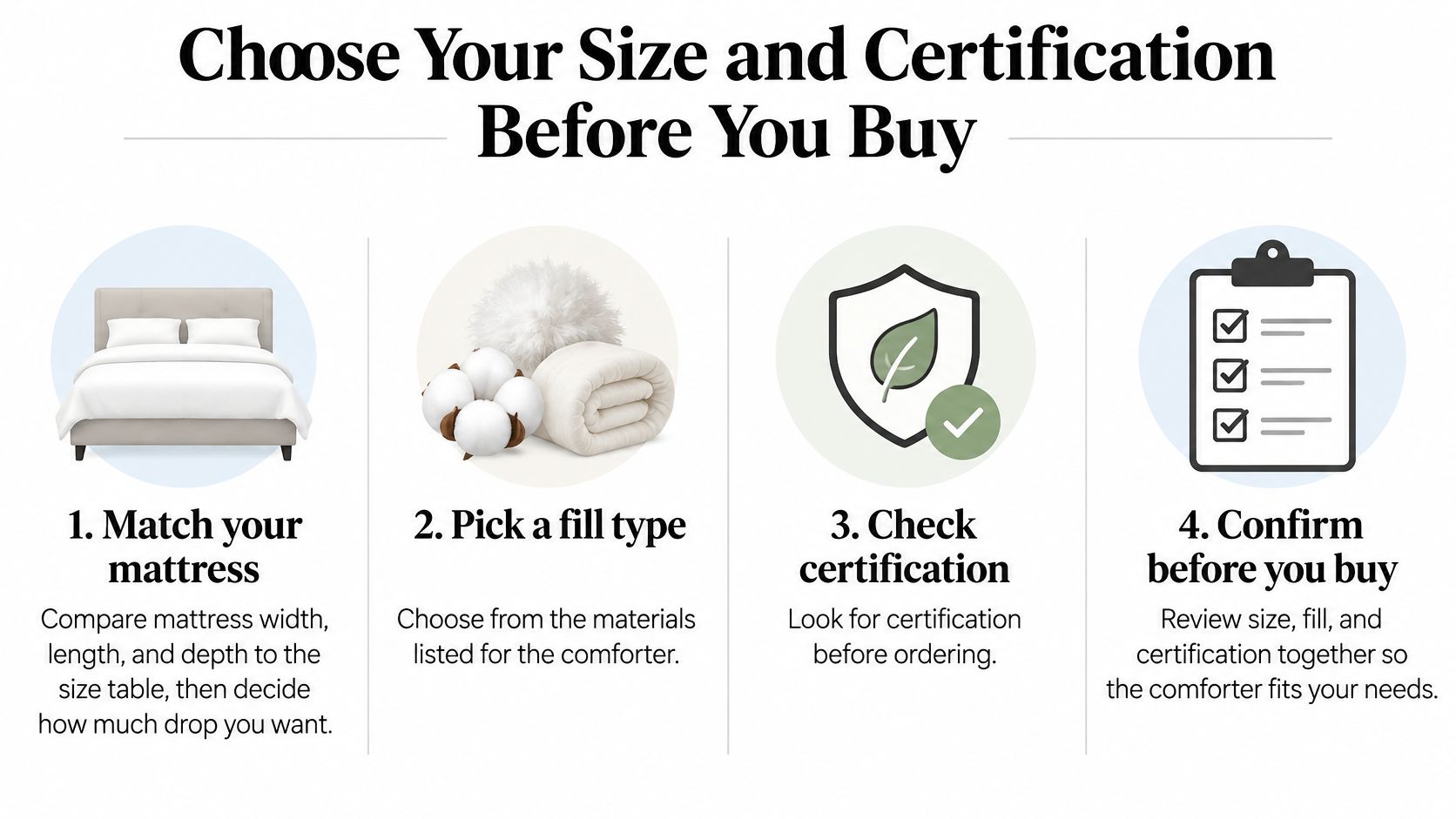
Four checks settle the purchase, and they take less time than reading reviews.
Match the mattress to a row in the size table. Measure width, length and depth, then decide the drop you want. That number picks the size, not the word on the package.
Pick the fill and verify the fill weight. Synthetic, down, down alternative or wool, then confirm the fill weight on the label. A plush face without a stated fill weight is a surface, not a product.
Confirm certification covers the finished comforter. OEKO-TEX® STANDARD 100 requires testing of every component, including fibers, sewing thread, labels, fasteners, linings and accessories, against a catalog covering more than 1,000 potentially harmful substances, per the OEKO-TEX STANDARD 100 standard. That distinction matters because a comforter is several material systems stitched together: face fabric, backing, pile, thread and fill. A shell that passes in isolation doesn't prove the finished article meets the same limits after dyeing, finishing and assembly.
Limit values are reviewed at least annually, so an older approval isn't permanent evidence of compliance. Keep the certificate number and check it against the current approval. Scale is the other reason the label carries weight: the OEKO-TEX account of its own history records more than 150,000 STANDARD 100 certificates issued since 1992, with more than 10,000 manufacturers, retailers and brands in 98 countries taking part at that point.
Check the care label against your washer. If the comforter won't move freely in the drum you have access to, you've bought a laundromat errand.
One habit prevents the most expensive mistake. Sizing names aren't dimensions, which is why we publish measurements per size rather than trusting a label: our Vilano Oversized Quilt Set comes in Twin / Twin XL, Full / Queen and King / California King, and each size is listed with its own numbers. Measure the bed, pick the matching row, confirm the certificate, then order.
SouthShore Fine Linens builds bedding for the beds people own, deep mattresses, adjustable bases and all, with oversized cuts that keep the drop below the mattress edge and fabric choices that survive a real laundry routine. If you're replacing a comforter that never quite fit, start with the plush and quilted collections and compare the finished dimensions against your measurements before you commit. Visit SouthShore Fine Linens to see the current sizes, fabrics and certifications for yourself.


