
Down Alternative Comforter Set vs Down: Which to Buy
The popular advice is tidy and wrong. You're told to pick a down alternative comforter set if you're allergic, buy down if you want luxury, and trust a word like all-season to settle the rest. That shortcut ignores the thing that controls your night. Warmth is set by fill weight, loft and shell together, so hypoallergenic doesn't mean cooler, and a cheap comforter that flattens in two years isn't cheap to own.
Down Alternative and Down Side by Side
| Criterion | Down alternative | Down |
|---|---|---|
| Fill material | Polyester or microfiber fibers | Goose or duck feathers and down clusters |
| Warmth for the same weight | Lower | Higher |
| Weight for the same warmth | Heavier | Lighter |
| Loft and bounce | Good when quilting holds the fill evenly | Highest, springs back after compression |
| Hypoallergenic status | Designed to avoid feather and down allergens | Can trigger reactions in feather-sensitive sleepers |
| Typical price tier | Lower to mid range | Mid range to premium |
The central trade-off fits in one sentence. Down traps more heat per gram, so a down alternative comforter set of the same warmth is usually heavier and bulkier. That weight gap affects everything after it, from how the comforter drapes to whether it fits your washer and how long it takes to dry.
What You're Actually Buying
A down alternative comforter set is a polyester or microfiber fill quilted inside a cotton, sateen or polyester shell, often sold with matching shams. It doesn't need feathers to feel plump on day one. What keeps it plump is whether the quilting holds that fill in place after washing.
Most sets come in Twin/Twin XL, Full/Queen, and King/California King. Match the size to your mattress and drop before you compare weights, because a King comforter at the same fill density will always weigh more than a Twin. Comparing finished weights across different sizes tells you almost nothing.
Down works differently inside the shell. Clusters expand into a three-dimensional structure that holds still air, which is why a light down comforter can feel surprisingly warm. Synthetic fibers can mimic that loft, but they need more material to hold the same air, and they recover from compression less reliably over time.
Practical rule: Compare fill weight, construction and shell fabric before you compare labels such as hypoallergenic or all-season.
That rule keeps you honest. Two comforters can share the same warmth label and sleep very differently because one carries more fill, uses a tighter shell, or lets fill migrate into clumps. Start with the specs you can measure, then use the marketing words as a rough guide, not a verdict.
Hypoallergenic Claims and What They Cover
The most common mix-up is simple. Buyers read hypoallergenic and assume it means cooler, cleaner and chemically safe all at once. It doesn't. It describes allergen suitability, not temperature and not chemical content, and those are three separate questions you should keep apart.
Three Questions Buyers Blend Into One
- Feather and down allergy: A down alternative removes feather and down allergens because there's no feather fill inside. For a sleeper who reacts specifically to feathers, that change alone can settle the purchase.
- Dust mites and dander: Dust mites can live in any fill, synthetic or natural. Washing, a fitted allergen-proof encasement and regular laundering still matter, and if morning symptoms persist, testing for a dust mite allergy helps you separate a mite problem from a feather problem before you replace bedding that isn't the cause.
- Skin-contact safety: Dyes, finishes and shell fabrics sit against your skin for the whole night. That's a chemical question, and it's answered by textile certification, not by the word hypoallergenic.
A certification such as OEKO-TEX STANDARD 100 checks harmful-substance limits for finished products and accessory materials. The OEKO-TEX STANDARD 100 standard tests certified products for more than 1,000 substances and requires laboratory measurements to remain below defined limits before certification is granted. It doesn't measure allergen load or warmth, so don't use it as proof of either.
Check scope before you credit the label. Certification should cover the actual finished article, including shell, sewing thread, labels and trims, not only a fiber input. A compliant fill inside an uncertified shell is a partial claim, not a certified comforter.
One edge case catches people out. A sleeper who reacts to a synthetic finish or a dye can still react to a down alternative, because removing feathers doesn't remove finishes. If that's you, test a sample against your skin where you can, or choose an unfinished cotton shell and wash it before first use.
Matching Warmth and Fill to Your Sleeper
Hypoallergenic does not mean cooler. Warmth comes from fill weight, loft, shell fabric and the room together, not from the fill label. A heavy synthetic comforter in a tight polyester shell will out-heat a light down comforter in open cotton, every night.
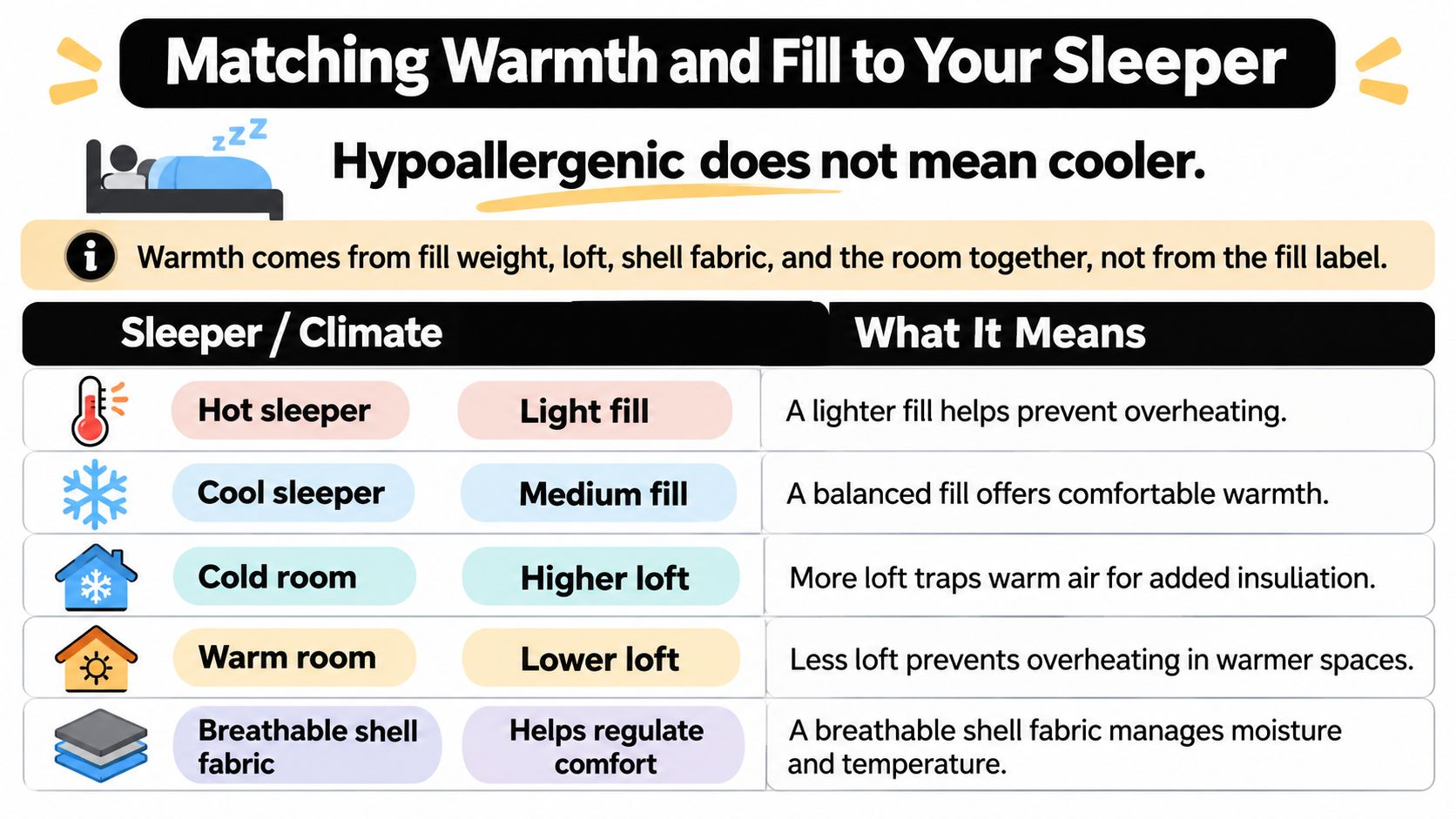
Use the Table Before the Label
| Sleeper or climate | Fill weight and construction | Shell and airflow |
|---|---|---|
| Warm sleeper or humid climate | Lower fill weight, lighter channels or box construction | Breathable cotton or sateen with open weave |
| Average sleeper in a moderate room | Mid fill weight, sewn-through or box construction | Balanced cotton or polyester blend |
| Cold sleeper or unheated room | Higher fill weight, sewn-through or box construction | Tighter weave to hold warmth |
| Couple with different temperatures | Mid fill weight on one side, lighter layer on the other | Matching shell with a blanket or second layer |
| Hot flashes or night sweats | Lowest fill weight that still covers the bed | Cotton or Tencel-type shell with airflow |
| Very cold winter climate | Highest fill weight, box or sewn-through construction | Tight weave with a wind-resistant shell |
Consider two comforters both sold as all-season. The one with the higher declared fill weight overheats a hot sleeper in a centrally heated home, yet suits a cold sleeper in an unheated spare room. Neither product is faulty. The label is the same, but the room and the sleeper changed the result.
That gap is well documented in current buying guidance. The National Council on Aging comforter guide notes that a down alternative can match down's warmth but generally requires more material, making it heavier and less lofty, and that performance varies by construction. So read fill weight and dimensions instead of trusting thread count or a season name, and if you want the down side of the ledger, our guide to down fill comforters lays out how natural fill is graded.
Five Situations, Five Fill Choices
- Allergy-prone household. Choose down alternative. It removes feather allergens and launders easily, which matters when you're washing bedding often.
- Hot sleeper. Fill type is secondary. Pick the lower fill weight in a breathable cotton shell, because a heavy synthetic set will still trap heat.
- Renter or frequent mover. Choose a lighter washable down alternative set. It packs down without special storage and survives shared laundry rooms.
- Hospitality manager or short-term rental host. Choose a durable down alternative set with a washable cover. Turnover cost drops when staff can wash the cover every stay and the full comforter only when soiled.
- Cold-climate sleeper who wants the lightest warmth. Choose down if you'll keep a careful care routine. You get more warmth per gram and less weight on your legs.
A mid-weight comforter plus a thin blanket beats one heavy comforter for couples, because either partner can shed a layer without uncovering the other.
Warm sleepers in humid climates should think about airflow as much as fill. A lower fill weight under a shell that doesn't breathe still feels clammy, because moisture stays close to the skin. Cold sleepers have the opposite problem, where a loose, oversized shell lets warm air escape at the edges no matter how much fill is inside.
Box size matters here too. Smaller quilted compartments limit migration and cold spots, while oversized channels look lofty on the shelf but need effective baffling or anchoring to stay even. If a listing shows big, puffy squares and no stitch spacing, assume you'll be shaking and redistributing fill.
The edge case is the dust- or feather-intolerant hot sleeper. I would prioritize the lowest fill weight over fill type in that situation, because overheating will ruin more nights than a modest difference in loft. Read the finished weight and dimensions for your exact size before ordering, since a King set at a hot sleeper's density can still feel heavy across the feet.
Washing, Drying and Fill Recovery Over Time
| Care task | Down alternative | Down |
|---|---|---|
| Machine washing | Usually yes, on the label's gentle cycle | Usually needs a down-safe detergent and gentle cycle |
| Drying method | Low heat tumble with dryer balls | Low heat tumble with dryer balls and a long cycle |
| Typical drying check | Check every 30 to 45 minutes until fully dry | Check every 30 to 45 minutes, then run extra time until no damp clumps remain |
| Fill recovery after laundering | Can flatten; re-fluff during drying | Loft usually returns once fully dry |
| Lifespan with routine care | Set by fill loss and seam wear, see the cost section | Set by fill loss and seam wear, see the cost section |
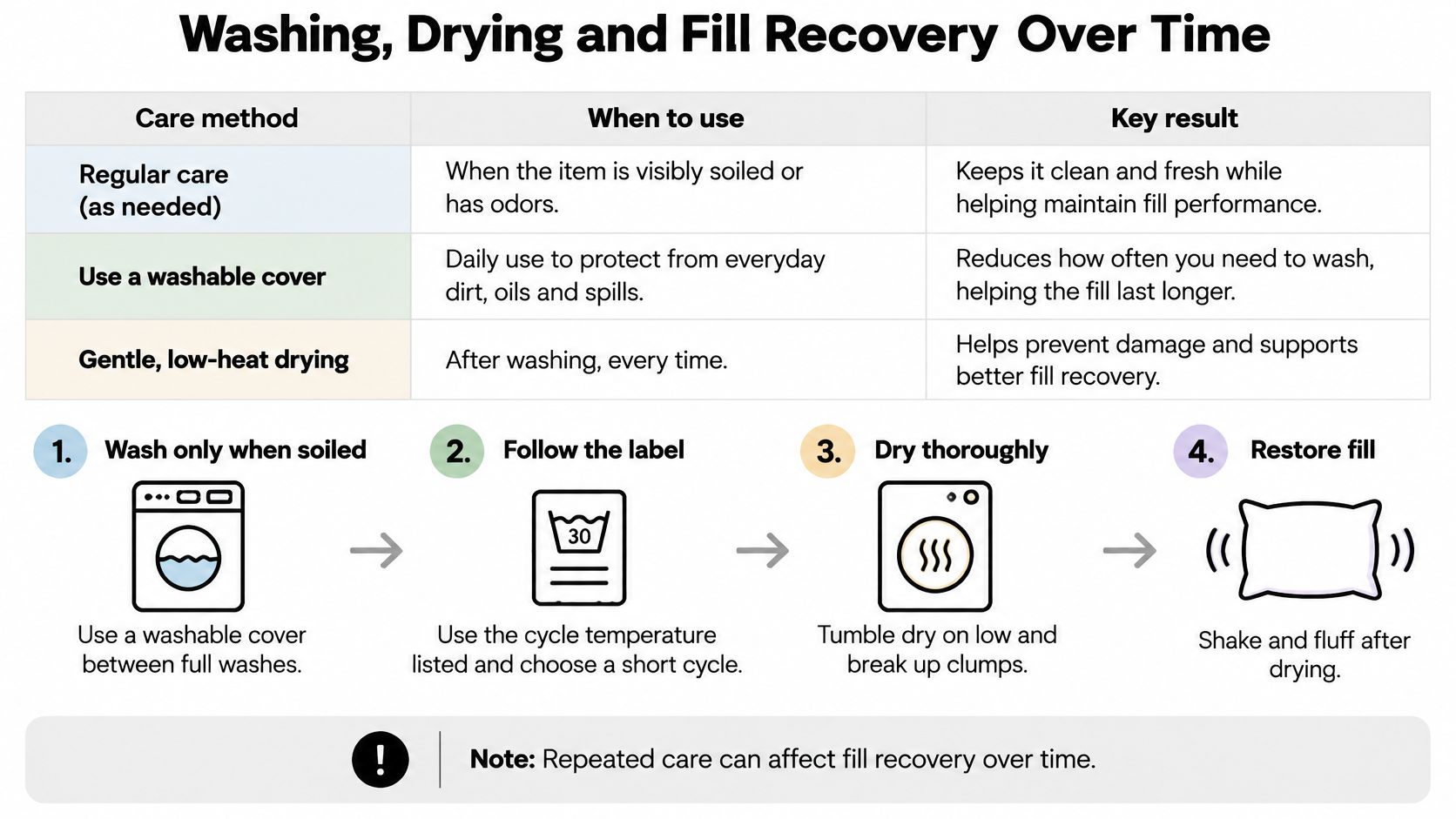
The Routine That Preserves Loft
- Wash only when soiled. Use a washable cover between full washes so the comforter itself goes through fewer cycles. The common slip is washing on a fixed schedule whether it's dirty or not.
- Follow the label's temperature, then keep it short. Choose a short cold or warm cycle when the label allows it. Long, hot cycles stress seams and fibers without cleaning better.
- Use mild detergent, skip fabric softener. Softener coats synthetic fill and reduces its ability to trap air. A small dose of mild detergent rinses cleaner.
- Spin fully and inspect. Check seams and look for fill that has migrated into one corner. Redistribute it by hand while damp, before it dries in place.
- Dry on low heat with dryer balls. Check every 30 to 45 minutes until fully dry, breaking up clumps as you go. Stopping early is how mildew smell starts.
- Re-fluff and cool before making the bed. Shake it out, let residual heat escape, then spread it. Folding a warm comforter traps moisture in the middle layers.
Our step-by-step notes on how to wash bedding cover load size and machine capacity in more detail. Capacity is the detail people skip. A King comforter crammed into a small drum won't rinse properly, and detergent left in the fill makes it feel flat and heavy.
The Fiber Cost of Every Wash
Machine washable is a practical benefit, not a complete sustainability claim. Reporting in WIRED's guide to down alternative puts household laundering at anywhere from 120 to 730,000 textile microfibers per cycle, and notes shorter, colder cycles reduced microfiber generation by about 30% compared with a conventional 40°C, 85-minute cycle. Washing less often still matters more than any single cycle choice, which is another reason the cover does the heavy lifting.
Fill recovery is where the two fills part company. A down alternative can flatten after repeated laundering and needs a dryer check plus re-fluffing to hold its shape. Down usually springs back once it's completely dry, but it clumps badly if you pull it out damp, so the last stretch of drying is not optional.
What a Comforter Costs Per Year of Use
Start with arithmetic instead of sticker price. The Vilano Down Alternative Comforter costs $69.99, and if it stays comfortable and uniform for four years, that's about $17.50 a year. If it flattens after two, you've paid roughly double per year for the same product.
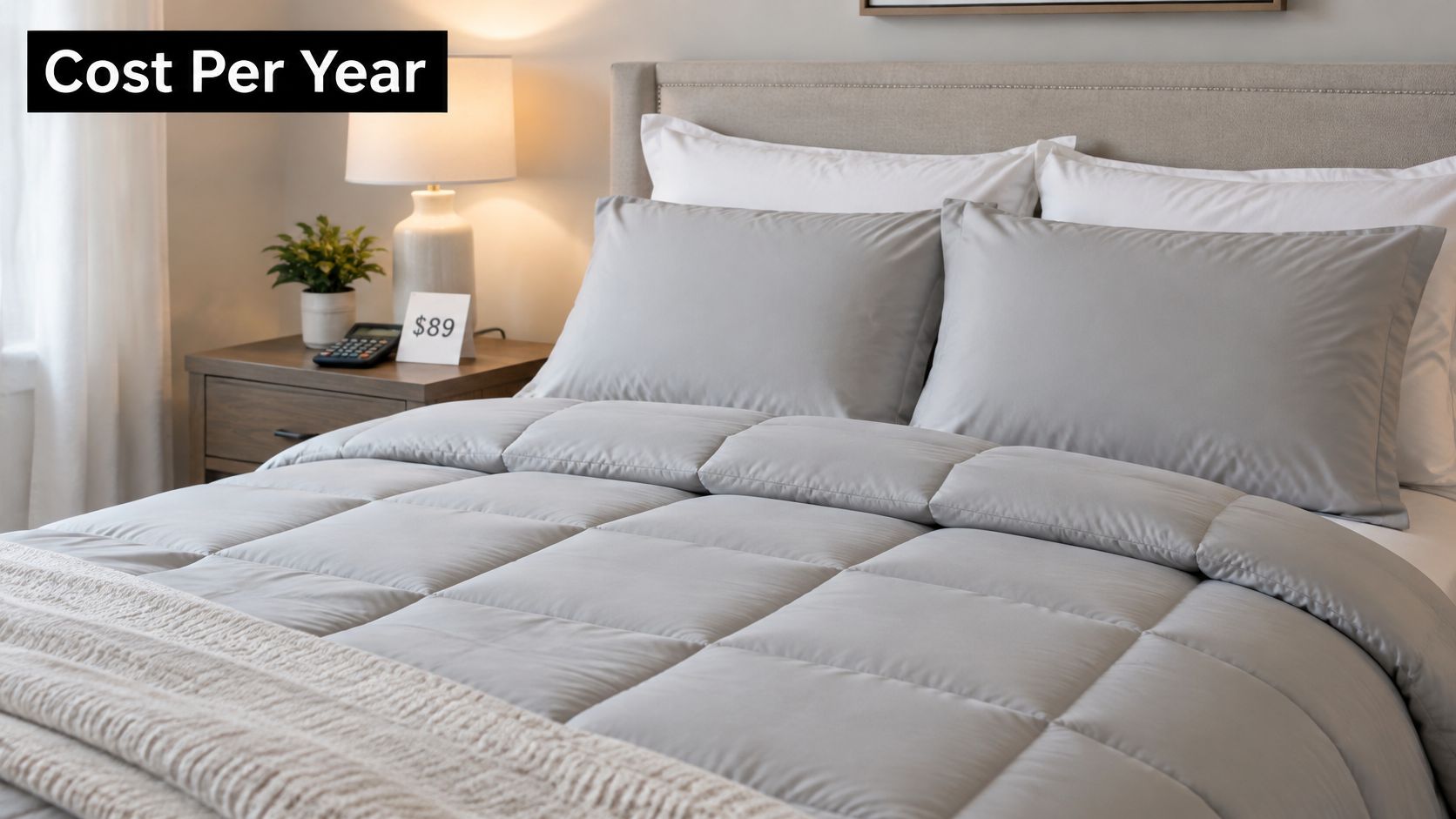
The formula is purchase price divided by the years the comforter stays serviceable. Serviceable means it still insulates evenly, not that it still exists in a closet. Once cold spots appear, you're compensating with blankets and heating, and the cost per year is already worse than the division suggests.
What Shortens the Useful Life
- Seam failure: Stitching opens at the edges and fill escapes or shifts.
- Fill migration: Fill collects in a few boxes and leaves cold spots elsewhere.
- High-heat drying: Repeated hot cycles damage synthetic fibers and bake in flatness.
- Oversized channels: Large compartments lose loft because nothing anchors the fill.
Down offsets the calculation differently. It can last longer with careful care, but it costs more to replace, and one damp or poorly dried wash can undo years of good handling. Our notes on high-quality affordable bedding explain how to weigh that replacement risk against a lower purchase price.
This short video is worth watching before you judge loft in a store, because unpacking loft and post-wash loft are different things.
Our Vilano range includes all-season down alternative comforters alongside extra-deep pocket sheets, embroidered quilt sets and oversized duvet cover sets with pillow shams, so you can compare a budget comforter against a fuller set with a matching cover. Do the check before you buy. Write down the expected years, divide the price, and compare that number with the alternative fill.
Choose Your Fill Using a Spec Checklist
A “hypoallergenic” label does not tell you how warm a comforter will feel. Warmth depends on fill weight, loft, and shell together, so compare construction details rather than relying on a single label. Choose down alternative if machine washing, budget, or allergy concerns lead your decision. Choose down if you want more warmth for less weight and can follow its care requirements.
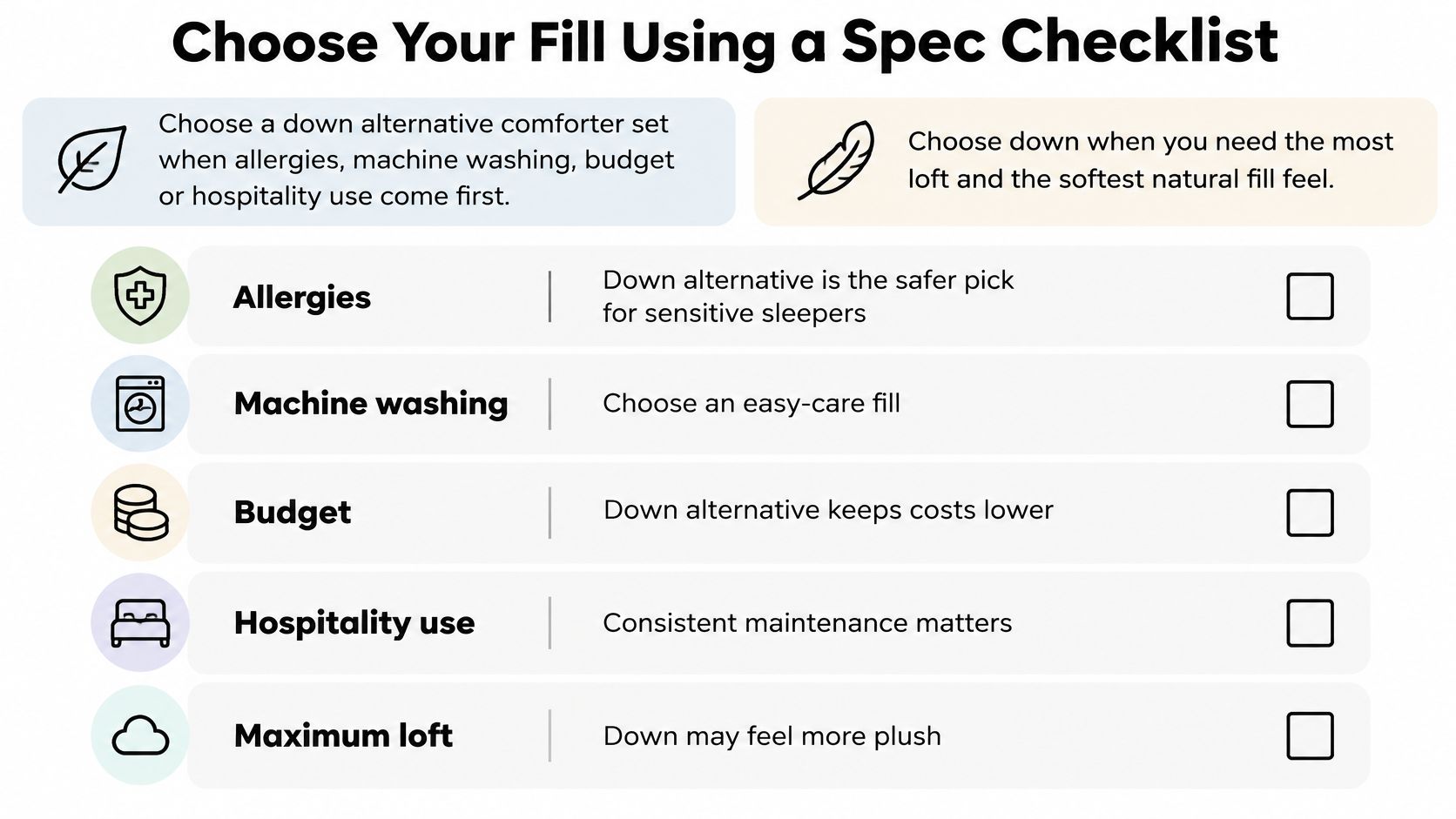
Softness is easy to describe, but it does not make two comforters comparable. The listing should give enough construction and care information to judge warmth, fit, and upkeep. If key specifications are missing, you cannot reliably compare the product with another option.
The Eight Fields to Record
- Declared fill weight for the exact size. For synthetic fill, weight helps you compare warmth because there is no interchangeable fill-power scale. Look for a weight matched to the size you plan to buy, not one figure for every size.
- Finished weight by size. This is the weight you will handle in the washer and feel on your body. Compare products in the same size.
- Dimensions and drop. Check the mattress width and the drop you want on each side. An oversized cut can help keep the comforter covering the bed without a nightly tug-of-war.
- Stitch or box spacing and edge construction. Stitching holds fill in place, while edge construction affects how well the perimeter withstands washing. Compare these details between products rather than assuming the same fill will behave identically.
- Shell fabric and thread count. Cotton, sateen, and polyester can feel and breathe differently, changing how warm the same fill feels. Thread count alone does not tell you the comforter's warmth.
- Machine wash and dryer instructions. Check the cycle, temperature, machine capacity, and drying method before buying. If your machine cannot accommodate the comforter, include laundry trips in your decision.
- Certification number and scope. Record the number and check what it covers, including shell, thread, trims, and fill. A certification label is useful only when its scope is clear.
- Return policy and warranty. A product photo cannot show how warm a comforter will feel in your room. Check whether the return policy gives you a practical way to judge it after purchase.
Start with the first four fields when a listing offers only warmth adjectives. Without fill weight, finished weight, dimensions, and construction details, you have little basis for comparing comforters. Ask for the missing information; if the answer is still only a description of softness or warmth, choose a better-documented listing.
Before you compare prices: Consider how well the comforter may hold its shape after care, not just how lofty it looks when new. A product that stays even through repeated washing may cost less per year than one that clumps and needs replacing sooner.
Putting the Fields to Work
A warm sleeper in a heated apartment is choosing between two Queen sets. Both are labeled all-season, but only one lists its fill weight and cotton shell. The listing with those details gives you a more useful basis for deciding whether its warmth and feel suit your room.
For a short-term rental with same-day turnovers, prioritize washing and drying instructions, the return policy, and a shell suited to frequent laundering. A comforter that is easy to care for may be a more practical choice than one that needs special handling, even if both seem suitable by their warmth labels.
SouthShore Fine Linens sells all-season down alternative comforters, extra-deep pocket solid color, lace and pleated sheets, extra-large flat sheets, 15 inch drop pleated bed skirts, embroidered solid quilt sets, and oversized duvet cover sets with pillow shams. These product categories let shoppers consider a comforter alongside other bedding, but the listing's own dimensions, fill, and care details still determine whether it fits their needs.
Check how measurements are stated and whether the listing explains how the comforter should be cared for. A comforter that does not cover the bed as expected may not meet your fit requirements. Treat dimensions and drop as part of the specification, not a minor detail.
Before opening product pages, write down your sleeper profile and the fill weight you want to compare. Then check each listing against that target, along with the other seven fields. Price makes sense only after you know the comforter is a plausible fit for your room and routine.
Write down your sleeper profile and target fill weight, then compare all-season down alternative comforters and oversized sets against those needs rather than warmth adjectives. SouthShore Fine Linens offers matching shams, duvet cover sets, and extra-deep pocket sheets at SouthShore Fine Linens.


