
What Is a Coverlet vs Quilt for Better Bedding
You're standing in the bedding aisle holding two folded covers that look almost identical. One tag says coverlet, the other says quilt, and a third nearby says quilted coverlet. You're not looking for a vocabulary lesson. You want to know which one will keep you comfortable tonight and still look right when you make the bed tomorrow morning.
What Shoppers Mean by Coverlet vs Quilt
You pick up the first package and it feels thin and flat. The second feels puffier, even folded. On the shelf photos, though, both beds look smooth, layered, and finished, so the pictures don't settle the question.
That's the mix-up most shoppers bring to what is a coverlet vs quilt. You're usually not asking for a museum definition. You're asking what job each piece does on your bed.
The Job, Not the Name
Think of a coverlet as the lighter decorative top. It sits on the bed to finish the look and add a light layer over your sheets. Think of a quilt as the insulating layered blanket. It can also look decorative, but it's built to give you more warmth and loft under or over your sheets.
That simple split helps, but it isn't the whole answer. Retail names overlap, especially when a product is called a quilted coverlet. If you shop by name alone, you can bring home a pretty top layer when you wanted real insulation, or a warmer blanket when you wanted something light for summer.
Practical rule: Don't trust the front of the package first. Turn it over and look for how the piece is built.
The Moments That Trigger the Search
You might be shopping for a summer topper because your comforter feels too hot by June. You might want one year-round blanket for a guest bed, so visitors aren't hunting for an extra throw at midnight. Or you might love a styled, hotel-style bed but still need it to sleep comfortably for two people who run at different temperatures.
Each of those problems points to a different answer. A light top layer solves the first one. A warmer, stitched blanket solves the second. The third often needs both pieces working together.
By the time you finish reading, you'll be able to look at a product, even one labeled quilted coverlet, and tell whether you're buying a woven top layer or a three-layer quilt. That's the decision that matters in the aisle.
How a Coverlet and a Quilt Are Made
Construction is where the two pieces stop looking alike. Once you know what to feel for with your hands, the labels get much easier to ignore.
One Woven Layer
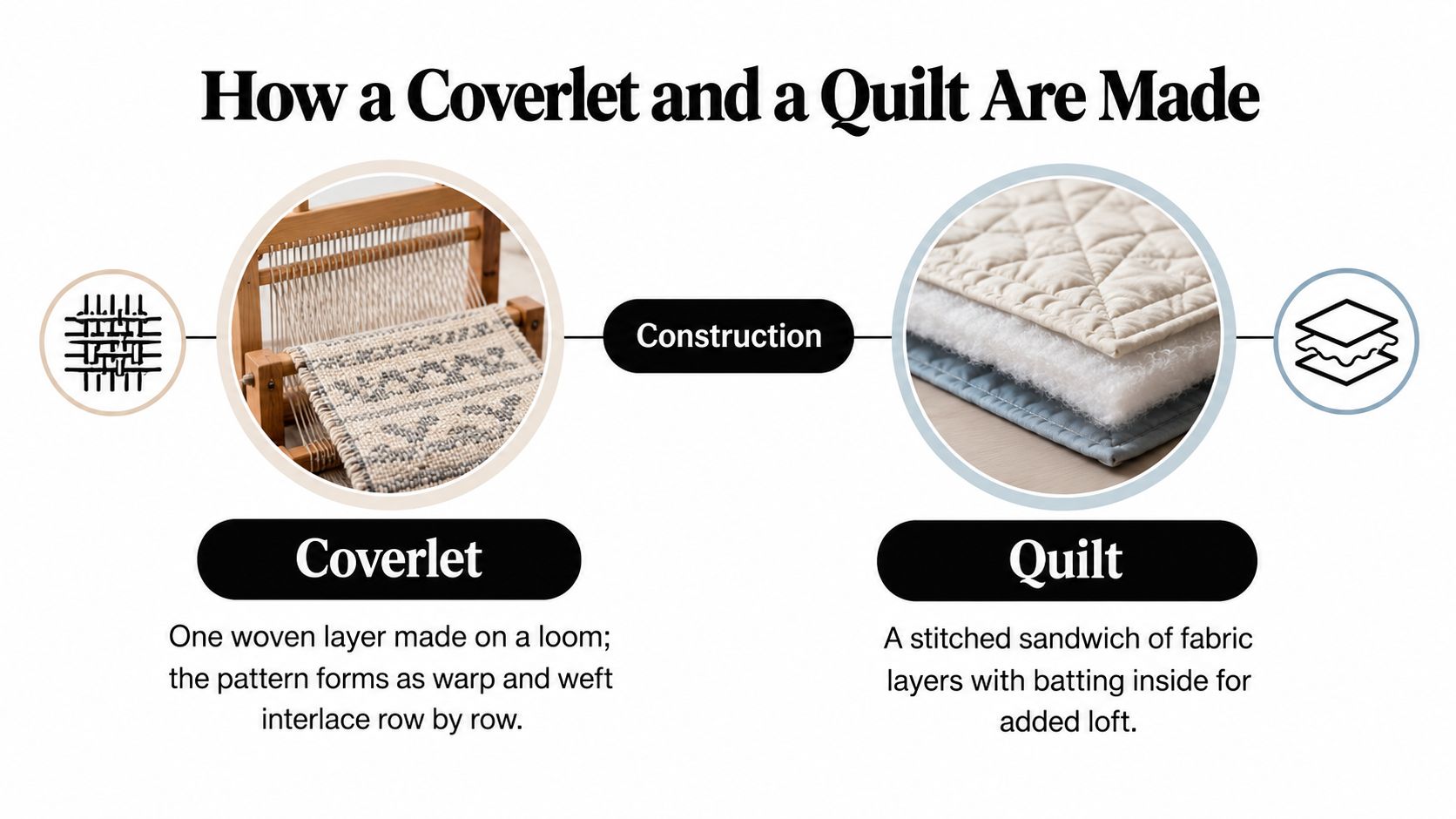
A traditional coverlet is a single-layer bedcover woven on a loom. Its pattern isn't stitched on top afterward. The design forms as the warp and weft threads interlace, row by row, during weaving, a process explained in the National Museum of the American Coverlet description of woven coverlets.
Flip a traditional coverlet over and you'll see the woven structure on both sides. That's why coverlets are generally reversible. One side may show the pattern more strongly, the other may reverse the colors, but you're looking at the same cloth either way.
The visual below maps that build against the quilt build beside it.
Three Stitched Layers
A quilt is assembled, not woven as one cloth. It has a decorative top, an insulating middle layer called batting or wadding, and a backing. Stitches pass through all three layers to hold the sandwich together.
That top layer gives quilts their variety. It may be pieced from multiple fabrics, appliquéd with shapes sewn on, or made from one continuous cloth. Historical whole-cloth quilts used that single-cloth approach, but they still had the layered, stitched build underneath.
Why the Two Traditions Feel Different
Coverlets came from loom-based, specialist weaving. Quilts grew from household sewing and layered assembly. You don't need the full timeline to shop well, but it explains what your hands notice today. One piece reads as woven pattern. The other reads as stitched texture with something soft inside.
Use this test in the store or on a product page:
- Three stitched layers: You're looking at a quilt, whatever the title calls it.
- One unquilted woven or printed layer: You're looking at a coverlet.
- Multiple layers with decorative stitching: Treat a so-called quilted coverlet as a quilt in function.
That's the construction test. The label can blur, but the layers don't.
Warmth and Weight Side by Side
Now put both pieces on the same bed in your mind. The coverlet lies flatter and feels closer to a sheet in weight. The quilt has a bit of lift when you shake it out. That lift is the whole warmth story.
Why Batting Changes How It Sleeps
Batting adds loft and traps air inside the quilt. Trapped air is what gives a quilt greater thermal resistance than a single-layer coverlet covering the same area, a structure outlined in the Illinois State Museum glossary definition of a quilt. No batting means no trapped-air layer, so a coverlet feels lighter and cooler by design.
Actual warmth still varies a lot from quilt to quilt. It depends on the batting fiber, how much fill is packed in by weight, how much loft the finished piece keeps, and how the stitching is spaced and patterned. Two quilts in the same size can sleep noticeably differently.
Common batting materials include cotton, wool, polyester, and blends. Don't assume one fiber automatically wins for your room. Read what's inside the specific product you're holding.
What the Stitching Does
Quilting stitches aren't just decoration. They stabilize the batting and limit shifting when you wash and use the quilt, and they shape how the loft spreads across the bed.
- Closely spaced stitching: It controls the layers well but can compress more of the insulation.
- Widely spaced stitching: It can preserve loft, but the materials need enough stability to stay put.
Before you buy, check the fill composition, fill weight or GSM when the maker discloses it, stitch spacing, edge binding, wash instructions, and finished size. If you're also comparing throws and blankets for the foot of the bed, this guide to common blanket types and their uses helps you sort those pieces by job too.
Coverlet vs Quilt at a Glance
| Buying question | Coverlet | Quilt |
|---|---|---|
| How is it built? | One woven or printed layer | Top, batting, and backing stitched together |
| What's its main job? | Light decorative top layer | Insulating blanket with texture |
| How warm does it feel? | Light, better for warm sleepers | Warmer, thanks to loft and trapped air |
| What texture do you see? | Woven pattern, often reversible | Stitched pattern with visible loft |
| Best priority | Easy layering and a tailored look | Soft warmth and year-round versatility |
Choose the quilt when you want a soft insulating layer you can use across seasons. Choose the coverlet when your priority is a lightweight decorative top that layers without adding much heat.
Styling Coverlets and Quilts in Real Rooms
Warmth decides how a piece sleeps. Styling decides whether you enjoy looking at your bed every day.
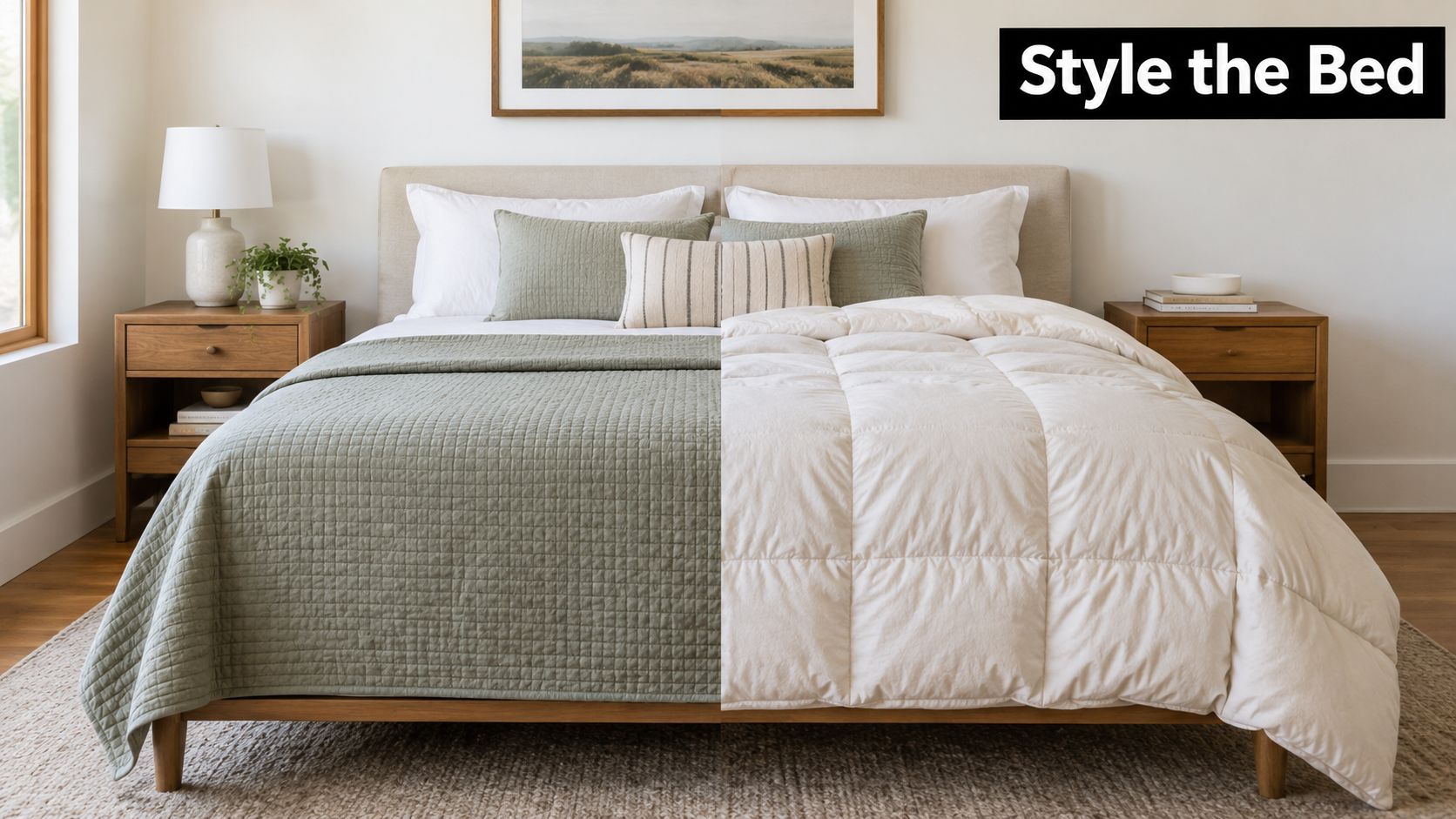
The split image here shows how different top layers change the whole read of a finished bed.
When the Coverlet Does the Visual Work
A coverlet's reversible woven pattern creates a polished top layer. It lies smooth, so it suits modern minimal, coastal, or neutral rooms where you want the bed finished without a thick folded edge. On a primary bed, a light coverlet over clean sheets gives you that neat daytime look in one quick pull.
That look has deep roots. Woven coverlets appeared in colonial North America in the early eighteenth century, and their popularity expanded in the nineteenth century as improved looms and Jacquard mechanisms enabled more elaborate motifs, names, dates, and pictorial designs, as traced in the Metropolitan Museum of Art essay on American quilts and coverlets. Pattern woven into the cloth, visible from both sides, is still the styling clue today.
When the Quilt Does the Visual Work
A quilt brings stitched texture to the surface. A pieced or appliquéd top can become the patterned focal point of the room. A solid quilt with a clear stitch pattern works the opposite way, as a quiet neutral that still has depth when the light hits it.
On a guest bed, that texture earns its keep. One quilt supplies both the blanket and the decorative layer, so the room looks ready without extra pieces to store. On a layered luxury bed, fold the quilt at the foot instead. The sheets or coverlet stay visible up top, and the quilt adds color and weight where your eye lands first.
Reversibility is what helps a coverlet pull double duty in styling. Stitch pattern is what helps a quilt do it.
The short video below walks through how these textural choices read once the bed is made.
Layering Coverlets and Quilts Through the Year
You don't have to pick one piece forever. Most comfortable beds use an order of layers, and you adjust that order as the weather and the sleeper change.
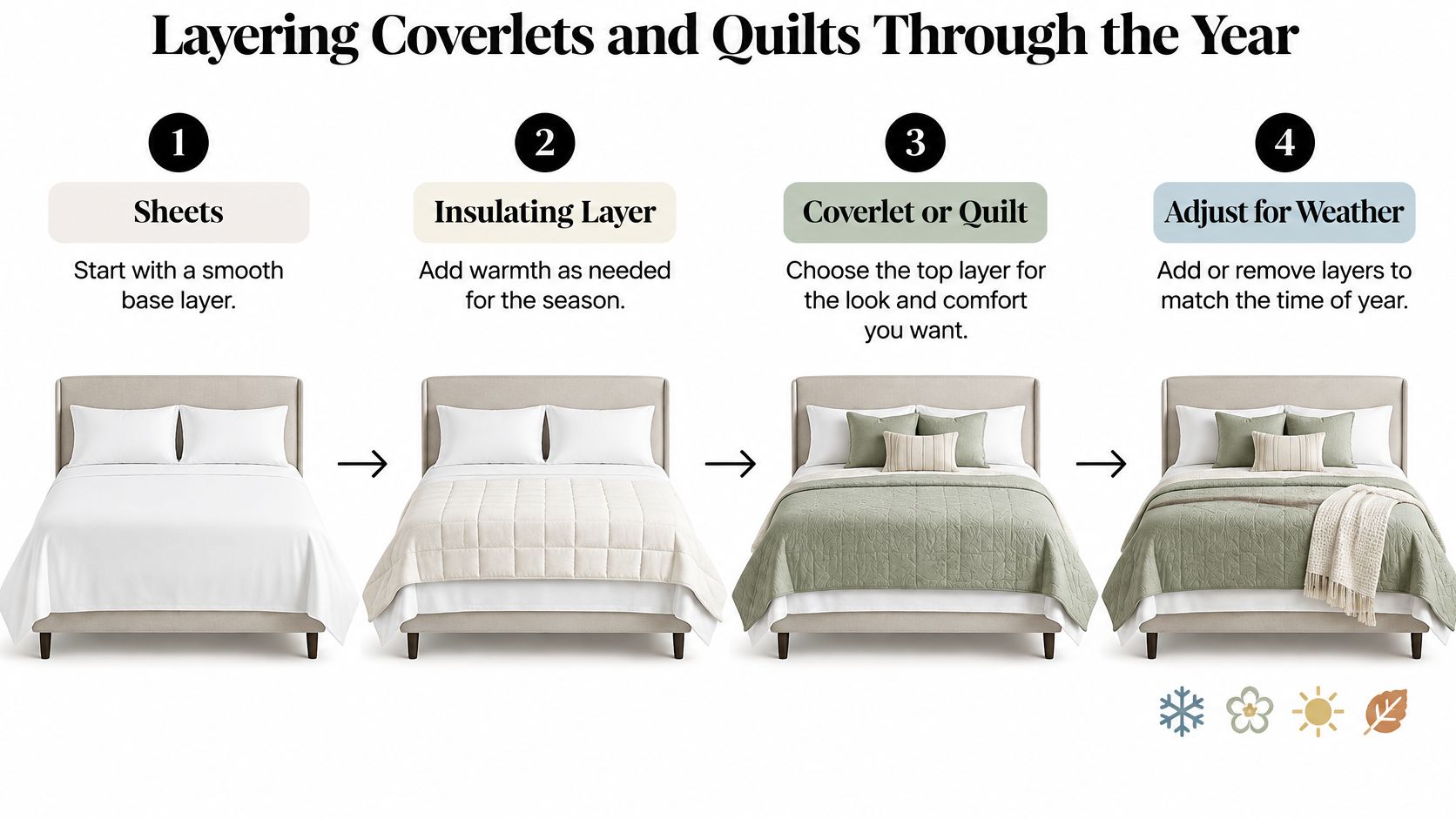
Start with a simple stack. Sheets go against your skin. The insulating piece goes next, because it needs to trap warmth close to you. The decorative top goes last, because it's the layer you see and the easiest one to pull back.
The sequence diagram below shows that order in four steps.
Three Setups You Can Copy
Warm months or warm sleepers. Use sheets plus a coverlet as your only top layer. Keep the quilt folded at the foot of the bed or stored nearby. If the night cools off, you can pull it up without remaking anything.
Cold sleepers. Make the quilt your main insulating layer over the sheets. Add a coverlet on top only if you want a smoother, lighter visual finish during the day. At night, the coverlet folds back and the quilt does the work.
Changeable seasons. Keep both on the bed, with the quilt folded to the foot. This is the setup that saves couples who disagree on temperature, and it's the same logic that makes a short-term rental bed work. Guests see a neat daytime bed and find a spare warm layer already within reach.
- Sheets first: Your smooth, washable base.
- Quilt in the middle: Your adjustable warmth.
- Coverlet on top: Your finished look.
A plush comforter can join this stack when you want more loft in deep winter. It doesn't replace the construction test, though. You still decide coverlet versus quilt by layers. For a fuller walkthrough of ordering every piece, this step-by-step bedding layering guide lays out the sequence in detail.
Fit Size and Care Before You Buy
A smart choice can still disappoint if it hangs too short or doesn't survive your laundry routine. Check fit and care before you fall for a color.
Measure for the Drop You Want
Match the finished size of the piece to your mattress size and to how much drop you want along the sides. Deep modern mattresses and adjustable bases eat up width fast. A coverlet or quilt can match your bed size on the label and still look short if it's cut to cover the top surface rather than hang like a bedspread.
Measure from the top center of your mattress down to where you want the edge to fall, then double that drop and add the mattress width. Compare that number to the finished width on the product page. The same measuring logic applies when you're sizing a faux fur bedspread, since decorative top layers only look generous when the drop is planned, not guessed.
Let Construction Guide Care
Quilt stitching exists partly to limit batting shift during washing and use. Help it do that job. Follow the stated wash instructions for that specific quilt, and don't assume every quilt tolerates the same cycle as your sheets. Look for sound edge binding, since the edges take the most pulling when you make the bed.
Care check: If a product page hides its wash instructions or fill details, treat that as missing information, not a minor detail.
For a woven coverlet, remember that the pattern is part of the cloth itself. Snagging and harsh agitation can distort the very structure that creates the design. Gentler handling protects both sides of a reversible piece.
Buying for a gift, a rental property, or a busy family changes the math. Durable, easy-care construction often beats a delicate look that needs special handling. When you're ready to plan washing and off-season storage, these instructions for washing and storing quilts cover the routine step by step.
How to Choose and What to Do Next
Bring it back to the priority that sent you searching in the first place. You don't need both pieces to win. You need the piece, or the stack, that matches your sleeper and your room.
Match the Piece to the Sleeper
If you sleep hot, or you mainly want a styled daytime bed that feels light at night, lean toward a coverlet. Its single layer finishes the bed without trapping much heat, and reversibility gives you a quick visual change.
If you sleep cold, or you're dressing a guest bed that has to keep different visitors warm, lean toward a quilt. The batting layer gives you loft and insulation in one piece, and the stitch pattern carries the decorative weight of the room.
If your seasons swing or you share the bed with someone who runs warmer or cooler than you, use the folded-quilt plan. Coverlet on top for the look, quilt at the foot for whoever needs it.
Put the Test to Work
When you shop, run the same short checklist every time:
- Count the layers: One layer points to a coverlet, three stitched layers point to a quilt.
- Read the fill details: Composition, weight or GSM when disclosed, and stitch spacing tell you more than the product name.
- Check finished size against your mattress: Include the side drop you want.
- Read the wash instructions before checkout: Make sure they fit your routine.
For shoppers building that layered setup, SouthShore Fine Linens offers oversized bedding, extra-deep pocket sheets for modern mattresses, plush faux-fur comforters for added loft, and quilt collections designed to be layered, with many textiles described as OEKO-TEX certified and responsibly sourced. Timeless neutrals mixed with seasonal patterns make it easier to pair a quilt or top layer with sheets you already own, whether the bed is in your home, a gift registry, or a short-term rental.
Your next step is simple. Open the quilt and bedding collections, check construction and finished size against your bed using the test above, and choose the coverlet, quilt, or layered combination that matches the sleeper rather than the product name alone.
Ready to build a bed that looks finished and sleeps at the right temperature? Explore oversized quilts, deep-pocket sheets, and layering pieces at SouthShore Fine Linens, check the construction and finished size for your mattress, and pick the coverlet, quilt, or combination that fits your sleeping habits.


