
Adjustable Bed Sheets with Straps: Fit and Safety Guide
Raise the head of an adjustable bed while reading, then lower it again before sleep. A sheet that looked secure on the flat mattress may shift during that movement, leaving a corner pulled up and a ridge of fabric beneath the hips.
The base changes the mattress's shape as it moves. A fitted sheet must follow the bend while staying anchored around the mattress edges. Straps add tension to help a correctly sized sheet stay in place; they cannot make an undersized pocket fit.
Solid adjustable bases, split kings, and mattress-and-topper stacks can all reveal the same fit problem once the base moves. Straps have a limited role: they can help stabilize a sheet that already fits, but too much tension or a poor fit can worsen bunching and corner pullout. A stiff fabric may also resist movement more than a flexible one.
The key is to tell a sizing problem from a retention problem before adding hardware. Check whether the sheet's pocket reaches securely around the mattress, then assess how the fabric shifts as the base moves. Straps can oppose that shift, but they cannot correct a pocket that is too shallow or safely compensate for interference with the moving frame.
Why Fitted Sheets Slip Off Adjustable Beds
Watch the head section rise and the geometry changes in real time. The mattress surface goes from a flat plane to a hinge, the sleeping surface lengthens along the head-to-foot axis, and the sheet has to travel with both. Fabric over the bending section follows the new curve while the skirt below stays wrapped around the sidewall. Those two zones now move different distances, and the difference shows up as tension at the corners.
Two forces work against the fabric. The first is longitudinal slide, the sheet creeping toward the foot as the head rises and the surface stretches. The second is shear at the corners, where the sheet is pinched between mattress and platform and can't move with either. Standard fitted sheets rely on edge elastic and a snug pocket. That holds well on a static surface because friction does the work. Elevation overcomes the friction.
The failures you'll recognize fall into three groups.
- Corner pockets pull free. Usually the pocket sat too close to the mattress edge to begin with, so any lift pops it.
- The whole sheet migrates toward the foot. Lengthwise stretch has nowhere to go, so the fabric redistributes.
- Wrinkles collect under the hips or torso. Tension concentrates at the highest load area instead of spreading along the sheet.
This is why retention hardware exists as a supplementary stabilization layer rather than a design flourish. It gives the sheet a second connection to the mattress underside so the corner isn't the only thing holding. And it only works in that role when the sheet is already sized for the stack it's covering. Everything you decide from here comes down to one question: is your problem retention, sizing, or both?
Check Pocket Depth and Shrinkage Before Adding Straps
A stronger strap on the wrong sheet doesn't fix the fit, it relocates the failure somewhere more expensive. Adding tension to a sheet whose pocket falls short of the mattress stack pulls harder on the corner seam and drags the mattress toward the frame edge. The corner stops popping, then the stitching starts to give.
Pocket depth needed for each mattress and topper stack
| Mattress plus topper height | Fit signal |
|---|---|
| Stack thinner than pocket | Sheet bunches or slides under the sleeper |
| Stack roughly equal to pocket | Corner lifts when the head rises |
| Stack thicker than pocket after adding a topper | Corners pop off when the head rises |
| Pocket exceeds stack enough to keep elastic engaged | Sheet holds through full range of motion |
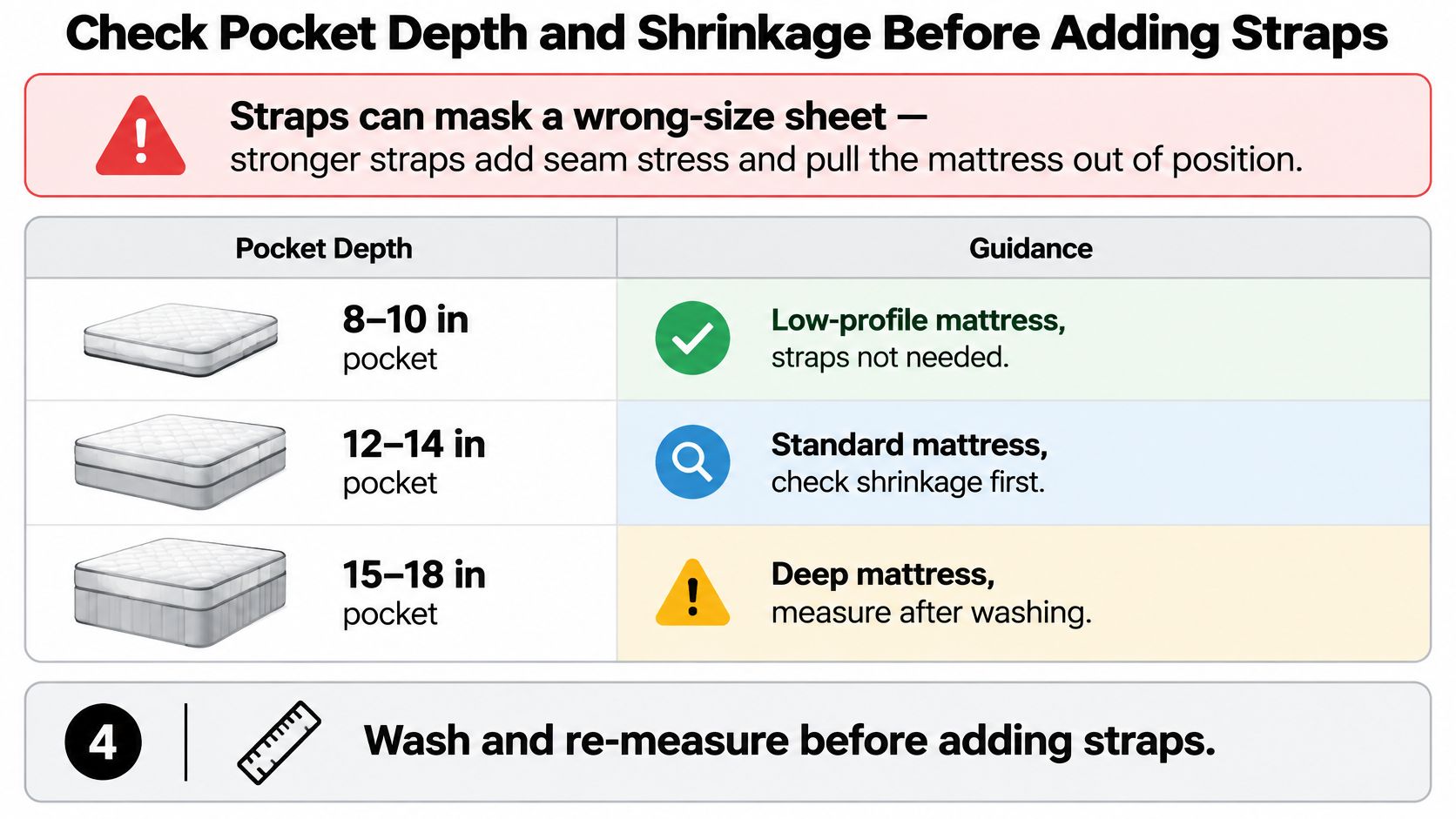
The five step fit audit
- Measure the stack, not the label. Run a tape from the support surface at the mattress edge to the highest sleeping surface, including the protector and any topper. Our walkthrough on how to measure mattress depth covers the exact points to mark.
- Compare that number with the pocket depth, either from the listing specification or measured inside the pocket, seam to seam.
- Wash and dry to the care label before judging fit. An eHow guide to keeping fitted sheets in place cites Consumer Reports testing in which nearly half of tested fitted sheets experienced severe shrinkage after more than 20 washes, enough to compromise fit. Heat also relaxes elastic, so a hot dryer costs you grip twice.
- Test flat, then raised. A sheet that looks secure at zero elevation can migrate the first time the platform bends.
- Add straps only if the fit is otherwise correct. If step two failed, no amount of tension will fix it.
Shallow pockets lift corners because the elastic sits high on the sidewall, where the mattress curves away. Excessively deep pockets leave slack that bunches under the sleeper and slides. The target is a pocket that exceeds the stack by enough material to keep the elastic engaged without concentrating load at the seam.
Where straps belong on the sheet
Straps should sit symmetrically and attach at reinforced zones near, but not directly on, the corner seam, which already carries combined tensile and tearing forces. Renters, hospitality managers, and anyone buying extra-deep-pocket sheets swaps mattresses or adds toppers over time, so repeat the audit after any layer change. Check the stated stretch on the listing too, since low-stretch fabrics slip more than knits, and add any topper to the stack you measured in step one before you pick a pocket depth.
Choose the Strap Design for Your Bed
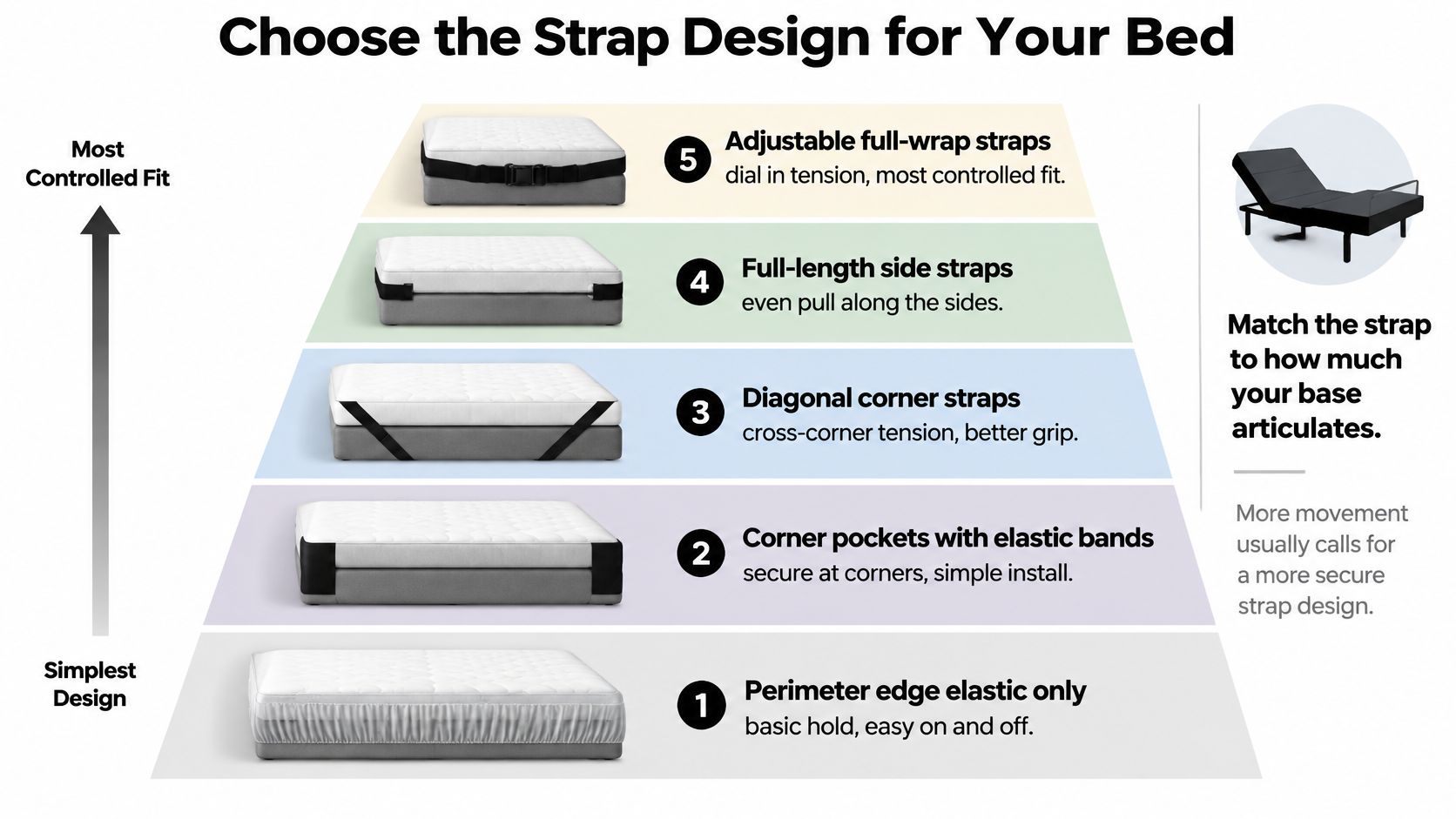
A corner strap can hold a lifted edge; it cannot make an undersized sheet fit. Choose a design for the way your base moves, then judge it by whether it keeps tension distributed without pulling the sheet sideways.
Strap designs by mechanism and bed type
| Strap design | How it grips | Best for | Check before buying |
|---|---|---|---|
| Perimeter edge elastic only | Gathers fabric around the mattress edge | Flat or gently raised beds | Pocket depth matches mattress stack |
| Corner pockets with elastic bands | Enclose each mattress corner | Standard mattresses at moderate elevation | Pockets fully cover the corners |
| Diagonal corner straps | Cross beneath each corner to resist lift | Frequent high head elevation with corner lift | Straps sit clear of the corner seam |
| Full-length vertical straps | Run from the top edge to the bottom edge of the sheet | Deep mattresses and frequent head and foot movement | Straps are spaced evenly along the length |
| Under-mattress clips or retainer bars | Attach the sheet to the mattress or frame | Split king beds or sheets that shift at the base edge | The hardware stays clear through the base's full movement |
What the designs actually do under load
Fitted sheets use stretch and recovery to stay in place. Corner pockets add enclosure, while diagonal straps add crosswise tension beneath the mattress. Full-length straps spread tension from the head edge toward the foot edge, reducing the chance that one corner pulls free while the opposite side remains anchored.
The trade-off is fit and hardware. More anchor points can help distribute tension, but they cannot correct a sheet that is too small, too loose, or incompatible with the mattress stack. A design that works on a frequently raised head section may add unnecessary straps to a bed that stays nearly flat.
Read the listing, not the word strap
“Strap” may describe a short elastic loop at each corner or a band that crosses much of the sheet's underside. Look for the strap's actual position and attachment method.
- Anchor points: Favor reinforced attachment zones near the corners, not the corner seams, which already bear tension.
- Elastic: Check whether the straps can stretch and return to shape. Elastic that loses recovery will provide less hold over time.
- Symmetry: Evenly placed straps help keep tension balanced instead of pulling the sheet to one side.
Test the design at the elevation you actually use
After fitting the sheet, check its tension at the positions you use most.
- Raise the head section to your usual maximum and check whether any corner lifts.
- Lower it slowly, watching for a corner that shifts or fabric that pulls diagonally.
- Repeat with the foot section raised on its own.
- Compare the result: a corner that moves first points to uneven tension or a weak anchor, not a reason to tighten every strap.
Choose the simplest design that holds at your usual settings. More straps add attachment points, but they do not compensate for the wrong sheet size.
Install Straps Safely Around Moving Bases
A sheet that stays tight while the bed is flat can turn into a hazard or a lever once the base articulates. The flat position tests almost nothing, because the fabric isn't loaded across the hinge. When raised, clips drift toward the frame, elastic crosses a motor housing, and a strap that seemed snug starts pulling the mattress sideways.
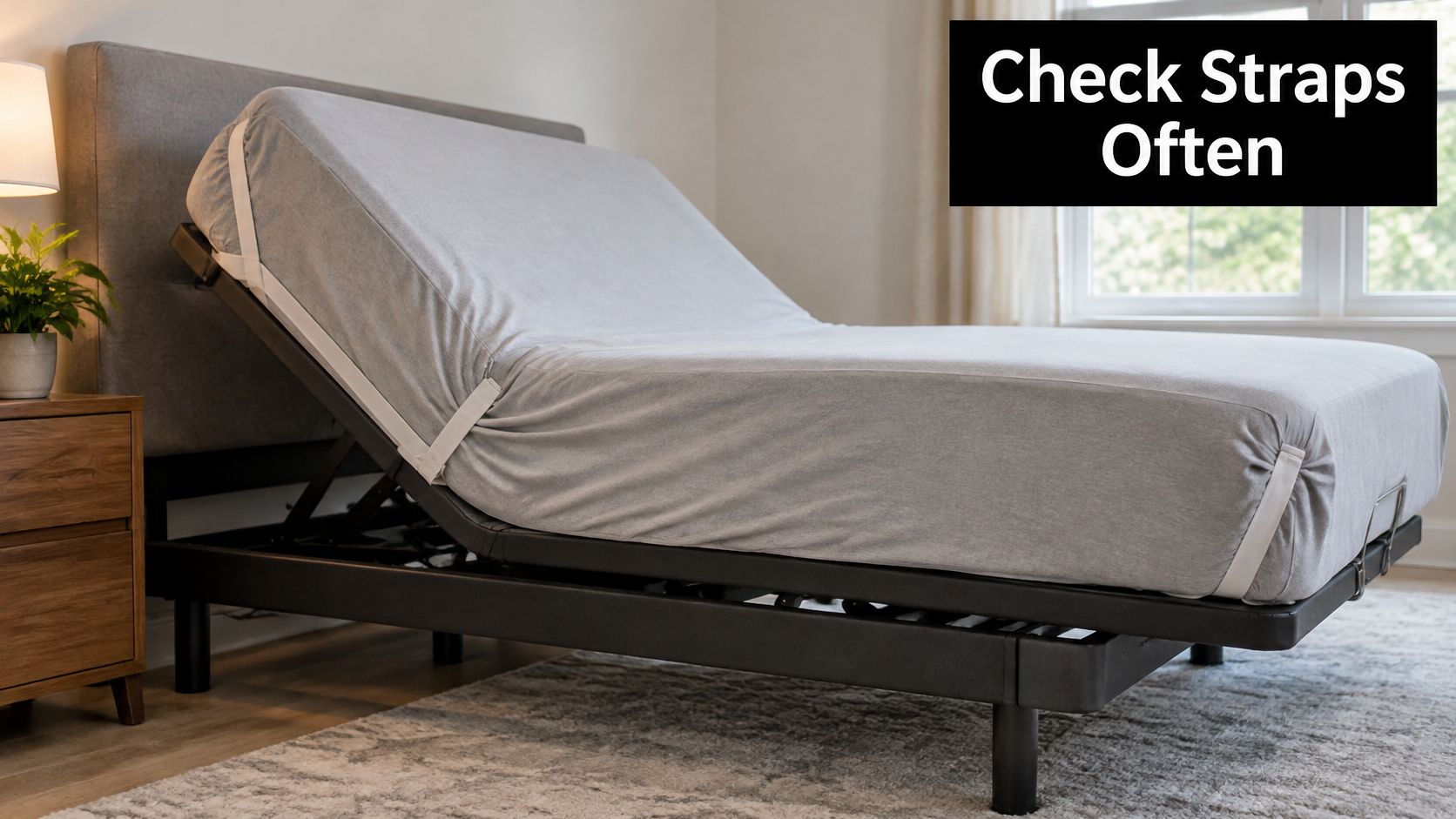
The clearance check, in order of priority
- Stop the base and follow the manufacturer's manual before adjusting or troubleshooting anything underneath it.
- Keep straps, clips, and elastic clear of hinges, motors, pinch points, heat-producing parts, and the space beneath the moving frame.
- Attach at reinforced zones, symmetrically, away from the corner seam.
- Raise the head and foot sections independently through their full range.
- Confirm the sheet doesn't restrict articulation, expose the mattress, or wrinkle under high-load areas.
- Inspect clearance at every position, not only flat.
The configurations differ enough to warrant separate habits. A standard single-articulation base bends as one unit, so one sheet with even perimeter grip usually works. A split king moves on two independent platforms, so two twin XL fitted sheets follow each side without one half dragging the other across the gap. Under-mattress clips need a check of where the clip lands relative to the frame rail, and retainer bars need a look at whether the sheet can slide along the bar as the head rises. If you're still working out how your own frame travels, our explanation of what an adjustable base is covers the mechanism.
Discontinue any strap system that catches, pops loose, or pulls the mattress toward the frame. That isn't a fit problem you can tune out. It's a clearance problem.
Most buying guides stop at "keep your sheets in place" and never address how retention hardware interacts with powered movement. The gap matters more than the shopping decision.
Fix Slipping, Bunching and Strap Damage
Match the symptom to the cause before you buy anything. Most of the time the table below tells you whether you need five minutes of adjustment or a different sheet.
Strap symptoms, causes and fixes
| Symptom | Likely cause | Fix |
|---|---|---|
| Corners pop off when the head rises | Pocket too shallow or elastic stretched | Measure the stack and move to a deeper pocket, or add diagonal corner straps |
| Sheet bunches under the sleeper | Pocket too deep or straps too loose | Choose a smaller pocket depth or tighten the straps on reinforced zones |
| Sheet no longer fits after washing | Shrinkage | Dry per the care label, re-measure, and replace the sheet if fit is lost |
| Strap pulls the mattress toward the frame | Tension too high or strap near frame hardware | Loosen, reposition away from hardware, and recheck clearance |
| Strap catches on hinge or motor | Clearance problem | Stop the base, reroute the strap, and do not use it until clear |
| Elastic no longer recovers | Worn strap elastic | Replace the strap or the sheet |
Repositioning or retensioning a strap takes minutes. A strap that no longer returns to length after you stretch it needs replacing, not tightening. And a sheet that's the wrong size for the stack needs a new sheet, full stop.
When the sheet is the problem, not the strap
Adding stronger straps to an undersized sheet raises seam stress and pulls the mattress off center. The fix is usually to change the sheet rather than the strap. If the sheet has been in rotation long enough that the elastic has given up, SleepHabits' guidance on how often to change your bed gives you a sensible interval to work from, and it's worth rotating two sets so no single fitted edge takes every week of tension.
Three things stay true across every symptom. Elastic loses recovery faster in a hot dryer than in a cold wash. Clips damage sheets when they grip thin fabric instead of the hemmed border. And a sheet that fails only in motion has a construction problem, not an installation problem, so retest through the full range after each change rather than once at setup.
Confirm Size and Certification Before You Buy
The buying sequence is short if you've done the audit.
- Match pocket depth to the mattress and topper stack you measured.
- Pick the strap design that suits your base and your highest elevation.
- Confirm the listed size and base configuration, including twin XL and split king, against your own frame.
- Verify chemical safety for anything that touches skin.
- Ask for a current certificate before you commit.
That fourth step is where most shoppers stop short. OEKO-TEX STANDARD 100 states that every component, including thread, buttons, and accessories, is tested against a list exceeding 1,000 potentially harmful substances, with requirements set by intended use and contact intensity. Bed linen falls under Product Class 2, the category for direct skin contact. That detail matters on a strapped sheet, because the strap, elastic, coating, printed label, and sewing thread can all contact the sleeper or transfer residues through repeated washing and mechanical movement.
Request a certificate covering the exact article or its certification number, confirm the straps are inside the certified scope, and check the date. OEKO-TEX reviews its criteria and limit values at least annually, so certification is a current status rather than a permanent attribute, and a claim covering only the base textile isn't the same as finished-product certification. Our Southshore Basics sheets come in seven bed sizes, including twin XL and split king, and our bamboo bedding carries OEKO-TEX Certification, so you can match the size to your base and the certification to the article you're buying. If you want to see what that certification covers across a finished sheet set, our guide to OEKO-TEX certified bedding breaks it down.
Measure the stack, choose the design, then test the fitted sheet through the base's full range of motion before you trust it overnight.
SouthShore Fine Linens builds bedding for the beds people own, including the adjustable ones that move every night. If you're tired of re-tucking corners, start with our extra-deep pocket sheet sets and measure your stack against the pocket before the base does it for you. Visit SouthShore Fine Linens to find the size, depth, and certified materials that fit your frame.


