
Embroidered Bedding Guide: Types, Buying Tips and Care
Two duvet covers hang side by side in a store, and one costs nearly twice as much as the other. The difference is a raised floral border you can feel with a fingertip, while the cheaper cover carries the same pattern printed flat. In a photograph, they look identical.
Stitching changes the deal. It adds weight and stiffness, it alters how the cloth tears, and it brings its own washing risks. Those effects show up in how the bedding drapes, whether it fits the insert properly, and how the motif looks after a year of Sundays. Here's how to read what you're buying.
What Embroidered Bedding Is and How It Developed
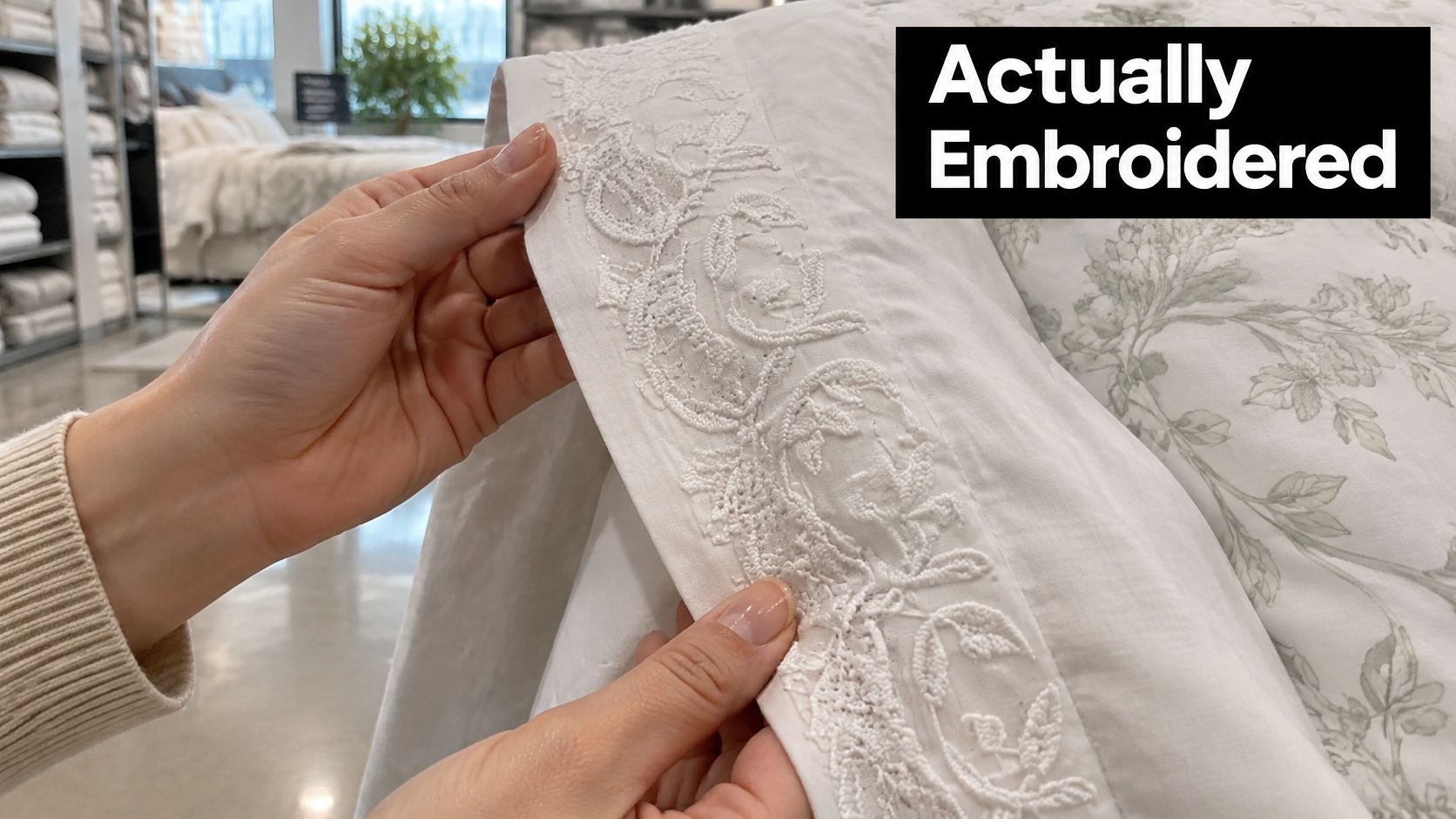
Embroidered bedding is bed linen where the design is stitched into the cloth with thread. That covers sheets, duvet covers, quilts, shams and bed skirts, and it's the difference between a surface you can feel under your hand and a print that sits flat. Think of initials sewn into a shirt cuff: the monogram is thread pushed through the weave, and the cuff around it hangs stiffer than the sleeve beside it.
The raised surface is the first thing your hand finds.
From Trade Goods to Coordinated Sets
The category is old enough that its trade routes are documented. The Metropolitan Museum of Art records Indian embroidered textiles reaching England by the late 1500s, and Indian quilts made for Portuguese trade entering London sales with growing frequency during the 1620s. By the eighteenth century, embroidered and painted cotton bedcovers were being produced in India for both domestic use and export, and those designs influenced English bed furnishings.
What those imports looked like is specific: cotton foundations, polychrome embroidery, central medallions and corner motifs. English makers answered with coordinated ensembles that included bolsters, pillows and matching valances, so a bed was dressed as one system rather than a pile of unrelated pieces. Materials came from India, design references from Persia and Turkey, trade networks from Portugal and domestic production from England.
Survival is the other half of the story. The Smithsonian's National Quilt Collection, which began in the 1890s with three donated quilts, now holds more than 500 quilts and quilt-related items. One of them, an 1883 to 1884 States and Territories bed cover, contains 56 embroidered, painted and crazy-patched squares representing the states and territories of that period, with the maker's initials embroidered into the gold silk lining.
What That Means on a Modern Bed
Today the same stitch work sits on cotton sateen, bamboo viscose, brushed flannel and microfiber, and the base cloth changes almost everything about how the embroidery behaves. A dense motif on a fluid bamboo cover reads differently from the same motif on a brushed flannel quilt, and each needs its own care routine.
The point to carry forward: embroidery is a construction choice, not a finish. It adds weight and stiffness, changes tear behavior and sets its own washing rules.
Embroidery Techniques and What Each Does to Bedding
A product page can say embroidered and tell you almost nothing. Stitch type, stitch density and backing are three separate specifications, and each one changes how the finished piece feels and how it holds up. Here is what the main options do.
| Technique or stitch | Typical use on bedding | What it does to the fabric |
|---|---|---|
| Machine satin stitch | Dense motifs, monograms and border lines | Stiffer and more dimensional; consistent tension gives sharp definition |
| Hand embroidery | Heirloom quilts and one-off pieces | Softer, sits closer to the base fabric and follows its drape |
| Chain stitch | Outlines, lettering and sturdy edges | Highest reported tearing strength among the tested structures |
| Herringbone stitch | Open decorative bands | Lowest reported tearing strength among the tested structures |
| Running or stem stitch | Fine lines and light accents | Light and flexible; limited test data available |
What the Thread Does to the Cloth
Thread isn't ink. Inserting it changes the fabric's mechanical profile rather than decorating the surface, and a textile engineering study on embroidery stitch properties reports higher areal weight, thickness, elongation and bending stiffness after thread insertion. Machine embroidery can produce greater stiffness than hand work because its more consistent thread tension compresses and stabilizes the stitched region.
That creates the trade-off you feel in the store. Dense motifs improve visual definition and local dimensional stability, yet they reduce drape and make the embroidered zone less supple than the sheet or coverlet beside it.
Tear behavior follows stitch geometry. In the same comparative testing, chain stitch produced the highest reported tearing strength and herringbone the lowest among the structures evaluated. The reason is structural. Chain stitch lays a looped line along the seam so stress travels through the row, while herringbone's spaced diagonal crosses leave more unstitched cloth between anchor points. Machine satin builds a solid, reflective block that reads crisp from across a room and feels board-like under a shoulder. Hand work sits into the weave and moves with it.
Finishing stitches get less attention and still matter. Running and stem stitches draw fine lines and light accents without adding much body, which makes them the safer choice for a sheet you sleep on night after night rather than a display cover.
A Buying Rule for Stitched Bedding
Specify the three variables separately instead of treating "embroidered" as one uniform construction. Ask for stitch type, stitch density and backing as distinct items, then ask what was tested. The same engineering study recommends measuring tear strength, seam slippage, bending stiffness and dimensional change after laundering, with separate readings taken through the motif and in unembroidered control areas.
Pay closest attention to where stitching clusters: edges, corners and attachment points. Those are the places where puckering and stress concentration show up first on an oversized quilt or duvet cover.
If you're weighing a stitched cover against a woven one, what jacquard fabric is explains how a pattern built into the weave differs from a pattern built from thread.
Practical rule: "Embroidered" is a category, not a specification. Judge the stitch, the density and the backing as three separate choices.
Fabric, Fit and Certification to Check Before You Buy
No stitching survives a bad base cloth. The material under the embroidery decides how the piece sleeps, how it washes and how long the motif stays flat, and the same weave that flatters a satin stitch can fight a dense fill.
| Material or collection | Listed spec | What it means for buyers |
|---|---|---|
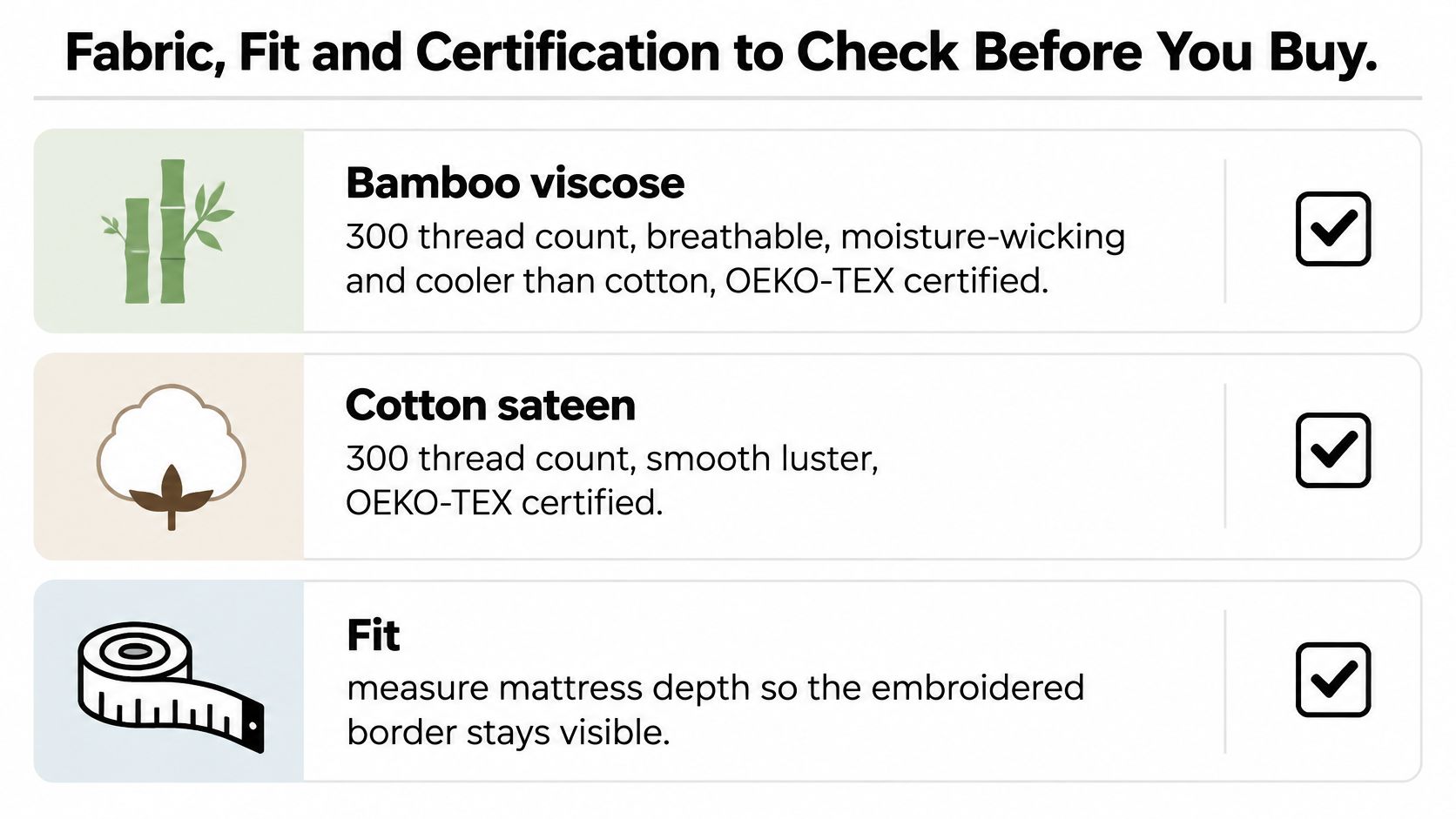
| Bamboo viscose | 100% viscose from bamboo, 300 thread count | Breathable, moisture-wicking and cooler to the touch than cotton; carries OEKO-TEX certification |
| Cotton sateen | 300 thread count, long-staple cotton | Smooth face that lets a motif sit cleanly; the Grand Symphony duvet cover set is 100% long-staple cotton |
| Flannel cotton | Brushed cotton | Extra softness and warmth; dense embroidery adds stiffness, so check motif placement |
| 500 Thread Count Tencel | 500 thread count Tencel | A denser, smoother weave; fine stitching shows cleanly on the tighter ground |
| Extra-deep pocket sheets | Briteyarn 300 thread count, 100% cotton | Deeper pockets for deep mattresses and adjustable bases; measure mattress depth first |
What Each Material Changes
Bamboo viscose brings an advantage that matters under stitching: the fabric is breathable and moisture-wicking and feels cooler than cotton, which offsets the small amount of warmth embroidered thread traps against the skin. Cotton sateen gives a motif a slick surface to sit on, and long-staple yarn resists the pilling that friction causes where a stitched edge rubs a sheet. Brushed flannel trades that slickness for warmth, so heavy stitching belongs on the show face rather than the areas you tuck and roll against. Microfiber and clipped jacquard round out the collections, with clipped jacquard building texture into the weave rather than adding it with stitches.
Treat fit the way you treat stitch density: as a number you verify, not an impression. A deep mattress or an adjustable base needs more pocket depth than a standard set offers, which is the gap the Briteyarn extra-deep pocket sets are built for. A coverlet needs enough drop to look intentional, and a bed skirt needs its own measurement; the Vilano line includes pleated bed skirts with a 15 inch drop. Get either number wrong and fabric you paid for ends up bunched or short.
What Certification Actually Covers
Chemical claims deserve the same scrutiny as thread count. Regulators in several U.S. states and the EU have been tightening restrictions on PFAS in textiles, and the thresholds and effective dates keep moving, so a "PFAS-free" tag can describe a different standard than the one that applies where you live now.
The trap is treating "PFAS-free" and "certified" as interchangeable. A claim depends on which component was tested, what the certification covers, which market it applies to and when it was issued. Embroidery itself is neither safer nor riskier than plain cloth; the exposure sits in finishes, dyes and backings, which is why scope matters more than the logo.
Three questions sort most labels quickly:
- Does the certification cover the finished article? That includes the embroidery thread, backing, dyes and any applied stain or water-resistant finish, not just the base fabric.
- Is it third-party verified? A self-declared claim and a tested one carry different weight, so look for the testing body named on the label.
- Does it apply where you live? A certification recognized in one market may not cover the restricted substance list in another.
Our guide to OEKO-TEX certified bedding walks through what that standard does and doesn't cover. Before you check out, run four checks: material, thread content, certification scope and pocket depth.
Measure Your Bed Before You Buy
The most common reason an embroidered duvet cover looks wrong on arrival isn't the embroidery. It's a size that never matched the bed. Do the measuring before you open a listing, not after.
- Measure mattress depth. Run a tape from the top of the mattress to the base, including any topper, then compare it with the pocket depth on the listing. Extra-deep pocket sheets are sized for deep mattresses and adjustable bases.
- Match the insert to the cover, not to the bed. A duvet cover is cut for a named duvet size, so check the insert's length and width against the cover label. A queen bed holding a king insert will bunch in the corners no matter how carefully you make it.
- Check the corner ties or buttons. Confirm they reach the corners of the cover and that the insert has loops to meet them. Ties that stop short let the insert drift, and a drifting insert pulls hardest on the embroidered corners.
- Decide the drop before you buy a quilt. Measure how far you want the coverlet to hang on each side, and whether it needs to clear the floor or meet a bed skirt.
- Write the numbers down. Keep depth, insert size and drop in a note on your phone so you're comparing products against your bed instead of against each other.
A loose fit doesn't just look rumpled. Extra fabric bunches when you roll over, and that bunching concentrates load on seams and stitched corners, which are the least forgiving parts of the piece.
A tape measure costs less than a return, and it answers most of the fit questions before you spend anything.
Styling Embroidered Bedding by Room
Let the embroidery carry the pattern and keep the rest of the bed calm. Stitching already creates shadow, relief and line, so a busy printed sheet underneath competes with it and both lose.
| Room or bed type | Pairing to use | Why it works |
|---|---|---|
| Primary bedroom | Solid neutral duvet cover under a tonal embroidered quilt | Texture carries the design without pattern clutter |
| Guest room | Blue Grand Symphony duvet cover set with matching shams | One purchase gives a finished, coordinated look |
| Oversized or layered bed | Vilano waffle-geometric quilt set with matching shams | Oversized drop covers deep mattresses when layered over a plain sheet |
| Bed with storage underneath | Cotton bed skirt | Hides under-bed storage and keeps dust from collecting |
Three Styling Moves That Work
Repeat one accent color across the pillowcases and the quilt rather than introducing a third or fourth shade. Two tones read as deliberate; five read as leftovers.
Mix one patterned piece with two solid pieces. If the embroidered quilt is botanical, put it over a plain white sheet set and plain shams, then let a single textured cushion do the extra work.
Keep shams in the same tone as the duvet, even when the quilt is a different color family. The bed then reads as one layered composition instead of a stack of purchases.
Practical details separate a styled bed from a staged one. The blue Grand Symphony duvet cover set is cotton sateen with a watercolor floral print and matching shams, and its insert corner ties and button enclosure keep the duvet from sliding down inside the cover by morning. The Vilano oversized quilt set uses a waffle geometric pattern with rounded corners and matching shams, and the oversized drop is what makes it work on a deep mattress layered over a plain sheet. A cotton bed skirt does quiet structural work, concealing under-bed storage and keeping dust from accumulating beneath the bed.
The Doorway Test
Step back to the doorway and look at the bed from there. If the embroidery reads as a clear shape from that distance, the scale is right. If it dissolves into noise, or if you can't tell stitching from print at three paces, the motif is too fine or too crowded for the size of the bed.
How to Wash Embroidered Bedding Safely
A quilt can look clean after the first wash and still be losing stitches inside the drum. Embroidery is a construction layer, not a surface print: thread changes stiffness, the backing controls puckering, and closures decide how much abrasion the piece can take. Protect the weakest component and the rest of the bedding usually follows.
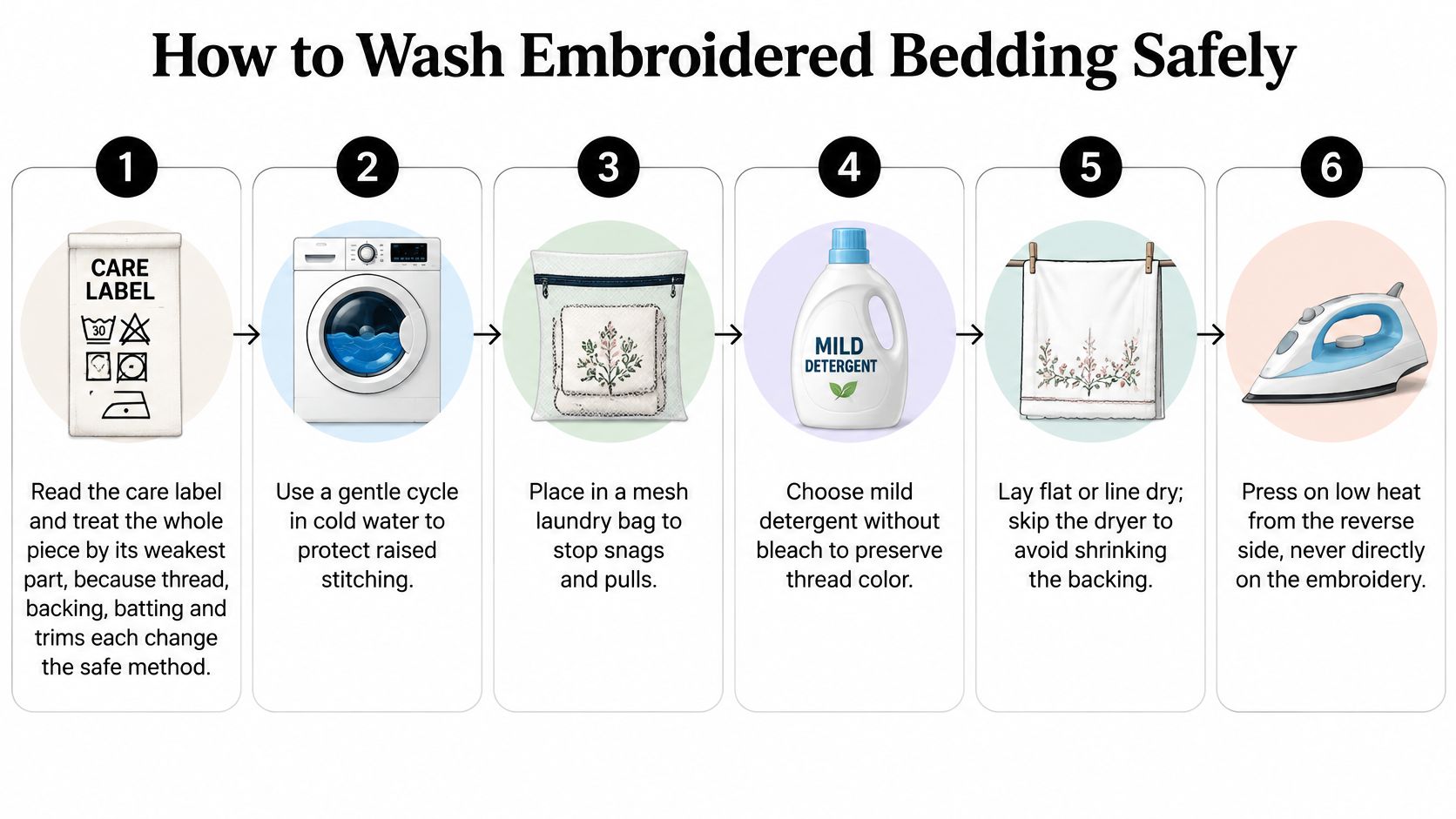
- Read the label and treat the piece by its weakest component. Thread, backing, batting, closures and trims do not tolerate the same treatment, so the most delicate one sets the rule. Australian and New Zealand textile guidance states that cleaning and maintenance instructions must account for all integral elements, including embroidery, dyes, finishes, construction, padding, lace, beading and fasteners, as set out in these home textile product regulations.
- Test a hidden corner first. Press a damp white cloth against an inside seam and check whether color comes off. Dye transfer shows up there before it shows up on the sheet underneath.
- Turn the piece inside out and fasten everything. Close buttons, tie the corner ties and zip any closures so metal and cord ends cannot catch on the motif during the cycle.
- Bag raised or metallic work. A laundry bag reduces friction by keeping satin stitches, cords and metallic thread away from zippers, buttons and heavier items in the same load.
- Wash cold on a gentle cycle. Skip bleach and fabric softener, and avoid optical brighteners when color stability is uncertain. Cold water and low mechanical action are the two settings that matter most, and our guide to washing bedding covers the cycle details for the base fabrics underneath.
- Dry low or lay it flat. Heat distorts raised stitches and shrinks backings, so use the lowest tumble setting or air-dry flat. Shake the piece out first so the motif does not set into a crease.
- Press from the reverse with a damp cloth between iron and cloth. Never press directly onto raised embroidery, because direct heat flattens the stitch and can leave a shine on the ground fabric.
- Put inspection on a regular rotation. After washing and drying, check for thread fuzzing, broken stitches, color change, puckering and motif lift. That is the same wear pattern repeated laundering creates, and it catches damage a quick look after one wash would miss.
Damage builds across cycles rather than appearing in one. A motif that looks intact early can be partway to a broken stitch after repeated abrasion, which is why the inspection rhythm matters as much as the wash setting.
When to Give the Piece a Rest
Loose thread ends, a stiff or crunchy motif, color bleeding into the surrounding cloth and visible puckering around the stitching are all signals to stop machine washing. Spot clean, hand wash, or send the piece out until you have decided whether it belongs in daily rotation. If the bed also carries a plush throw, keep the same fiber-first habit: On Pins & Needles minky care treats pile and stitching as separate risks.
For a visual version of the routine, this walkthrough is worth a few minutes.
Choose Embroidered Bedding That Fits Your Bed
Three checks decide the purchase. The stitch and base cloth have to match how the bed is used, the measurements have to match your mattress and insert, and the certification has to cover the whole article rather than the base fabric alone.
Our collections run across Bamboo, Cotton, Microfiber, Clipped Jacquard and 500 Thread Count Tencel bedding, and the bamboo bedding is made from 100% viscose from bamboo at a 300 thread count with OEKO-TEX certification. Extra deep pocket sheet sets are tagged as Briteyarn 300 thread count 100% cotton for deep mattresses and adjustable bases, and bamboo sheet sets include fitted and flat sheets in several sizes. Certification scope varies by product, so check each product page for exactly what's covered.
The next step is straightforward. Pick the room, measure the mattress depth, choose the fabric and the stitch weight you want, then start the washing routine from the very first wash rather than after the first sign of trouble. Once you know what you're looking for, browsing gets faster.
SouthShore Fine Linens builds embroidered quilt sets, duvet covers and deep-pocket sheet sets for the beds people own, including deep mattresses and adjustable bases. If you're ready to compare stitch styles, fabrics and pocket depths against the measurements you just wrote down, browse the collections at SouthShore Fine Linens and match the piece to your room.


