
Stain Resistant Sheets: How They Work and What to Buy
If a stain resistant sheet can send a splash of water rolling off its surface, why does a drizzle of salad dressing leave a mark that outlives three washes?
That question exposes the gap in how stain resistant sheets get sold. The packaging shows a liquid beading on fabric. A real bed involves body oil, night cream, coffee, sweat and the occasional glass of red wine, and those behave nothing alike on a finished textile.
Two mechanisms get blurred together in the marketing. Stain repellency stops liquid from wetting the fibers in the first place. Stain release lets wash water lift a stain out after it has already taken hold. A sheet can do the first badly and the second well, or the reverse. Neither one is the same as stain proof.
How Stain Resistance Works in Sheets
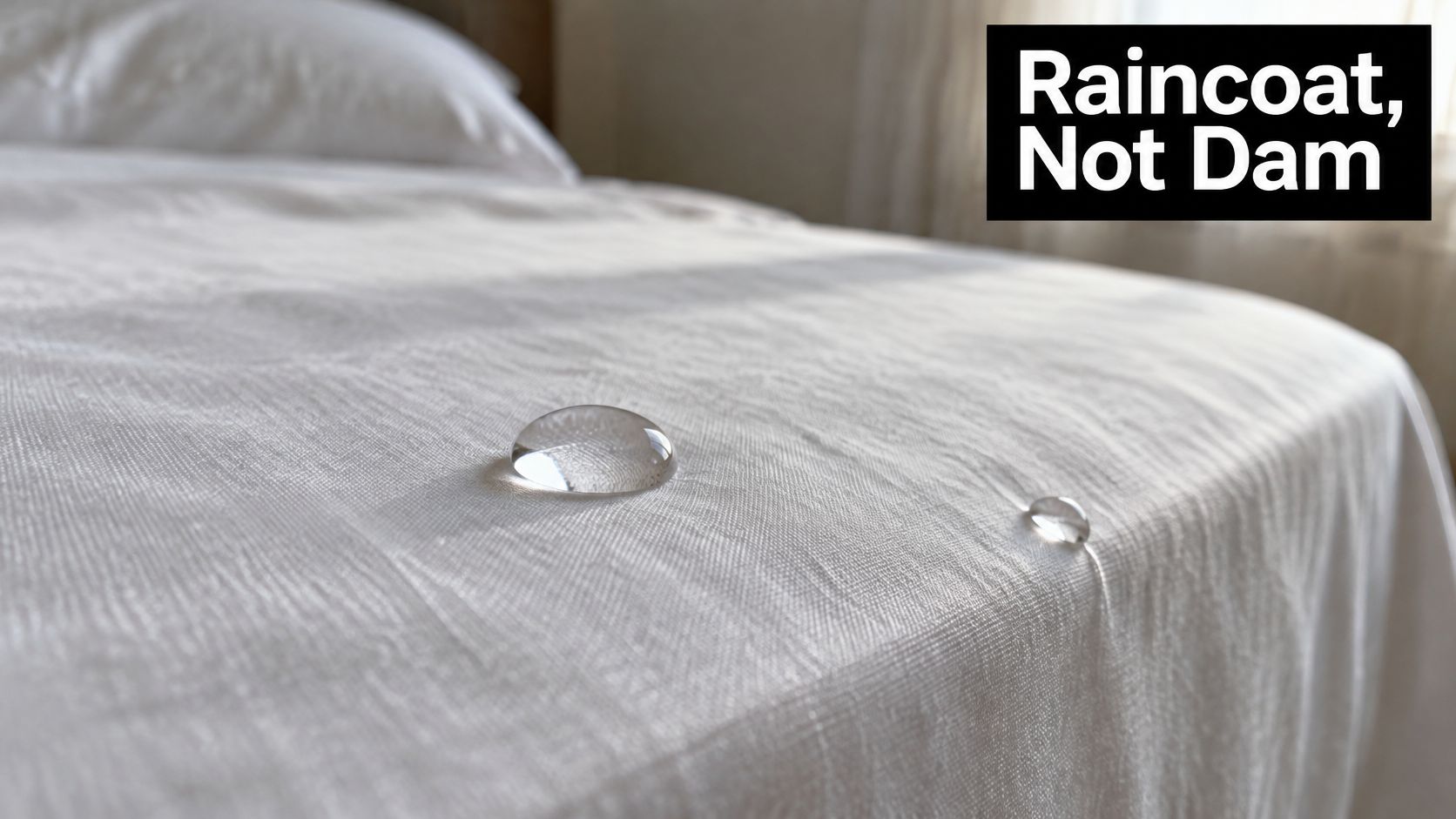
A stain resistant sheet doesn't turn into a waterproof mattress pad. Think about a raincoat. A light drizzle beads up and rolls off the sleeve, but walk twenty minutes in steady rain and you feel the damp at the seams. Fabric finishes behave the same way: a spill sits on the surface for a while instead of sinking straight in, and time decides what happens next.
Surface energy is what makes that possible. On a low-energy surface, a liquid pulls itself into a rounded droplet rather than spreading flat. On an absorbent surface, the same liquid flattens out, wicks into the weave and carries pigment or oil along with it. The Minnesota Pollution Control Agency's textile guidance describes the goal as a low-surface-energy barrier that slows liquid absorption, the same finishing concept that has shaped upholstery, apparel and bedding for decades. That document also draws a line worth memorizing: a traditional wax treatment can repel water without repelling oil, so a product described as water resistant may still take up body oils, cosmetics or wine.
What the finish changes and what it can't
Weave density does part of the job before any chemistry is applied. A tight percale leaves fewer gaps for liquid to pass through in the first seconds after a spill, which is why a crisp cotton sheet sometimes outperforms a loosely woven one carrying a treatment. The finish adds margin on top of that structure. It doesn't replace it.
Oil is the test that separates the two. Water has high surface tension and beads readily. Body oil, foundation and cooking oil have much lower surface tension, so they spread into a fabric that sheds water all day. That's why a sheet can pass a splash test in the shop and still develop a faint grey mark where a shoulder rests.
Every claim has to be judged against four things at once.
Judge a claim on four factors: the fabric, the treatment, the washing routine and the type of stain. A finish that handles coffee may fail against sebum, and one that survives ten washes may not survive thirty.
Materials and Finishes Compared
The same sheet can handle one spill well and another poorly. Fabric structure and finish both matter, but they do different jobs.
| Option | How It Resists Stains | Typical Strength | Main Limit |
|---|---|---|---|
| Untreated cotton | Fibers absorb liquid, so stains soak in | Breathable and washes well | Spills need prompt treatment |
| Tight-weave cotton percale | Dense weave slows spill penetration | Crisp, cool feel | Oil and dye can soak in if left |
| Polyester microfiber | Tight, double-brushed fabric has low absorbency | Soft, wrinkle and fade resistant | Oil can cling, and heat can set stains |
| Fluorinated (PFAS) finish | Lowers surface energy so water and oil bead up | Strong repellency against spills | Restricted in many markets and wears with washing |
| Fluorine-free finish | May use a water-based repellent or stain-release polymer | Avoids fluorinated chemistry | Performance varies, so look for wash-test data |
| Stain-release treated sheets | Helps soil lift out during washing | Easier stain removal in the wash | Stains still need prompt treatment |
The three options most shoppers actually weigh
Percale relies on its weave rather than a stain-resistant treatment. Its dense, matte structure gives it a crisp, cool feel that suits warm sleepers. The weave can slow a quick spill, but oil left on the fabric can still soak in. For a closer look at how fabric choices affect feel and care, see our guide to choosing material for sheets.
Microfiber works differently. Its tight, double-brushed construction has low absorbency, while the fabric is wrinkle and fade resistant. Oil can cling to the fine fibers, and heat can make a food stain harder to remove.
Fluorinated versus fluorine-free finishes
Fluorinated finishes deliver strong water and oil repellency because they lower surface energy more than most alternatives. However, they face heavy regulatory restrictions and wear away with laundering, so their advantage is temporary.
Fluorine-free finishes may repel spills or help stains release during washing. Those are distinct functions: repellency helps keep a spill on the surface, while stain release helps wash soil away. Performance varies, so a fluorine-free or stain-resistant label alone does not prove how well a finish works or how long it lasts. Ask for documented test results. Similar finish families are used on upholstery, too, so a family-friendly fabric guide for Bay Area homes may help when considering how a sofa and bedding handle the same spills.
Choose fabric for the feel you want, then consider the finish and the care it requires.
Reading Stain Claims and Certifications
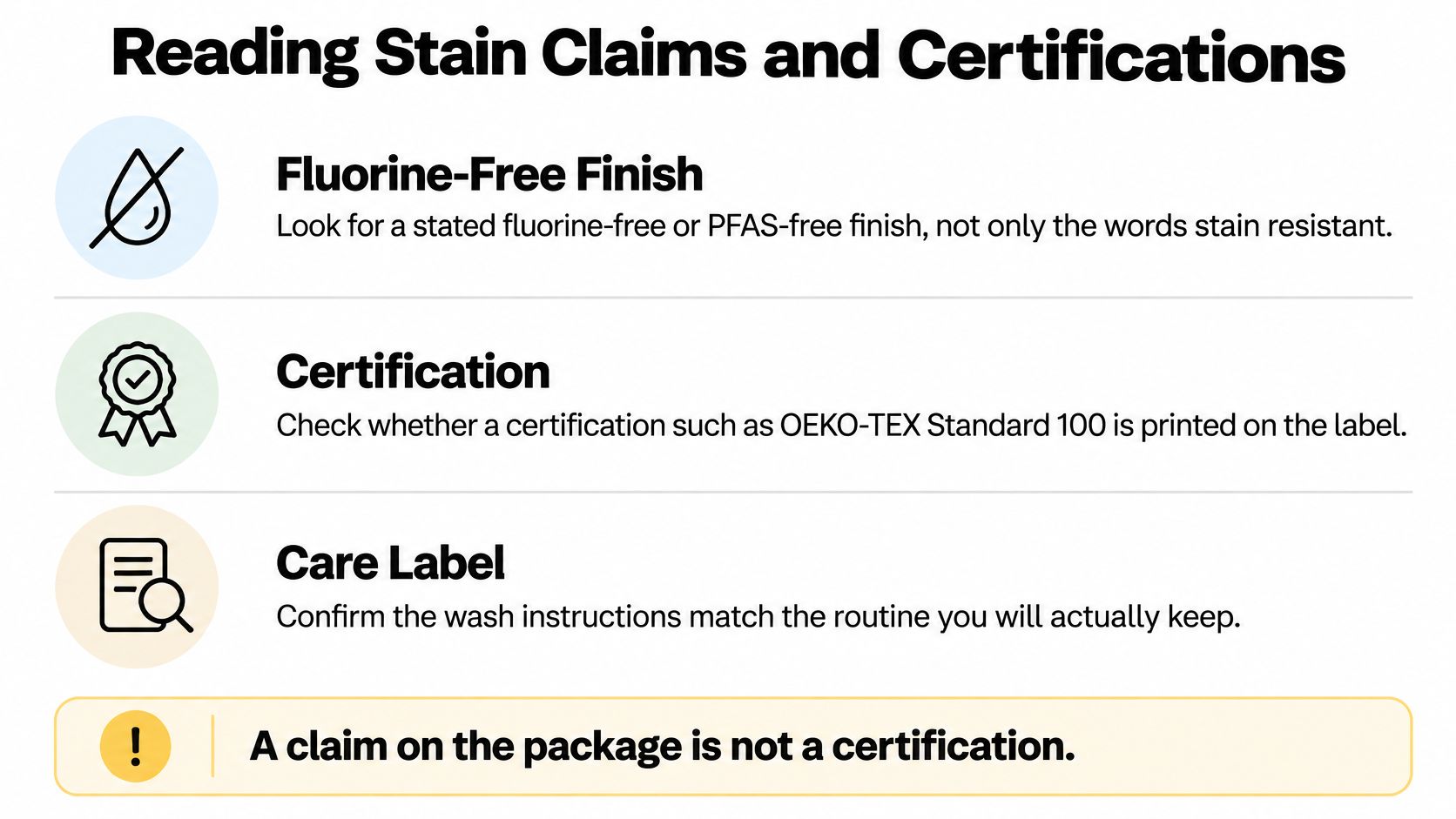
A stain-resistant label can describe two different jobs. Repellency keeps a spill on the surface; stain release helps soil lift away during washing. Check which one the seller means, and look for evidence that supports the claim.
- Finish type. Look for a clear statement about the finish, including whether it is fluorine-free or PFAS-free. Those terms describe chemistry, not how well the sheet handles stains, so seek performance evidence too.
- Certification scope. Check whether certification applies to the finished sheet and any treatment, rather than only the base fabric. The guide to OEKO-TEX certified bedding explains what those marks cover.
- Wash durability data. Ask for results from the finished fabric after repeated laundering, not just an untreated swatch. An AATCC technical review on durable finishes reports that stain-release fluorochemical finishes used in general apparel were generally expected to remain effective for approximately 25 to 30 home launderings. It also cautions that accelerated washfastness tests may not predict performance in a real washing machine.
- Mechanism. Find out whether the claim means spills bead on the surface or soil releases in the wash. A sheet may offer one effect without the other.
- Paperwork. A supplier declaration or lab record that names the test method gives you something concrete to assess. Packaging adjectives alone do not show how the claim was tested.
The rules behind the labels
Certification rules and local regulations address chemical content, not stain performance. OEKO-TEX announced that, after a transition period, its STANDARD 100, LEATHER STANDARD and ECO PASSPORT certifications would generally ban PFAS and PFCs in textiles and footwear beginning in the first quarter of 2023. From January 1, 2024, it tests with total fluorine against a limit of 100 milligrams per kilogram for relevant certifications, as described in its 2023 regulations announcement. California and Minnesota have moved to restrict intentionally added PFAS in textiles, so confirm which rules apply where you buy.
A threshold is not a promise of zero, and a stain-resistant claim does not, by itself, identify the finish chemistry. Ask for documented evidence of both the stain mechanism and any fluorine-free or PFAS-free claim. The 2025 ECO PASSPORT findings report explains OEKO-TEX's approach of screening total fluorine first, then having a lab determine whether it comes from PFAS or another source.
A practical check: The more of these questions a seller can answer with documentation, the more meaningful the claim. If the label offers no evidence, treat the sheet as washable, not stain-proof.
Which Stains Sheets Resist and Which Still Set
Stains don't behave alike, and a finish that handles coffee may be useless against foundation. Learn what to expect and what to do in the first minutes.
| Stain | Expected Resistance | First Action |
|---|---|---|
| Water and juice | High on a repellent finish | Blot, then wash in cool water |
| Body oil and sweat | Moderate; oil penetrates over time | Pre-treat with mild detergent within a day |
| Makeup and cosmetics | Low to moderate | Dab with a gentle cleanser and avoid rubbing |
| Red wine and coffee | Moderate; sets if left to dry | Rinse cold from the back, then wash |
| Ink and dye | Low | Test a hidden corner before using any solvent |
| Blood | Low | Use cold water only, never hot |
A red wine spill, hour by hour
Say a glass goes over at 11 pm on a sateen sheet. The repellent finish holds the wine in a pool for a minute or two, and that window is the whole advantage. Press a clean towel down to blot, working from the outside of the puddle inward so you don't spread it. Don't rub, because friction pushes pigment into the fiber.
Then rinse from the back in cold water. Running water from underneath pushes the wine out the way it came in, instead of driving it deeper. Wash cold with a mild detergent, and check the stain before the sheet sees the dryer, since heat sets what's left. A finish buys you time. It doesn't guarantee removal.
The test you can run at home
Overnight sweat and skincare are the slow-motion version of the same problem. The finish slows staining from repeated exposure, but a pillowcase that meets moisturizer and sebum for eight hours a night will yellow over months regardless of treatment. Wash those more often than the flat sheet.
To check what you own, drop a little water on a hidden corner, a hem or the underside of the fitted sheet. Leave it for 60 seconds. If the drop still beads, the finish is working. If it soaks in immediately, the finish is weak, worn or was never there.
Stain resistance means easier spot cleaning. It doesn't mean immunity to oil, sweat, cosmetics or repeated washing.
How to Wash Sheets and Keep Protection
Every wash either preserves the finish or wears it down. The routine below is the difference between a treated sheet that lasts and one that behaves like plain cotton after a month.
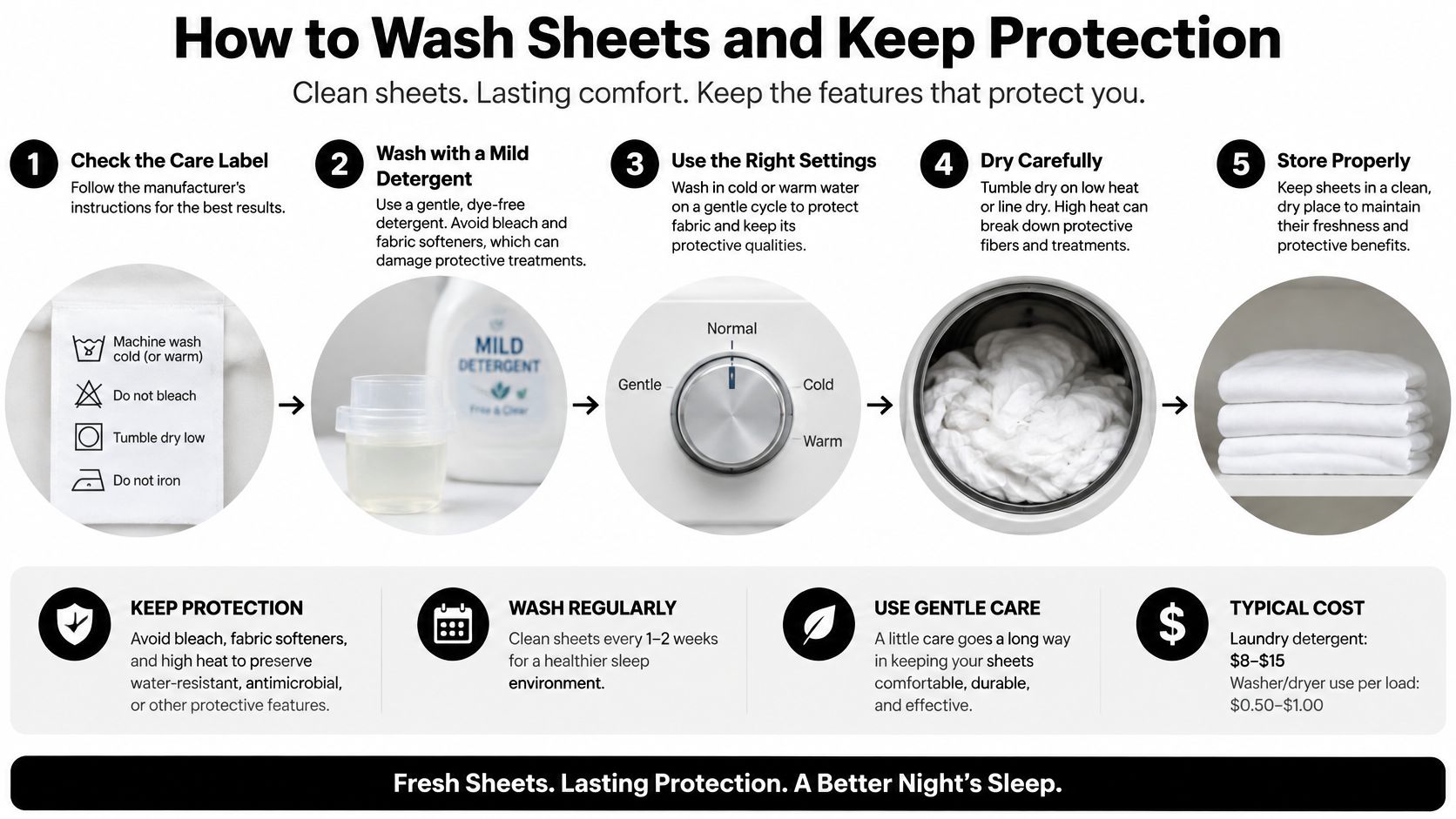
- Wash cold on a gentle cycle with a mild, non-chlorine detergent. Heat sets protein and dye stains, and chlorine bleach attacks the finish itself, so a sheet washed hot and brightened is a sheet that stops beading sooner.
- Skip fabric softener and dryer sheets. Both coat the fibers with a waxy film that fills in the low-energy surface, and repellency drops the moment the surface is covered. If you want softness, use wool dryer balls.
- Tumble on low or line dry. High dryer heat stresses the finish and sets any stain you missed. Pull sheets out while slightly damp and smooth them onto the bed, and you skip most ironing.
- Recheck the finish every five washes. A few drops on a hidden hem tell you more than the label does. Note the result somewhere you'll see it, because the decline is gradual and easy to miss.
Signs the finish is fading
Three signals show up in order. Water soaks in where it used to bead. Stains spread outward faster than they used to. The fabric loses that faint slickness under your fingers and starts feeling like ordinary cotton again.
When that happens, check your habits before you blame the sheet. Overloading the machine, using too much detergent, washing hot "just this once" and skipping the low-heat setting all shorten a finish's life. Our guide to washing bedding covers load size and cycle choices in more detail if you want the full routine.
Practical rule: a finish is a wear item, not a permanent feature. Plan your laundry around preserving it and you'll get months more protection from the same set.
Wash temperatures, detergent type and dryer heat decide most of the outcome. None of them are expensive changes, and all of them are within your control.
Myths and Limits to Plan Around
Stain resistant means stain proof. It doesn't. The finish slows absorption and makes a spill easier to lift, which buys you minutes to blot. Leave a spill until morning and a treated sheet stains about as readily as an untreated one.
PFAS-free automatically means stain resistant. A fluorine-free sheet can be weakly treated, lightly finished or not treated at all beyond a mill name. The absence of one chemistry says nothing about performance, so ask what the finish does and who tested it.
A higher price guarantees repellency. Thread count and price tag sell sheets, not finishes. A 400-thread-count percale with a documented finish will outperform a 700-thread-count sheet with vague packaging copy, because the weave and the test record decide the result.
More washing builds protection. The opposite is true. Each cycle removes a little of the surface treatment, and detergent plus agitation plus heat do the work of stripping it. Wash as often as hygiene requires and no more.
Where testing falls short
Even good screening has gaps. The Wirecutter review of PFAS bans for clothing notes that OEKO-TEX bans intentional PFAS use in its certified products, yet its 2025 ECO PASSPORT testing still found total fluorine above the screening threshold in 1.52% of 1,903 tests. That's why documentation matters more than a single word on a label.
The same review points to the regulatory squeeze now shaping the category: California and New York began prohibiting intentionally added PFAS in many textiles and apparel in 2025, while France passed a 2025 law targeting PFAS in clothing by 2026. Formulas and labels are changing under you, which is itself a reason to buy on evidence.
What to plan around is simple. The finish is a temporary advantage. Keep spot-cleaning habits even with a treated sheet, keep the care routine steady, and replace the set when the beading stops rather than pretending it's still protected.
Choose Sheets and Start Your Care Routine
Four things decide whether a purchase works out. Start with the feel you want against your skin at night, because no finish compensates for a texture you dislike. Then weigh the finish type against the stains you encounter. Next, judge the strength of the evidence: a named test, a certification covering the finished sheet, or an honest product page that doesn't overclaim. Last, be realistic about the routine you'll keep. A sheet that needs careful washing you won't do is a sheet that loses its advantage in a month.
A cotton or microfiber set can be a sensible everyday choice when the claim is documented. Our sheets are tagged machine washable, and our microfiber line is double-brushed in a special process, hypoallergenic and dust mite resistant. Those aren't stain-resistance claims, so read the individual listing for the finish and any test or certification detail before you buy on that basis. If you're layering protection under the sheets, this explanation of when to choose a mattress encasement helps you decide whether you need a full encasement or a simpler protector.
Then run a test plan you can start tonight.
- Buy one set first. Don't replace every bed at once.
- Check the finish yourself with a few drops of water on a hidden hem, and note what you see.
- Follow the cold-wash, no-softener, low-heat routine for five washes.
- Compare the beading after each one. If protection fades early, change the habits before you change the sheet.
SouthShore Fine Linens makes bedding for real bedrooms: extra-deep pocket sheet sets that fit modern mattresses, machine-washable constructions, and textiles that are OEKO-TEX certified across much of the range. If you want sheets that hold up to nightly use and a care routine you can keep, start with a set built for your mattress depth and your washing habits, then read the finish details on the listing before you commit. Visit SouthShore Fine Linens to browse the collections and choose your next set.


