
8 Hotel Style Bedding Ideas for a Luxury Bed at Home
Hotel beds aren't magical. They're methodical. A housekeeper repeats the same sequence every morning: a fitted sheet that stays on the corners, a flat sheet pulled tight, a duvet with a clean folded edge, and pillows stacked by size. The luxury comes from crisp layering, proper fit, and varied texture, not from a loud color story.
That method is now a global business. In 2024, the global hotel-linen market was estimated at $17.8 billion, with a forecast of $25.4 billion by 2030, according to DataString Consulting. Properties buy textiles that still look finished after a hard wash, which is why the same habits work in a primary bedroom, a guest room, or a short-term rental. Hosts who fold the bed into their daily cleaning priorities for hospitality teams already know a popped corner reads as unfinished, even when the rest of the room is spotless.
These eight hotel style bedding ideas are a toolkit you can mix. You'll get white monochrome layering, a daytime fold-back, euro sham stacking, a bolster, hospital corners, an extra-deep foundation, a textured neutral palette, and a quilt-over-duvet build. Each one includes measurements plus a day-versus-night adjustment, so the bed looks composed at noon and still sleeps well at 10 p.m.
1. Crisp White Monochrome Layering
White won hotel rooms for a laundry reason, not a mood-board reason. Through the late 1980s and 1990s, properties dropped colored bedspreads once commercial washers could keep white cloth visibly clean, and the white-sheet history of hospitality ties that shift to one visual standard across every room. Westin's 1999 "Heavenly Bed" then stacked sheets, a duvet, pillows, and accents in white and made the bed the centerpiece other brands copied.
Copy the stack, not the logo. Use a fitted sheet, a flat sheet, a duvet cover, and cases in white or warm ivory. Keep one fiber per layer and change the weave. Percale stays matte and cool against skin. Sateen adds a quiet sheen on the duvet. A matelassé or waffle coverlet breaks the flat plane without introducing a print.
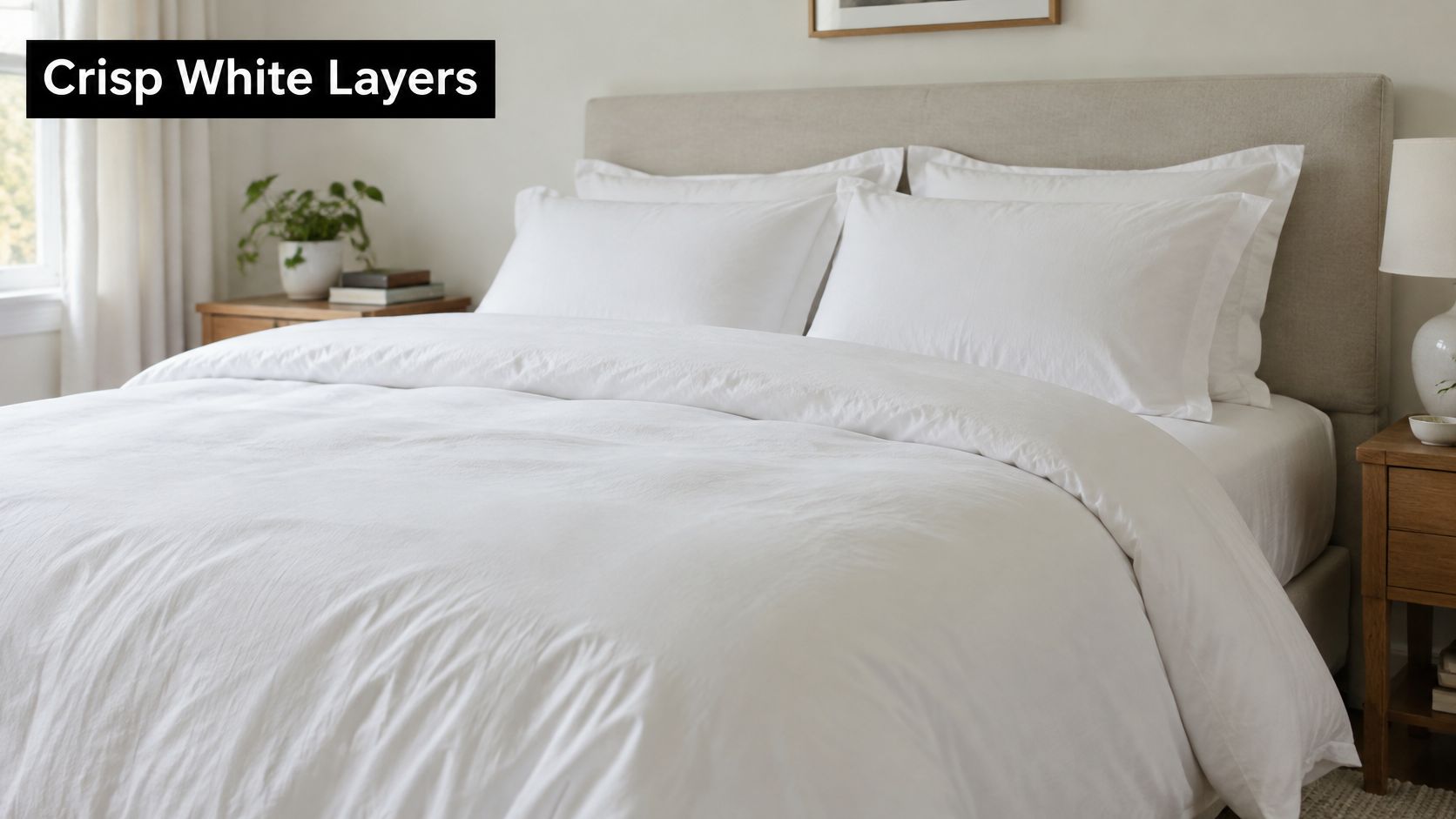
Say the room has oak floors and greige walls. Warm bulbs, near 2700K, stop the white from looking clinical. One oatmeal throw at the foot is the only extra tone. A second pattern fights the calm.
A white bed looks expensive only when every visible edge is straight. Wrinkles read as dirt faster on white than on taupe.
For day, pull the duvet to the headboard and fold the throw once. At night, take the throw off and turn the duvet aside so you're not sleeping under three full layers.
2. Duvet Fold-Back and Evening Turndown Styling
The fold-back is the move that makes a bed look staffed. By day, turn the duvet down about one third of the mattress length so a band of flat sheet shows. On a queen that's roughly 20 to 24 inches of exposed sheet, measured from where the pillow faces end. A bed scarf or lightweight throw then crosses the foot, wide enough to cover the mattress top and short enough that it doesn't puddle on the floor. Two to four inches of drop on each side is plenty.
A lightweight duvet holds that fold. A high-loft winter insert slumps and looks accidental by afternoon.
How the two looks differ:
- Day presentation: Duvet folded straight across, scarf centered, decorative pillows still in front.
- Evening turndown: Top sheet and duvet turned on a diagonal at one corner, scarf removed, sleeping pillows pulled forward.
- Reset: Shake the flat sheet, retuck the foot, then replace the scarf. Don't rebuild the whole bed.
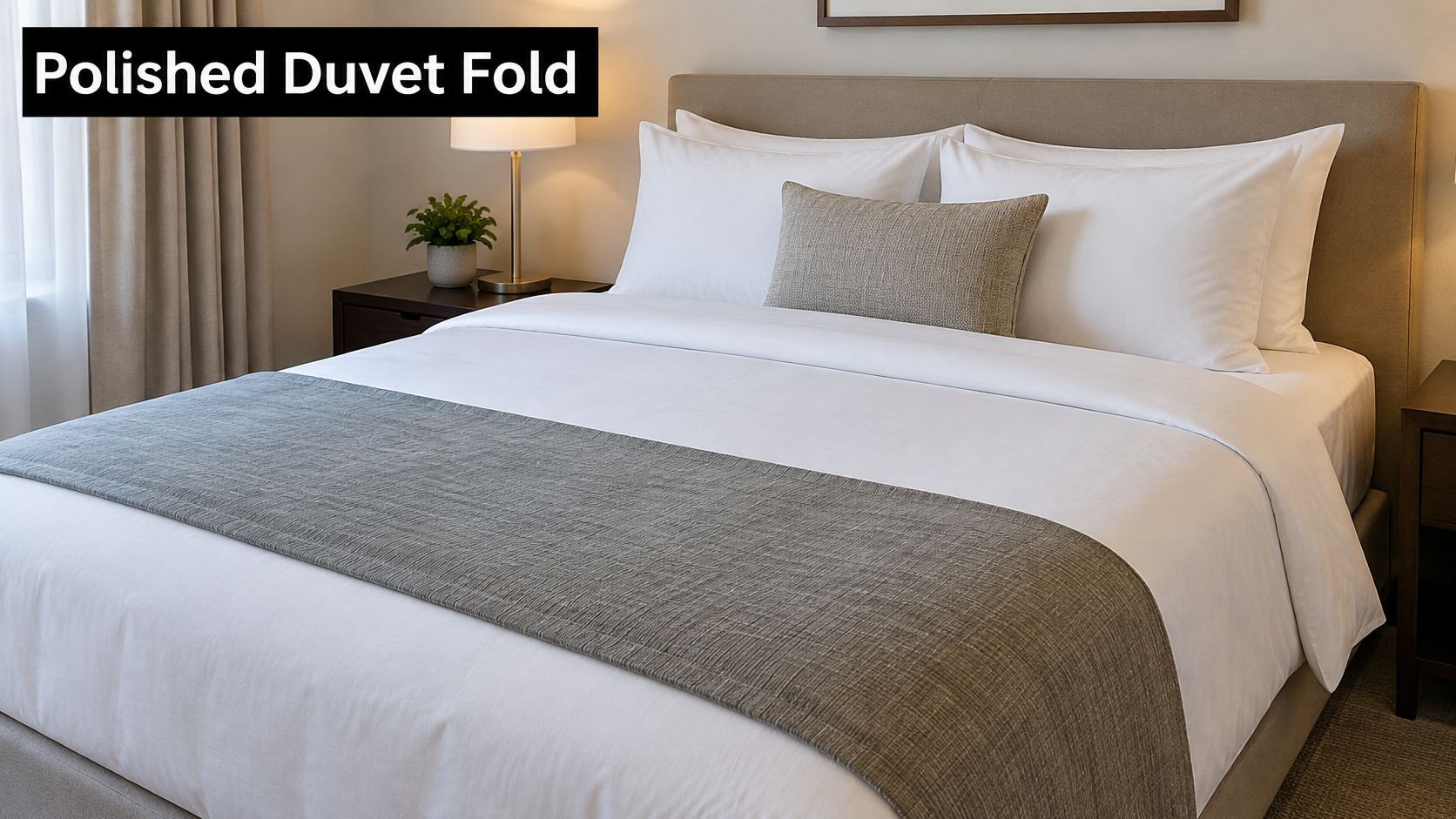
Picture a guest room you turn over between visitors. Leave the fold-back in place when you photograph the listing or when someone arrives in daylight. At bedtime, the diagonal turn-down is the signal that the bed is ready to use, the same cue luxury properties use for evening service. A scarf that clashes with the duvet undermines the fold, so pick one neutral that already appears in a pillow or the quilt edge.
3. Euro Shams and Layered Pillow Stacking
Hotels don't pile pillows at random. They build a wall that fills the headboard and still leaves a place to put your head.
Size Order From the Headboard
Euro shams sit against the headboard, usually 26 inches square. Standard sleeping pillows in shams come next, then one smaller accent if the bed is a queen or king. Four pillows is enough on a full. Six is the ceiling on a king before the stack tips forward and looks like storage. Our European pillow size guide walks through how those squares relate to standard and king cases so the back row doesn't dwarf the sleep pillows.
Firmness follows the same order. The euros are mostly visual, so a firmer insert keeps the square from collapsing by morning. The pair you sleep on sits in front, one firmer and one softer if two people share the bed. Don't hide the soft pillow behind a decorative sham or your guest will grab the wrong one.
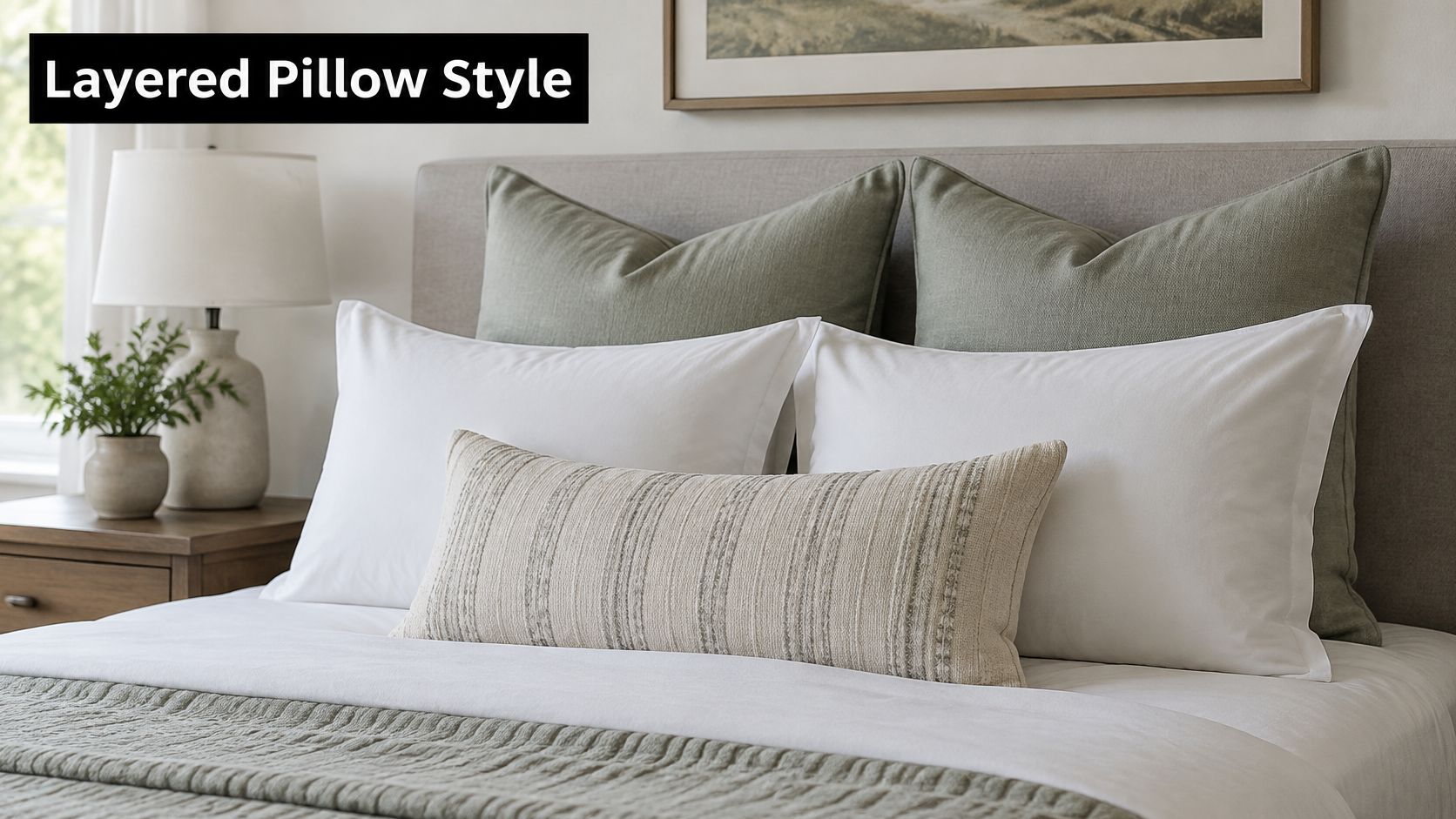
On a king with a low upholstered headboard, two euros side by side, two king shams in front, and one lumbar centered is a balanced stack. Skip the lumbar on a twin. It eats the sleeping surface.
At night, move euros and the lumbar to a bench or the floor. Leaving them on the bed is how people end up sleeping on a decorative edge. In the morning, fluff the euros from the corners inward so the square holds, then set the sleep shams so their openings face the center.
4. Bolster Pillow Accent Arrangement
A bolster is the horizontal bar that makes a headboard look finished when the wall behind it is plain. Place the cylinder across the back, between the euros and the sleeping pillows, or in front of the euros if you don't own squares yet. It should span about 60 to 70 percent of the bed width. On a 60-inch queen, that's a 36- to 42-inch bolster. A full-width cylinder reads as a pool noodle. A short one looks lost.
Practical rule: Pair the bolster with two equal accent pillows, one on each side, or with nothing. One pillow on only one end breaks the symmetry hotels rely on.
Choose a removable cover. Bolsters collect hair oil along the seam you lean on, and a fixed cover means washing the whole insert. A cotton or linen cover in the same neutral as the duvet keeps the shape neat. Velvet works on a lounge-style suite, but it shows crush marks if you use it as a backrest every evening.
Say the bed is a queen in a rental with a simple panel headboard. A 40-inch taupe bolster, two 12-inch square accents, and no extra throw pillows is the whole arrangement. Guests move the bolster to the bench at night and you drop it back in the morning. That single reset takes less time than refluffing a pile of mismatched cushions, and the bed photographs the same way every turnover.
5. Hospital Corners and Tight Sheet Tuck
The pressed look isn't starch. It's a miter that locks the flat sheet so it can't creep.
The Miter in Four Moves
Start only after the fitted sheet is fully seated. A loose fitted corner makes the miter fail.
- Pull the flat sheet so the top edge sits about 6 inches below where the pillows will land, with equal hang on both sides.
- At the foot, lift the side hang and lay it on the mattress, forming a 45-degree fold.
- Tuck the foot hanging fabric under the mattress, then drop the side flap and tuck that too.
- Repeat on the other foot corner, then pull the sheet toward the head and smooth once with your palm.
Practice the fold on one corner until the angle matches on both sides. Uneven miters show in photos faster than a slightly wrinkled center.
This short walk-through shows the hand position that keeps the corner from bulging:
On an adjustable base, don't miter so tight that the sheet fights the bend. Tuck the foot, leave a little ease at the hip break, and rely on a deep fitted sheet for the corners. By day the miter stays in. At night, untuck only the top corner on the side you enter, the way a turndown works, and leave the foot locked so the sheet doesn't ball up by morning.
6. Extra-Deep Fitted Sheets and Mattress Topper Foundation
The hotel plush comes from a topper under a sheet that still grips. Measure the full stack before you shop: mattress height, plus topper, plus any pad, from the bottom edge of the mattress to the top of the pad. A 12-inch mattress with a 3-inch topper is a 15-inch stack. A pocket labeled for 14 inches will walk off the corner the first time someone sits down.
Our guide on how to measure mattress depth covers where to place the tape when a pillow-top slopes. Buy pocket depth with clearance, not a size that matches the number exactly. For stacks over 14 inches, an extra-deep pocket is the safer spec. Elastic should run all the way around, not only at the corners.
Consumer Reports' sheet buying guide notes that a pocket deeper than the mattress still may not hold after repeated washing and drying. Allow for shrinkage. If the sheet is snug on day one, it will pop after a few hot cycles.
Wash cotton sheets in cold water and dry them on low so the pocket doesn't shrink away from the corner.
Under commercial laundry, bed linens commonly withstand about 100 to 150 wash cycles and may need replacement within 12 to 24 months, depending on fabric, occupancy, and wash procedure, according to a hospitality linen-use white paper. A sheet that shifts all night wears faster because of friction. On a 16-inch hybrid plus a 2-inch topper, an 18-inch pocket with full elastic is the setup that still looks smooth after a guest sits on the edge to put on shoes. Check the elastic after the first three washes. If a corner has already crept up, the pocket was nominal, not usable.
7. Textured Neutral Palette with Blended Fabrics
Color isn't what makes a neutral bed look expensive. Temperature and texture do.
A comfortable climate under the covers sits broadly around 30 to 33°C, while summer field research found the lowest dissatisfaction with a slightly cool sensation and a room near 24 to 24.6°C, as summarized in PolyU research on bedroom thermal conditions. A dense velvet layer against the skin fights that, no matter how pretty the taupe is. Put the smooth, moisture-managing face where the body lies. Park loft and plush where you can remove them.
Limit the palette to three neutrals, such as ivory, stone, and charcoal. Give each a job.
- Smooth face: Percale or sateen sheets in the lightest tone.
- Structure: A waffle, linen, or quilted layer in the middle tone.
- Accent only: Faux fur or velvet on a throw or one pillow, never as the sheet.
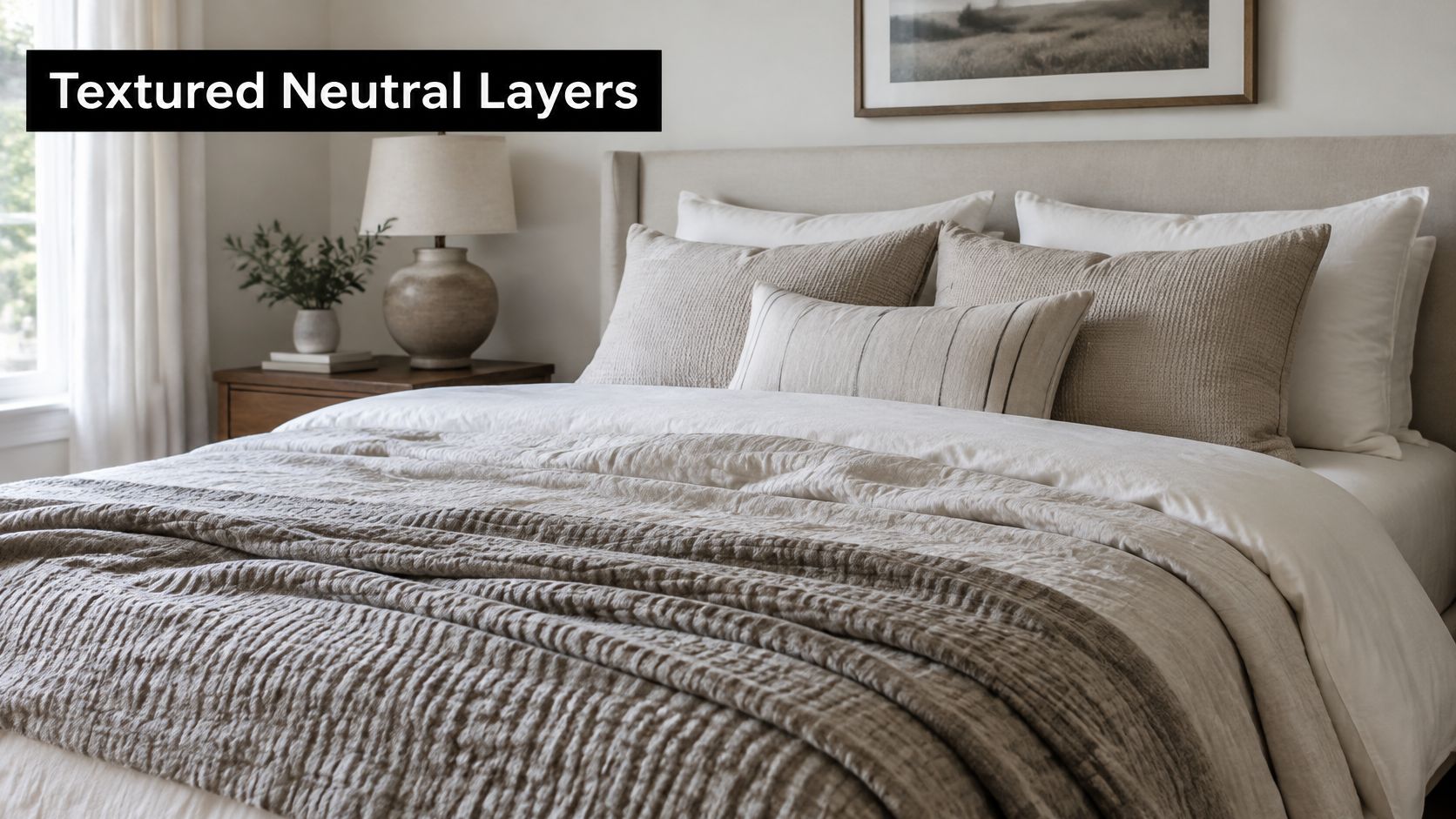
Read care labels before you commit. A dry-clean velvet quilt next to a weekly-wash cotton sheet becomes the piece you stop using. In a desert primary bedroom, linen or percale sheets, a light stone coverlet, and a charcoal throw at the foot stay comfortable when the room is warm. In January, add the lofted layer on top and leave the base alone. Couples who sleep at different temperatures can each pull or reject that top layer without remaking the bed.
8. Hotel-Style Bed with Coordinated Quilt and Duvet Layering
One heavy "hotel" comforter is the look that fails in real weather. Build an adjustable stack instead: breathable sheets, a quilt or coverlet for structure, and a duvet you can add or remove.
A review of sleep and bedding found that linen sheets improved sleep quality in warm conditions, while goose-down duvets increased slow-wave sleep in cool conditions, which is laid out in research on bedding insulation and room temperature. Match the layer to the season. Don't buy one fill and hope.
Quilt Weight Versus Duvet Loft
Use a lighter quilt year-round as the visible layer. Fold it at the foot by day so about a third of the bed shows the sheet or duvet edge, the same proportion as a fold-back. Pick one accent in the quilt, a hem stitch or a quiet geometric, and repeat it on a single pillow or the throw. A second accent color turns the bed into a sample board.
For the steps that keep a quilt from swallowing the pillows, follow how to make a bed with a quilt. An oversized quilt with a longer drop hides the mattress side and needs less tugging after someone sits down.
In a four-season guest room, summer is linen or percale, the quilt, and no duvet. Winter adds a duvet folded at the foot so a cold sleeper can pull it up and a hot sleeper can leave it. The daytime photo stays the same because the quilt is what the camera sees. The night routine is only whether that upper layer comes into the bed.
Hotel Style Bedding Ideas at a Glance
| Idea | Core Technique | Effort Level | Best For |
|---|---|---|---|
| Crisp White Monochrome Layering | Layer white or off-white bedding and use fabric texture for contrast | Low | A clean, timeless, spacious look |
| Duvet Fold-Back and Evening Turndown Styling | Fold the duvet back to reveal the sheet and add a throw at the foot | Moderate | A polished daytime bed and a restful evening routine |
| Euro Shams and Layered Pillow Stacking | Stack Euro shams behind sleeping pillows in graduated sizes | Moderate | Adding height and structure to the bed |
| Bolster Pillow Accent Arrangement | Place a bolster horizontally with smaller accent pillows | Low | Creating a tailored focal point |
| Hospital Corners and Tight Sheet Tuck | Tuck sheets tightly with neat, mitered corners | Moderate | A crisp, secure, hotel-style finish |
| Extra-Deep Fitted Sheets and Mattress Topper Foundation | Pair a topper with deep-pocket sheets sized for the mattress | Low | A plush base and a secure fit on thick mattresses |
| Textured Neutral Palette with Blended Fabrics | Combine neutral shades with contrasting fabric textures | Moderate | A warm, layered look without bold patterns |
| Hotel-Style Bed with Coordinated Quilt and Duvet Layering | Layer a quilt or coverlet over a duvet or sheet | Low | Seasonal variety and a visually layered bed |
Build Your Hotel Bed Tonight: Where to Start
Don't restyle eight layers in one evening. Start with the foundation that makes every other move look intentional.
Measure the mattress, topper, and pad as one stack, then put on an extra-deep fitted sheet that stays seated after you sit on the corner. Add one textural layer, a quilt or a waffle coverlet, in the same neutral family. Master a single styling move before you collect more pillows. The fold-back is faster if you care about photos. Hospital corners matter more if the sheet creeps by morning.
Keep a two-speed routine. By day the duvet or quilt is folded, the scarf is centered, and the pillow wall is up. At night the decorative pieces leave the sleeping surface, one corner opens, and the warm layer is optional. That split is what keeps hotel style bedding ideas livable instead of staged.
If you host often, durability is part of the look. A sheet that shifts creates friction and looks sloppy in listing photos. A scarf you can wash separately saves you from laundering the whole duvet between guests. Pair that habit with clear vacation rental pricing and turnover strategies so the bed reset has a place in the checkout window, not as an afterthought when the next arrival is in the driveway.
We build oversized, deep-fit bedding around that same principle. Extra-deep pocket sheets, oversized duvet covers, and quilt sets in our collections are cut for thick mattresses and adjustable bases, in fabrics that include OEKO-TEX® certified options meant to look composed after repeated washing. A solid percale stays crisp for warm sleepers. A sateen duvet cover gives the fold a smoother face. You don't need a new color story to get the hotel read. You need fit, one texture change, and a fold you can repeat half asleep.
Set the foundation tonight, fold the top layer back, and leave the pillow experiment for the weekend. The bed will already look staffed.
SouthShore Fine Linens makes extra-deep pocket sheets, oversized duvet covers, quilts, and layered neutrals cut for the thick mattresses and simple routines in these hotel style bedding ideas. If you want the fold, the stack, and the fit to hold up after real washing, start with pieces built for that job. Visit SouthShore Fine Linens and put the foundation on the bed first.


