
California King Quilt Size: Dimensions and Fit Guide
102 × 112 inches is QuiltLab's suggested California king quilt size, but its comparison of published charts found recommendations ranging from 102–106 inches wide and 100–112 inches long, according to QuiltLab's California king sizing guide. That spread isn't a measuring error. Different quilts are designed to cover different amounts of the same bed.
The useful question isn't which quilt carries a California king label. It's how much fabric you need across your dressed mattress, down its sides, and over any pillows you want to cover. Your mattress, preferred drop, and pillow arrangement determine the fit.
California King Quilt Sizes Compared at a Glance
A width around 102 inches is a common starting point, not a universal standard. Published recommendations include shorter quilts for an exposed-pillow arrangement and longer options for generous foot coverage or a pillow tuck. A combined king and California king retail label can describe yet another set of proportions.
Use this comparison as a collection of possible fits, rather than a list of interchangeable sizes.
Published California king quilt sizes by source and fit profile
| Source or fit profile | Finished width (in) | Finished length (in) | Use it when |
|---|---|---|---|
| Minimum functional fit, Stitchin' Heaven | 92 | 94 | Tailored coverlet with a small drop |
| Typical generous quilt, same chart | 104 | 114 | Everyday quilt with room for a pillow tuck |
| Oversized layered look, same chart | 112 | 119 | Deep coverage and a full tuck |
| QuiltLab suggested size | 102 | 112 | Starting point for balanced coverage |
| Missouri Star Quilt Co. standard | 102 | 100 | Published dimension for a 72 × 84-inch mattress |
| Cozy Stitchery | 102 | 99 | Planning a pieced California king quilt |
| Cotton Print Club | 96 | 106 | Smaller side drop, also listed for standard king |
| Product Bible retail range | 108–110 | 92–95 | Comparing combined king and California king listings |
How to read the differences
The repeated width in several recommendations makes it a useful shopping reference, but length deserves separate attention. A wide retail quilt can still be comparatively short from head to foot. Conversely, a narrower, longer quilt may suit someone who wants exposed bed rails and covered pillows.
Cotton Print Club describes its listed size as providing approximately a 12-inch side drop on a California king. That's a different visual result from the generous and oversized profiles, even though all can appear in a king-size search.
The fit descriptions in the table are starting points. A quilt described as oversized won't necessarily reach your chosen hem position on a tall bed, and a generous quilt won't automatically accommodate the way you fold it around pillows.
Shopping rule: Treat the bed-size label as a category. Treat the finished width and length as the specification.
Charts disagree because their authors assume different drops, pillow arrangements, construction methods, and styling goals. Before ordering, confirm which measurement is the width and which is the length, especially when a listing gives dimensions without identifying their orientation.
Choosing a Drop and Quilt Style for Your Bed
Drop is the portion of the quilt that hangs beyond the mattress edge. Choose where you want the hem to stop before choosing the quilt. That decision determines whether you see upholstered rails, a bed skirt, or mostly fabric.
The following are hypothetical fit profiles, calculated by adding the chosen drops to the mattress footprint. They aren't manufacturer standards, and none includes extra fabric for covering pillows.
Finished size by drop and fit profile
| Fit profile | Side drop (in) | Foot drop (in) | Width × length before pillow tuck (in) |
|---|---|---|---|
| Tailored coverlet | 10 | 10 | 92 × 94 |
| Everyday quilt | 15 | 12 | 102 × 96 |
| Layered look | 15 | 15 | 102 × 99 |
| Oversized | 18 | 18 | 108 × 102 |
Match the profile to the room
A well-chosen coverlet works when the bed frame is part of the design. Say you have a low upholstered frame with attractive side rails. A shorter quilt lets you show that upholstery rather than hiding it beneath fabric.
The trade-off is less spare coverage when someone rolls over or pulls the quilt toward their side. This profile makes the most sense when a neat outline matters more than an enveloping drape.
An everyday quilt offers a middle ground. Picture a bedroom where you want the mattress edges covered but don't want fabric pooling around the frame. This profile leaves the foot slightly more exposed than the sides.
Its advantage is manageable coverage without an especially long foot section. Its limitation is that covering pillows requires an additional length allowance.
Decide how much fabric you want to manage
A layered look gives more foot coverage while retaining the everyday profile's width. It can suit a bed styled with a folded blanket or exposed pillows, where you want the quilt to remain the main visible layer.
An oversized quilt is a stronger candidate for a guest room with a tall platform bed. A host may prefer generous coverage so guests can pull the quilt comfortably around themselves, but durability still depends on fabric, stitching, and care requirements, not size alone.
Consider these practical differences:
- Show the frame: Choose a shorter drop when you want upholstery or a bed skirt visible.
- Allow for movement: Choose more coverage if sleepers tend to pull bedding toward themselves.
- Check the corners: A deep drop can gather near the foot, especially around projecting rails.
- Separate size from warmth: Extra fabric improves coverage, but filling and construction affect insulation.
If you're also deciding between bedding types, our quilt versus comforter comparison explains the construction differences.
When you're torn between finished sizes, the larger option usually leaves more room for layering. First make sure its hem won't drag or interfere with the frame.
Deep Mattresses, Toppers and Frames That Change the Drop
A correct bed-size label doesn't guarantee a correct drop. The common mistake is measuring the bare mattress, then expecting the quilt to reach the same point after the bed is fully assembled.
Measure from the surface you sleep on, as shown below.
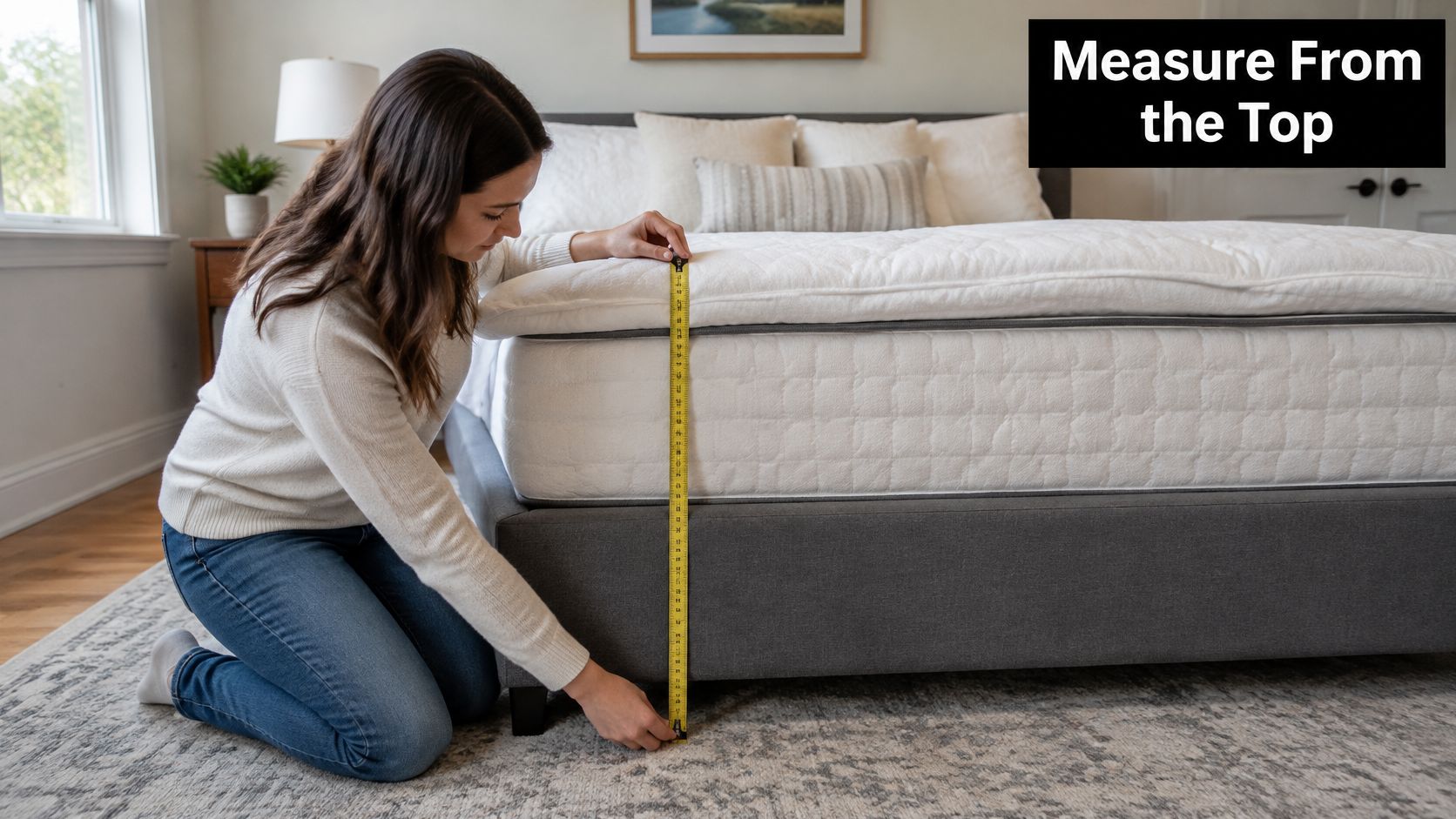
A nominal 14- to 18-inch drop can provide less visible coverage than expected when shoppers fail to account for the complete mattress setup, as Linda's quilt-dimension guidance explains. The right reference point is the highest dressed sleeping surface, not the mattress base.
Check what changes the hanging distance
- Pillow-top mattress: The cushioned top contributes to the height the quilt must cover. Don't measure only the firmer mattress body beneath it.
- Topper or mattress pad: Leave these in place while measuring. Removing them gives you a target for a bed you don't use.
- Platform or adjustable base: Choose whether the quilt should reveal or conceal the base. Check an adjustable bed in its usual resting position and keep fabric clear of moving components.
- Visible bed skirt: Decide whether the quilt should overlap the skirt or leave its upper edge exposed. Either can be intentional.
Our guide to measuring mattress depth can help you identify the correct measuring points.
For another visual reference, use the measurement demonstration below.
Measure the mattress width and length, then hold a flexible tape from the dressed surface down to your desired hem on each side and at the foot. Note the platform's height when it affects how much frame you want visible.
Don't add mattress depth twice. If you've measured directly from the sleeping surface to the intended hem, that distance already includes the height you want covered.
How to Calculate Your Quilt Width and Length
The calculation separates fabric needed across the bed from fabric needed down its length. That distinction matters because the quilt hangs over both sides, but its foot allowance is added only once.
Mattress Firm's California king measurement guidance uses a 72 × 84-inch mattress footprint; a 15-inch side drop and 12-inch foot drop produce 102 × 96 inches before a pillow tuck, while roughly 10–20 inches of additional pillow allowance brings the target to approximately 102 × 106–116 inches.
Build the dimensions in order
- Measure the mattress width and length. Use the actual edges rather than the outside of the bed frame. Keep your tape straight so rounded upholstery or projecting rails don't enlarge the footprint.
- Choose the side drop and double it. Add that combined allowance to the mattress width. Doubling matters because a centered quilt must cover both sides, not just the side you measured.
- Choose the foot drop. Add it to the mattress length to establish the minimum head-to-foot dimension. This assumes the quilt starts near the head of the mattress without consuming extra fabric over pillows.
- Allow for your pillow arrangement. Add length if you'll draw the quilt over pillows or fold it around them. Leave that allowance out if the quilt will stop beneath exposed pillows.
- Compare the result with the listing. Look for finished quilt measurements, not package dimensions or sham measurements. If the nearest available quilt differs from your target, decide whether that difference belongs at the foot, above the pillows, or along the sides.
Keep the basic measuring sequence handy while recording your choices.
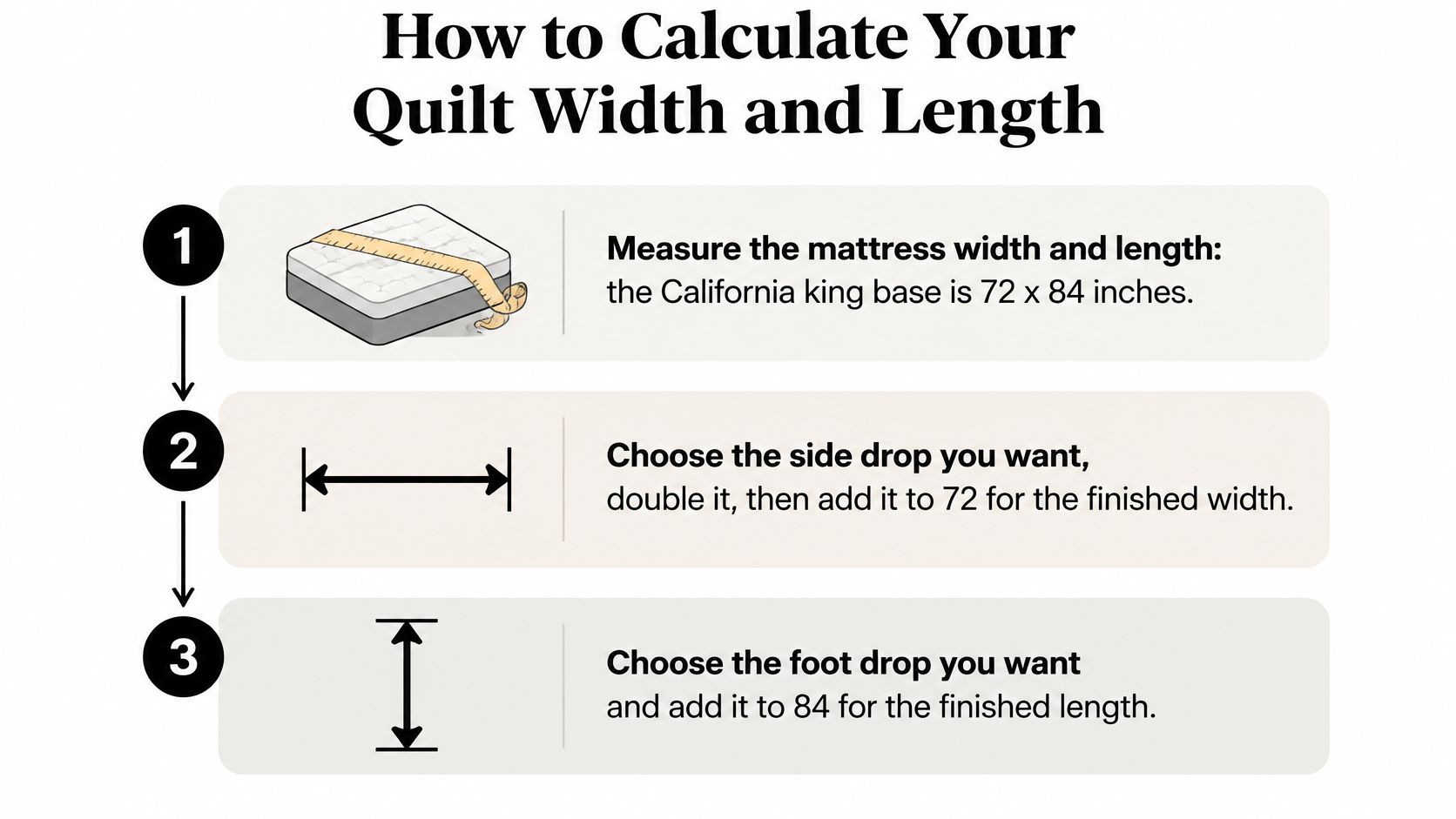
Check the worked example
In the example, the side allowance is added twice to the mattress width, while the foot allowance is added once to the length. Covering pillows changes the length requirement without changing the width requirement.
That's why a quilt can provide satisfying side coverage yet feel too short when you make the bed. Pulling fabric toward the head leaves less available at the foot.
Record width, length, and pillow allowance separately. A single bed-size name can't preserve those decisions for you.
A useful listing states both the intended bed category and the finished dimensions. Combined labels are convenient for browsing, but they don't tell you whether the quilt matches your chosen proportions.
Before shopping, write down your final width and length, along with whether the length includes a pillow tuck. That small note prevents you from comparing a no-tuck calculation with a pillow-covered display photograph.
How California King Differs From a Standard King
A California king and a standard king offer nearly the same sleeping area, but they distribute it differently. According to the Los Angeles Times mattress-size comparison, a California king measures 72 × 84 inches, while a standard king measures 76 × 80 inches. Their respective areas are 6,048 and 6,080 square inches, a difference of only 32 square inches, or about 0.5%.
For bedding, the important distinction is shape. The California king is narrower and longer, so a quilt won't retain the same proportions when moved between the beds.
What happens when you swap the quilt
Assume you keep the same quilt, center it across the mattress, and position its upper edge in the same place. Moving it from a standard king to a California king leaves more fabric available at the sides but less at the foot.
The reverse produces less side coverage and more available length. A California king quilt placed on a standard king does not automatically become too short at the foot. Whether either swap works depends on the quilt's finished dimensions and the coverage you want.
- Standard king to California king: Inspect the foot first, then check whether the side drape looks too deep.
- California king to standard king: Inspect the sides first, then decide what to do with the additional length.
- Combined-size quilt: Evaluate the actual rectangle rather than assuming the shared label guarantees identical drape.
A centered rectangular quilt should still hang evenly from side to side. Unevenness usually means it's off-center, pulled toward a sleeper, or affected by nearby furniture, not that it carries the wrong bed label.
Check the room as well as the bedding
The longer California king footprint can suit taller sleepers, but frame dimensions and walking space also matter. If you're changing bed sizes, Lucas Furniture & Mattress's guide to will a cal king fit your room offers a useful room-planning reference.
For another bedding category, our king comforter dimensions guide helps distinguish mattress dimensions from finished cover dimensions.
Check any quilt against the destination mattress before reusing it. Similar total sleeping area doesn't mean identical bedding coverage.
Quilt Sizing Mistakes and How to Avoid Them
| Mistake | What happens | Fix |
|---|---|---|
| Buying a standard king quilt for a California king without measuring | Foot coverage may be inadequate, and side proportions change | Check finished length against the mattress plus your chosen foot drop |
| Measuring only the bare mattress | The hem sits higher after adding a topper | Measure from the dressed sleeping surface |
| Ignoring pillow tuck | Pulling the quilt over pillows reduces foot coverage | Include a separate pillow allowance |
| Trusting the label alone | The delivered proportions don't match your expectations | Compare published finished width and length |
| Using one drop for every bed | The quilt conceals too much frame or exposes too much mattress | Choose the hem position for that particular bed |
Recognize the symptoms
Wrong proportions show up as a bare foot area or side hems that extend farther than intended. Re-centering can correct uneven placement, but it can't create missing length.
An overlooked topper becomes obvious when the quilt no longer reaches the intended frame line. Pulling it down on one side only transfers the shortage to the other.
Missing pillow allowance appears when the bed looks right with exposed pillows but short at the foot after you cover them. Choose your everyday pillow arrangement before judging fit.
Label assumptions become apparent when the quilt's measured dimensions differ from what you thought you ordered. Check the product specification, and make sure you didn't mistake a sham measurement for the quilt measurement.
An unsuitable drop can look wrong even when every dimension matches the listing. A quilt that hides a decorative frame may be as disappointing as one that exposes the mattress edge.
Before blaming the size, spread the quilt flat, identify its intended orientation, and center it on the bed.
Correct the cause before exchanging
Change one variable at a time. Check placement first, then orientation, then the finished measurements, so you don't exchange a suitable quilt merely because it was turned sideways.
If the dimensions don't work, identify whether you need more width, more length, or both. Compare the replacement's finished measurements with your calculation before ordering, rather than choosing a product described as larger.
Allowing for Shrinkage and Size Tolerance
A published size is a selection guide, not permission to ignore the care label. Fabric and construction can affect how a quilt responds to washing. Cotton fabrics, batting, and an unwashed handmade quilt deserve particular attention when your intended fit leaves little spare coverage.
Check whether the maker describes the quilt as prewashed and whether it gives an expected dimensional change. Don't apply a generic shrinkage percentage to every quilt, and don't assume heavier quilting requires a fixed extra allowance.
Separate chart differences from manufacturing tolerance
Published charts describe different intended sizes. That disagreement doesn't establish how far an individual delivered quilt may differ from its own advertised measurements.
Use the manufacturer's stated tolerance if one is available. Without one, there's no sound basis for declaring a particular dimensional discrepancy normal.
- Before ordering: Read the fabric content, care instructions, and return conditions.
- When choosing between sizes: Prefer some spare coverage if the smaller option only just reaches your desired hem.
- On arrival: Measure the quilt flat without stretching it, then place it on the dressed bed.
- Before washing: Keep the packaging, tag, and receipt until you've checked the fit and applicable return terms.
A small listing difference may be acceptable if you're flexible about the hem position. If you need an exact visual line, compare more carefully rather than assuming the fabric will stretch into place.
Record the arrival measurements as a baseline. Follow the care instructions, and avoid washing a quilt you may need to return until you understand the return policy.
Final Pre-Order Checklist
Use this check with any listing, including ours. A product photograph can suggest a style, but your measurements decide whether that style is achievable on your bed.
- Confirm the bed: Verify the mattress footprint and measure with the topper, pad, and usual bedding in place.
- Set the hem: Record your preferred side and foot drops, then include them in the finished-size calculation.
- Resolve the pillows: Decide whether they'll remain exposed or need additional quilt length.
- Compare dimensions: Match your target against the listed finished width and length, checking their orientation.
- Verify the specification: Make sure the listing identifies both the nominal bed category and the quilt's actual finished size.
Our Vilano Oversized Quilt Set is offered in Twin / Twin XL, Full / Queen, and King / California King. Apply the same dimensional check to our combined-size listing rather than choosing by its label alone; each listed variant requires shipping.
Write your target finished width and length on paper, check those numbers against the product specification, and review the care and return information. Allow for delivery time before placing the order, especially if you're preparing a guest room for a particular arrival.
SouthShore Fine Linens offers oversized quilt collections and coordinating bedding for a thoughtfully layered bed. Visit SouthShore Fine Linens with your finished-size measurements in hand, and compare the quilt specifications with the coverage you want before choosing your set.


