
How to Tighten Loose Fitted Sheets for Good
You bought a queen sheet, the package matches the mattress, and by morning one corner is off while the middle looks rumpled. You tug it back, roll over once, and the same corner lets go. That usually isn't weak elastic on its own. The sheet is fighting the height of the whole stack, or the bed is changing shape under it. Extra pull on a pocket that's already too deep only drives slack toward you. A pocket that's too shallow rides up no matter how hard you tuck. Knowing how to tighten loose fitted sheets means matching height and motion first, then tension.
Pocket Depth That Stops a Loose Sheet
A queen label can be right and the sheet can still fail. Width and length are fairly standard in major U.S. sizes, while height changes with pillow tops, foundations, protectors, and toppers. The Sleep Foundation sheet-size guide notes that a queen mattress is generally 60 by 80 inches, a king about 76 by 80 inches, and a California king 72 by 84 inches. The number that stops a corner from popping is depth, not the name on the package.
Measure the stack two ways
Strip the bed. Leave on every layer that stays overnight, including the protector and topper.
- Height. Measure from the sleeping surface straight down to the bottom edge.
- Wrap. Measure from the bottom edge on one side, across the top, to the bottom edge on the other side, topper included.
Write both numbers down before you retuck anything. A shallow pocket forces the elastic upward until the corner releases. A pocket that's far too deep leaves fabric that shifts. If you want a fuller walk-through of the tape measure, use our guide on how to measure mattress depth.
Read the pocket band
Published sizing puts standard pockets around 10–14 inches, deep pockets around 15–17 inches, and extra-deep versions at about 18 inches or more, according to the Bambusa Sheets fitted-sheet size guide. The same guidance says a 10-inch pocket cannot reliably retain a 14-inch mattress, and that you should keep roughly 1–2 inches of extra pocket after you measure the stack while avoiding more than about 3–4 inches of extra depth. Wider catalog ranges still show up on labels: standard pockets commonly cover roughly 7–14 inches, and extra-deep pockets run approximately 16–24 inches.
Practical rule: If your written stack height isn't inside the pocket band on the package, stop tugging. The sheet can't be tightened into a size it doesn't have.
| Pocket band | Typical depth | Stack it suits | What goes wrong |
|---|---|---|---|
| Standard | 10–14 in, some lines 7–14 in | about 7–12 in | corners pop on pillow tops and toppers |
| Deep | about 15–17 in | about 12–16 in | still releases if a topper pushes past the band |
| Extra-deep | 18 in or more, often 16–24 in | about 15–21 in | excess fabric bunches on a short mattress |
| Too much slack | more than 3–4 in deeper than the stack | any shorter mattress | center bunching and sideways creep |
| Too tight | shallower than the stack, under 1 in clearance | thick mattress plus topper | elastic rides up and fatigues |
A corner that pops on a pillow top is usually the first or last row. A sheet that looks baggy in the center, with corners that still hold, is usually the slack row. Match the band, then refit.
How to Refit Loose Fitted Sheets
Use this sequence only when the pocket already suits the stack. Repeated retucking hides a mismatch. It doesn't fix one.
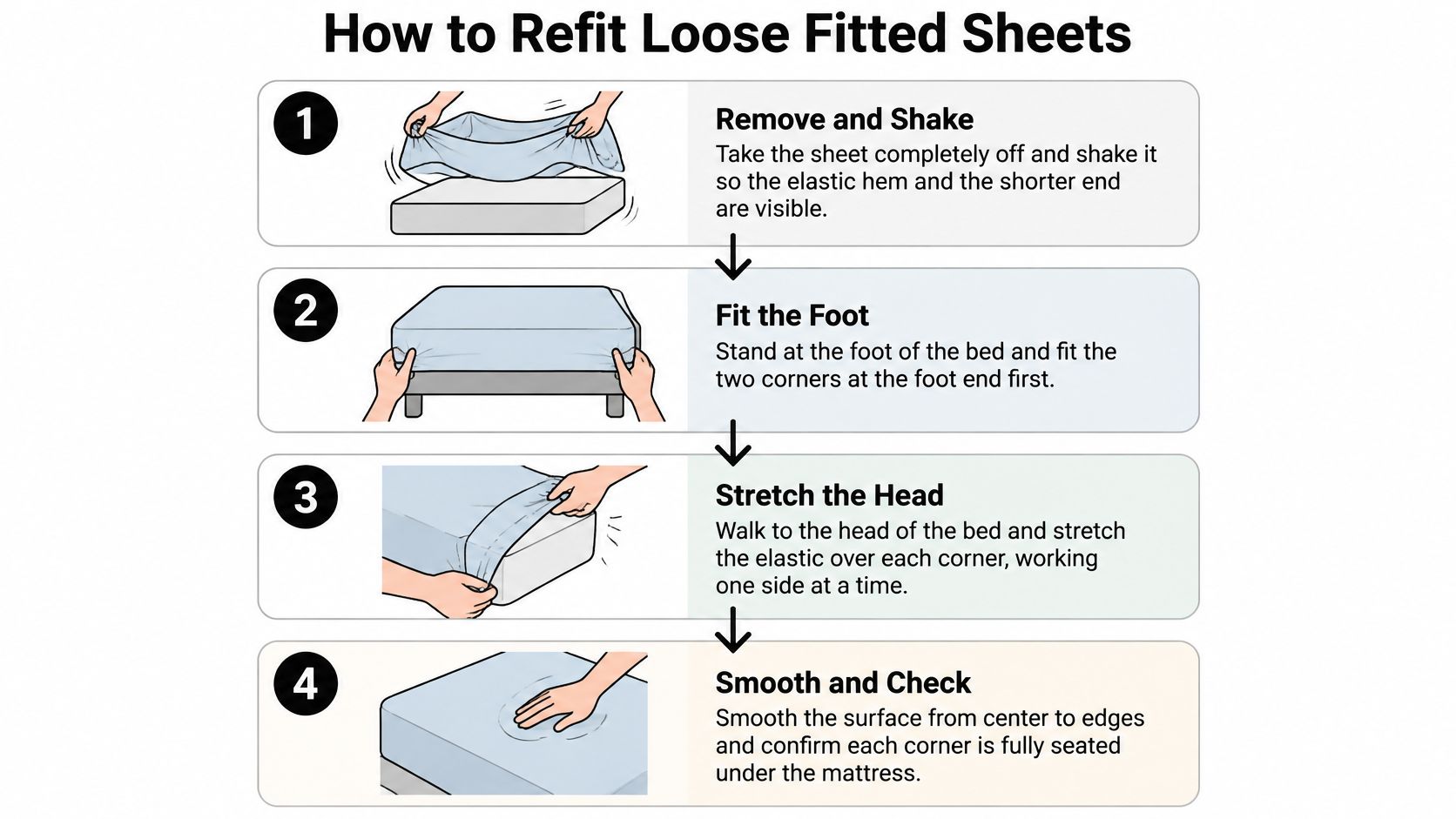
The Kitch Prep measuring guide puts stated pocket depth about 1–3 inches greater than the complete mattress stack, so the pocket wraps under without yanking the elastic upward. If you skipped that check, do it before these steps.
Seat the corners in order
- Take it off. Remove the sheet and shake it so you can see the elastic hem and which end is shorter. A half-on sheet hides twists, and a twisted hem locks slack into one side.
- Start at the foot. Stand at the foot. Fit the two far corners first. Seat each elasticated corner fully under the mattress, with the seam sitting on the mattress corner, not perched on the tip.
- Cross the near corners. Pull those corners diagonally across the mattress rather than straight down. A straight pull traps a wrinkle in the middle that you'll fight all night.
- Tuck the long sides. Lift each sidewall slightly and push extra fabric under the mattress. Don't yank one corner harder to make up for a loose side.
- Smooth outward. Work from the center toward the edges, then tug the long sides taut so tension sits on the perimeter.
- Test it. Sit in the middle and shift your weight. A good fit stays flat, and the corners stay buried.
Starting on the near side pushes wrinkles toward the head, where you notice them first. Overstretching one corner tires that bit of elastic, so the next night is worse even if tonight looks fine.
A short clip of the same seating motion makes the diagonal pull easier to see than a still photo.
Two signs the pocket is still wrong
Center bunching usually means the pocket is oversized in depth. More pulling won't remove fabric that has nowhere to go.
Corners that pop usually mean the sheet is too shallow, or too small in the footprint, so the elastic never stays under the edge.
If the pocket is right and the sheet still creeps after this sequence, move to straps. Another tuck of the same corners won't change the result.
Straps and Clips When the Sheet Is Yours
Suspenders are a backup for an adult bed whose sheet already has the right footprint and still walks. They aren't a way to stretch a small sheet onto a tall stack.
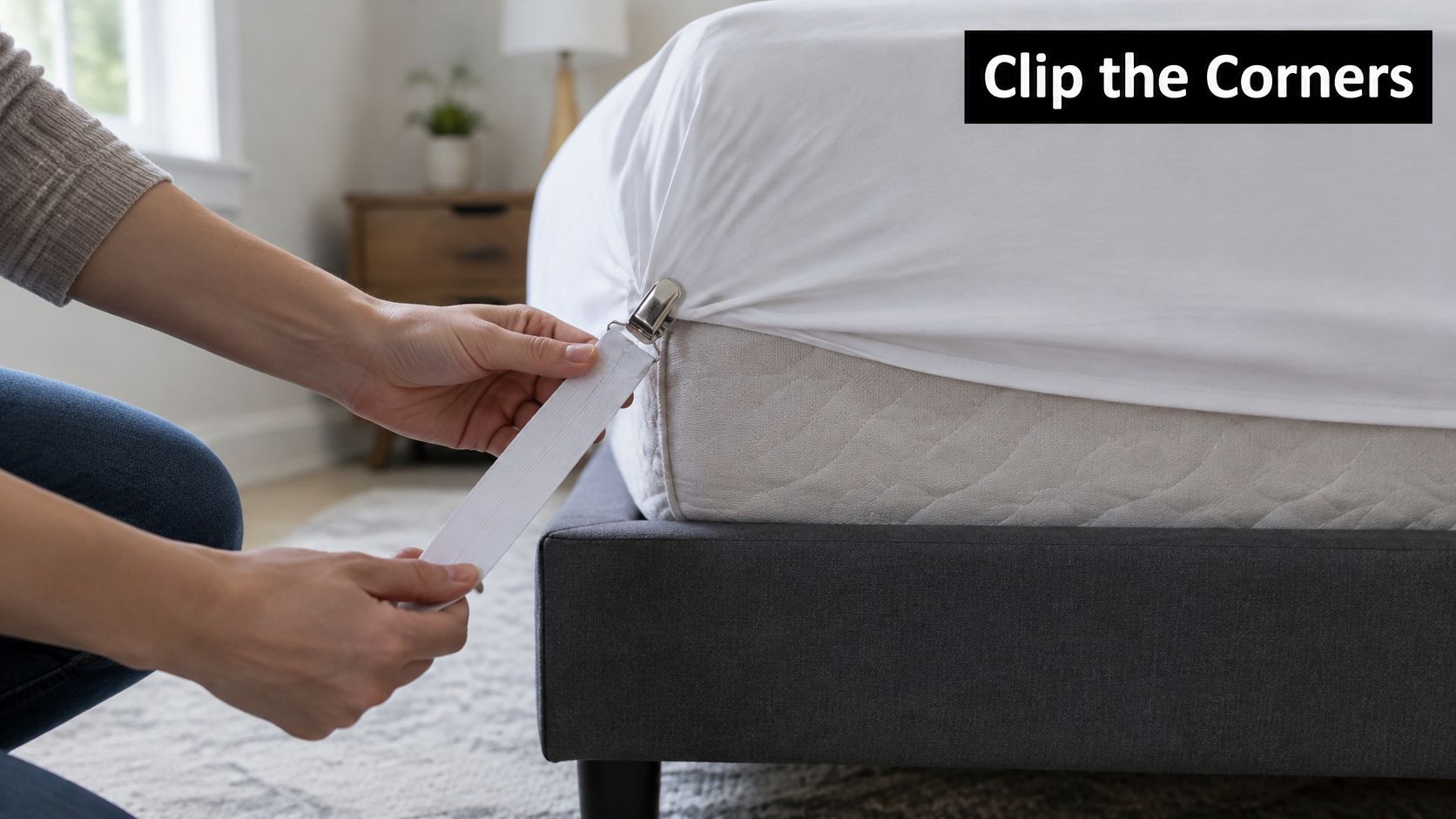
Sheet suspenders are elastic bands that run under the mattress and clip opposing edges. They spread pull across several points instead of loading one corner. That even perimeter hold is the same idea the fitted sheet was built on, which is why the PandaSilk history of fitted sheets treats corner fasteners as a follow-up when a thick mattress, a topper, or an adjustable base keeps loosening a sheet that was seated correctly.
Set the tension by feel
Clip the bands to the middle of each long side, and to the short sides if the set includes them. Run every band underneath the mattress so nothing crosses the sleeping surface. Shorten them until the sheet lies flat and a hand still slides under each clip.
A strap that dents the sidewall or bows the center is too tight. That concentrated pull creates a ridge you'll feel, and it can tear the hem on percale or sateen. Safety pins do the same damage and put metal against skin. Skip them.
Fasteners belong only where the maker's instructions say they go, and they stay off any bed an infant uses. A loose or detachable clip can choke or entrap.
Suspenders earn their place on a thick mattress, a topper stack, or a bed someone sits on at the edge every evening. They don't earn a place on a pocket that's inches shallower than the stack. Forcing that sheet wears the elastic out. Moderate, even tension around the perimeter outlasts one hard pull on a single corner. If the corners can't reach under without strain, replace the sheet instead of adding another clip.
Fitted Sheets on Adjustable and Split Beds
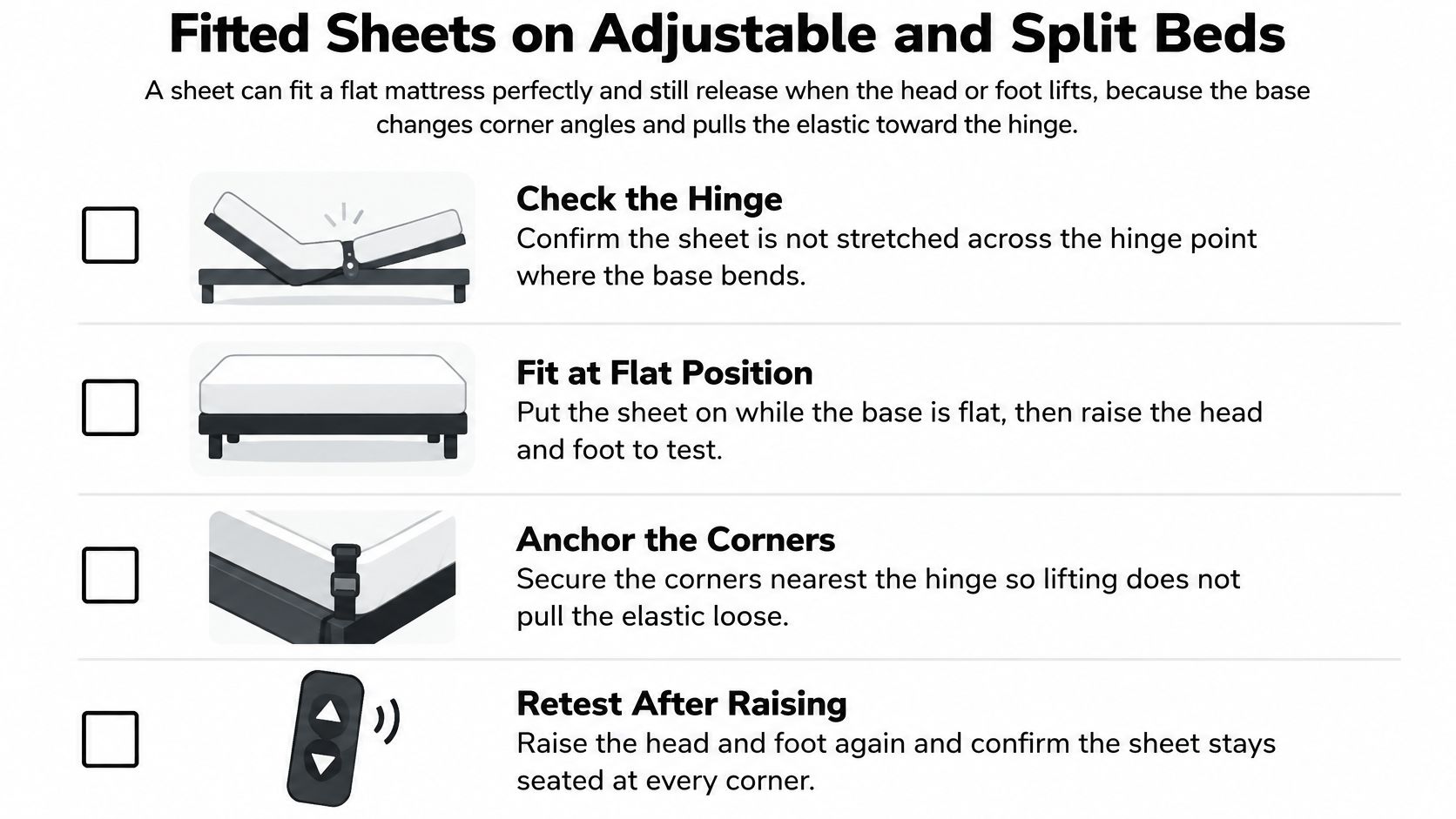
A sheet can sit perfectly while the base is flat and still let go when the head or foot rises. The hinge changes the corner angle and pulls the elastic toward the bend. Most tightening advice assumes a still mattress, so it misses that difference.
Adjustable bases are common, not a specialty setup. One industry market analysis estimated that adjustable bases represented 40.96% of the U.S. bed-base market in 2025, in the GII Research mattress-bases share analysis.
Run four positions
Test the full stack: mattress, protector, and topper. Note which corner releases, and during which movement.
- Flat. Confirm every pocket is fully seated before you move anything.
- Head up. Watch the head corners. A release here is the elastic being drawn toward the hinge.
- Foot up. Watch the foot corners the same way.
- Zero gravity. This combines both bends. Return to flat and reseat any corner that walked.
A corner that fails only in one raised position is a motion problem. A corner that fails while the base is still flat is still a shallow pocket or tired elastic. Don't treat those as the same job.
Split beds and straps that clear the mechanism
On a split king, fit each mattress with its own sheet. One sheet bridged across the gap will tear at the split as soon as the two sides move differently. Our notes on split king sheet sets cover that footprint.
Straps can help if they clear the mechanism. Take off any clip that binds a hinge, pinches a cable, or makes a hard ridge under you.
Cranking tension higher doesn't freeze a moving mattress in place. It bunches fabric at the bend and can stress the lift.
Keep the sheet if every position holds after you reseat the corners. Move to a deeper pocket if the same corner releases whenever that end rises.
Wash Day Looseness and When Not to Tighten
The useful question is whether more tension will improve the fit or damage the fabric and make nighttime bunching worse. A sheet that was always loose is a different problem from a sheet that changed after laundry or after you added a layer.
Layered, personalized sleep setups, with toppers and adjustable bases, make that check routine rather than a one-time hack, as BedTimes describes in its look at personalized sleep systems. Measure height again after every added layer. A protector plus a topper can push a once-correct pocket past its range, and measuring the bare mattress is the usual miss. Our bedding wash guide is the place to check cycle and heat before you blame the elastic.
If slip starts only after washing, compare the pocket with the original label and feel the band. Elastic that stays stretched and won't snap back is fatigued, not merely untucked. Uneven shrinkage shows up as one side baggy and the other drum-tight. A pocket that's too deep feels loose in the center even when the corners hold. Stuffing that extra fabric under the mattress, or clipping it harder, drives the slack toward the sleeper. Overstretching to compensate speeds the failure.
| What you notice | Usual cause | What to do |
|---|---|---|
| Corners pop only after a wash | shrinkage or elastic that no longer recovers | remeasure; replace if the pocket no longer covers |
| Baggy only in the center | pocket several inches too deep | do not add tension; use a shallower pocket |
| One long side wrinkles | uneven tuck or a bunched protector | lift that side and push fabric under once |
| Fine until a topper was added | height measured on the bare mattress | remeasure the full stack and rematch the pocket |
| Elastic stays stretched | fatigue from overpulling a small sheet | retire it; do not clip it tighter |
Stop tightening when the center is baggy from extra depth, or when the elastic no longer recovers. One careful refit is still worth it for a single wrinkled side, or for a new topper that was never in the measurement. Families, renters, and hosts can repeat the height check whenever the stack changes, instead of buying another set of clips.
Replace the Sheet or Keep the Fix
Decide before you buy another fastener.
Keep the sheet when the pocket is only slightly deeper than the full stack, the corners stay seated after you sit and roll, and any strap is a light backup rather than the thing holding the bed together.
Add suspenders on an adult bed that already has the right footprint but carries a topper, or gets sat on at the edge every day.
Replace the sheet when the pocket is shallower than the stack, the elastic stays stretched and won't snap back, or the same corner fails every time the head or foot of an adjustable base rises. A package that only says queen doesn't state pocket depth. Match the number you wrote down.
Stacks that fall in the extra-deep band need that pocket, not another standard sheet pulled harder. Our extra-deep pocket sets in that range are the Briteyarn 300 thread count 100% cotton sheet sets. For best results, wash cotton bedding in cold water and tumble dry on low heat so the first laundry cycle doesn't shrink a correct pocket out of range.
Record the stack height, pick the band that covers it with a little clearance, and retire any sheet you can keep on only by force.
SouthShore Fine Linens makes extra-deep pocket sheet sets and related bedding cut for thick mattresses, toppers, and adjustable bases, so the pocket can wrap the stack instead of fighting it. If your measurement calls for more depth than a standard band, that fit is the place to start rather than another clip. Visit SouthShore Fine Linens to match a set to the height you wrote down.


