
Extra Deep Pocket Sheets California King Buying Guide
You've pulled the fitted sheet back over the corner again, but by morning it's halfway up the mattress. Your California king looks generously dressed when you make it, then turns into loose fabric, exposed edges, and another round of tugging. Before you buy another extra-deep set, measure the bed with everything you sleep on. The right purchase starts with that assembled height, not the size printed on your mattress receipt.
Why California King Sheets Keep Popping Off
A fitted sheet can look convincing while you're standing beside the bed and still be wrong for the setup. You pull the final corner into place, smooth the sleeping surface, and assume the elastic will handle the rest. But if installation requires wrestling the mattress, don't mistake that tension for a secure fit.
A pillow-top, removable topper, and quilted protector change what the sheet must cover. Shoppers often buy against the mattress's advertised thickness, then expect the fitted pocket to accommodate everything added afterward. That's how a seemingly appropriate sheet ends up perched around the sides instead of anchored underneath.
Start with the right mattress format
California king and standard king aren't interchangeable. California king mattresses measure 72 by 84 inches, while standard kings measure 76 by 80 inches, making the California king narrower and longer, as documented in the Los Angeles Times account of California king sizing. Extra width doesn't compensate for missing length.
Skip listings that blur the distinction with a generic king label. Ask for the fitted-sheet dimensions, not just the set name, and don't let an oversized flat sheet distract you from an incorrectly shaped fitted sheet.
Identify the failure before replacing the sheet
Watch what happens after you've made the bed:
- Corners lift: Check whether the pocket can cover the complete setup and reach underneath.
- Fabric drifts sideways: Check the mattress format and whether the pocket leaves excessive slack.
- The surface pulls diagonally: Inspect how the corners are seated before blaming the fabric.
These are useful diagnostic clues, not proof of a single defect. My recommendation is straightforward: stop buying progressively deeper sheets without measuring first. Record your mattress footprint, assembled height, and the pocket specification you need. Then judge the replacement on your bed, under normal movement, rather than by how reassuring the packaging sounds.
Measuring Your Mattress and Calculating Stack Height
A fitted sheet can have the right mattress label and still pop off if its pocket cannot cover every layer and tuck underneath. Measure the complete setup first, then add the fabric needed to anchor it. Stack height is the distance from the underside of the mattress to the highest layer beneath the fitted sheet. Use a tape measure and rigid straightedge; don't estimate from the side or include the bed frame.
For size terminology, keep bed sheet size charts explained handy. For the vertical measurement, follow this guide to measuring mattress depth.
Use this visual as a checklist. Add the tucking allowance only after you've established the actual stack height.
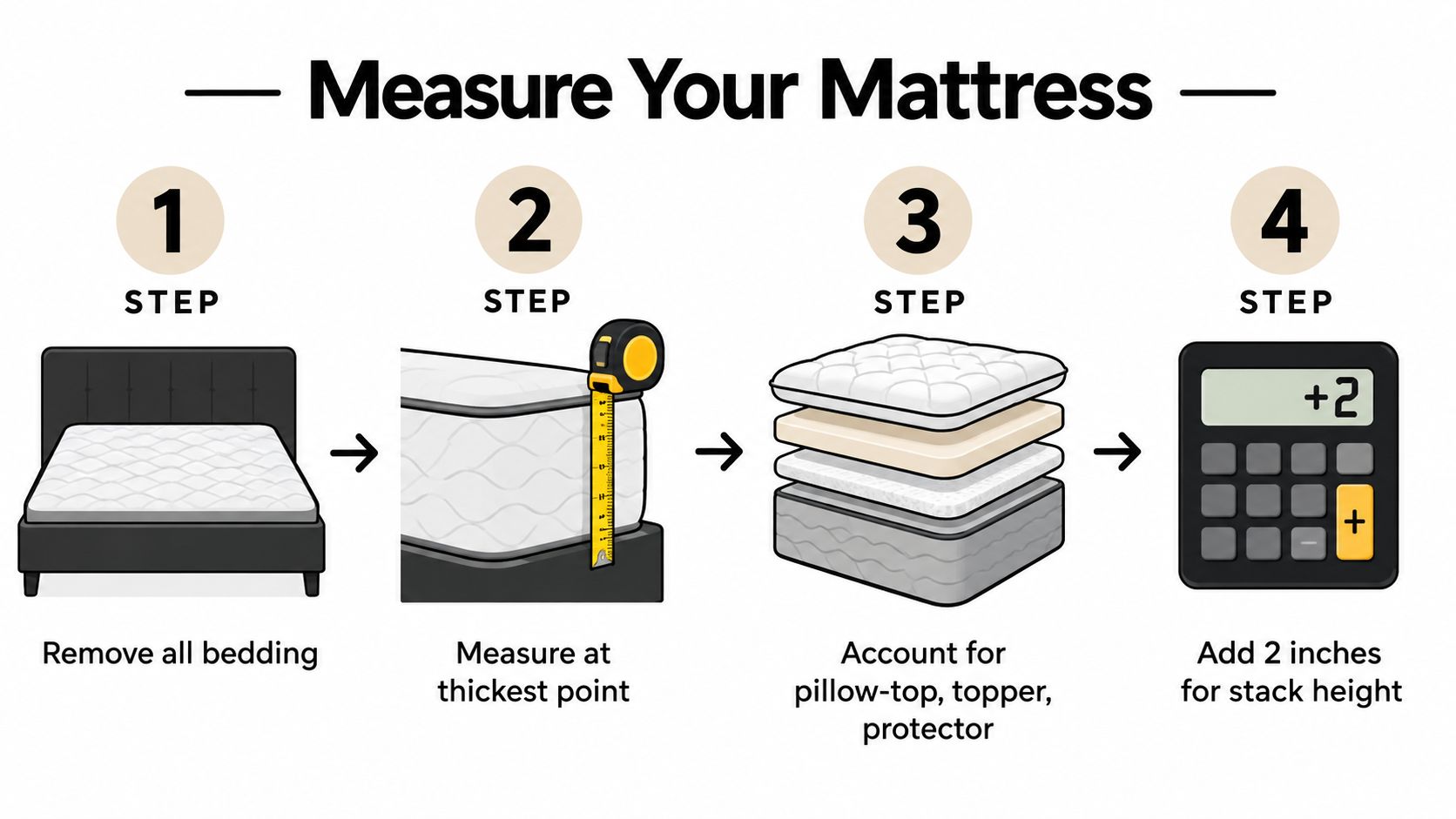
Measure the layers without double-counting
- Strip the bedding: Remove the fitted sheet and loose bedding to expose the mattress edges.
- Check the footprint: Measure width and length through the mattress center, not across rounded corners. Confirm you have a California king, not a split-king setup with separate mattresses.
- Find the highest surface: Measure vertically from the mattress's bottom edge without compressing the padding. Check several spots and record the largest reliable reading.
- Reassemble your sleep setup: Include the topper, pad, and protector that will stay beneath the fitted sheet.
An integrated pillow-top is part of the mattress measurement, not a separate layer to add again. If you measure the assembled stack directly, don't add the topper thickness a second time.
Calculate the pocket you need
Use required pocket depth = mattress thickness + topper thickness + protector thickness + approximately 2–3 inches of under-mattress allowance, following the pocket-depth formula in Amerisleep's bed-sheet sizing guide.
For example, a 14-inch mattress, 3-inch topper, and 0.5-inch protector make a 17.5-inch stack. A 20-inch or larger pocket gives the sheet more fabric to hold the corners than a nominal 18-inch pocket. The bed's actual stack and the sheet's stated pocket depth matter more than the product label.
Published categories describe 13–17-inch mattresses as deep-pocket and 18–25-inch mattresses as extra-deep-pocket. Treat those labels as a rough guide, not a fit guarantee. Check the stated pocket measurement against your assembled stack and tucking allowance.
Practical rule: Record the stack height and target pocket depth separately. The first describes your bed; the second includes the fabric needed to anchor the sheet.
Choosing Sheets That Match Your Sleep Style
Buy for fit first, then choose the surface you want against your skin. A beautiful fabric won't rescue the wrong fitted-sheet shape, and a correctly sized pocket doesn't tell you whether you'll enjoy sleeping on the material.
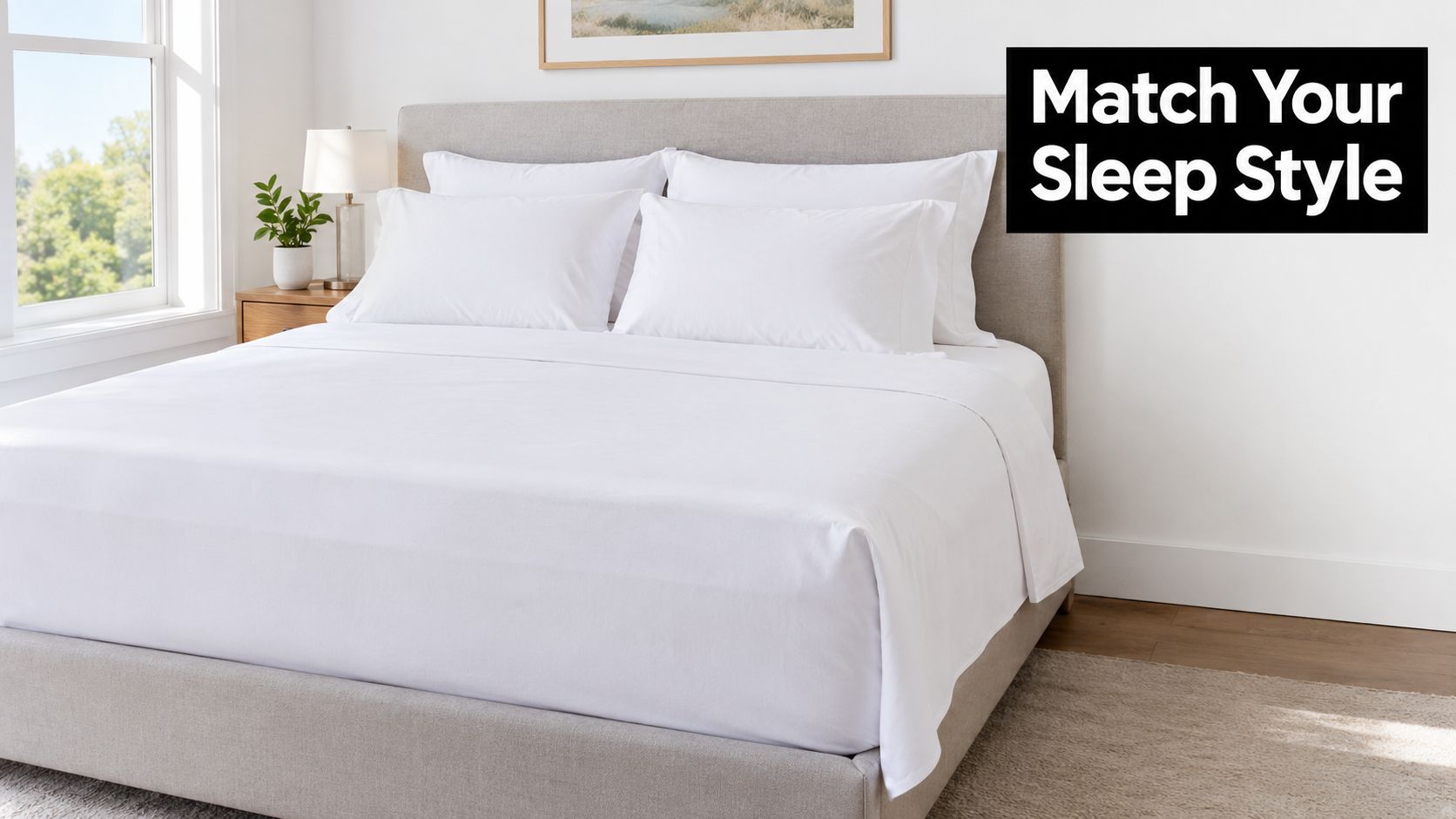
A smooth-looking bed is useful inspiration, but appearance alone doesn't establish fabric feel or corner retention.
Choose fabric by preference, not prestige
My recommendation is to start with what you already enjoy. If your favorite sheets are cotton, investigate long-staple cotton, but still compare weave, finish, and care instructions. Don't pay for impressive fiber terminology without checking the rest of the listing.
Consider microfiber if you prefer that fabric's hand-feel and want it again in a correctly sized pocket. Choose linen if you actively like its texture and relaxed appearance, rather than expecting every sheet to feel polished and silky. For bamboo blends, read the fiber composition carefully; the collection name shouldn't substitute for knowing what you're buying.
- Prefer a crisp surface: Look for descriptions that emphasize the finish you want, and check fabric samples when available.
- Prefer a smooth surface: Compare the actual material and weave instead of assuming all soft-looking sheets feel alike.
- Dislike complicated laundry: Eliminate products whose care requirements don't match your routine.
For a broader preference check, use this guide to choosing sheets for the way you sleep. Treat comfort as a personal buying criterion, not a universal ranking.
Put construction ahead of thread-count marketing
I wouldn't set a universal thread-count target across cotton, microfiber, linen, and blended fabrics. Compare similar materials, and don't assume the largest number identifies the most comfortable sheet.
For a deep mattress, I'd prioritize full-perimeter elastic over a listing that mentions only elasticized corners. Ask how the elastic runs around the hem and whether the manufacturer describes additional retention features. If those details are missing, contact the seller before buying.
Use the accompanying video as additional viewing, not as a substitute for the product's written specifications.
Finally, check certification information at the specific product level. If an OEKO-TEX certification is advertised, look for verifiable details rather than relying on a broad brand statement. Don't assume one certification proves every separate claim about sourcing, durability, or environmental performance.
My buying order is fit, elastic construction, preferred fabric, then verified product information. Thread-count marketing comes last.
Matching Pocket Depth to Your Setup
The useful comparison isn't ordinary versus premium. It's your assembled bed versus the sheet's usable coverage. A bare mattress and the same mattress under a topper are different fitting assignments, even though the mattress-size label hasn't changed.
Mattress thickness varies between models, so don't borrow another shopper's pocket recommendation just because they also own a California king. Ashley's California king mattress listings illustrate why the format alone doesn't identify the mattress profile.
California King Pocket Depth by Setup
Use the allowance calculated earlier for each row. These are measurement-based buying directions, not promises that every sheet with the same label will fit identically.
| Setup | Total Stack Height | Recommended Pocket Depth |
|---|---|---|
| Bare mattress, lower profile | Measured bare mattress height | Calculated target, without unnecessary extra depth |
| Bare mattress, middle profile | Highest reliable mattress measurement | Pocket that clears the measured height and permits tucking |
| Bare mattress, tall profile | Full height, including the integrated pillow-top | Extra-deep option if the calculation requires it |
| Mattress plus protector | Mattress and protector measured together | Calculated target for the assembled setup |
| Mattress plus topper | Mattress and topper, including any protector | Pocket matched to the complete stack |
| Fully layered configuration | Highest measurement with all regular layers installed | Usable coverage that accommodates the stack and under-mattress allowance |
Don't automatically buy the deepest pocket available. Excess fabric can bunch or shift, just as insufficient coverage can cause a corner to release. Choose the nearest suitable specification, then validate how the sheet behaves after installation.
A deeper pocket is useful only when your setup needs the additional fabric.
Save this shopping checklist
- Mattress format: Confirm the fitted sheet is specifically labeled California king.
- Measured setup: Keep your width, length, and assembled height in a phone note.
- Pocket wording: Determine whether the listing describes pocket construction or the mattress height it claims to accommodate.
- Elastic details: Look for a clear explanation of the hem and retention features.
- Return conditions: Check whether installation or laundering affects eligibility before opening the set.
If the seller can't clarify coverage, skip the listing. Buying against an ambiguous specification isn't a bargain when you're replacing another poor-fitting sheet.
Testing Fit Before You Commit
Don't judge fit by whether you can force the final corner into place. A useful test checks whether the sheet stays seated through ordinary movement without developing loose folds or strained seams.
Labeled pocket depth isn't always usable coverage. Seam geometry and elastic placement consume part of the stated depth, which is why roughly 2–3 inches of spare fabric beyond the measured setup helps with tucking and corner retention, as explained in Carré Blanc's fitted-sheet pocket-depth guidance.
Install carefully, then establish a baseline
Raise or tilt the mattress only if you can do so safely. Seat each pocket fully over its corresponding corner and check that the elastic rests beneath the mattress edge, rather than gripping the vertical sidewall.
Use this checklist to inspect the installation before adding the rest of your bedding.
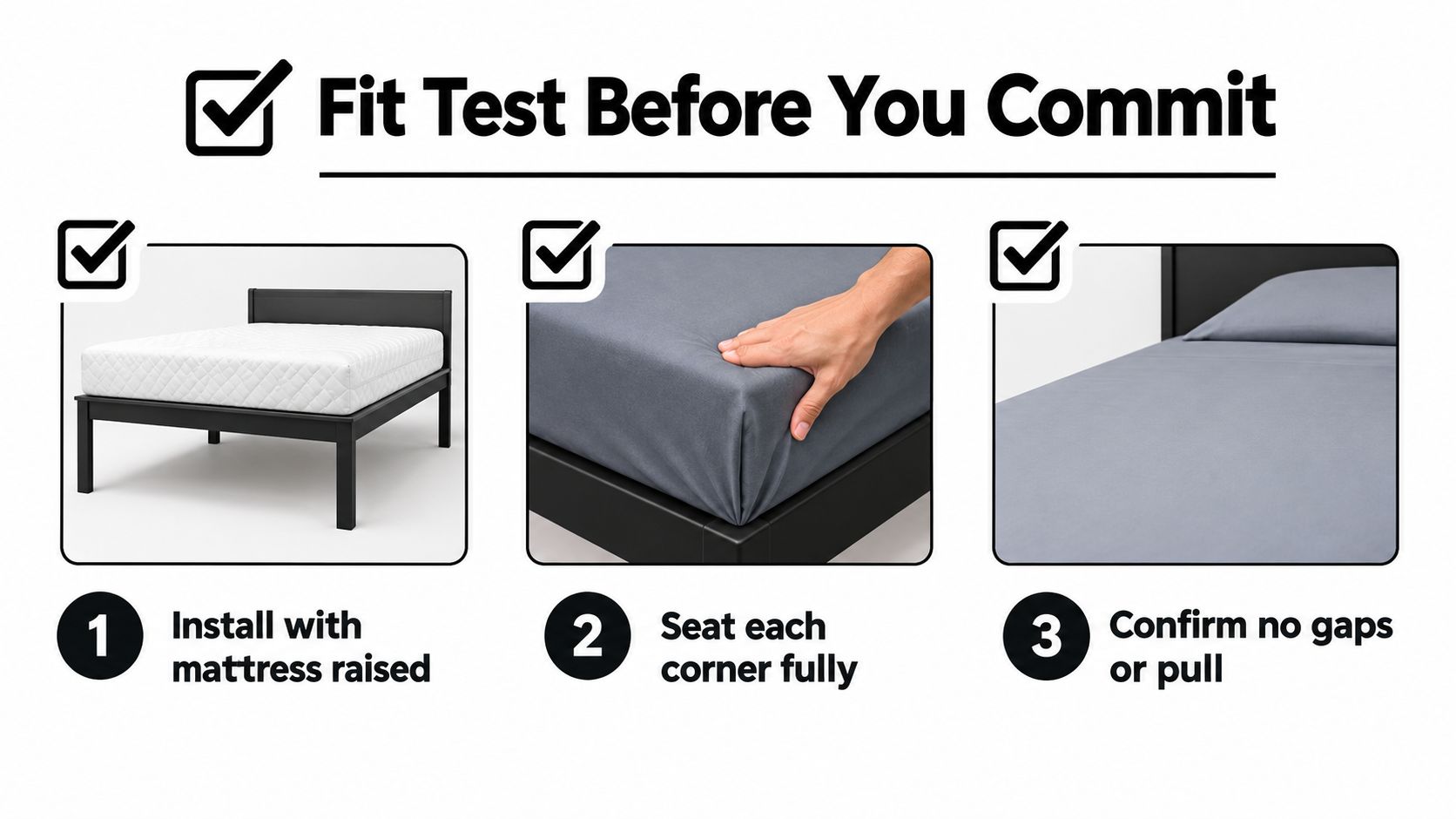
Measure any exposed sidewall at each corner and note where the elastic sits. That gives you a baseline against which to judge movement, rather than relying on whether the bed still looks mostly tidy.
Run the same movement test each time
- Sit at each corner: Check whether normal pressure lifts the pocket or exposes more mattress.
- Lie down and roll: Move across the center, then inspect for lateral migration and diagonal pulling.
- Operate your adjustable base: Use the positions you sleep or relax in.
- Recheck the corners: Compare the sheet's position with your starting notes.
My pass criterion is no corner release during repeated normal use. If you must reset the fitted sheet after the test, don't call it a successful fit.
Keep results separate for different bedding configurations. A sheet that passes on the bare mattress hasn't proved it can handle your topper. Test the setup you intend to keep, and respect the retailer's return conditions before laundering.
Adjustable Bases, Split Setups, and Other Fit Traps
An adjustable base changes the fitting problem because you're asking the sheet to stay anchored while the mattress bends. Maximum pocket depth isn't the answer by itself. Look for a sheet that provides sufficient coverage without leaving uncontrolled slack.
A short sheet can pull at the corners during articulation, while an excessively deep one can gather as the mattress folds. Controlled fabric movement and secure elastic deserve as much attention as the depth label.
Diagnose the mattress before buying
A split king generally consists of two Twin XL mattresses, not a California king, and it requires separate fitted sheets for the mattress sections, as explained in RTINGS' mattress-size and dimensions guide. A single California king fitted sheet is the wrong purchase when you expect those sections to move independently.
Don't identify the setup from the bed frame alone. Remove the bedding, inspect the mattresses, and measure each section separately if there's a split. For selection help, consult the split king sheet-set guide.
- Solid mattress: Match its actual footprint and assembled height, then test articulation.
- Separate mattresses: Buy fitted sheets for each section rather than stretching a single sheet across the pair.
- Unusual or partially split design: Obtain the mattress manufacturer's sheet requirements before ordering.
A nonstandard configuration deserves a specific answer from the seller. Don't assume that “adjustable-compatible” describes every possible split design.
Check raised positions, not just a flat bed
The visual below illustrates why insufficient coverage causes trouble during elevation. Treat the secure deep-pocket example as a correctly matched fit, not evidence that every deeper sheet will perform better.
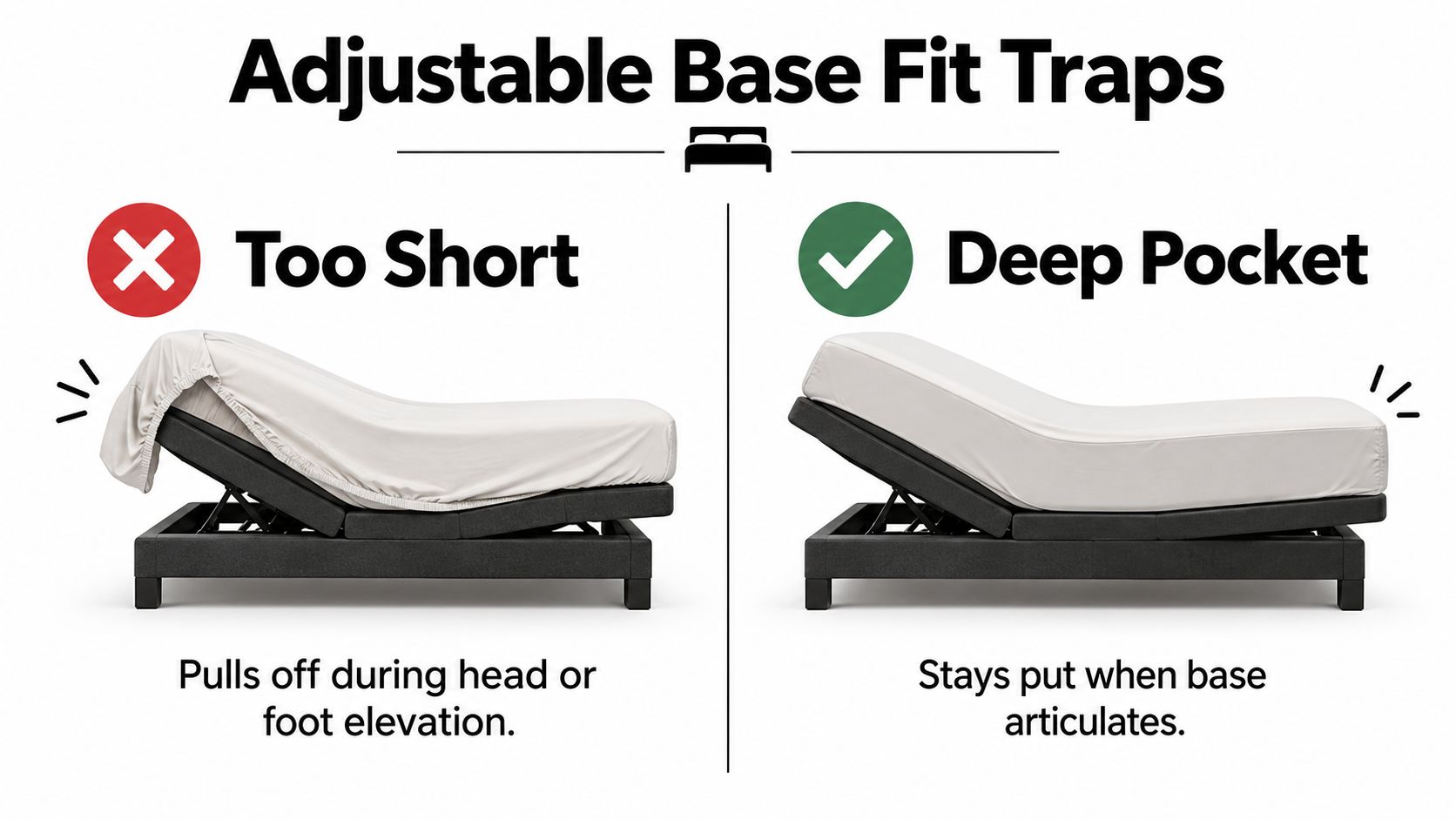
Inspect the bed in your usual head-raised and foot-raised positions. Check whether fabric gathers beneath you, whether the topper shifts, and whether the hem remains underneath. Consider compatible retention straps only after confirming that the sheet itself is correctly sized; straps shouldn't compensate for the wrong mattress format.
Care recommendation: Follow the sewn-in care label before following generic laundry advice.
Where the label permits, my preference is cool washing and low-heat drying or air-drying rather than aggressive heat. Recheck the corners after laundering, and don't return a sheet to regular use while it's damp. If fit changes, compare the same assembled setup before deciding whether the problem is the sheet, a moved topper, or installation.
Putting It All Together for a Confident Purchase
The strongest buying decision is a measured one. You're not shopping for the most dramatic extra-deep label; you're choosing a fitted sheet whose dimensions, usable coverage, and construction match the bed you own.
Keep the stack-height calculation saved with your mattress measurements. If you change the topper or protector, update that note before ordering replacement bedding. Your old pocket recommendation may no longer apply.
Make the product page answer your questions
- Correct format: Does the fitted sheet match your actual mattress, including any split configuration?
- Suitable coverage: Does its stated specification accommodate your calculated target?
- Clear construction: Can you identify how the elastic anchors the sheet?
- Practical ownership: Do the fabric, care instructions, and return conditions suit your household?
Searches for extra deep pocket sheets California king can produce plenty of appealing sets. Reject the ones that leave these questions unanswered, regardless of how luxurious the photography looks.
Choose the closest suitable fit, install it carefully, and run the movement test on your complete bedding setup. A successful purchase should let you make the bed and leave the corners alone, not start another nightly tugging routine.
SouthShore Fine Linens offers California king extra-deep-pocket sheet sets and oversized bedding options for layered, modern beds. Visit SouthShore Fine Linens with your saved mattress and stack measurements, then compare the specific fitted-sheet coverage and care details before choosing your set.


