
What Goes in a Duvet Cover: Insert, Sizing and Care
A duvet or comforter insert goes inside a duvet cover, which is the removable fabric shell around it. If you've just unpacked a cover that looks like an oversized, empty pillowcase, you haven't necessarily bought the wrong thing.
The confusion usually starts with the packaging: a beautifully photographed bed looks plump and finished, while the cover in your hands is flat. To get that finished result, you need to match the shell with the right filling, not just push any spare blanket inside.
What Goes Inside a Duvet Cover and How the Parts Work
A filled duvet insert is the intended partner for a duvet cover. An existing comforter can also work, but a quilt, throw, or pillow isn't an equivalent substitute.
Use this table to identify what you already own before buying anything else.
| Item | Goes Inside the Cover? | Why |
|---|---|---|
| Down or feather duvet insert | Yes | The traditional filled insert the cover was made to enclose |
| Synthetic or wool duvet insert | Yes | Same role with a different fill for warmth and weight |
| Quilted comforter | Yes, if sized to the cover | Works as an insert but can bunch in the corners |
| Quilt | Usually no | A standalone layered bed cover, not built to fill a shell |
| Throw blanket | Usually no | Loose blankets shift and leave empty corners |
| Pillow | No | Pillows go in pillowcases, not duvet covers |
Recognizing the cover and the insert
Think of the cover as a pillowcase and the insert as the pillow. The cover gives you a washable outer surface; the insert gives the bedding its body.
A cover generally consists of woven fabric panels sewn together along the sides, leaving an opening for the insert. Buttons, ties, snaps, a zipper, or a flap secure that opening, while internal corner ties, when present, serve a separate purpose.
As Terry's Fabrics' duvet-cover guide explains, the cover protects the filled bedding from body oils, perspiration, dust, and laundering wear. It also lets you change the bedroom's appearance without replacing the insulating layer.
The insert supplies most of the warmth and loft, meaning the raised, filled-out appearance of the bedding. A cover alone won't create that same shape, regardless of how substantial its fabric feels.
Understanding the materials
Traditional inserts contain duck or goose down, the fine underfeathers associated with the French origin of the word duvet. Other fillings include feathers, polyester fibers, wool, and silk, each providing a different combination of weight, feel, and insulation.
The cover's fabric is a separate choice. Common options include cotton, linen, polyester, and blends, so choosing a down insert doesn't commit you to a particular outer material.
If the product names still seem interchangeable, our explanation of what a duvet insert is can help you distinguish the filled piece from its shell. When shopping, read the package contents rather than relying on the photograph: a cover set isn't necessarily a complete filled bedding system.
Practical rule: A filled insert sized to the cover goes inside. Treat anything else as a compatibility check, not an automatic substitute.
Matching Insert Size to Your Duvet Cover
Choose an insert that matches the cover's finished width and length. A slightly smaller insert can work, but don't deliberately buy a noticeably smaller one to make changing the cover easier.
The cover sets the available space, so measure it rather than measuring only the mattress. Bed-size names describe a category, not a guaranteed match between products.
Start with the finished measurements
These common UK-style cover dimensions provide a reference, not a universal sizing standard. For the simplest fit, use an insert with the same stated dimensions.
| Cover Size (UK-Style) | Cover Dimensions |
|---|---|
| Single | 135 x 200 cm |
| Double | 200 x 200 cm |
| King | 230 x 220 cm |
| Super king | 260 x 220 cm |
The dimensions above are the UK-style examples in Terry's Fabrics' bedding guide. They shouldn't be treated as interchangeable with similarly named products from other markets.
Lay the empty cover flat on a clean surface and smooth it without stretching the fabric. Use a tape measure along its finished width and length, then compare those measurements with the insert's label. Our duvet-cover sizing guide offers additional help when sorting through size names.
Why a mismatch looks and feels wrong
An undersized insert leaves excess fabric around it. You may pull the cover into shape in the morning, only to find empty edges and a gathered section after sleeping beneath it.
An oversized insert has the opposite problem: too much filled material has to occupy too little space. Rather than creating reliable extra fullness, it can fold near the edges, compress the filling, and leave an uneven surface.
Buy for the dimensions printed on the cover label, not for the size name you recognize.
Deep mattresses introduce another decision: how far you want the bedding to hang down the sides. Choose the cover dimensions that provide that coverage first, then match the insert to that cover. Don't try to solve insufficient overhang by putting a larger insert inside a smaller shell.
For adjustable beds and oversized bedding, also check that you can reach and secure the internal attachment points comfortably. Before ordering, write down the cover's actual measurements and keep them beside the insert listing.
Choosing a Matched Cover and Insert
A high thread count doesn't tell you whether a cover will work well with your insert. Fiber quality, weave, fabric weight, finishing, seams, and dimensional stability all affect the finished result.
The WWD luxury duvet-cover guide identifies construction and material specifications as important considerations beyond thread count. Compare the whole product description rather than treating a single fabric number as a quality grade.
Read the specifications as a system
Start with the fabric that will touch you. Cotton or linen may suit someone seeking a breathable outer layer, while percale-style constructions generally suit warm sleepers and sateen prioritizes a smoother hand feel.
Then check how the pieces connect:
- Fiber composition and weave: Look for a clear material description, not just a softness claim.
- Fabric weight: Where stated, use it to distinguish a lighter shell from a more substantial one.
- Internal attachments: Match the cover's ties to the insert's loops or other attachment points.
- Opening closure: Check whether you'll be fastening buttons, a zipper, snaps, or ties.
- Dimensional stability: Look for preshrinkage information and washing instructions before assuming the fit will remain unchanged.
The opening closure and the internal ties do different jobs. A buttoned opening keeps the shell closed; it doesn't connect the insert's corners to the cover.
For a concrete example, our Grand Symphony Duvet Cover Set uses insert corner ties and a button enclosure. The Full/Queen cover measures 92 in x 92 in, comes with two 20 in x 26 in pillow shams, and is machine washable with like colors. Those details identify the shell's dimensions, its fastening system, and its care requirements without implying that the shams or an insert fill the same role.
Ask these questions before buying
- Will the attachment points connect? Check the insert's corners, not just the cover's feature list.
- Do the finished dimensions agree? Compare width with width and length with length.
- Can you maintain both pieces? Read the cover and insert care labels separately.
For an adjustable base, prioritize secure attachments and an opening that stays fastened during movement. If you're only refreshing the room's appearance, keep the compatible insert and focus your purchase on the cover's fabric, color, and finish.
Using a Comforter or Quilt Instead of an Insert
Not every blanket becomes a suitable duvet insert just because you can fit it through the opening. The useful question is whether it will stay aligned, fill the shell, and lie comfortably once enclosed.
Say you have a patterned comforter you no longer like. Covering it can be a practical update, but only if its dimensions and construction suit the new shell. A thick, heavily quilted comforter may be awkward to tuck into the corners even when its size label sounds correct.
The Sleep Foundation's duvet-cover guide provides context for choosing covers and compatible inserts. For reuse, evaluate dimensions, thickness, attachment points, and fill distribution together rather than treating the item's name as the deciding factor.
When reusing a comforter makes sense
A comforter is a reasonable candidate when it lies flat inside the cover without folding and has usable attachment points. Its existing stitching should also hold its filling evenly enough that you're not enclosing an already lumpy bedcover.
Check it before committing:
- Lay both pieces flat: Compare their outlines instead of judging the fit while they're folded.
- Inspect the corners: Confirm that the cover ties have loops or suitable attachment points to connect to.
- Check the bulk: Avoid forcing thick bound edges or folded sections into the shell.
- Test the appearance: Spread the assembled bedding on the bed and inspect the corners and sides.
Ties can help only when they make a secure connection. A loose string beside a comforter without an attachment point won't stop that comforter from sliding.
When a purpose-built insert is the better choice
Choose a duvet insert when predictable loft, drape, and corner alignment matter most. That's especially useful for bedding that gets handled frequently or moves with an adjustable base.
Quilts and throws usually work better as separate layers. Their flatter construction often won't produce the filled-out appearance people expect when asking what goes in a duvet cover, and a smaller throw can disappear into the middle of the shell.
Reuse a comforter after checking its fit and attachments. Don't buy a cover expecting it to correct the comforter's shape.
For renters refreshing a bedroom, replacing only the cover can be sensible. Keep the existing comforter if it passes the compatibility checks; otherwise, choose an insert designed for the shell.
How to Fill a Duvet Cover Without Lumps
Start on a clear bed with a dry insert and an unfastened cover. Work from aligned corners rather than pushing a bundle of bedding through the opening and hoping it straightens itself.
Use this visual to prepare the pieces before enclosing the insert.
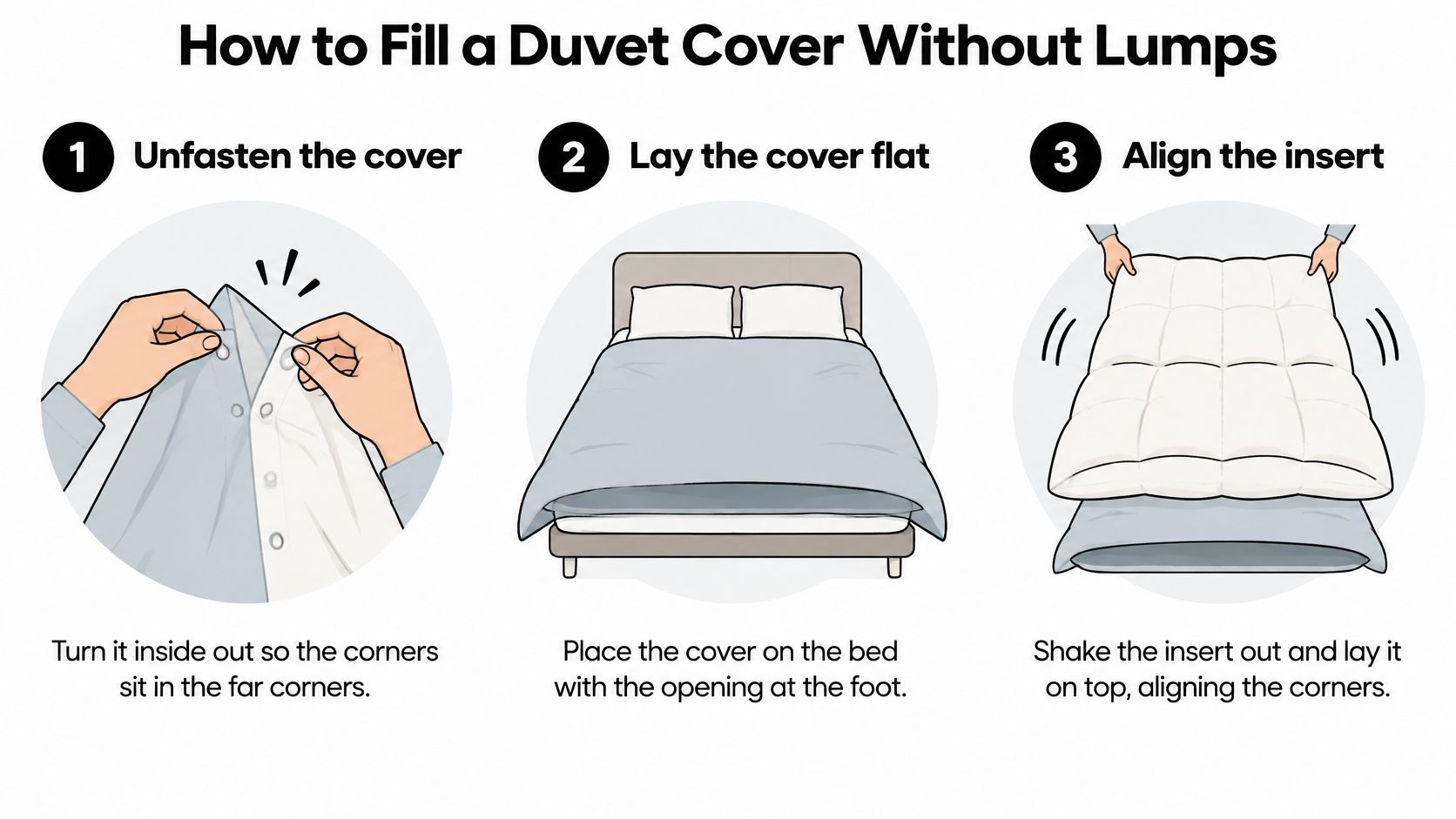
Align first, then turn the cover
- Unfasten and turn the cover inside out. Open it fully and pull out the enclosed corners so you can identify them. Leaving a corner tucked into itself makes it easy to mistake twisted fabric for a fit problem.
- Lay the cover flat with its opening at the foot of the bed. Smooth the side seams and identify the top edge. Don't start with the shell lying diagonally, because you'll have trouble keeping the insert aligned.
- Shake out the insert and place it on top. Match its top corners and side edges to the cover, checking the insert's orientation if it isn't square. If the top ties are accessible, connect them now so the corners stay together during turning.
- Pull the cover right-side out over the insert. Reach through the opening to grasp the aligned top corners through the fabric, then draw the shell down over the filling. Work in manageable sections rather than folding the insert into a tight bundle, which can trap a twist.
- Secure the remaining internal ties. Connect each tie to its corresponding loop or attachment point before closing the opening. Skipping an accessible connection can leave that corner free to migrate during use.
- Seat the corners, smooth, and close. Guide the insert's corners into the shell's corners, then give the assembled bedding a controlled shake. Fasten the opening only after you've checked for folded edges and gathered filling.
For a moving demonstration, watch how the cover passes over the insert while the corners stay aligned.
A good result has occupied corners, straight edges, and an even layer across the bed. If a large ridge remains, reopen the cover and unfold that area rather than trying to flatten it from outside.
Care Schedule for the Cover and Insert
The cover is the washable contact layer, so it generally needs cleaning more often than the filled insert. It collects everyday sweat and body oils while protecting a bulkier item that may require special washing or drying arrangements.
Bedsure's comforter-and-cover care framework recommends washing the cover every 1 to 2 weeks and the comforter approximately every 6 to 8 weeks, subject to the manufacturer's instructions and machine capacity. The same guide advises selecting an insert that matches the cover's finished dimensions or is approximately 1 to 2 inches smaller in each direction.
Treat that washing schedule as guidance, not permission to ignore a dry-clean-only or otherwise restrictive label. A removable cover doesn't make every insert machine washable.
Wash and dry without crowding the filling
- Read the sewn-in label before washing. Check whether home laundering is permitted and note the temperature and drying restrictions. Repeated wetting and drying can affect dimensions and put stress on seams.
- Choose a machine with enough room. The insert needs space to move rather than remaining tightly packed against the drum. Wash compatible colors together, and use a larger-capacity laundry machine if your home washer is too small.
- Select the specified cycle. Use a gentle setting only when it's compatible with the label, and measure detergent according to the product and machine instructions. Extra detergent isn't a substitute for adequate washing space.
- Dry at the permitted temperature. Use low heat when allowed, pausing to loosen and redistribute clumped areas. Follow any fill-specific restrictions rather than assuming all inserts tolerate the same treatment.
- Check for complete dryness. Feel the thicker areas and corners, not just the outer fabric. Continue drying as permitted if any filling still feels damp.
Our guide to cleaning duvet covers can help you plan care for the removable shell. Between washes, air the insert on a dry day in a clean, sheltered place.
If the cover is clean but the insert is still damp, wait before remaking the bed. Enclosing moisture isn't a shortcut to finished bedding.
SouthShore Fine Linens offers duvet covers, comforters, quilts, and bedding essentials to help you build a coordinated bed. Visit SouthShore Fine Linens to compare cover dimensions and fastening details, then choose a shell that works with your insert rather than relying on the bed-size name alone.


