
Washable Comforter Sets: Size, Care and Drying Guide
The usual advice for washable comforter sets starts with cold water and a gentle cycle. That's the wrong starting point. Check whether the comforter can move in your washer and dryer first. A careful wash setting won't rescue an oversized comforter packed into a drum with no room to circulate, rinse or tumble.
Treat machine washability as a combination of product care, appliance fit and drying space, not a promise that every home laundry setup will work. The best purchase is bedding you can maintain realistically, without wrestling a wet bundle into an undersized dryer.
Match the Set to Your Bed and Machine
Fit the comforter to the bed, then check whether it fits your laundry equipment. Bed-size labels are a starting point, not a guarantee of exact dimensions. Typical comforter sizes are:
| Bed size | Typical comforter dimensions |
|---|---|
| Twin | About 66 x 90 in |
| Twin XL | About 66 x 90 in |
| Full | About 80 x 90 in |
| Queen | About 90 x 90 in |
| King | About 106 x 96 in |
| California King | About 106 x 96 in |
These are typical dimensions, not a promise that every product follows the same measurements. Check the comforter size chart and the specific listing for bed coverage, especially for Twin XL, California King and oversized styles.
Bed size alone does not establish machine capacity. Comforters with similar dimensions can take up different amounts of space because their fill, quilting and shells differ. Check the washer and dryer manuals for their guidance on bulky bedding.
For Twin and Twin XL, a narrow bed does not mean the comforter will fit a compact apartment washer. With Full or Queen bedding, assess the comforter by itself rather than loading the entire matching set together. King, California King and oversized comforters need particular care in the fit check: the dryer may be the limiting appliance even when the washer accepts the load.
Test movement, not just space
Load the dry comforter loosely, following the appliance manufacturer's instructions. If it must be firmly compressed to fit, stop and use a larger machine. In the dryer, it needs room to lift, fall and open out instead of rotating as a dense bundle.
A packed dryer may leave the shell feeling dry while the filling stays damp. That hidden moisture can leave bedding smelling musty in storage. If either home appliance fails the fit check, a larger laundromat machine is the practical alternative.
Allow time to attend the laundry and reposition the comforter as needed. Don't start a load shortly before you need to leave or remake the bed. A little room in the schedule helps you check that thick areas are dry before putting the bedding away.
Before buying, check three things:
- Washer fit: Can the comforter move without being forced into the drum?
- Dryer fit: Can it tumble rather than turn as a compressed bundle?
- Dryness access: Can you unfold it and feel the thick central sections before storing it?
Reading the Care Label as a Spec Sheet
Machine washable doesn't automatically mean tumble-dry safe. That's the most consequential label-reading mistake with bulky bedding. Read the washing and drying instructions together before deciding whether a set suits your home.
The Federal Trade Commission's Care Labeling Rule describes care requirements for covered apparel and certain piece goods, including washing methods and drying conditions. It shouldn't be treated as a blanket legal requirement for finished comforters. For bedding, the practical principle remains useful: look for instructions that describe the complete care process.
| Label wording | What it means | Action |
|---|---|---|
| Machine wash, cold | Machine washing is permitted using cold water | Use a cold, gentle cycle unless another cycle is specified |
| Machine wash, warm | Warm washing is permitted within the stated limits | Use the specified cycle and temperature setting |
| Do not bleach | Bleaching isn't permitted | Skip bleach, including oxygen bleach |
| Tumble dry low | Tumble drying is permitted at low heat | Use low heat; add dryer balls only if suitable for the product |
| Do not tumble dry | Tumble drying isn't permitted | Follow the stated air-drying method; support the wet bedding adequately |
Check the whole construction
The shell may tolerate treatment that the filling, binding or decorative trim cannot. The most vulnerable component sets the safe routine. Matching shams may also have different instructions from the comforter, so read their tags separately.
Use this checklist when comparing a listing with the sewn-in label.
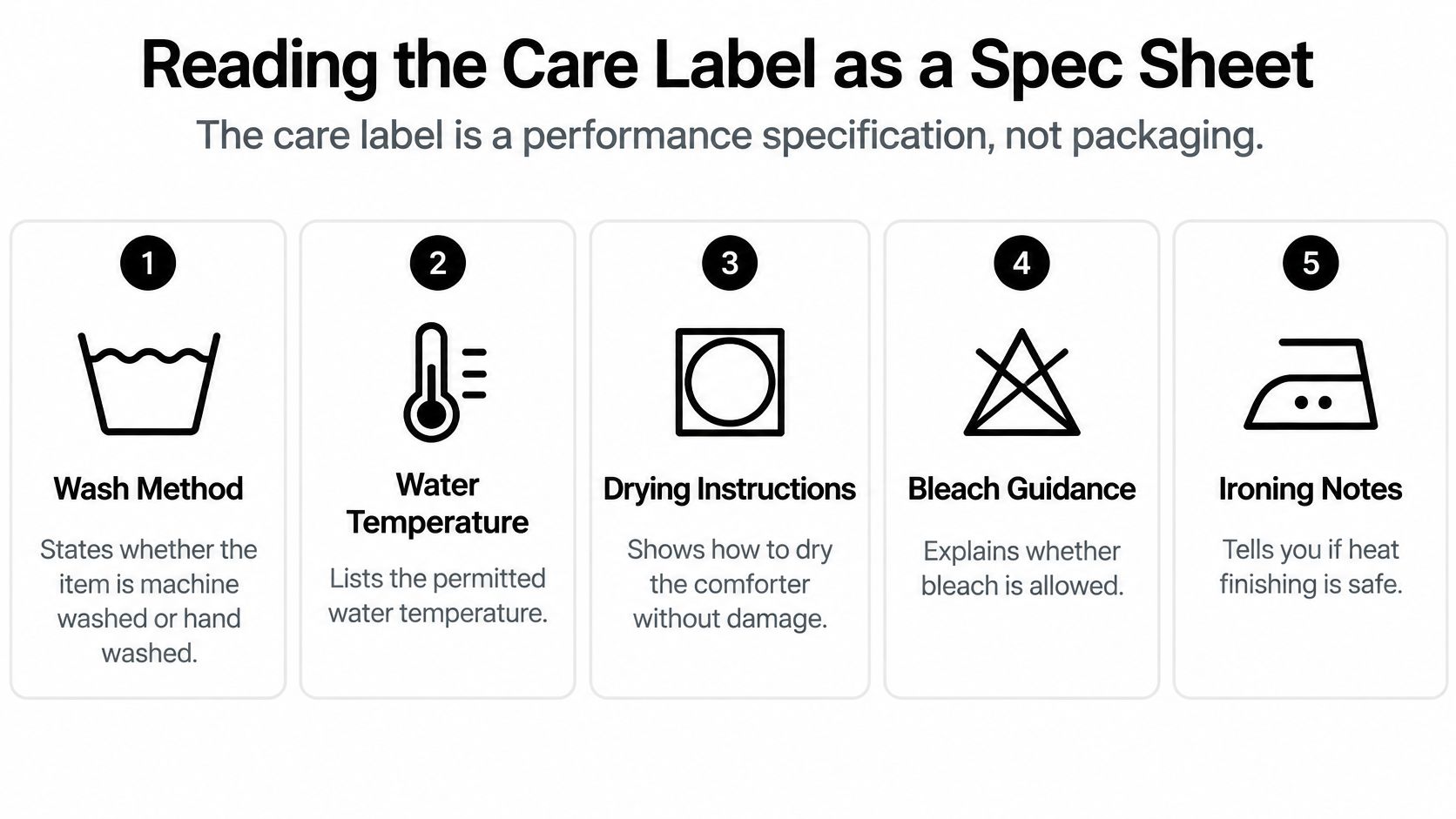
Check the wash method, water temperature, cycle restrictions, drying setting and bleach permission. Ironing guidance matters for a removable cover, but don't assume a filled comforter can tolerate an iron.
A missing temperature doesn't necessarily mean cold washing is mandatory, and silence isn't permission to experiment with high heat. For unfamiliar symbols, consult the guide to symbols on wash tags. Resolve unclear instructions before washing, rather than choosing a setting based on habit.
Materials and Construction That Hold Up
| Fill | Washing tolerance | Drying | Best for |
|---|---|---|---|
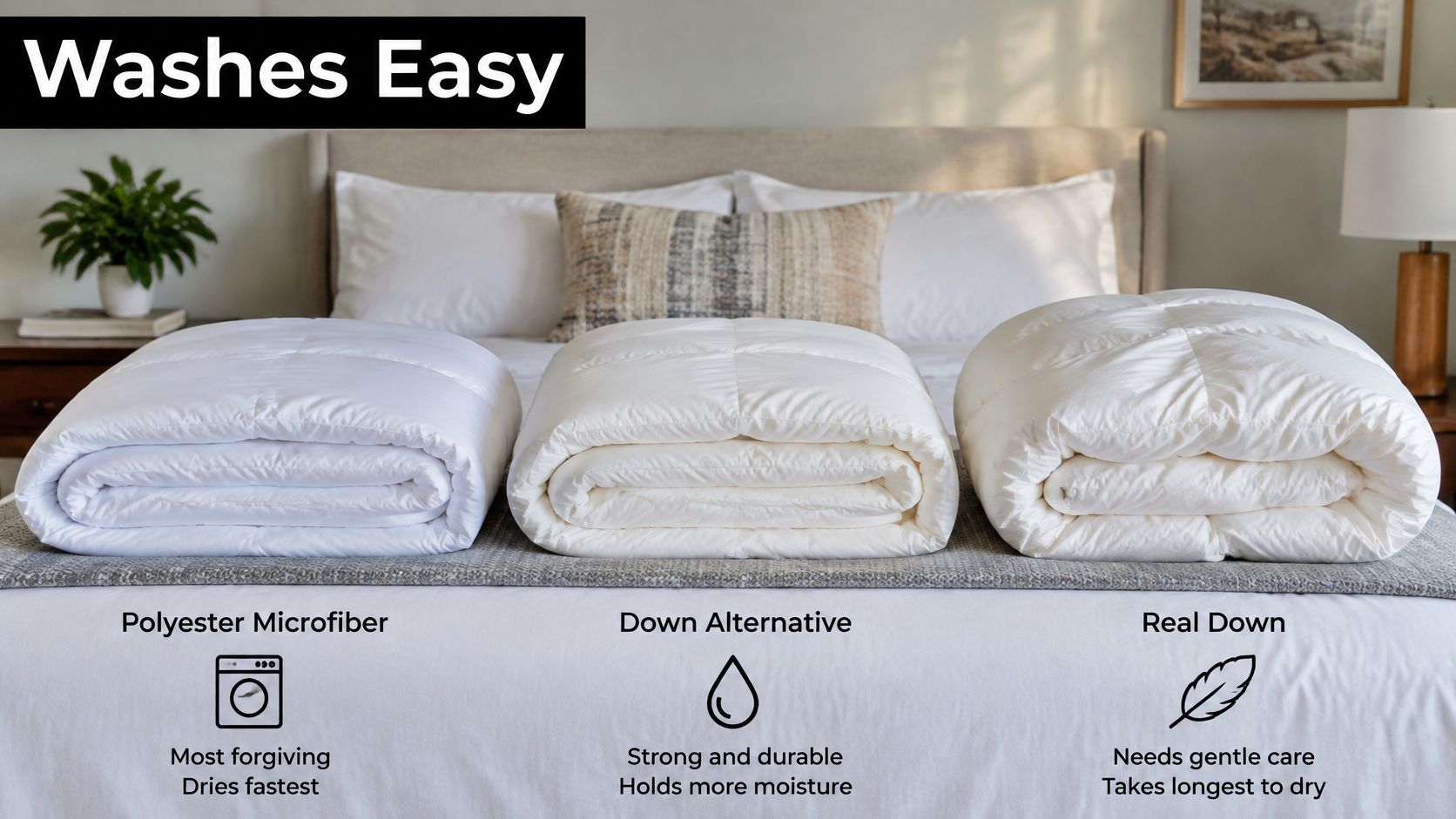
| Polyester microfiber | Often forgiving when the product permits machine washing | Lightweight versions are generally easier to dry | Everyday family use and frequent laundering |
| Down alternative | Usually practical, but construction determines care | Dense or lofty versions need careful moisture checks | Buyers avoiding down or animal-derived fill |
| Real down | Needs appropriate detergent and gentle handling | Requires patient drying and redistribution | Warmth-first buyers prepared for more involved care |
Polyester microfiber and down alternative aren't necessarily separate materials. A down-alternative comforter may contain polyester microfiber. Read the actual fill description instead of treating those marketing terms as a reliable performance ranking.
Likewise, microfiber isn't automatically the fastest-drying option. A thick synthetic comforter can be harder to dry than a lighter product with a different filling. For allergy-prone sleepers, avoiding down may address a specific sensitivity, but it doesn't make bedding universally allergen-proof.
The visual difference between these fills can be subtle once the bed is made.
Inspect what holds the fill in place
Sewn-through quilting restrains filling in defined areas. Baffle-box construction allows more depth, but the compartments still need sound internal stitching. Look for consistent quilting, secure binding and seams without loose threads or exposed filling.
A tightly constructed shell helps contain fill and resist snagging. Double stitching can reinforce stressed edges, but stitch quality matters more than a decorative claim. For broader context on choosing bedding layers, the comforter advice from Gorins Furniture & Mattress is a useful companion when comparing comforters with covers and other bed essentials.
Separate safety from durability
OEKO-TEX STANDARD 100 tests textile components against more than 1,000 potentially harmful substances, with bed linen classified under Product Class II for direct skin contact. Check that the certificate applies to the exact article, including its components, rather than assuming a brand-wide claim covers every set.
Certification isn't a laundering endurance test. Choose the fill for your maintenance routine, the shell for feel and construction, and certification as a separate safety check.
How to Wash a Comforter Set Step by Step
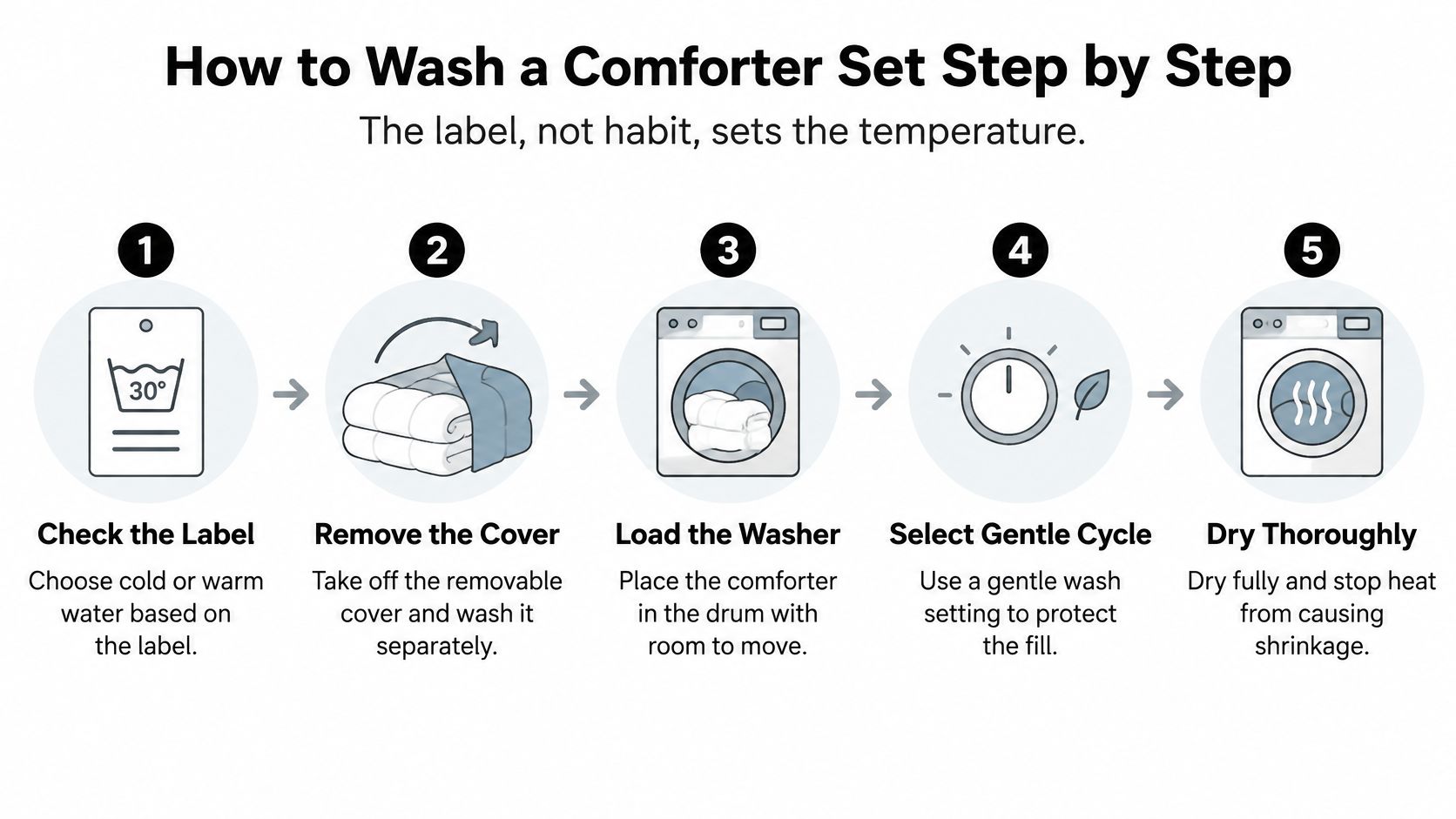
Start when you have time to finish the drying, not just run the washer. Clear a clean surface where you can unfold the comforter, inspect it and redistribute the filling without dragging wet fabric across the floor.
Keep the process simple and deliberate.
Prepare before adding water
- Read the care instructions and inspect the seams. Choose the permitted water temperature and wash method, then check for tears, loose binding and escaping fill. Repair openings before washing because wet bedding places more strain on damaged areas.
- Separate removable pieces. Take off a duvet cover and wash it with compatible colours according to its own label. Remove shams and other accessories rather than assuming the entire set belongs in the same load.
- Treat visible marks gently. Blot a suitable stain treatment onto the affected shell, testing an inconspicuous area first. Don't scrub aggressively or soak the filling unnecessarily, and avoid treatments the care label prohibits.
- Load loosely without extra laundry. Spread the comforter around the drum as the appliance manual directs. Adding towels to fill gaps increases bulk and makes rinsing and load balance harder.
Wash, rinse and finish
- Measure detergent for the machine and load. Use a mild, compatible detergent, or a down-specific product when the manufacturer calls for it. Skip fabric softener and avoid adding bleach unless explicitly permitted; more laundry additives don't mean cleaner filling.
- Select the permitted gentle or bedding programme. Use an extra rinse if the appliance allows it and detergent remains difficult to clear. If the machine repeatedly stops or struggles to balance, don't keep forcing the same overloaded arrangement.
- Transfer promptly and support the weight. Lift the wet comforter with both hands instead of hauling it by a corner or seam. Don't leave it folded in the washer while you wait for dryer space.
- Dry using the approved method. For tumble-dryable bedding, use the stated heat setting and suitable dryer balls if permitted. Pause periodically to unfold, turn and gently loosen damp clusters, then continue until the filling is dry throughout.
Practical rule: Don't use extra heat to compensate for inadequate drying space.
When air drying is required, support the comforter across a clean rack or suitable flat surface with airflow underneath. Turn it regularly and avoid leaving a heavy wet centre hanging unsupported.
The finished comforter should have reasonably even loft, no damp patches and no stale smell when unfolded. Let it cool before your final check so residual dryer warmth doesn't disguise moisture. If you can't complete the process properly at home, use suitable larger equipment before washing begins.
Fixing Lumps, Damp Centres and Shrinkage
Lumps after laundering don't automatically mean a comforter is ruined. Damp filling can gather into clusters, particularly when the bedding hasn't opened out during drying. Start by identifying whether you're dealing with remaining moisture, shifted fill or permanent material damage.
| Symptom | Likely cause | Fix |
|---|---|---|
| Lumps or clumps | Fill gathered while damp or shifted within compartments | If tumble drying is permitted, continue at the approved setting and gently loosen clusters |
| Damp centre or musty smell | Incomplete drying; odour may indicate the bedding needs washing again | Unfold and inspect; dry damp bedding fully, but rewash persistent mustiness |
| Shrinkage or puckering | Excess heat, differential shrinkage or construction tension | Use permitted cooler settings in future; don't expect full recovery |
| Pilling on the shell | Surface abrasion, potentially worsened by crowding | Reduce friction and separate bedding from rough or fastened items |
| Dull colour | Fading, chemical damage or detergent residue | Check for residue before assuming colour loss; avoid prohibited bleach |
Rescue moisture problems first
For a newly washed, odour-free comforter with damp clusters, additional approved drying may be enough. Work gently through the shell with your fingertips rather than pulling hard at the filling. Don't tear internal baffles in an attempt to flatten a stubborn lump.
A persistent musty smell needs more than a fragrance spray. Rewash according to the label and arrange adequate drying before starting again. If odour returns after proper cleaning and complete drying, consider professional assessment or replacement rather than repeating the same unsuccessful routine.
The centre should feel as dry as the edges before the comforter goes back on the bed or into storage.
Recognise damage that drying won't fix
Heat-related shrinkage usually won't reverse just because you stretch the corners. Puckered quilting can reflect unequal shrinkage between the shell, thread and filling, so pulling the fabric may stress the seams further.
Pills are also different from loose dirt. A suitable fabric shaver may improve some shells, but test carefully and avoid thin fabric, seams and raised quilting. Washing again won't remove permanent colour loss or restore heat-damaged synthetic filling.
Replace rather than repeatedly repair when the shell tears easily, internal compartments have failed or the filling remains hard and uneven after appropriate care. The useful distinction is simple: moisture needs finishing; structural damage needs repair or replacement.
How Often to Wash Without Wasting Resources
A universal weekly wash for the whole comforter isn't a sensible default. Set the routine around actual exposure: direct skin contact, pets, spills, illness, allergies and whether the bedding is used nightly or only for guests.
A removable cover takes much of the surface soil and can be laundered separately. That doesn't make the insert maintenance-free, but it lets you inspect the insert rather than washing it automatically whenever the cover needs cleaning. With a fixed outer shell, the whole comforter needs attention when soil or odour reaches beyond a small, safely treatable mark.
Use condition-based washing
- Pets on the bed: Inspect for hair, dirt and odour, and protect the sleeping surface with a washable layer.
- Illness or contamination: Clean affected bedding promptly using the product's permitted care method.
- Allergy management: Follow an individual care plan rather than assuming a cold wash meets every need.
- Occasional use: Check stored or guest bedding for freshness and moisture instead of washing by calendar alone.
For a household-wide schedule, the guide to how often to wash bedding helps distinguish frequently handled layers from bulky pieces.
Account for the environmental trade-off
A peer-reviewed PLOS ONE study examining 37 textile samples found microfiber losses ranging from 9.6 to 1,240 milligrams per kilogram of textile per wash. Those results aren't a prediction for an individual comforter, but they show why washable synthetic bedding shouldn't be described as impact-free.
Avoid unnecessary full-insert washes, choose label-approved cooler settings where appropriate and maintain any compatible external microfiber filter according to its instructions. Don't assume an ordinary washer drain filter captures fine fibres, and put collected lint in household waste rather than rinsing it down the sink.
Efficient loading still means leaving bulky bedding room to move. Adding laundry until the drum is packed isn't resource-conscious if you then need to repeat the wash. Easy-care bedding is convenient bedding, not zero-impact bedding.
Styling Washable Sets Without Losing Their Shape
A neutral comforter, matching shams and a folded throw can make an ordinary bedroom feel settled without adding difficult-to-clean layers. A patterned set changes the mood more visibly, while a plain shell lets you introduce seasonal colour through smaller accessories.
Keep the bed's outline simple and the comforter evenly spread.

Say you're dressing a guest bed with a solid set. Start with the sheet, centre the comforter so its drop looks balanced, then place the throw across the foot rather than covering the entire surface. That gives luggage or everyday handling a separate, easier-to-clean contact layer.
Restore shape without another wash
After laundering, spread the comforter fully and gently shake it from opposing edges. Smooth the shell without pressing the loft flat, and redistribute accessible filling by hand. If you use a duvet cover, secure any compatible internal ties so the insert doesn't slide toward the foot.
A cover can also change the room's appearance without replacing the insert. Choose one that matches the insert's dimensions closely enough to avoid loose empty corners or bunching.
For another styling reference, this bedding video offers visual context.
Store for loft, not maximum compression
Put away only clean, completely dry bedding. Fold it loosely in a breathable storage bag and avoid squeezing it under heavy objects. Vacuum packing saves cupboard space, but prolonged compression isn't the best choice when retaining loft matters.
If a clean comforter looks flat between washes, start by shaking, rotating and redistributing it. Another trip through the washer isn't a styling technique.
Choose a Set You Can Wash Confidently
Buy washable comforter sets in maintenance order: dimensions, care method, construction, then appearance. Colour is easy to compare on a screen. Whether you can handle the wet bedding and finish drying it takes a more deliberate check.
Before ordering, confirm the listing's exact width and length, the appliance manufacturer's bedding guidance and the product's complete washing instructions. If certification matters to your purchase, verify the article-specific certificate rather than relying on a general badge.
Make the product match your routine
At SouthShore Fine Linens, our Grand Symphony Duvet Cover Set is machine washable and should be washed with like colours, making the removable cover the practical cleaning layer. Our Vilano Oversized Quilt Set comes in Twin / Twin XL, Full / Queen and King / California King; compare the selected variant's listed dimensions with your bed and laundry setup before ordering.
Most cotton bedding is machine washable and can be tumble dried, but the individual product's instructions still decide the settings. A washable cover also doesn't establish that the insert inside it can use the same care method.
Choose bedding you can maintain on a busy laundry day, not just bedding you can squeeze into the machine.
For frequent family laundering, favour straightforward construction and manageable bulk. Choose down alternative for a non-down preference, not as a guarantee against every allergy, and choose real down only when its care requirements suit your routine.
Today, measure your bed, find your washer and dryer specifications, and read the intended set's care instructions. Choose the colour after those checks pass.
SouthShore Fine Linens offers comforters, quilts and duvet covers for different bedding and care routines. Visit SouthShore Fine Linens to compare dimensions, materials and washing instructions, then choose a set that fits both your bedroom and your laundry setup.


