
Down Comforter vs Duvet: Which Fits Your Bed
The usual advice to buy a duvet for luxury and a comforter for convenience misses the most important distinction: down describes the fill, while duvet describes how you use the bedding. You can buy a down-filled duvet insert, and you may already own a comforter that works inside a cover. The useful down comforter vs duvet comparison starts with your mattress measurements, laundry equipment, and tolerance for putting a cover back on.
Down Comforter and Duvet Defined at a Glance
A down comforter is generally a finished bed covering whose shell, insulation, and quilting stay permanently assembled. A duvet system separates the filled insert from a removable outer cover, allowing you to choose and maintain those components independently.
The terminology isn't consistent across countries or retailers. As Wikipedia's duvet overview explains, duvet comes from the French word for down, Australian English commonly uses doona, and historical British usage included eiderdown. That naming history helps explain why visually similar products appear under different labels.
Read the fill and construction separately
Down is the soft underlayer beneath the ordinary feathers of ducks and geese. It identifies the insulation, not whether the product needs a cover.
A duvet insert can contain down, feathers, wool, cotton, silk, or synthetic fibers. A comforter can also use different fillings, but a product accurately described as a down comforter should contain down. Synthetic comforters belong to the down-alternative category, not the natural-down category.
Down comforter vs duvet at a glance
| Feature | Down comforter | Duvet with insert and cover |
|---|---|---|
| Construction | One finished, permanently quilted piece | Filled insert placed inside a removable cover |
| Fill options | Down or a down-and-feather blend; related comforters also come in feather or synthetic versions | Down, feathers, wool, cotton, silk, or synthetic |
| Routine cleaning | Whole piece, potentially requiring a large washer or professional cleaning | Cover washed separately; insert cleaned according to its label and condition |
| Bed fit | Uses the finished piece's own dimensions | Requires compatible insert and cover dimensions; mismatches can shift or bunch |
| Best for | Simple setup, layered beds, fewer full washes | Frequent surface laundering, changing cover colors, guest rooms and rentals |
The distinction doesn't establish a quality ranking. An adequately sized comforter with clear care instructions can be more practical than an expensive insert inside a poorly matched cover.
The overlap shoppers often miss
A comforter can serve as an insert when its dimensions and attachment points work with a cover. You don't necessarily need to replace insulation you already like just to gain a removable washable surface.
Inspect what you own before shopping. Look for corner loops, check whether the quilting holds the fill evenly, and measure the finished piece rather than trusting its bed-size label.
Practical rule: Buy the insulation for sleeping comfort and the construction for the work you're willing to do on laundry day.
Also separate the jobs of the bedding layers. A duvet cover protects the insert, while a mattress protector addresses the mattress underneath you. Indian River Furniture's guide can help you compare mattress protector options without confusing those functions.
A comforter offers immediate simplicity: spread it over the sheets, straighten the edges, and you're done. Its visible fabric remains part of the insulated piece, so changing that fabric means covering it, layering over it, or replacing the comforter.
A duvet gives you more control over the surface fabric and appearance, but it introduces assembly. You'll need to align the corners, secure the attachments, and redistribute the insert after putting the cover on.
For a fixed bed whose appearance rarely changes, a comforter is a sensible starting point. If you expect frequent laundering or regular changes in color and texture, the removable-cover system deserves closer attention. Neither choice excuses a poor fit or a cleaning method you can't realistically manage.
Fill Power and Real Warmth Per Ounce
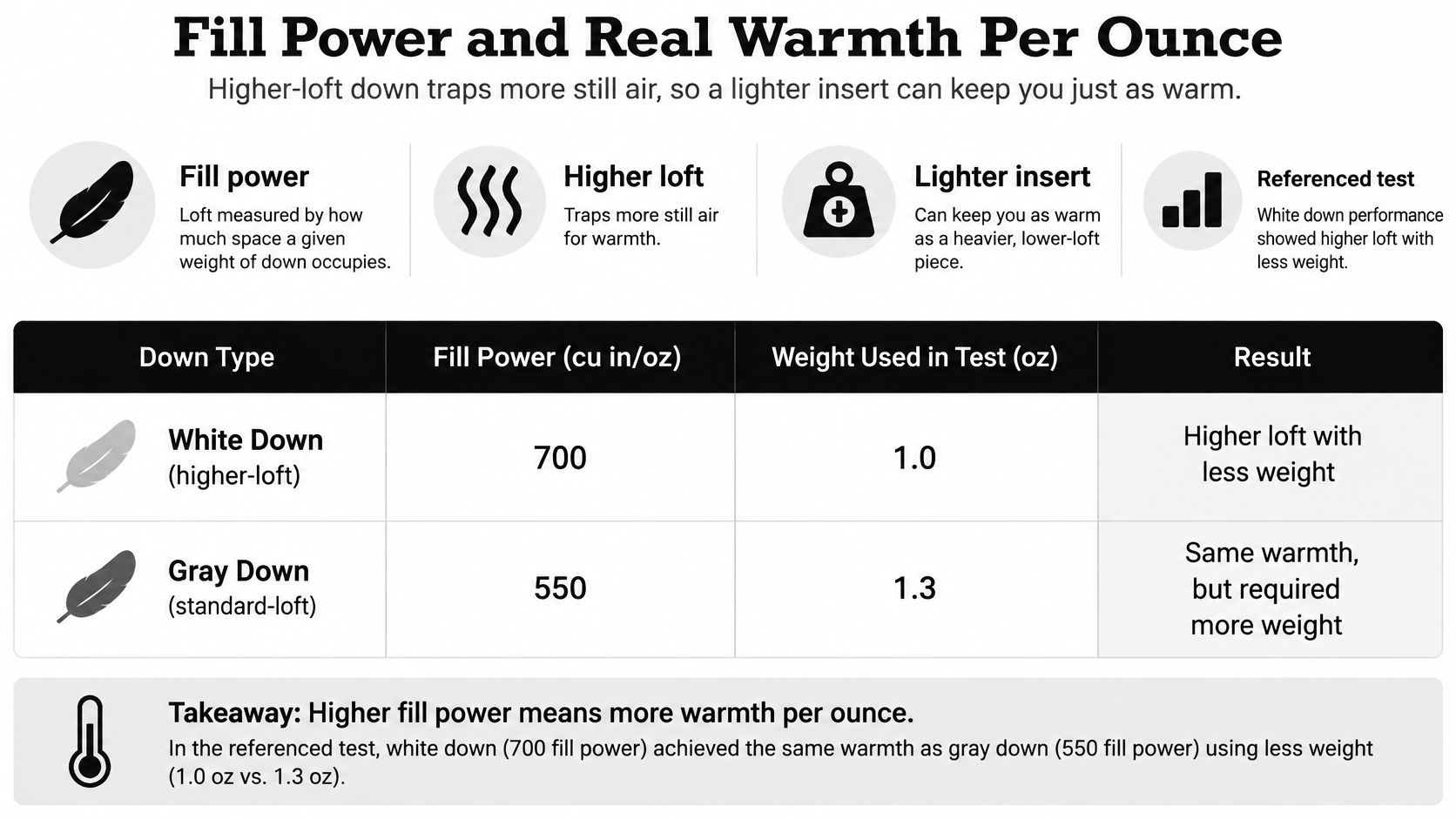
A lighter down insert can deliver useful warmth without the bulk of a denser, lower-loft piece. Loft alone does not set total warmth. Read fill power and fill weight together.
Fill power measures the volume occupied by a fixed weight of down, usually expressed as cubic inches per ounce. Higher-loft clusters hold more still air, improving insulation efficiency without requiring the same increase in filling mass. For a duvet setup, that rating belongs to the insert. For a comforter, it describes the entire insulated piece. The cover changes the surface and construction, not the down's loft.
In a Textile & Leather Review study, the tested white duck down averaged approximately 648.8 cubic inches per ounce and 6.18 CLO of insulation, compared with 3.10 CLO for the tested polyester fiber. Those figures describe the tested materials. They do not prove that every down comforter will outperform every synthetic alternative.
Use fill power as a comparison tool
Use the following bands to compare labels, not as tested warmth ratings or universal climate recommendations. A lightly filled high-loft insert can still provide less insulation than a heavily filled alternative.
Fill power bands and what they mean for warmth
| Fill power | Loft | Warmth feel | Best for |
|---|---|---|---|
| 700 to 800, comparison band | High loft per ounce | Potential for substantial warmth at lower weight | Comparing lightweight options for a cold bedroom, with fill weight checked |
| 800 and above, comparison band | Higher loft per ounce | Potential for greater insulation efficiency, without a guarantee of greater total warmth | Prioritizing low weight while matching the actual insulation requirement |
Composition matters too. A 90/10 label means 90% down and 10% feathers under the European labeling classification described in Encyclopedia.com's down overview. A feather-heavy blend should not be expected to provide the same softness or loft as a down-rich filling.
That label-reading habit carries into other textile purchases, including choosing between merino and cashmere sweaters. For bedding, get these specifications together:
- Fill power: How much loft the down provides for its weight.
- Fill weight: How much insulation the manufacturer puts into that specific size.
- Down percentage: How much of the filling is down rather than feathers.
When two inserts appear similar, I give preference to the one that discloses all three specifications. Then inspect how the fill is held in place. Baffles help contain down, while stitched-through areas can create thinner insulation paths. Our guide to down-fill comforters provides additional context for comparing the insulated piece rather than relying on premium or all-season wording.
Cleaning, Drying and How Long Each Lasts
- Wash the removable cover regularly. Ideal Home's bedding-cleanliness guidance recommends about weekly cover washing and insert cleaning approximately every two to three months, or at least twice annually; it also reports a University of Worcester finding that an unwashed duvet could contain up to 20,000 live dust mites after six months.
- Read the insert's care label before wetting it. Separate machine-washable bedding from products requiring professional cleaning.
- Use adequate machine capacity. The bedding needs room to move and rinse, not merely enough room to squeeze through the door.
- Dry completely using the permitted method. For washable down, use low heat when specified and dryer balls if the care instructions allow them.
- Check and redistribute the filling. Gently separate clumps and work fill back through its compartments.
- Store clean bedding dry and loose. Avoid packing away an insert that still feels damp inside.
A removable cover makes the routine soil-bearing layer easier to handle.
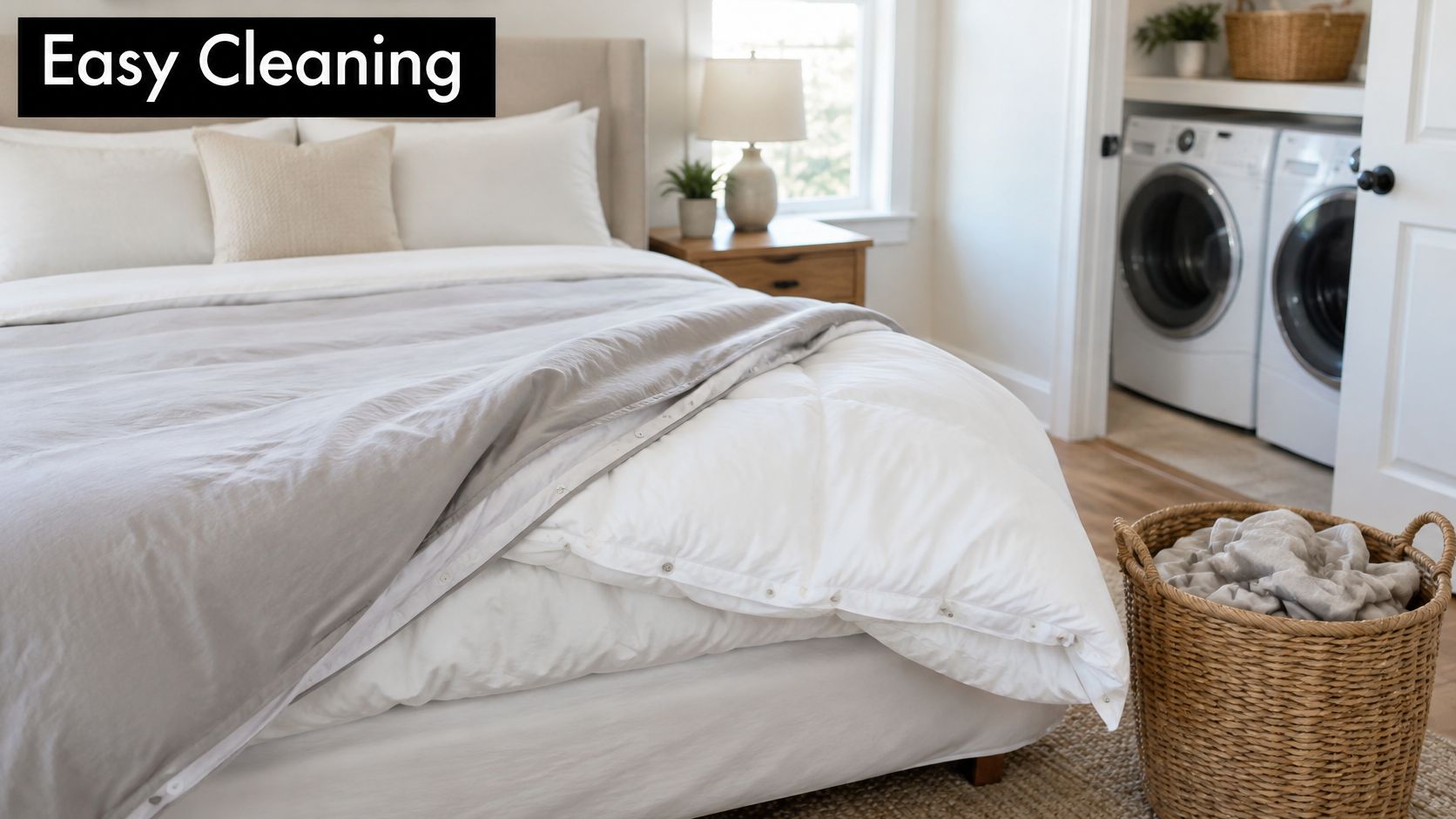
Drying is the step you can't rush
Wet down clusters collapse, so an insert can feel flat until the filling has dried and separated. Incomplete drying can also cause odor or microbial problems, making a superficially dry shell an unreliable stopping point.
Pause the dryer to reposition the bedding and feel through the thickest compartments. Dense, cool clumps deserve further checking rather than an immediate return to the bed.
Low heat limits unnecessary thermal stress where the label permits tumble drying. Fluffing restores distribution, while loose, dry storage avoids compressing bedding before its next use.
For fabric-specific preparation and washing checks, use our bedding washing guide. Treat the sewn-in care instructions as the final authority when general advice and product requirements differ.
This video offers another visual reference for handling bulky bedding.
Compare ownership effort, not promised lifespan
There's no defensible universal lifespan for either format. Shell quality, seams, fill containment, washing, and storage all affect when replacement becomes necessary.
A comforter exposes the entire filled piece to each full cleaning. A covered insert can avoid unnecessary full washes, but only if you maintain its cover and address spills that reach the filling.
For rentals or busy family rooms, a washable synthetic comforter may be operationally simpler. For someone prioritizing lightweight insulation, properly maintained down can justify more careful drying. Neither advantage matters if the bedding won't fit your laundry setup.
Allergy and Hygiene Facts Worth Checking
Down isn't automatically allergenic, and down alternative isn't automatically hypoallergenic. A fill label doesn't tell you whether the bedding has accumulated dust, whether its shell contains the filling well, or whether you'll clean it consistently.
The practical distinction is exposure management. Martha Stewart's duvet guide explains the role of a washable cover and the laundering difficulties associated with bulky bedding. A manageable cleaning routine is more useful than an absolute allergy-friendly claim.
Evaluate the household, not just the filling
Consider cleaning frequency, dust-mite exposure, shell construction, and laundering practicality together. A breathable, closely woven shell is worth checking, but it doesn't replace washing the surfaces that receive body oils, dust, and pet contact.
A renter using shared laundry may find a removable cover easier to maintain than a bulky finished comforter. A household with suitable machines may prefer a fully washable synthetic piece because removing and replacing a cover is a task they won't consistently do.
The more useful hygiene question is whether you can clean the bedding properly, not whether the packaging uses a reassuring adjective.
Use this checklist before buying:
- Verify the cleaning method. Read the actual care instructions, including drying restrictions.
- Check usable capacity. Confirm that both your washer and dryer can handle the complete item without crowding.
- Choose a realistic surface routine. Decide whether removing, washing, and refitting a cover is something you'll maintain.
- Address other bedding surfaces. Consider suitable dust-mite encasements for the mattress and pillows rather than focusing exclusively on the top covering.
- Separate known sensitivity from marketing. If you have a diagnosed feather or down sensitivity, follow clinical advice rather than a general comparison.
Breathable construction and clear care requirements are meaningful shopping signals. Neither natural nor synthetic filling gives you permission to ignore the room, pillows, sheets, or drying process.
Matching the Cover or Insert to Your Mattress
Measure the bed before choosing the size label. A deep mattress needs enough fabric to travel over its edges and down its sides, so a cover that looks generous on a shallow display bed may leave your foundation exposed.
Use a flexible tape measure with the mattress and topper in their normal sleeping arrangement. Keep a note of the measurements alongside the product dimensions you're comparing.
Measure the coverage you actually want
- Record mattress width and length. Measure the sleeping surface rather than the outside of the bed frame.
- Measure the full mattress height. Include any topper that remains on the bed.
- Choose the finished side drop. Hold the tape where you want the bedding to end, considering exposed rails, storage drawers, or a bed skirt.
- Check the base in use. Raise an adjustable base through your usual positions and look for pulling, trapped fabric, or uncovered edges.
- Compare the filled piece and cover. Use actual finished dimensions and the manufacturer's fit guidance, not just matching queen or king labels.
For a centered covering, the available side drop is the covering's width minus the mattress width, divided equally between the sides. That's a useful starting calculation, but loft and the way the bedding bends over the mattress edge affect the finished appearance.
Our duvet-cover sizing guide can help you compare the available cover formats. These are our cover-and-sham dimensions, not universal measurements for every brand.
Cover dimensions and shams by bed size
| Bed size | Cover dimensions | Pillow shams |
|---|---|---|
| Twin / Twin XL | 69 in x 92 in | One sham, 20 in x 26 in |
| Full / Queen | 92 in x 92 in | Two shams, 20 in x 26 in each |
| King / California King | 106 in x 92 in | Two shams, 20 in x 36 in each |
Match the attachment system as well as the size
A down comforter can function inside a cover when its dimensions and corner attachments are compatible, a practical overlap reflected in Business Insider's comforter guide. Look for loops on the filled piece and ties positioned to meet them.
Don't deliberately undersize an insert just to make installation easier. Excess empty cover fabric can fold around you while the insulation migrates toward the middle.
Likewise, forcing an oversized insert into a tight cover can produce bunching and compressed edges. Close dimensional compatibility is the goal, with any intentional fullness guided by the products' fit instructions.
Our Grand Symphony Duvet Cover Set uses insert corner ties and a button closure. Those features help maintain alignment, but they can't compensate for a substantial mismatch.
A duvet isn't automatically more luxurious or better fitting. On a deep or adjustable bed, the better choice is the piece that maintains usable coverage when you're sleeping, not merely when the bed is photographed.
Choose the Bedding That Fits Your Bed
The strongest decision usually comes from the inconvenience you most want to avoid. Some sleepers dislike handling a cover; others would rather fit a cover than transport a bulky comforter to a suitable machine.
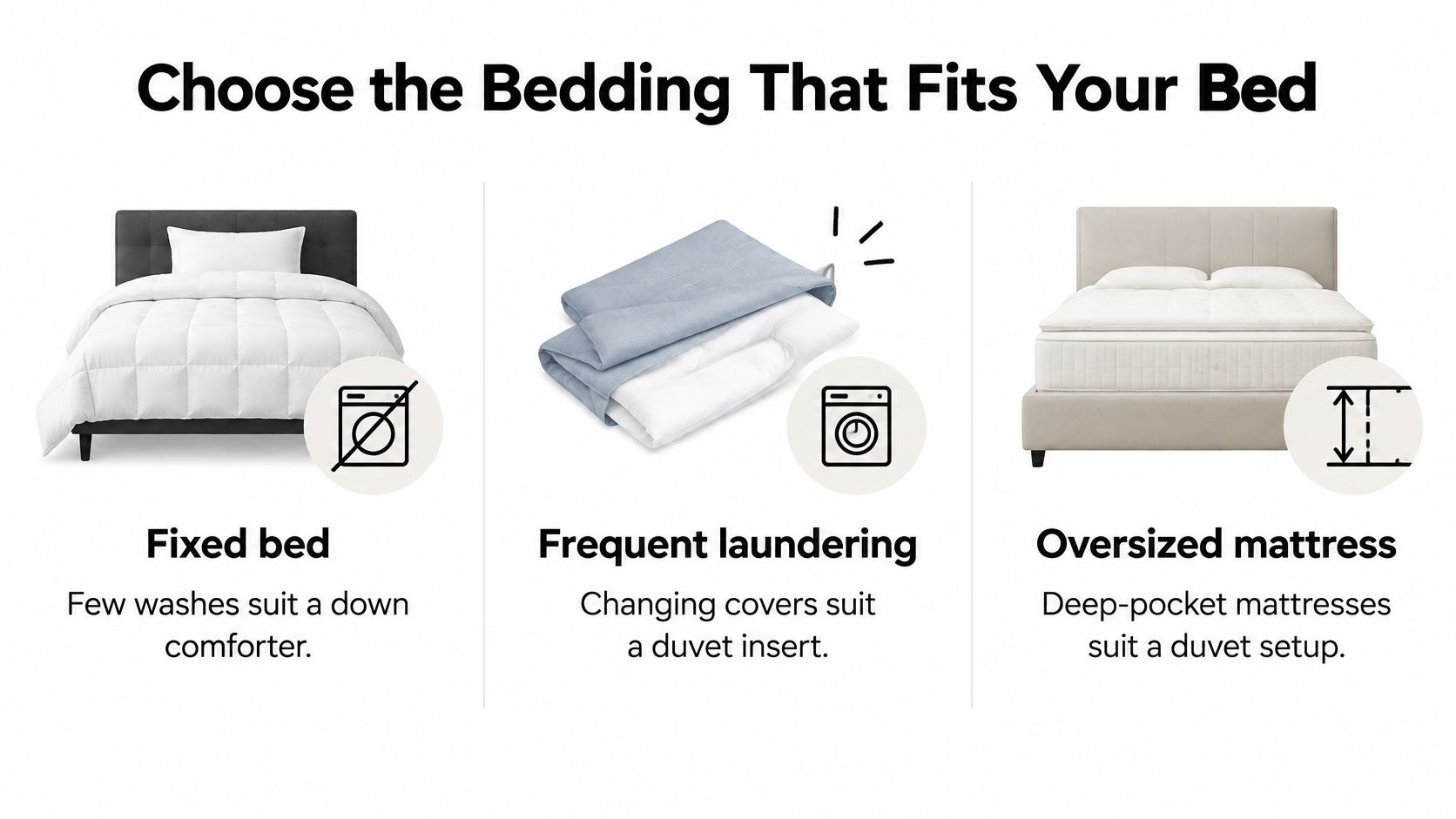
Choose for the room you have and the routine you'll maintain:
- Fixed bed with an established look: A down comforter suits a straightforward setup where you don't need regular changes in the outer fabric.
- Frequent surface laundering: A duvet system lets you manage the washable exterior independently.
- Deep or oversized mattress: Choose whichever complete setup provides the required drop. Construction alone doesn't guarantee coverage.
- Cold bedroom: Compare insulation specifications and fill distribution, with lightweight loft a priority if you dislike heavy bedding.
- Hot sleeper: Start with less total insulation and a breathable shell. Lower fill power alone doesn't guarantee a cooler bed.
- Allergy-sensitive household: Favor the cleaning method you can carry out completely, including drying.
This visual summarizes the main starting points, but mattress depth still requires an actual measurement.
Budget for the whole setup
A cover-and-insert purchase can spread replacement costs across separate components. You might replace a worn cover while keeping usable insulation, but buying additional covers also increases your initial spending.
A finished comforter keeps the purchase simpler. Whether it costs more to maintain depends on your equipment, the cleaning method, and whether you need paid laundry or professional care.
For a concrete synthetic option, our Vilano Down Alternative Comforter costs $69.99. That's a down-alternative product, so don't compare its price with a natural-down insert as though the filling were identical.
Include the cover, any spare cover, cleaning trips, and storage needs when comparing ownership costs. Don't assume a duvet saves money merely because its components are replaceable.
Make the final choice in a practical order
Start with measurements, then select the construction. Once the format fits your household, compare insulation specifications, inspect the care label, and confirm the final cover-to-insert match before purchasing.
Room styling belongs after those checks. SEYANTE's discussion of quality bedding for better sleep offers useful context for creating a coordinated bedroom, but a polished appearance shouldn't take priority over manageable care and adequate coverage.
Which habit is strongest in your household: frequent washing, a fixed bed setup, or the need to cover a deep mattress? Buy the option that handles that constraint with the least compromise, rather than the one with the more luxurious-sounding name.
We offer comforters, duvet covers, sheets, quilts, and layering pieces so you can build the setup that suits your mattress and cleaning routine. Visit SouthShore Fine Linens with your bed measurements in hand, then compare dimensions, construction, and care instructions before choosing your bedding.


