
Bed Ruffles for Adjustable Beds: Measure, Install, Fix
You've made the bed, smoothed the quilt, and raised the head to read. Now the skirt hangs crooked, the foot-end band has slipped, and a metal leg shows beneath the hem. The problem isn't necessarily the fabric. It's that a skirt fitted while the bed is flat may behave differently once the base changes shape.
Bed ruffles for adjustable beds need a movement-based fit, not just a matching mattress size. Before ordering, identify where the fabric will attach, measure its shortest safe drop, and check what happens at full head-up and foot-up. Sometimes a shorter panel gives a better finish than a full-length ruffle that needs constant adjustment.
Measurements That Decide the Right Drop Length
| Base type | Mattress height range | Drop length to order | Check before buying |
|---|---|---|---|
| Single-deck queen | Measure the installed mattress and check the base manual | Attachment-edge-to-floor measurement, reduced for hem clearance | Floor clearance at full head-up and foot-up |
| Split queen | Check each mattress against its base requirements | Size each moving section separately and confirm seam position | Each half lifts without catching the skirt |
| Split king or California king | Use the mattress range specified for each base | Confirm against the manual and measure each attachment edge | Center support bars and motor housings |
| Zero-gravity base | Use the base manufacturer's approved mattress range | Measure in the preset and at the permitted movement extremes | Lift height and tilt clearance at the floor |
Mattress height and skirt drop aren't the same measurement. Mattress height runs from the deck to the mattress's top edge. Drop runs from the skirt's actual attachment line to its hem, which may start at a rail rather than the deck.
One adjustable-base manufacturer's manual specifies an 8- to 14-inch mattress range and warns that mattresses may shift during adjustment. That's a requirement for that particular system, not a universal range for every base in the table.
Measure from the attachment line
With the base flat, use a tape measure to record the distance from the proposed attachment edge to the floor. Measure at the sides and foot, then note rail thickness, leg locations, and anything projecting beyond the frame. A thick rail may prevent a clamp from closing even when the skirt's length is correct.
Next, operate the bed without fabric attached. Observe where the attachment edge travels and where hinges, cables, and lifting arms need open space. Never reach beneath an operating base.
Queen describes size, not movement. A single-deck queen moves as a continuous platform; a split queen has separately moving sections. A 2024 estimate summarized by Mordor Intelligence's adjustable-bed-base market analysis placed split adjustable bases at 52% of the global market, not split queens alone.
Check the room's proportions
On a low frame, a long ruffle can overwhelm the bed before it causes a mechanical problem. For styling references that don't depend on floor-length fabric, Interiors by DeX low bed ideas can help you judge the relationship between the bed, exposed floor, and nearby furniture.
Before ordering, write down mattress height, floor clearance at full head-up, and split-seam position. Add the flat attachment-edge-to-floor measurement so you can distinguish the visual drop from the clearance needed during movement.
Confirm Your Measurements Before You Order
Treat compatibility as a decision, not a promise printed beside a mattress size. Your order notes should identify:
- Base type and split configuration: Single moving deck, independently moving halves, or a stationary outer surround.
- Attachment dimensions: Rail thickness, usable edge depth, and the location of any upholstery.
- Obstructions: Legs, support bars, retainer bars, motor housings, and cable routes.
- Measured drop: The available hanging distance at the chosen attachment line.
A setup is compatible when the skirt attaches securely and remains outside moving components. It needs modification when a hem adjustment or professionally finished opening can solve an isolated obstruction. It's not recommended when fabric must cross a hinge, block service access, or join independently moving sections under tension.
Our Vilano collection includes 15-inch-drop pleated bed skirts. Treat that as a textile dimension to compare with your measurements, not confirmation that the skirt will suit an adjustable mechanism.
Ordering rule: Choose a hem that clears the floor throughout travel. Don't round up for extra coverage if the extra fabric will gather underneath the frame.
Record the measurements before shopping, compare the attachment arrangement with the table, and plan an early inspection after normal use. If no available drop clears the base cleanly, choose a shorter alternative rather than forcing the fit.
Choosing an Attachment Method That Survives Movement
A ruffle must stay secure through head and foot movement without becoming a restraint. A tight band can look excellent while flat yet pull against a raised deck; a loose band can migrate toward the lifting mechanism.
Furniture Today's reporting on adjustable-base manufacturers documents the category's move beyond conventional foundations. For fitting purposes, the important distinction is straightforward: an articulated deck needs a different attachment strategy from a stationary box spring.
| Method | How it holds | Behavior on split bases | Main risk |
|---|---|---|---|
| Wrap-around skirt | Elastic or hook-and-loop band under the mattress edge | Can shift and drag unless sections remain independent | Slides out of place during repeated articulation |
| Adjustable clamp system | Compatible clamps grip rails or deck edges | Can hold firmly with separate attachment points for each half | Clamps can mark the frame or obstruct movement |
| Tailored skirt | Sewn to measured panels with a set drop | Works when panels and openings follow each half independently | Hard to alter after a measuring error |
Choose the base configuration first
A wrap-around skirt is the simplest starting point when its band can follow an unobstructed perimeter. It's less convincing when the band must bridge moving sections or pass behind hardware. Increasing tension won't fix an unsuitable route.
Clamps give positive attachment where there's an accessible, manufacturer-permitted edge. Use padded contact surfaces and test them on an inconspicuous area. Never clamp onto wiring, lifting arms, or a rail that travels into another component.
A custom skirt offers the cleanest control over openings and hem position. However, adjustments should follow a temporary fitting, not precede it. Mark the fabric while positioned, remove it, and sew away from the bed.
If you're unsure which parts move, our explanation of what an adjustable base is helps distinguish the deck from the supporting frame.
Fabric weight comes second. A heavier textile won't compensate for an attachment point that moves in the wrong direction.
Choose enough structure to hang neatly, but avoid bulky gathers near hardware. More fabric means more material to control, not automatically better coverage.
How to Install a Ruffle Without Lifting the Mattress
A genuine no-lift installation requires a wrap-around or detachable design with an accessible attachment edge. A traditional skirt with a full fabric platform beneath the mattress isn't a no-lift product.
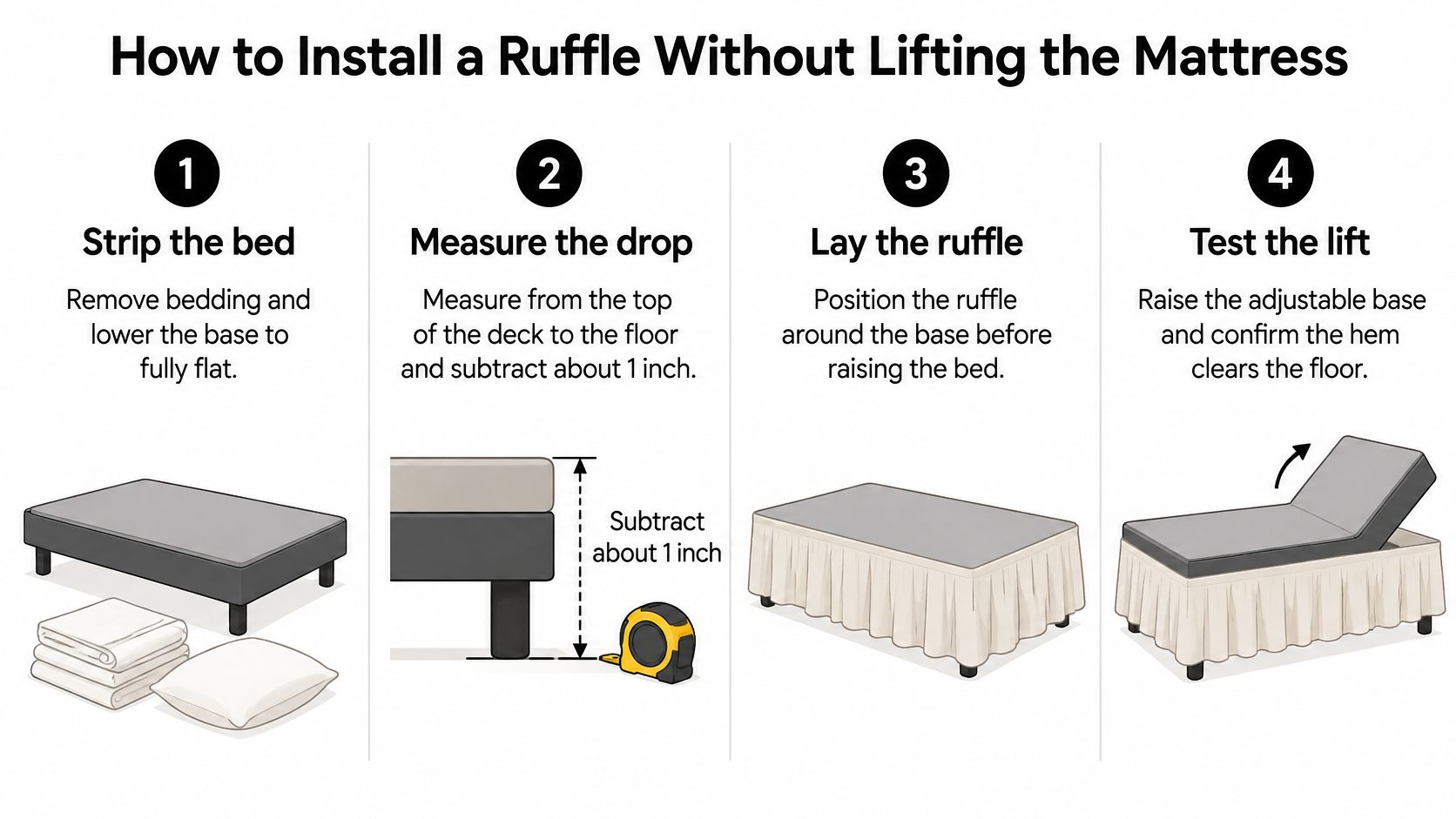
- Strip the bedding and flatten the base. Remove hanging linens so you can see the attachment edge, then lower the bed completely. Fastening while the deck is raised can lock in uneven tension and a crooked hem.
- Compare the actual drop with the product. Measure from the intended attachment line, not automatically from the mattress top. The Target listing for Bare Home's adjustable wrap-around ruffled skirt specifies a 15-inch drop and describes adjustable-bed compatibility, but that dimension still needs to clear your particular frame.
- Position the skirt outside the base. Lay it around the perimeter and mark the head and foot with removable painter's tape. Don't drape loose fabric across the mechanism while arranging it.
- Work from the foot toward the sides. Feed the band along the accessible mattress edge without hauling the mattress upward. If you can't reach the attachment area comfortably, stop and choose a detachable arrangement rather than forcing your hand into a tight gap.
- Secure only approved attachment points. Disconnect power before reaching near hardware, and keep each split section separately attached. Don't add a fastener across the center merely to make the foot panel look continuous.
- Test from outside the bed's footprint. Reconnect power, clear people and pets, and operate full head-up, full foot-up, and the positions you normally use. Stop immediately if fabric tightens, disappears beneath the deck, or approaches a moving joint.
- Return to flat and inspect the result. Check that the band hasn't migrated and that corners still hang freely. After sleeping on the bed, inspect again before making permanent alterations.
Keep hands out during the test
Watch the hem from beside the bed, not from underneath it. If an adjustment is needed, stop movement and disconnect power before touching the fabric or fasteners.
Fitting a Ruffle on a Split or Dual-Motor Base
A king-size skirt doesn't automatically belong on a split king. Dual motors also don't necessarily mean a split bed: some bases use separate motors for head and foot movement on a continuous deck. Identify the actual moving sections before selecting the skirt.
The Target customer questions about adjustable-bed skirt fit raise the practical problem of a single skirt restricting movement and needing accommodation around support bars. The critical issue is where fabric crosses from one moving section to another.
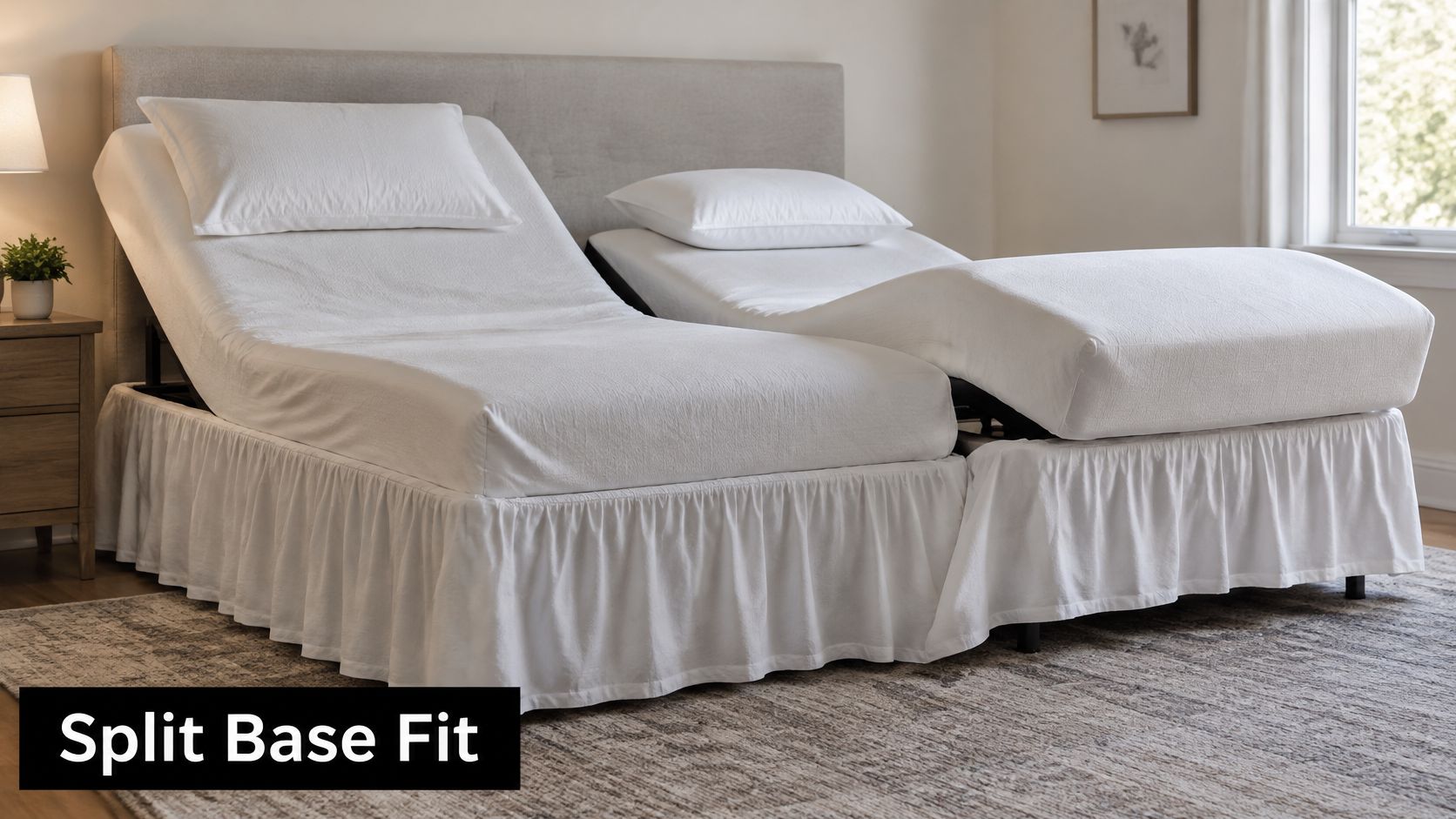
Fit the seam before the perimeter
Choose an arrangement that leaves independent movement intact:
- Separate ruffles: Each half gets its own attachment and hem, without fabric stretched across the center.
- Finished support-bar openings: A tailor can place reinforced openings around stationary obstructions after a trial fitting.
- Split panels with removable fasteners: Panels meet visually while remaining mechanically independent.
Mark each half's head and foot positions on the temporarily fitted fabric. Account for rail thickness and leg placement before marking any opening, then remove the skirt for alterations. Never cut near cables or through fabric while it's attached to the base.
For mattress-level bedding, split king sheet sets address the separate sleeping surfaces; the ruffle needs its own independent fit below them.
An oversized universal skirt can hide more frame while creating more places to snag. Extra width isn't a substitute for a correctly placed split.
Run each half separately through its permitted head and foot travel, then test opposing positions. Watch the center seam and support-bar crossings for tension, not merely visible gaps.
Also keep bedside access clear. If someone uses a mobility aid, DME Superstore's winter rollator guide offers related equipment context; loose fabric shouldn't extend into the route beside the bed.
Accept the fit only when both halves move freely without pulling the other side's panels.
Fixing Movement, Gaps and Bunching
A hem that drags after adjustment needs diagnosis before another clip. Start by checking whether the skirt is too long or whether its attachment band has slipped downward. Those problems can look alike but need different fixes.
| Symptom | Likely cause | Fix |
|---|---|---|
| Skirt drags on the floor when the head rises | Drop too long for the attachment height | Shorten or re-hem, then recheck throughout travel |
| Gap at the foot end | Band pulled off as the base moved | Reposition the band and add compatible fasteners at the foot |
| Bunching at the split seam | Independent sections pull shared fabric differently | Use a finished opening or separate panels |
| Visible motor or cable | Required clearance interrupts decorative coverage | Keep the fabric outside the housing, vents, and cable route |
| Snagging on casters | Loose fabric travels beneath the base | Shorten the drop or use a securely retained removable panel |
A visible motor isn't automatically a fitting defect. Don't lower a panel over ventilation or service access to remove a visual gap. Cables must retain their intended routing and movement allowance.
Repair the cause, not the appearance
Repositioning a band, replacing an unsuitable clamp, or redistributing gathers can be a straightforward afternoon repair. A wrong drop or a continuous panel spanning independent halves usually calls for alteration or replacement.
For seam-related bunching, choose among the split-base arrangements rather than tightening the shared fabric. Pulling it taut may hide wrinkles while increasing the load on stitching and fasteners.
Inspect after washing and adjustment
Set a monthly inspection habit during the initial period of use, and repeat the movement test after laundering. Check for pulled seams, loose clips, stretched elastic, and a changed hem position. Follow the care label and compare the cleaned skirt with your original measurements before reinstalling it.
Fabric weight matters here too. A heavier hem can pull a marginal attachment downward, while a lightweight loose panel can fold toward an opening.
Safety takes priority over concealment: Leave clearance around motors, legs, and emergency-lowering access when covering them would interfere with operation.
Disconnect power before correcting a snag. If fabric has entered a mechanism or damaged a cable, stop using the base until the obstruction or damage has been addressed appropriately.
Polished Alternatives When a Ruffle Will Not Work
If the skirt looks strained whenever the bed rises, stop trying to make it resemble a stationary upholstered bed. A clean, deliberately exposed base often looks better than a decorative panel caught halfway through movement.

Choose what stays visible
- Deep-pocket fitted sheets with a flat top sheet: Keep the fitted layer on the mattress and control the top sheet's overhang. The frame remains visible, but there's no decorative skirt attached to its mechanism.
- A short detachable panel: Attach it only to an approved surface, with the hem above hardware and legs. Don't sew into the base upholstery without explicit manufacturer permission.
- A fabric-covered base wrap: Cover a compatible stationary surround without bridging articulated sections. This creates an upholstered appearance while leaving the floor open.
- A raised skirt: Use a shorter, structured hem to soften a tall frame while deliberately showing the legs.
Coordinate the visible frame with bedding neutrals rather than attempting to hide every surface. Choose fabric that holds its line instead of folding under the frame, and judge the finished bed height against your nightstands.
For the upper layers, these ideas for bedspreads for adjustable beds can help you manage coverage without relying on a long skirt.
Reserve a near-floor ruffle for a single-deck arrangement that passes the full movement check and whose manufacturer permits the attachment. Even then, the hem should clear the floor, not puddle on it.
SouthShore Fine Linens offers pleated bed skirts, extra-deep-pocket sheets, quilts, and oversized bedding for a coordinated finish. Bring your measured drop and base configuration when you visit SouthShore Fine Linens, and choose the skirt or bedding layers that suit your bed's movement rather than its size alone.


