
Wash Comforter at Home: Label-First Steps for Every Fill
The comforter is on the bed, the tag is somewhere near the foot end, and the washer door is standing open. You've decided today is the day, and then the doubt arrives: is this thing supposed to go in there?
A king comforter that has spent two winters on a bed is heavy, bulky, and absorbs water like a sponge. Cram it into a drum that's too small and you don't get a clean comforter. You get a damp, lumpy, detergent-heavy one that smells faintly of mildew three days later.
The fix isn't a stronger detergent or a clever hack. It's doing five things in the right order: read the tag, check the drum, wash on the label's terms, dry until the middle is dry, and store it so it survives to next season. Each step is simple. Skipping one is what causes the damage.
Read the Care Label Before Anything Gets Wet
Find the sewn-in tag and read it before a single drop of water lands on the fabric. That label is the manufacturer's tested instruction set for this specific shell, fill, and finish, and it outranks every generic bedding routine you've picked up from social media.
The label exists because of a legal rule, not a courtesy. In the United States, the Federal Trade Commission's Care Labeling Rule, first issued in 1971, makes it an unfair or deceptive practice to sell covered textile goods without stating the regular care needed for ordinary use. It was amended in 1983 to clarify washing and dry-cleaning information, and in 1997 the FTC allowed approved care symbols to replace written instructions. The stakes show up in the same record: an FTC-cited 1995 Garment Analysis database of 25,160 damaged garments attributed 40% of that damage to inaccurate care labels. Comforters weren't the sample, but the lesson transfers cleanly. You cannot infer fiber content, filling, or finish from how a comforter looks on a bed.
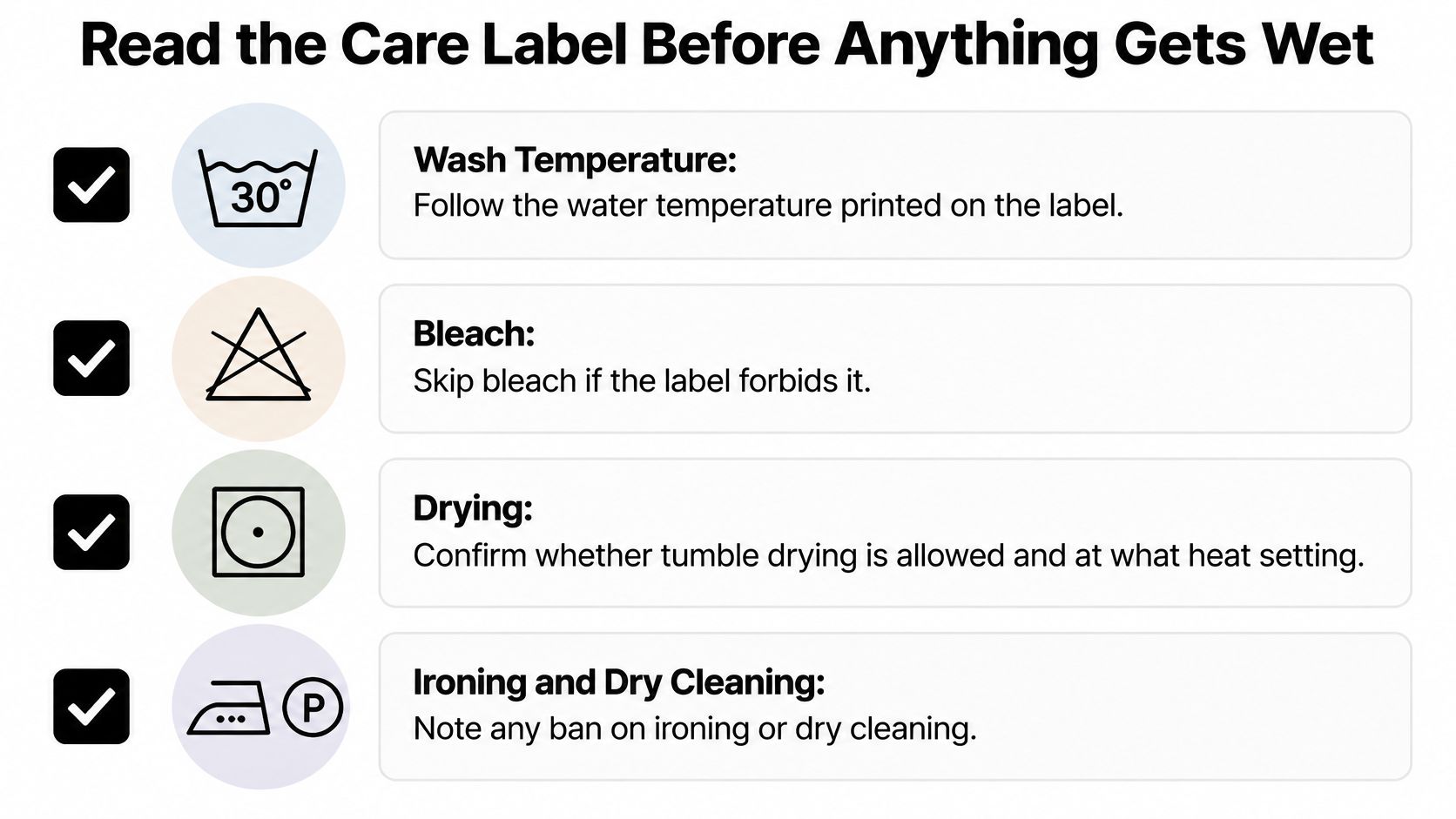
A symbol-only tag is still a complete instruction. Plenty of imported comforters carry nothing but pictograms, and that's legal. Decode them rather than guessing, using our breakdown of the symbols on wash tags. A washtub with a hand inside means hand wash only. A tub with one line under it means a gentle or permanent-press cycle. A tub with a cross through it means no water at all.
Four checks, in this order
Work the label the same way every time, because the order matters.
Wash method. Machine washable, hand wash only, or dry clean only. This single word decides whether the rest of the label even applies to your washer.
Water temperature. When hot water could damage the product, the label must state an appropriate setting. If it names a number or a dot pattern, that's your ceiling, not a suggestion.
Bleach. A triangle with a cross means no bleach of any kind, including the color-safe oxygen type. Most down and down-alternative shells fall here.
Drying method. Tumble dry low, tumble dry any heat, dry flat, line dry, or do not tumble dry. This is the check people skim, and it's the one that ruins the most comforters.
That last point deserves emphasis. Under the labeling rule, washing directions are tied to drying instructions, so the two travel together. A tag that says machine wash but dry flat means you can wash at home and must air dry it, no exceptions for a rainy week.
Which path the label sends you down
| Label wording | Typical fill | Correct path | Risk if ignored |
|---|---|---|---|
| Machine wash, tumble dry low | Down alternative, microfiber | Home washer and dryer if capacity allows | Compressed fill, trapped detergent, clumped filling |
| Machine wash, dry flat or line dry | Cotton shell with light batting | Home wash, air dry only | Shrinkage and warped shell in a hot dryer |
| Hand wash only | Delicate or embellished shell | Hand wash in a tub or a commercial gentle cycle | Seam stress and finish damage |
| Dry clean only | Wool, silk blends, some down | Professional dry cleaning | Fiber damage, matting, voided warranty |
| Symbol-only tag | Any | Decode the symbol and follow it exactly | Wrong temperature or cycle chosen by guesswork |
Before the comforter goes anywhere near the drum, run one hand along every seam. Look for split stitching, loose piping, and a shell that has worn thin at the corners. Pre-treat stains with a small amount of mild detergent and a soft cloth, then let them sit for ten minutes. A stain that goes into the wash untreated usually comes out set.
Check Capacity and Wash in Five Steps
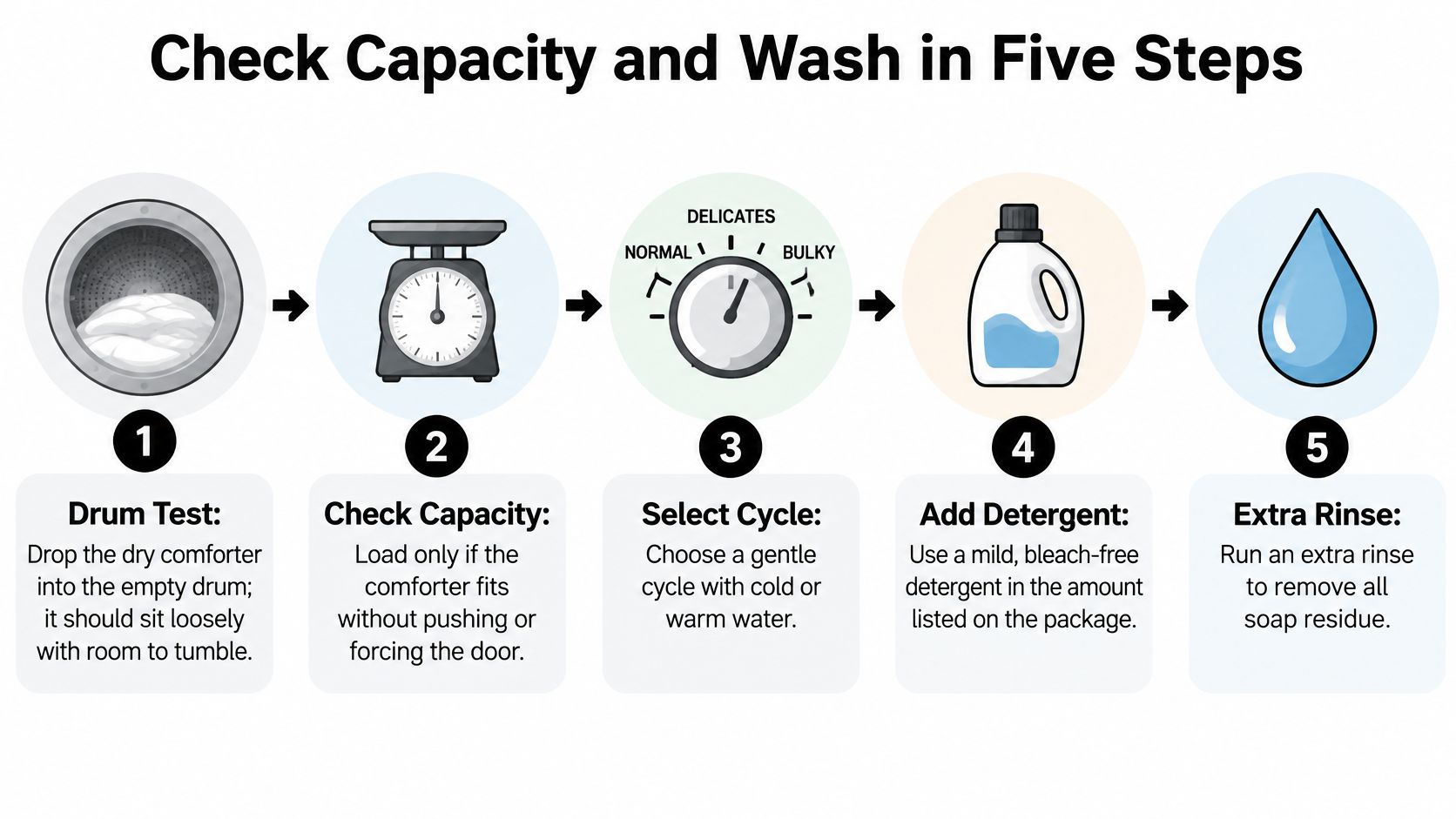
Drop the dry comforter into the empty drum before you add water or detergent. It should sit loosely, with visible air around it and room to turn over. If you have to push it in, fold it, or force the door shut, the machine has already told you the answer.
That test beats any specification, because it accounts for the actual bulk of your actual comforter. A thin queen quilt and a thick, overfilled queen down-alternative insert are nowhere near the same load, even though both say queen on the packaging.
What the capacity numbers actually mean
Numbers help when the drum test is borderline. Consumer Reports recommends a washer of at least 4.5 cubic feet, and notes that even that may not be enough for a thick, overfilled comforter. It cites a 7-cubic-foot dryer guideline. Treat those as a floor, not a guarantee.
Here's the part most guides skip: washing capacity and drying capacity are two separate verdicts. A 4.5-cubic-foot washer can admit a king comforter that a smaller dryer then fails to dry through the filling. If either machine fails, the load belongs in a laundromat's commercial machine.
| Comforter | Minimum washer | Minimum dryer | How the load should sit | If it fails the test |
|---|---|---|---|---|
| Twin, light fill | Below 4.5 cu ft is fine if the drum test passes | Matching dryer, drum test decides | Loose, tumbles freely | Home wash is fine |
| Full or queen, medium fill | 4.5 cu ft or larger | 7 cu ft | Turns over without pushing | Rinse twice and dry in two sessions |
| Queen, thick down alternative | 4.5 cu ft or larger | 7 cu ft | No more than half the drum | Commercial machine |
| King or oversized | 4.5 cu ft or larger, often tight | 7 cu ft | Loosely loaded with an air gap | Commercial machine |
| Any size that fills the drum | Not suitable | Not suitable | Compressed, cannot move | Laundromat or professional cleaning |
If you manage short-term rentals and swap comforters between guests, a guest-ready cleaning guide for Airbnb owners helps you keep linen turnaround off the same morning as a same-day check-in.
Here's a short walkthrough of the washing motion itself, so you can see how much room the comforter needs to move.
The five steps
- One comforter per load, never two. Doubling up removes the space the fill needs to rinse and drain. Two comforters in one drum is the single most common cause of a load that comes out soapy.
- Choose a gentle or bulky cycle with cool or warm water. Use the temperature the label allows, and pick a mild, bleach-free detergent. Front-loaders without a center agitator are gentler on stitching than top-loaders with a pole.
- Skip fabric softener and measure the detergent. Softener coats the shell and reduces breathability, and excess detergent is what leaves the slick residue people blame on hard water. Use only the amount the package or dispenser specifies.
- Run a second rinse, then inspect. Pull the comforter out and feel the shell. If it's slick, if suds are visible, or if the filling feels uneven, run another cold rinse with no detergent rather than moving on to the dryer.
- Move to drying while it's evenly damp. Don't let a washed comforter sit in the drum. Transfer it straight to the dryer or lay it flat to air dry.
Capacity rule: the drum test decides, not the size printed on the tag. A comforter that can't tumble freely isn't being washed, it's being soaked.
Dry on Low Heat and Check the Middle
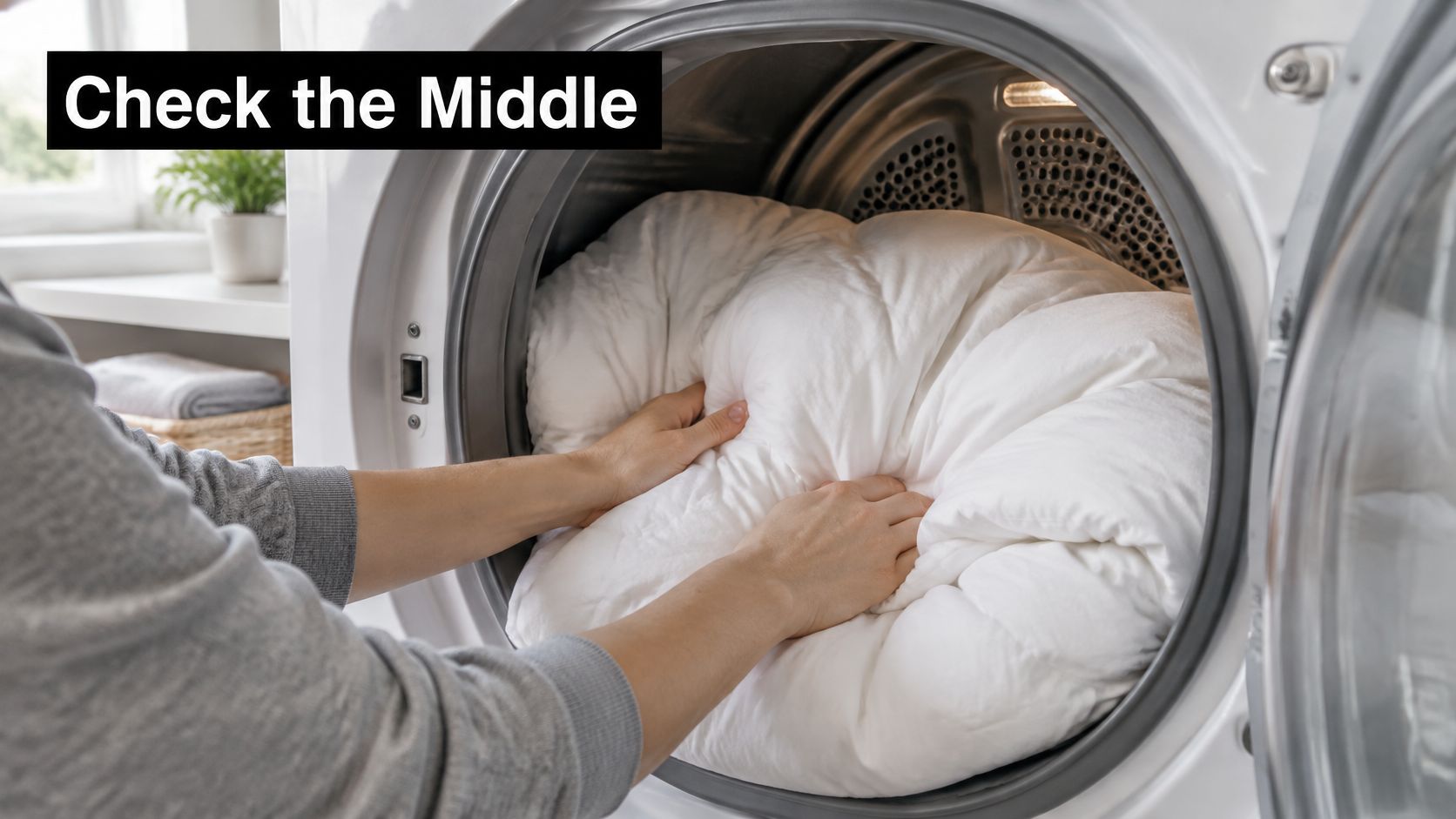
Drying is the stage that ruins more comforters than washing does, and it fails without warning. The shell can feel bone dry to your hand while the filling two inches down is still holding water. That trapped moisture is what produces the musty smell, the mildew spots, and the hard clumps you find a month later.
The shell lies because it's thin and exposed to airflow. The middle tells the truth because it's thick, insulated, and the last part of the comforter to give up its water.
The check-in rhythm that fixes it
When the label permits tumble drying, use low heat or the air/no-heat setting and load the comforter loosely. Then interrupt the cycle. Pause roughly every 30 minutes, pull the comforter out, shake it hard, separate the corners, and redistribute the filling by hand so each stitched compartment dries at the same rate.
Purdue Extension recommends low-heat machine drying or flat air-drying and notes that adding a clean dry towel to the drum improves even drying. University of Florida Extension allows moderate dryer heat with several bath towels, or air-drying in a warm, ventilated room with a fan. The rule that settles the difference: follow the label's heat setting and never exceed it.
High heat does permanent damage. It shrinks cotton shells, weakens coatings, damages fibers, and distorts synthetic fill into flat, matted patches that never loft again.
The doneness test
Press the center of the comforter and then a corner compartment. You're feeling for warmth with no dampness and no heaviness. If there's any doubt, air it for several more hours before folding. A comforter that goes onto a bed or into a cupboard even slightly damp will smell of the inside of a gym bag within a week.
| Fill type | Method | Heat setting | Check every | Done when |
|---|---|---|---|---|
| Down alternative | Tumble dry with 1 to 2 dry towels | Low or air only | 30 minutes | Center and compartments warm and dry, no damp weight |
| Down | Tumble dry with dryer balls or towels | Low or air only | 20 to 30 minutes | No clumps when shaken, fully lofted |
| Cotton shell, light batting | Tumble dry low or line dry | Low | 30 minutes | Shell crisp, no shrinkage at seams |
| Microfiber plush | Tumble dry low | Low | 30 minutes | Pile springy, no matted patches |
| Any fill when the label forbids heat | Flat air dry with a fan | No heat | 2 to 3 hours | Dry through the middle, turned once |
For air drying, lay the comforter flat across two drying racks or a clean sheet on a spare bed. Draping it over a single rail or a door concentrates weight and moisture in one fold, and that fold is where the clumps and the smell start.
Fixes for Clumped Fill, Leftover Suds and Musty Smells
Hard clumps in the filling. The fill migrated and stayed damp. Break the clumps apart with clean hands, run another low-heat cycle with two or three dryer balls, then air the comforter flat for a day. It worked when the comforter lofts evenly after a good shake.
A slick or stiff shell with faint suds. Too much detergent, or a drum that was packed too tightly for the rinse water to reach the fill. Run a cold rinse with no detergent at all, and repeat until the water runs clear and the shell feels soft again. This takes one or two extra cycles, not a rewash.
A musty smell after storage. Moisture got sealed in. Rewash on the gentle cycle, dry fully on low with the 30-minute check-ins, and air it before folding. Confirm the fix by pressing the center and smelling it, not by sniffing the surface.
Chalky streaks on dark fabric. Powdered detergent didn't dissolve. Switch to a liquid detergent and add a second rinse. The streaks disappear in one wash, and the switch prevents a repeat.
A shrunken cotton shell. Dryer heat went past what the label allowed. There's no full recovery, so air dry from here on and measure the comforter against its original dimensions to see how much you've lost.
Pulled seams or loose piping. An oversized load or a harsh cycle stressed the stitching. Repair the seam before the next wash and drop to a gentle cycle. It's fixed when every seam lies flat under your hand.
Most of these trace back to two decisions made before the comforter ever got wet: how full the drum was, and how much detergent went in. Fix those and the symptom list shrinks fast.
| Symptom | Likely cause | Fix | Confirm it worked |
|---|---|---|---|
| Filling in hard clumps | Overload or stopped drying early | Break up by hand, low-heat cycle with dryer balls, air a day | Comforter lofts evenly when shaken |
| Shell slick or faint suds | Too much detergent or packed drum | Cold re-rinse without detergent | Water runs clear, shell feels soft |
| Musty smell after storage | Stored damp | Rewash gentle, dry fully on low, air before folding | No smell in the center when pressed |
| Streaks on dark fabric | Undissolved powder detergent | Switch to liquid, add a second rinse | Even color, no chalky lines |
| Shrunken cotton shell | Dryer heat above label limit | No full fix, air dry going forward | Measure against original dimensions |
| Pulled seams or loose piping | Oversized load or harsh cycle | Repair before next wash, use gentle cycle | Seams flat after inspection |
Store It Loose and Breathable Between Seasons
A clean king comforter goes into a zippered plastic bag in May. In October it smells like a basement. The bag saved a shelf, and it also trapped the last bit of moisture the dryer never quite finished. A vacuum bag is worse: it squeezes the fill flat and leaves no path for that moisture to leave.
Store the comforter only when the center is fully dry. Fold it loosely, never rolled tight, and put it in a breathable cotton bag or a clean pillowcase. A sealed plastic shell works like a closed jar. Whatever humidity went in stays in, and a cool closet wall turns that humidity into condensation on the fabric.
Choose the spot the same way you choose a wash cycle: read the conditions first. A dry interior closet is the right place. An exterior wall that sweats in winter is not, and neither is a garage shelf that swings from hot to damp. If your closets run damp, these Restore Heroes closet mold prevention tips cover the ventilation and humidity side of the problem.
A cedar block or a lavender sachet keeps the bag fresh without the chemical smell of mothballs. In a humid climate, tuck a small desiccant packet inside the breathable bag so it can pull moisture without sealing the comforter shut.
Before it goes back on the bed: air the comforter outside on a dry, breezy day for a few hours, then shake it out. One afternoon of airflow undoes a season of compression.
Between full washes, spot-clean a small mark with a damp cloth and mild detergent, and air the bed each morning before you make it. A top sheet sits between you and the fill, so everyday oils stay off the shell. For the full off-season method, see our guide on how to store bedding for next year.
Washing less often also sheds fewer fibers, as long as stains, allergens, and hygiene still set the schedule. A 2026 study reported in Water, Air, & Soil Pollution measured 5.16 mg of microfibres released from fleece and 7.67 mg from towel fabric under its test conditions, with emissions falling over successive washes. Skip the extra cycle when the comforter is only dusty from storage, and you cut both wear and shed.
Buy for Easy Home Care and Start Today
The easiest comforter to wash at home is the one that was designed for it. Three things make that difference before you ever get it wet: a label that explicitly says machine wash and tumble dry, a shell tight enough to survive repeated cycles without pilling or fraying, and a fill that resists migrating into clumps.
A removable duvet cover does most of the work. The cover takes the weekly contact and the weekly wash, so the comforter underneath needs a full wash far less often. That single change extends the life of the insert more than any detergent will. If you're still deciding between constructions, our guide to the types of comforters breaks down how fill and stitching affect care.
What to look for on the label and in the drum
Check the tag before you buy, not after. Then check your appliances. Oversized bedding is where home washing fails most often, so confirm your washer and dryer pass the drum test with the size you're considering, or plan on a laundromat trip each season.
Our Vilano Down Alternative Comforter costs $69.99 and pairs with a machine-washable cover, while the Grand Symphony Duvet Cover Set in cotton sateen is machine washable and should be washed with like colors. Our microfiber products can be washed and dried in a home washer and dryer, which takes the guesswork out of the weekly cycle.
The label decides the method. The drum decides whether you can do it at home.
The one-minute wash-day summary
Read the tag. Run a hand along the seams. Drop the dry comforter into the empty drum and confirm it sits loosely. Wash one comforter at a time on a gentle or bulky cycle at the label's temperature. Pause the dryer every 30 minutes to shake and redistribute, then test the middle for dampness before you fold anything. Store it loose, dry, and breathable.
Your next action is small and takes under a minute: go read today's tag, then write the cycle and water temperature on a note and tape it inside the linen closet door. Next wash day, nobody has to guess.
SouthShore Fine Linens builds bedding for real homes, which means bedding that survives real wash cycles. Our comforters, duvet covers, and quilts are designed with care labels that make home laundering straightforward, so you can keep them fresh without a trip to the dry cleaner. Browse the collection at SouthShore Fine Linens and start with a comforter you can wash.


