
Are Microfiber Sheets Hot? Why They Feel Warm or Cool
Microfiber sheets aren't hot by default. Untreated polyester microfiber has a moisture regain of about 0.4%, against roughly 8.5% for cotton, so the fiber itself soaks up almost no sweat, and whether a set sleeps warm comes down to how densely it's woven, how heavy it is, and what sits underneath it.
So why do so many shoppers swear microfiber left them sweating? Ask five people whether microfiber sheets are hot and you'll get five confident answers, usually based on one purchase. The fiber name tells you how thin the filaments are. It doesn't tell you the fabric weight, the weave, the brushing, or the finish, and those are the things your body feels at 2 a.m.
Do Microfiber Sheets Sleep Hot? The Short Answer
A dense, brushed sheet pulled tight over a deep mattress holds warm, humid air against your skin, and that's the setup many picture when they call microfiber hot. A light, open weave lets air and moisture leave, and it can sleep cooler than plenty of cotton sets. Same fiber family, different result.
Why the reports disagree
One shopper calls microfiber cozy and easy to wash. Another says it left them clammy by 3 a.m. Neither is wrong. They bought different constructions and slept on different beds.
The fiber decides how much water the fabric can absorb into itself. Everything else, the yarn, the weave, the brushing, the finish, the grams per square metre, decides whether that moisture and your body heat can get away from you.
Match your sheets to a row
| Fabric trait | How it tends to feel | Why |
|---|---|---|
| Lightweight, open weave | Feels cooler | More air exchange and vapor transmission |
| Dense, tightly woven | Feels warmer | Restricts airflow near the skin |
| Heavily brushed or fleece-like | Feels warm and clammy | Traps air and moisture against the body |
| Moisture-management finish | Cooler first touch and faster drying | Moves sweat away from the skin |
If your current set sits in the first row, you probably sleep fine in it and the internet's warnings don't apply to you. If it sits in the third row, the sheet is doing exactly what a high-loft brushed fabric does, and no amount of thread-count marketing changes that.
Rule of thumb: when a listing calls a sheet plush, fleece-like or extra-soft and gives no weight, assume a warmer build and plan for it.
Find the weight and the weave on the product page before you buy. If a listing gives neither, that silence is information too.
Why Polyester Microfiber Absorbs Less Sweat Than Cotton
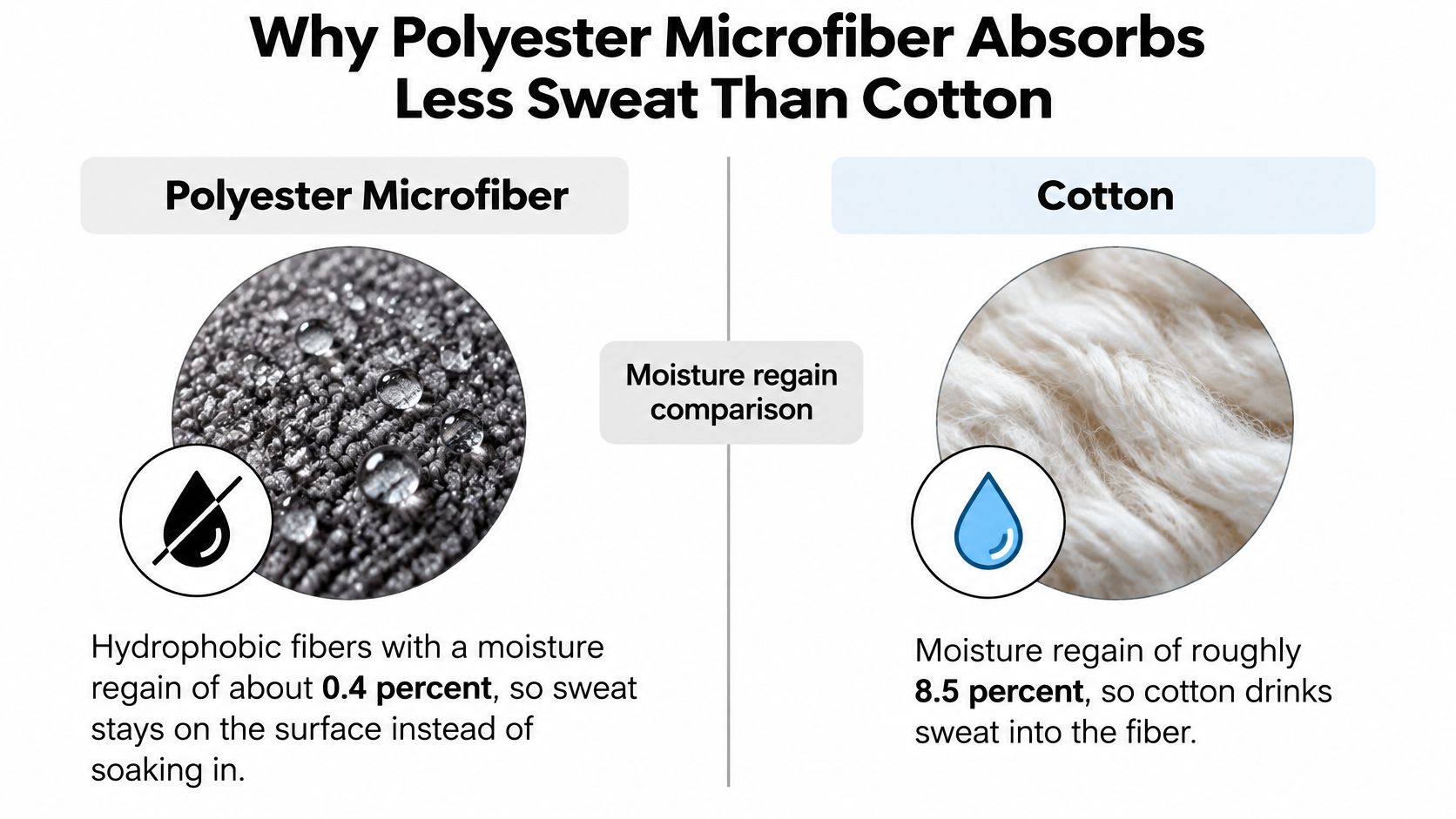
Microfiber is usually polyester drawn into filaments far finer than a human hair. Polyester is hydrophobic, and its moisture regain, the amount of water vapor a fiber takes up from the surrounding air, sits around 0.4%, compared with roughly 8.5% for cotton, according to published research on microfiber sheet comfort. Cotton pulls sweat into the fiber itself. Untreated polyester keeps it on the surface.
The sponge and the raincoat
Think of cotton as a sponge and untreated microfiber as a raincoat. Water sits on the raincoat until it runs off or evaporates. Nothing soaks in.
That's fine when air is moving and the room is dry. It's miserable when humidity builds in the space between you and the mattress, because the moisture has nowhere to go and no fiber to hide in. A tightly woven or poorly ventilated microfiber sheet then feels clammy rather than wet, which is a harder sensation to diagnose.
| Fiber | Moisture regain | What it means at night |
|---|---|---|
| Untreated polyester microfiber | About 0.4% | Absorbs little sweat into the fiber, so moisture can sit on the surface |
| Cotton | About 8.5% | Absorbs far more moisture into the fiber itself |
| Engineered micro-denier polyester | Same low regain, with the finish doing the work | Moves moisture across the surface when finished for wicking |
What finishing changes
Low regain is a starting point, not a life sentence. Textile historians trace the modern microfiber to fiber engineering in Japan at the end of the 1980s, and the material has been re-engineered repeatedly since, in different weights, pore structures, finishes and blends (Journal of Textile Design Research and Practice). Some treated polyester fabrics have reached moisture-content increases approaching 14%, which shows how much a chemical finish can shift performance.
The fiber sets the floor. The finish and the structure decide where the sheet lands.
How Fine Fibers Move Sweat Away From the Skin
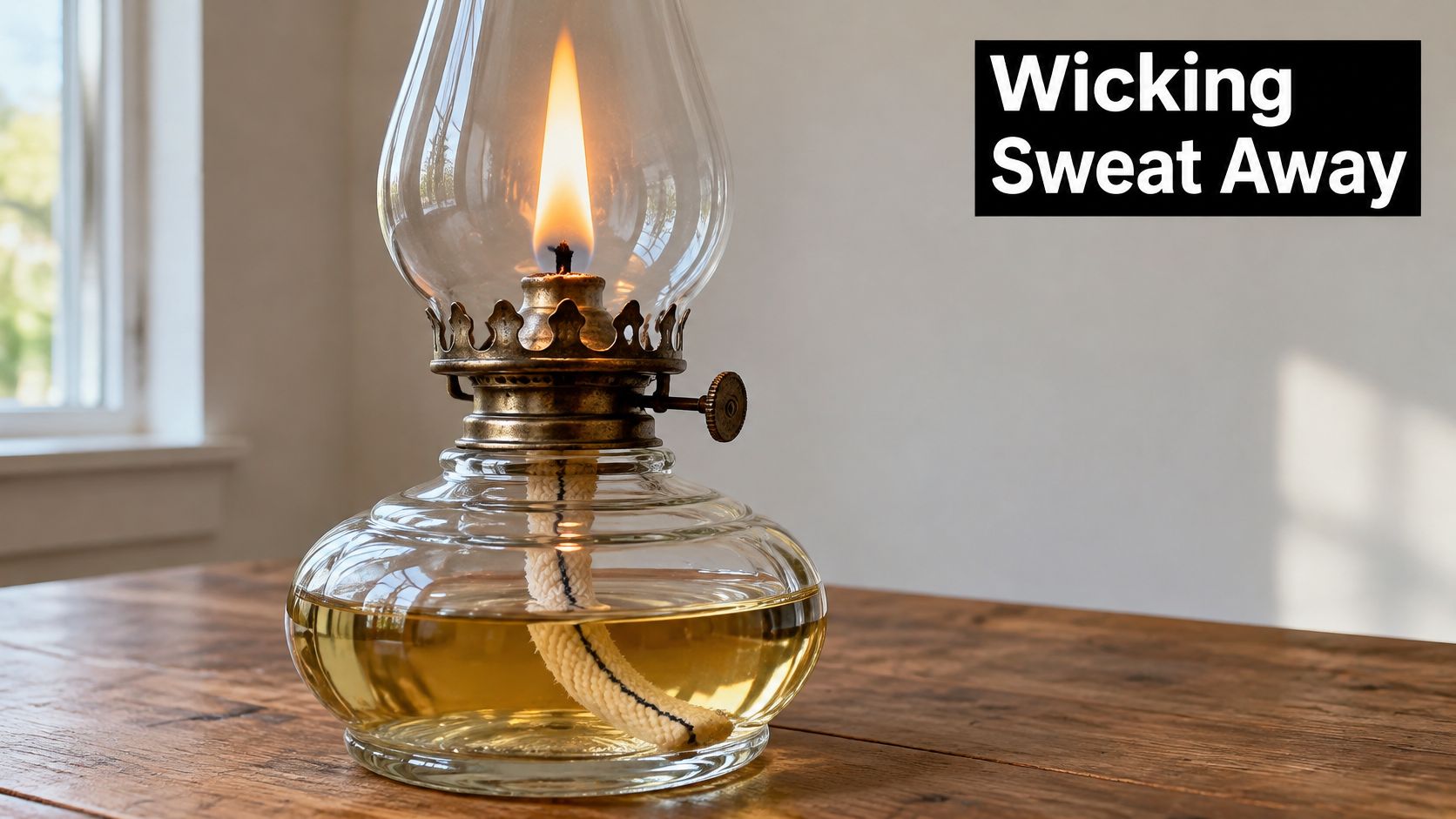
Picture an oil lamp. The wick doesn't pump fuel upward. Capillary action pulls it, and the flame burns steadily because liquid keeps arriving at the tip. Fine synthetic filaments work the same way with sweat. Liquid creeps along the filament surfaces and through the pores between yarns, spreads across a larger outer area, and evaporates from there.
What the comparison study found
A controlled study put micro-denier polyester up against spun polyester, a polyester-cotton blend, filament polyester and cotton. The micro-denier version with a moisture-management finish transferred heat faster, evaporated sweat more quickly and felt cooler on first touch, as reported in research on moisture transport in knit fabrics. The fine filaments were doing the work the cotton fiber normally does.
The catch is that the advantage came from the finish and the structure, not from the word microfiber on the label.
Why the label isn't the guarantee
Polyester moves vapor and liquid mainly through porosity, precisely because it absorbs so little into the fiber. A smooth, lightweight microfiber sheet with open pores can feel dry and neutral. A dense, brushed one blocks the same routes and turns clammy.
If you want the wicking effect, look for a stated moisture-management finish and a lighter build. Our guide to moisture-wicking bedding walks through how those finishes are described on real product pages.
Never assume a microfiber sheet sleeps cool because the listing says so.
Five Construction Factors That Decide Heat
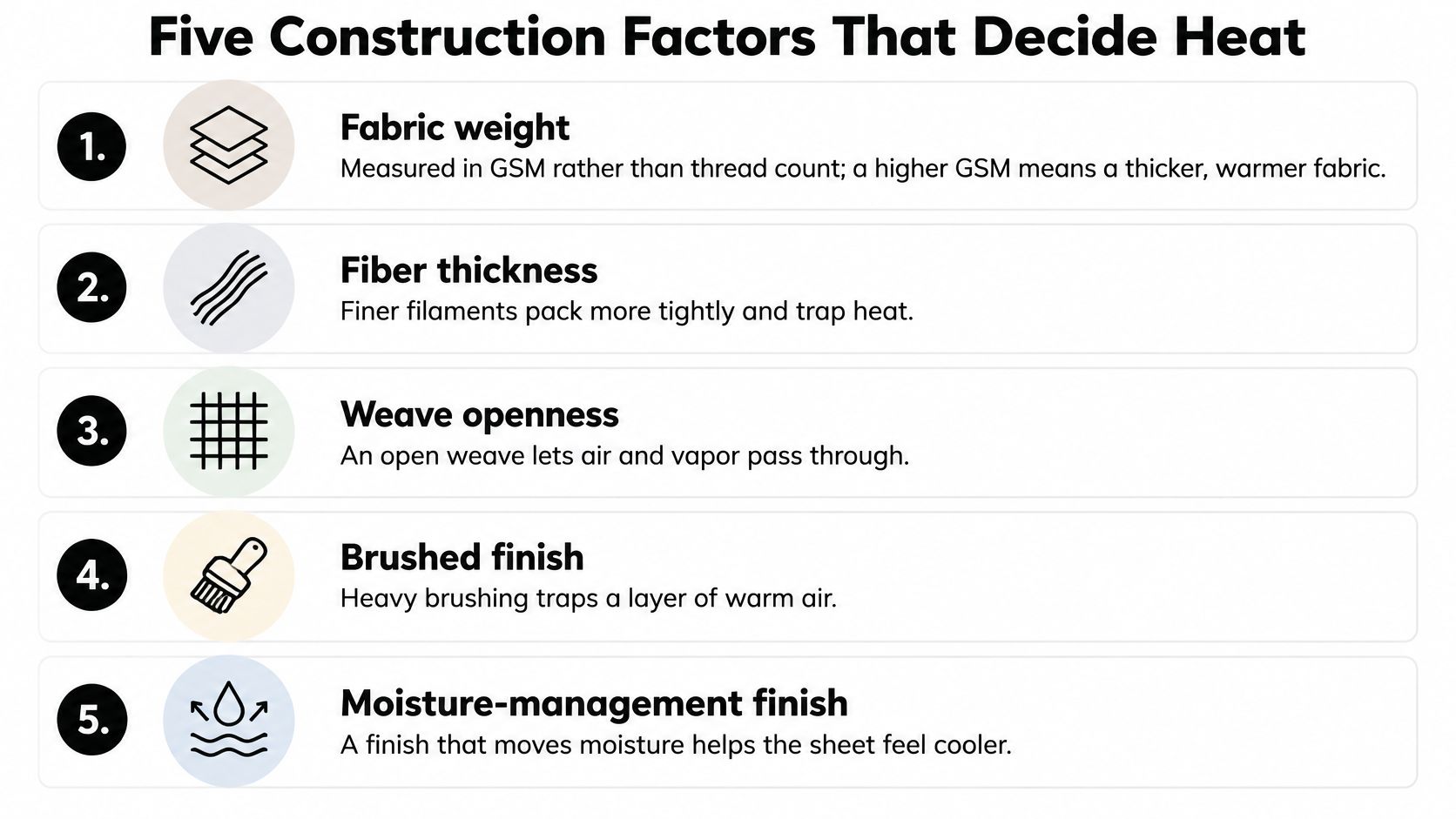
Heat builds up in a bed when three things fail together: air can't move, vapor can't escape, and the fabric adds insulation. Each factor below pulls one of those levers, ordered from the one that should decide your purchase to the one that just fine-tunes it.
1. Fabric weight. Microfiber weight is measured by GSM rather than thread count, and a higher GSM means a thicker fabric. Thicker fabric holds more still air, and still air is an insulator. Check GSM first, before weave or finish, because it's the most direct signal of how warm a sheet will sleep.
2. Fiber thickness. Coarser filaments insulate more. Research on polyester and cotton fabrics found that higher polyester-fiber linear density raised thermal resistance and produced a warmer sensation on first contact with skin (Fashion and Textiles).
3. Weave openness. Open constructions increase air permeability and moisture-vapor transmission, the two routes heat and humidity use to leave the bed. A study of microfiber polyester woven fabrics found that weave structure shifted air permeability, water-vapor permeability, moisture absorption and thermal resistance (effect of weave structure on comfort properties), so two sheets of identical weight can behave differently.
4. Brushing. Double-brushing raises a nap of loose fibers across the surface. That nap is what makes the sheet feel like a peach, and it's also a layer of trapped air sitting between you and the weave. On a cold night it's pleasant. In a warm room it's a blanket.
5. Moisture-management finish. A wicking finish gives sweat a path off your skin and into the fabric's surface area, where it can dry. It won't rescue a heavy, densely woven sheet, but on a mid-weight one it changes how the first hour of sleep feels.
A tightly woven, brushed, high-weight sheet can hold a warm, humid pocket between sleeper and mattress all night. Drop the weight and open the weave, and the same fiber feels like a different product.
A pre-purchase check
- Weight stated? If GSM appears on the page, you can compare products directly.
- Weave described? Plain, percale-style or open weaves beat plush and brushed for airflow.
- Finish mentioned? A named moisture-management treatment is worth paying for. Vague "cooling technology" claims aren't.
- Brushing disclosed? Double-brushed means soft and warmer. Know which you're buying.
- Bed setup considered? Deep mattresses, waterproof protectors, thick pads and dense comforters all cut ventilation before the sheet gets a chance.
How Mattress Layers and Room Heat Change the Result
Say you sleep in a warm upstairs bedroom on a deep foam mattress. Under the sheet sits a waterproof protector, then a thick mattress pad. Over you is a dense comforter. You wake up damp in a brushed microfiber set and blame the fabric.
The sheet is one layer in a stack that traps heat at every stage. Foam holds warmth, a waterproof membrane blocks vapor, a thick pad adds insulation, and a heavy comforter caps it. Any sheet feels warmer under that arrangement, cotton included. Change one layer at a time and the cause becomes obvious.
The swaps that usually help
- Protector first. Swap a waterproof membrane for a breathable, washable protector and give the mattress a route to vent. This single change often does more than a new sheet set.
- Comforter second. Move to a lighter summer weight, or use the comforter as a layer you can kick off without waking fully.
- Room temperature third. Dropping the thermostat a degree or two at night is unglamorous and effective, especially in humid weather.
- Sheet last. Once the layers above and below are sorted, judge the sheet on its own.
Humidity compounds all of it. Moist air conducts heat poorly and evaporation slows, so the same temperature feels warmer when the air is wet. That's why a sheet that felt fine in a dry spring feels sticky in July.
Run the test properly. Change one layer, sleep on it for a week, and note whether you wake up clammy or dry. If you're on a memory foam mattress, our notes on the best sheets for memory foam mattresses cover how foam changes the airflow picture.
Choose Microfiber Sheets You Will Not Overheat In
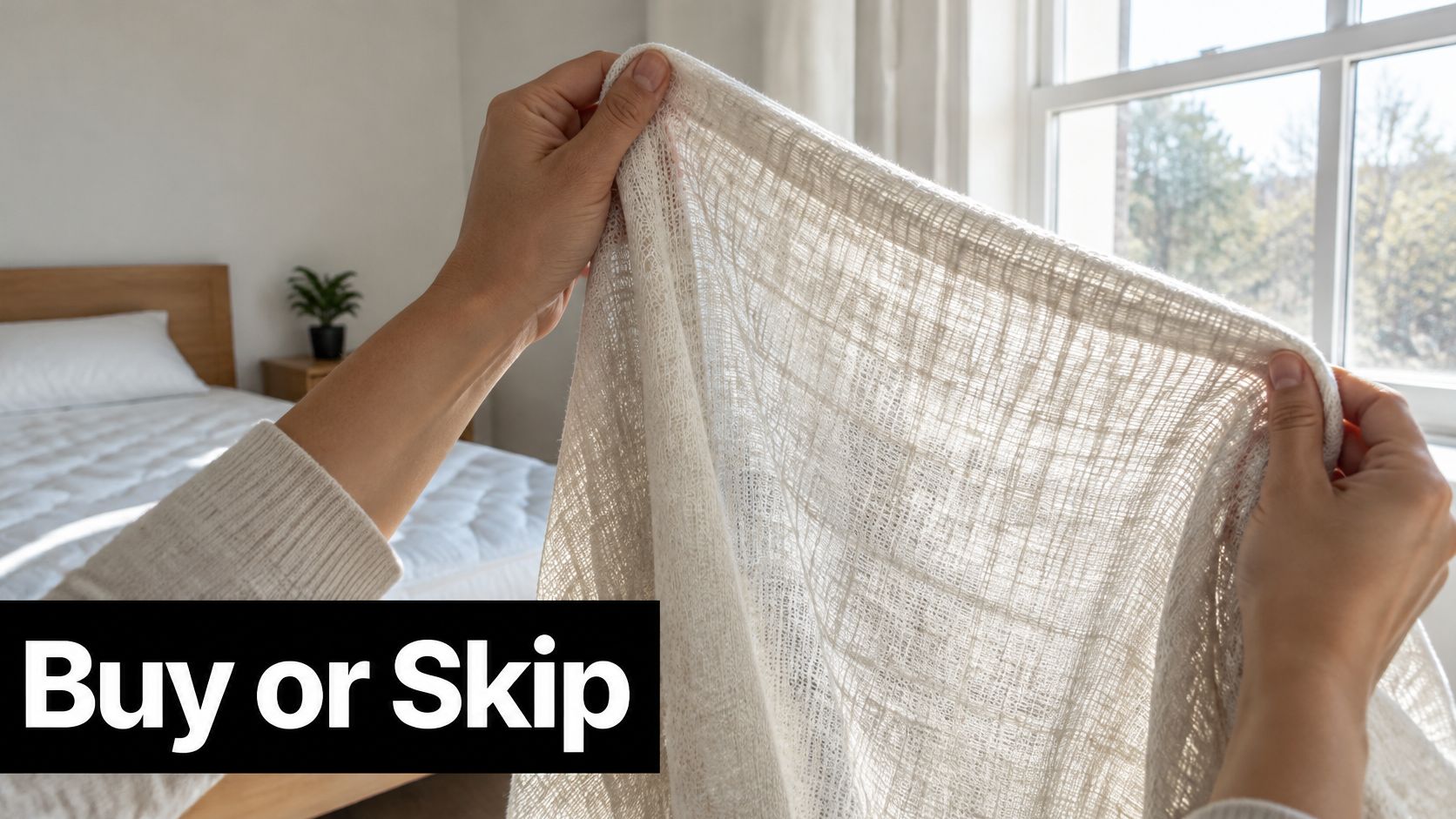
Here's the buying rule. Buy when the listing gives a weight, describes an open or plain weave, mentions a moisture-management finish, and doesn't lead with the word fleece. Skip when the only description is microfiber, no weight or weave appears anywhere, and the photos suggest an extra-plush, brushed surface.
The softness trade-off
Brushed microfiber feels softer because the brushing process lifts surface fibers into a fine nap. That same loft can hold warm air next to your skin, so softness and airflow pull in opposite directions. A very soft sheet can still feel warm if the fabric is thick and the nap is dense. A cooler choice usually needs a lighter hand, a clearer weave description, and less reliance on plushness as the selling point.
Our microfiber products are double-brushed in a special process, are hypoallergenic and are dust mite resistant, which is exactly why the weight matters. Southshore microfiber products will not pill or shrink and are wrinkle and fade resistant, so the decision depends more on heat and hand feel than on durability worries. Check the stated weight and weave before you decide whether a set suits a warm sleeper, rather than assuming softness means warmth.
For a cooler feel, look at percale constructions too. Percale sheets have a crisp, cool feel with a matte finish and are ideal for warm sleepers. Our guide to breathable bed sheets compares how open weaves and lighter fabrics change the overnight picture.
The same logic holds if you're furnishing a guest room or a holiday let, where you can't ask each guest about their sleep temperature. Hosts who want a bed that works in July as well as December tend to start with breathable bedding and layer warmth on top. That approach also fits relaxing self-catering stays in Norfolk, where comfort is part of the appeal.
Then test it. Compare weight and weave across two or three product pages, sleep on your pick for a week, and swap it out if you wake up clammy. A sheet that leaves you damp isn't a sheet you should keep, whatever the label promised. SouthShore Fine Linens offers collections that include Bamboo, Cotton, Microfiber, Clipped Jacquard and 500 Thread Count Tencel bedding, so shoppers can compare fabric styles before choosing the one that matches how they sleep.


