
Extra Deep Queen Bed Sheets: How to Get the Right Fit
Why does a sheet that says queen, extra deep, and fits up to 22 inches still come off your 14 inch mattress at 2 a.m.? Because many shoppers shop for the mattress they bought, not the bed they sleep on. Once you add a topper, a protector, and a pad, the stack your fitted sheet has to climb over is taller, softer, and less square than the number on the mattress label. That's the gap where corners pop off. For extra deep queen bed sheets, the right question isn't "Is it deep enough?" It's "Is the usable pocket depth right for my complete bed stack, and will the elastic still hold after washing and, if you have one, after the base moves?"
What Extra-Deep Queen Sheets Mean on a Label
Say you're holding two queen sets that look identical. Both say extra deep. Both are made for a nominal 60 by 80 inch queen footprint. Put them on the same 14 inch mattress, though, and one feels strained while the other wrinkles across the top. The difference is hidden in the specifications, not the front of the package.
Why the label can't tell you enough
Deep pocket and extra deep aren't fixed standards. They're marketing ranges, and brands set them differently. A neutral sizing guide for queen fitted sheets puts deep pockets at roughly 15 to 17 inches and extra deep at 18 to 22 inches or more, which means two sheets with the same label can differ by several inches of vertical fabric. That spread matters because pocket depth, not footprint, decides whether the elastic can get under the mattress and stay there.
Take that 14 inch mattress and add a 3 inch topper plus a protector. Your real stack is now around 17 to 18 inches, before any tuck under allowance. An 18 inch pocket sheet has almost nothing left to wrap underneath, so the corners work under constant tension and release when you roll over. A 22 inch pocket on a bare 14 inch mattress swings the other way. It fits, but the spare fabric has nowhere to go, so it bunches under the sleeper and the surface never pulls taut.
Deeper is not automatically better. Too little depth pops off. Too much depth loses tension and wrinkles.
The same guide recommends adding at least 2 inches to your measured stack. I would treat that as your floor, not a nice to have. It gives the elastic room to sit beneath the mattress instead of perched on the corner seam.
The three numbers that replace the label
Before you buy extra deep queen bed sheets, you need three things written down.
- Your stack height: Mattress, topper, pad, and protector measured together, not from memory.
- The usable pocket depth: The actual inches listed in the product specs, not the words deep or extra deep.
- The corner elastic type: Corner only elastic, all around elastic, or reinforced corners, because depth without grip still fails.
If a listing won't give you the second and third items, you're guessing. Move on to one that will.
How to Measure Your Bed Stack Before You Buy
You don't need special tools for this. You need a flexible tape measure, five minutes, and the bed stripped back to the layers you'll sleep with under the fitted sheet. If you're also confirming the footprint itself, this overview of queen bed sizing for Virginia bedrooms from Guynn Furniture and Mattress is a useful cross check before you start on depth.
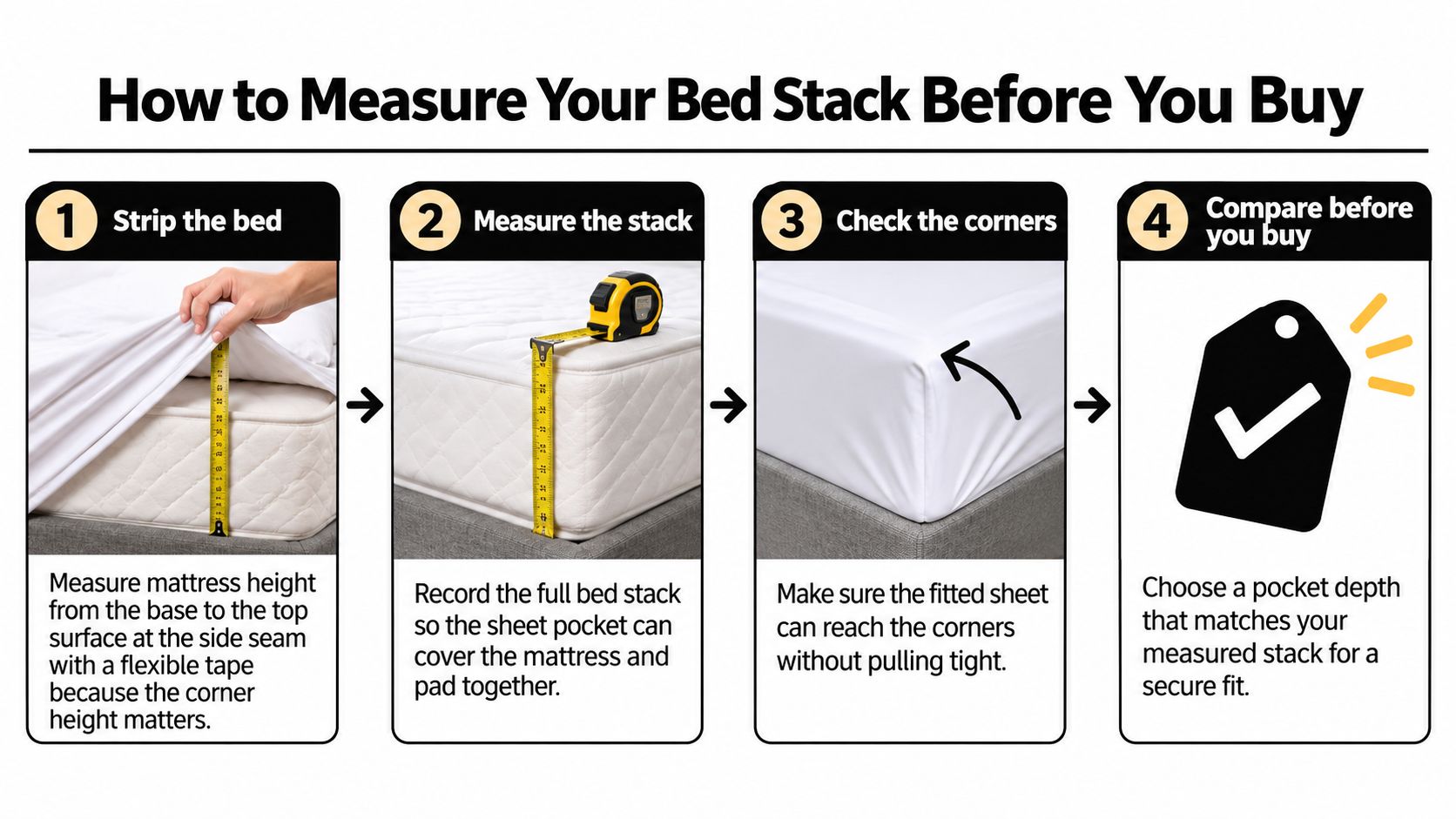
Measure in this order
- Strip the bed and measure the bare mattress. Run the tape from the base to the top surface at the side seam, not at the plush crown in the middle. The side is where the pocket has to travel and where the corner has to hold, so that measurement is the honest one.
- Add the topper back and measure again. A 3 inch topper adds 3 inches of stack. Don't estimate it from the product name, because foam toppers often measure slightly under their advertised loft once they've expanded and settled.
- Add the protector or pad and measure a third time. This is the layer people forget, and quilted protectors are thicker than most shoppers expect. If the fitted sheet goes over it every night, it counts.
- Press down with a flat hand and recheck. Push firmly on the top surface near the edge to mimic sleeping weight. Pillow tops and hybrids compress under load, and the height your sheet experiences at the corner drops and shifts as you move. Note both the uncompressed and pressed figures if they differ.
- Add 2 inches to the total. That sum is your minimum usable pocket depth. It's the tuck under allowance that lets the elastic sit below the mattress instead of gripping the side wall.
- Compare against the listed usable depth, not the label. Check whether the maker's figure already assumes a topper, and whether the stated range is a mattress height range or the pocket depth itself. Those are different numbers and listings blur them often.
Why the full assembly matters
Fit is a functional specification. Pocket depth should be mattress height plus topper or pad thickness, plus material for the tuck under, rather than the nominal queen size alone. The U.S. Consumer Product Safety Commission document on fitted sheet and mattress testing treats fitted sheet fit and corner gap formation as measurable issues, noting that a tight fitting sheet can alter mattress compression and create gaps. That guidance concerns regulated crib products, but the engineering principle transfers directly. Judge the complete mattress and sheet assembly, inspect all four corners after movement, and test on the thickest setup you'll use.
Practical rule: Measure the tallest stack you regularly sleep on. A sheet that fits the bare mattress can fail the first night you add the topper back.
The most common mistake is simple. Someone measures the mattress alone, forgets the protector, buys a correctly labelled sheet, and then blames the elastic when it pops off. The sheet was never deep enough for the actual stack. For a second walkthrough of the tape work itself, see the guide on measuring mattress depth step by step, then save your numbers in a phone note. Repeat the whole routine whenever you change the mattress, topper, or pad, because your minimum changes with them.
Pocket Depth Chart for Every Bed Stack Height
The one line rule is short. Minimum pocket depth equals your bed stack height plus 2 inches. Find your stack in the left column, read across, and you've got the shallowest pocket that should reliably stay on. Anything below that figure is a gamble, no matter what the package calls it.
| Bed stack height | Minimum pocket depth (stack + 2 in) | Where it sits in labelled ranges |
|---|---|---|
| 10 in | 12 in | Covered by a standard 15 in deep pocket |
| 14 in | 16 in | Covered by a 15-17 in deep pocket |
| 16 in | 18 in | Entry point of the 18-22 in extra-deep range |
| 18 in | 20 in | Middle of the 18-22 in extra-deep range |
| 20 in | 22 in | Top of the common extra-deep range; check corner elastic |
| 24 in | 26 in | Beyond most labelled ranges; confirm usable depth with the maker |
The rows that surprise people
The 10 inch stack row surprises shoppers in a good way. You need a 12 inch pocket, which a standard 15 inch deep pocket sheet already covers. Buying extra deep queen bed sheets for that bed usually buys you bunching, not security. I would spend the money on better elastic instead.
The 14 inch stack is where many modern queens land once a protector goes on. You need 16 inches, still inside deep pocket territory. This is the row where people overbuy depth and then complain about wrinkles, when a well made deep pocket sheet would've held flatter.
At a 16 inch stack, you cross into true extra deep territory with an 18 inch minimum. That's a typical pillow top or hybrid plus topper setup. At 18 inches of stack, your 20 inch minimum sits mid range, which is a comfortable place to shop because you've got options above and below. Flexibility disappears at a 20 inch stack. You need 22 inches, the top of most labelled ranges, so there's no slack for a listing that rounds up. Check the corner elastic closely and confirm the depth is usable pocket, not total fabric.
At 24 inches, you're beyond most labels. Don't trust any front of pack wording at that height. Ask the maker to confirm usable depth in inches before you order.
Minimum means floor, not target
Pillow top and hybrid mattresses often measure differently once compressed, so use the height under body weight rather than the box height when you pick your row. The chart gives you a floor. If your bed articulates, or you wash sheets weekly in a hot dryer, a little allowance above the minimum protects you against slack loss over time.
A correct fit looks boring. All four corners covered, gentle even tension, no visible gap under the mattress, no ridge of spare fabric across the top.
Test it with your hands. Tug each corner sideways and let go. The sheet should settle back smoothly without the elastic riding up the side wall. If you can pull a corner free with light pressure while standing at the bedside, body weight and movement will do the same job overnight. Size up in depth or choose stronger elastic, depending on which limit you hit.
Sheets on Adjustable Bases Need Different Fit Checks
Does a queen sheet stay put when the bed rises? A flat fit does not answer that. On an adjustable base, movement shifts fabric across the hinges and changes the pull at the corners.
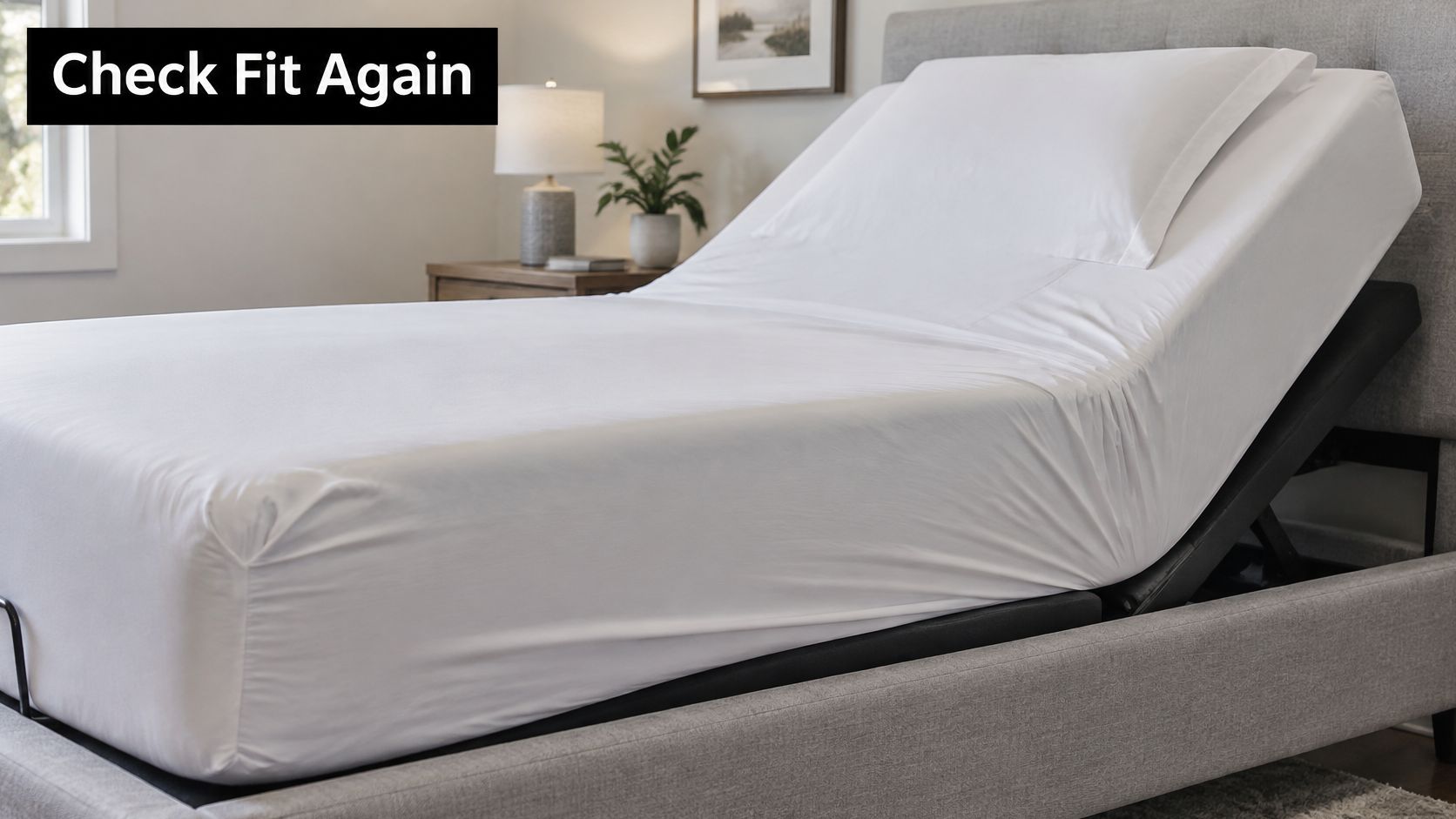
As the deck bends, fabric is drawn from the pockets toward the hinge points. A sheet with little spare reach can release at the foot or strain near the head during adjustment. Queen is a common size, but the base configuration matters as much as the mattress size. See this guide to sheets for adjustable beds for an overview of the fit considerations.
Retention beats raw depth
On a moving base, prioritize how the sheet stays attached over adding pocket depth alone.
- All-around elastic: Helps distribute tension around the perimeter as the deck bends.
- Strong corner elastic: Resists repeated pulling at the corners nearest the hinge.
- Room to flex at the corners: Shaped corner fabric can allow movement without pulling free.
- Designed for articulation: Frequent movement puts different demands on a sheet than a stationary, flat bed.
Base geometry changes the fit. A one-piece queen base moves as a single surface. With a split base, each side moves independently, which can pull a shared sheet toward the center. Match the sheet configuration to the base, rather than stretching one queen sheet across two independently moving halves.
Too much slack can bunch when the bed returns to flat. Too little can strain seams and restrict the base's travel. The right pocket depth must accommodate the complete stack, while elastic and corner construction keep the sheet in place during movement.
Run the flat versus elevated test
Check the fit through the base's full range of motion before relying on it overnight.
Make the bed with the topper and protector in place. Check all four corners with the base flat, then with the head raised, the foot raised, and both raised. Lower the base and inspect the corners again; fabric can shift during the return. Repeat the checks after washing, since shrinkage can reduce the fit allowance. For more on fitting sheets on adjustable beds, compare how different base types affect sheet movement. Choose reliable corner retention over the deepest pocket available. Depth gets the sheet on; retention helps keep it in place as the bed moves.
Popping Off, Bunching and Corner Gaps Fixed
Almost every fit complaint traces back to one trade off. A pocket shallower than stack plus 2 inches pulls off. A pocket far deeper than the stack leaves spare fabric with nowhere to go. Put an 18 inch pocket on a 12 inch stack and roughly 6 inches of material gathers under the sleeper or wrinkles across the surface. The sheet isn't defective. It's the wrong depth for that bed.
Elastic is the other half of the diagnosis. Depth positions the sheet, but corner elastic does the actual holding, so a deep sheet with tired or narrow elastic still releases. Too tight a fit strains seams and makes bed making a wrestling match. Too loose a fit gaps after washing, once the fabric relaxes and shrinks unevenly. This corner, caught mid release, is what shallow depth or worn elastic looks like up close.
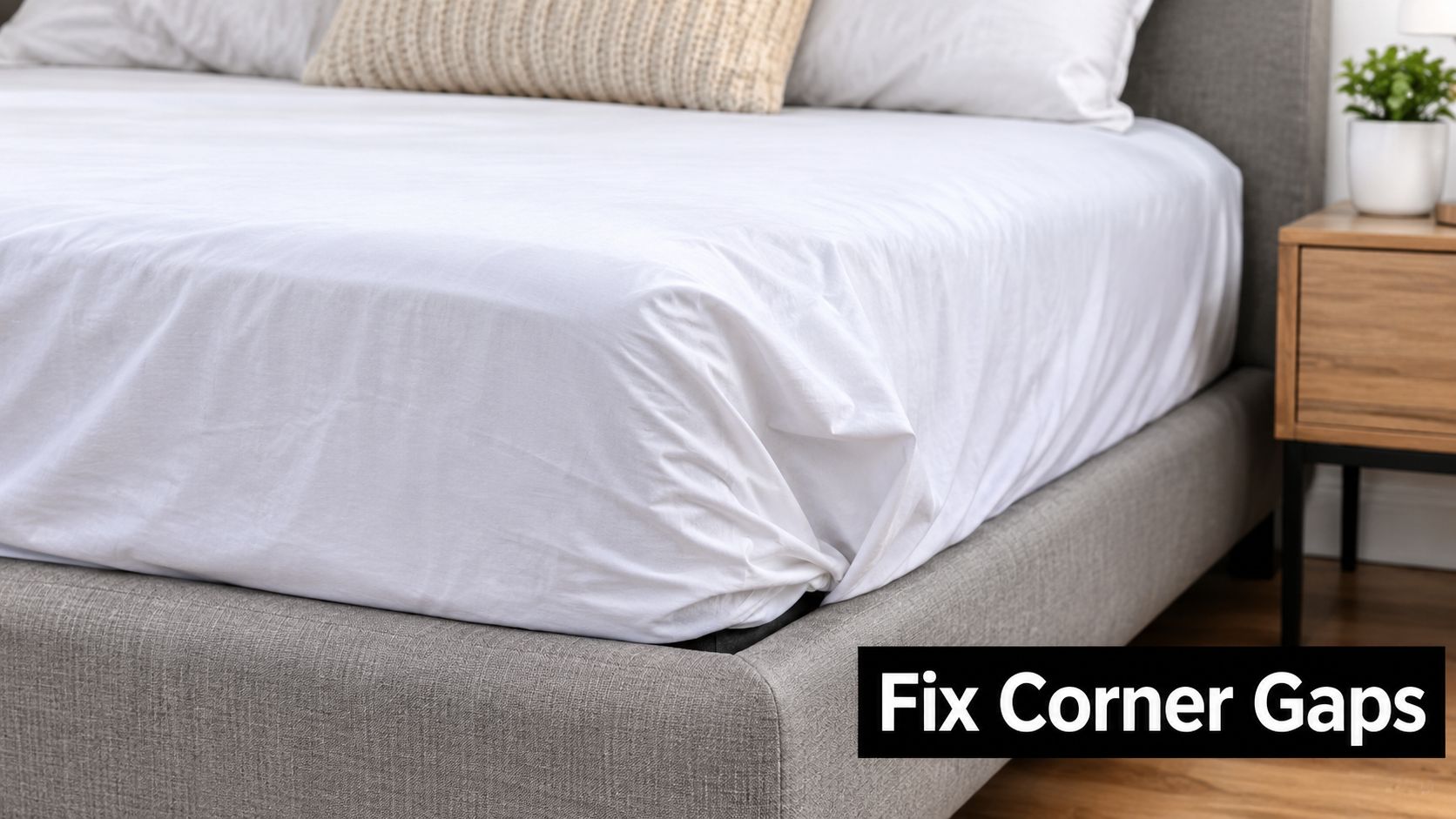
Match the symptom to the cause
| Symptom | Likely cause | Fix |
|---|---|---|
| Corners pop off during the night | Pocket shallower than the full stack, or worn elastic | Re-measure the stack, choose a sheet with 2 in more usable depth, or replace it |
| Excess fabric bunches under the sleeper | Pocket much deeper than the stack, too much slack | Choose a sheet closer to stack plus 2 in and re-seat the corners |
| Sheet pulls off when head or foot rises | Flat-bed fit with no slack for articulation | Test every position and choose a sheet with all-around elastic |
| Gap at a corner after several washes | Length shrinkage after laundering | Dry on moderate heat and re-check the length after the first washes |
| Loose sheet wrinkles across the top | Pocket too deep for the stack, weak tension | Choose a smaller pocket or fully secure all four corners |
Diagnose in this order
Don't start by buying accessories. Start with the numbers, because straps and clips only mask a depth problem and add pressure points that wear the fabric.
- Confirm the stack. Re measure with every layer in place. If the stack grew since you bought the sheet, the mystery is solved.
- Check the pocket against the minimum. If usable depth is under stack plus 2 inches, no amount of careful tucking fixes it. Replace with the correct depth.
- Inspect the elastic. Stretch each corner and watch the recovery. Slow, uneven snap back, visible rippling, or elastic that feels thin and crunchy means it's done, even if the fabric looks fine.
- Test articulation if you have a base. Run every position and note which corner moves first. That corner tells you where the slack runs out.
Fix depth first, elastic second. A deeper sheet with dead elastic fails just as reliably as a shallow one.
Set realistic timelines. Bunching and surface wrinkles usually resolve within a day. Re measure, fully re seat each corner so the elastic sits under the mattress, smooth the spare fabric toward the foot, and sleep on it. If the bunching returns in the same spot, the pocket is too deep for the stack and sizing down is the fix. Base related pull offs need patience instead. Give it a week of testing across the positions you use, including reading angle and zero gravity if that's your routine, before you decide a sheet can't work.
The five minute test
Make the bed properly, then pull each corner gently outward and release it. The sheet should return with no gap and no ridge. Press down near each corner with your knee to simulate getting in and out, then look underneath with your hand. The elastic should still be under the mattress, not riding the side wall. If a corner lifts during this test, it will lift at night.
Replace the sheet when the corner elastic is visibly stretched out, when the pocket measures shallower than stack plus 2 inches after washing, or when the same corner fails after a correct depth replacement points to a mattress corner that's badly rounded or compressed. In that last case, favor all around elastic and oversized corners on the next set. Good extra deep queen bed sheets shouldn't need daily negotiation. When the depth matches the stack and the elastic is alive, making the bed takes a minute and the corners stay where you put them.
Caring for Extra-Deep Sheets So the Pocket Keeps Its Depth
A sheet can lose length without looking any different folded on the shelf. That's why a set that fit perfectly when new starts gapping at one corner two months later. The fabric didn't tear and the elastic may be fine. It shrank where it matters most, along the length that wraps under the mattress.
Shrinkage in cotton isn't even. Cotton Incorporated research on dimensional change in cotton fabrics identifies dimensional change from repeated laundering as a critical attribute, evaluated with standardized methods including AATCC Test Method 135. In one cotton fabric study, warp direction shrinkage was approximately 1.29 to 1.71%, compared with only 0.002 to 0.045% in the weft direction. In plain terms, the sheet loses length and keeps its width, so the corner wrap shortens even when overall shrinkage sounds tiny.
| Fabric or direction | Reported shrinkage | Effect on pocket depth |
|---|---|---|
| Cotton, warp (length) | 1.29 to 1.71 percent | Loses length; reduces corner wrap |
| Cotton, weft (width) | 0.002 to 0.045 percent | Width barely changes |
| Polyester, tumble dried | Lower than cotton and wool | Keeps pocket depth more stable |
| Wool, tumble dried | Higher than polyester | Loses depth faster than polyester |
Tumble drying drives most of it. Cotton shrinks more when tumble dried than line dried, with agitation and temperature as the main causes. Polyester shrinks less than cotton and wool under the same drying, which is a genuine fit advantage if you launder weekly and always use the dryer. Choose fabric by your laundry habits, not just by feel in the store.
The routine that protects the pocket
- Wash gentle, moderate heat: Use a gentle cycle and dry on moderate rather than high heat. High heat costs you length and elastic life at the same time.
- Remove promptly: Pull the sheet out as soon as the cycle ends and shake it flat. Don't stack hot, damp sheets, which sets creases and lets the fabric relax unevenly.
- Measure after the first washes: Check length and width separately after two or three wash and dry cycles. A single overall shrinkage figure hides the length loss that breaks corner retention.
Protectors deserve the same discipline, since a shrunken protector changes your stack height too. This bedding and mattress protector guide from Suburban Furniture is a solid companion for care basics, and our own notes on washing bedding without wrecking the fit go further on water temperature and detergent. If a pocket has lost noticeable length and the corners have started to release, retire that sheet from the tall bed before it fails nightly. It may still serve fine on a shallower guest bed.
Confirm Your Pocket Depth Before You Buy
Shop by three numbers and the decision gets simple. Your stack height, your minimum usable pocket depth at stack plus 2 inches, and whether the bed articulates. If a listing can't be checked against all three, it isn't giving you enough to buy with confidence. For a broader framework on fabric, weave, and budget once fit is settled, Groen's Fine Furniture explains how to choose bed sheets in a way that pairs well with the depth math here.
A short pre purchase checklist
- Usable depth in inches: Confirm the figure on the product page and whether it includes a topper. Compare it to your minimum, not to the label words.
- Corner construction: Look for all around elastic, and oversized corners if your base moves.
- Fabric versus laundry habits: Cotton feels familiar but loses length faster under tumble drying. Factor that into how much allowance you leave above the minimum.
We offer a few extra deep queen bed sheets options worth measuring against your numbers. Our extra deep pocket sheet sets are tagged as Briteyarn 300 thread count 100% cotton sheet sets, which suits readers who want cotton with a stated pocket depth. Our Vilano range includes extra deep pocket solid color, lace, and pleated sheets, and the Vilano Extra Deep Pocket Pleated Sheet Set has a sale price of $42.99. I would still compare each listing's usable depth against your calculated minimum before choosing on color or finish.
Write the three numbers down and shop against them in order. Depth first, elastic second, fabric third, appearance last. That sequence is what keeps a sheet on the bed six months from now, not just on delivery day.
Measure your full stack, add 2 inches, and bring those numbers to SouthShore Fine Linens, where you'll find extra deep pocket sheet sets with stated depths you can check against your minimum instead of guessing from a label. Pick the pocket that matches how you sleep on your bed, protector, topper, and all, and stop remaking corners in the dark.


