
Sateen Duvet Cover: Feel, Fit, and How to Choose
You're standing in the bedding aisle with one hand on a crisp cotton cover and the other on something smooth that catches the light. Both look fine folded up. Only one will feel right at 2 a.m. when you're warm, restless, and kicking at a corner that's gone empty.
Why a Sateen Duvet Cover Feels Different
You already know the basic job. A duvet cover is the removable case around your insert, like an oversized pillowcase with buttons, ties, a zipper, or an envelope flap to close it. You wash the cover instead of wrestling the whole insert into the machine, and you can change the look of the bed without buying new fill.
The confusion starts when two covers carry the same label and behave differently. One sateen duvet cover drapes like a soft shirt that's been washed a dozen times. Another feels slick, warm, and a little fragile. A third looks beautiful on the package photo, then barely covers the sides of your mattress at home.
The Three Decisions Behind the Hand
That gap isn't a mystery once you split it into three decisions. First, there's the weave that creates the sheen and the silky hand. Second, there's the climate pairing, meaning how the fabric weight and your insert work together for the way you sleep. Third, there's fit, which has almost nothing to do with the word queen or king printed on the front.
Sateen describes how a fabric is built, not a guarantee that every sateen cover will feel, wash, or sleep the same.
Two jackets can both be cotton and both be navy, but one is a light unlined layer and the other is dense and warm. You wouldn't judge them by color alone, and you don't need to judge bedding by sheen alone either. The useful questions are concrete. What's it made from, how heavy does it feel in your hand, what insert will live inside it, and how deep is the bed it has to cover?
What You'll Be Able to Spot
By the end, you'll have a short list of specs that matter more than the word sateen, a sense of when sateen helps a warm sleeper and when it works against one, and a simple measuring habit to use before you pay. You'll also know why a cover can match your insert perfectly and still look skimpy on a tall mattress, and why gentle washing protects the very thing you liked in the store.
That silky first touch is real information. It just isn't the whole story.
How the Sateen Weave Creates That Sheen
Start with the most common mix up. Sateen isn't a fiber. It's a way of weaving, most often applied to cotton. Cotton is what's in the yarn. Sateen is how those yarns cross each other, and that crossing pattern is what changes the surface you touch at night.
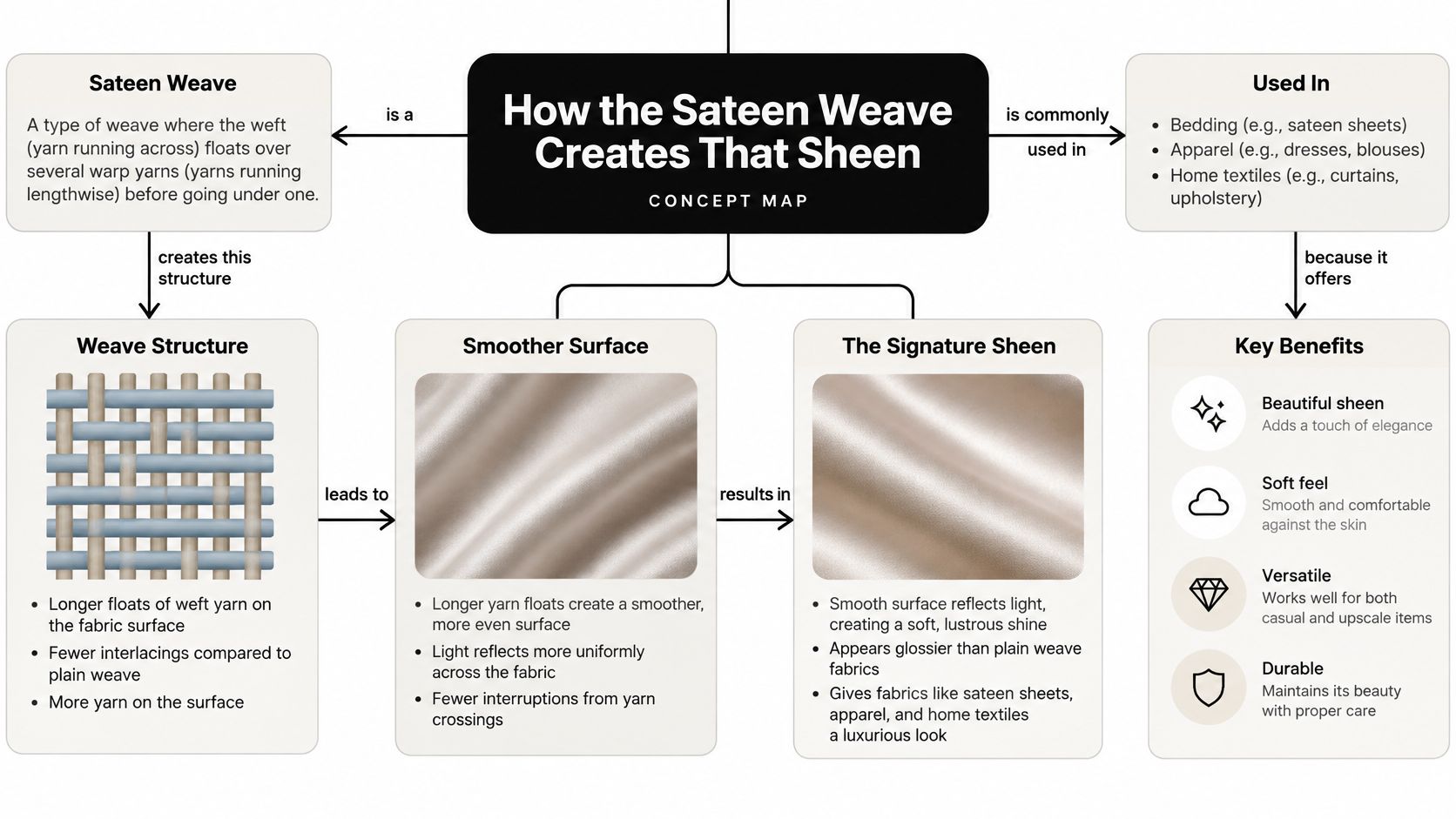
This visual maps how the weave pattern turns plain cotton yarns into that smooth, light catching face.
Fewer Crossings, More Surface
In a sateen weave, warp yarns float over weft yarns for longer stretches before dipping under. Common arrangements are 4/1 or 7/1, meaning a yarn passes over several yarns and under one, as explained in this guide to how cotton sateen mimics silk through its satin style weave. Picture a road with very few cross streets. The surface runs long and uninterrupted, so it reflects more light.
Fewer interlacing points also mean fewer tiny bumps under your palm. That's why a cotton sateen duvet cover can feel silk like while still being cotton through and through. It drapes in soft folds instead of standing crisp, and it catches a low glow rather than looking flat matte.
The Trade Off Built Into the Smoothness
Those long floats are exposed. They give you the sleek hand and fluid drape, and they're also the part that needs gentler handling in the wash than a tightly interlaced plain weave. Nothing's wrong with the fabric when a care label asks you to go easy. It's the construction asking for respect.
Fiber length adds another layer. Long staple and extra long staple cotton are often used for premium sateen because longer fibers can be spun into smoother yarns with less surface roughness. Shorter fibers leave more fuzzy ends. Longer fibers leave a cleaner surface for that float to show.
Finishing That Changes Color and Strength
Many cotton sateens are also mercerized, a finishing process that can increase cotton fiber tensile strength by as much as 20% and improve dye uptake by approximately 15 to 25%, according to the same sateen weave guide linked above. In plain terms, the yarn gets a bit stronger and color goes in richer and more even.
Put those pieces together and the store shelf makes sense. Weave, staple length, and finish decide softness, sheen, durability, and color. Two covers can share a name and sit at different points on every one of those dials.
Sateen Versus Percale and Polyester Satin
Three fabrics get tangled together in most shoppers' heads, and untangling them saves returns. Cotton sateen and percale can start from the same cotton and end up feeling like cousins who dress differently. Polyester satin is a different family altogether that happens to share the shine.
Percale uses a plain weave with yarns crossing over and under in tight alternation. The hand is crisp and cool, a bit like a freshly ironed cotton shirt, and the surface looks matte. Sateen's longer floats make it smoother, warmer to the touch, and more fluid in drape. If you want a deeper side by side on sheets in these weaves, this comparison of sateen and percale sheets walks through the feel in more detail.
Where the Trade Offs Show Up
Those exposed floats that make sateen glide can also snag and abrade more easily than percale's tight grid. That's why construction matters. A tightly engineered cotton sateen with reinforced seams and secure closures is the version that holds up in a busy home or a guest room that gets washed often. A loose, glossy fabric with weak stitching isn't the same product just because it shines.
| Option | Hand and drape | Structure trade-off | What to verify |
|---|---|---|---|
| Cotton sateen | Smooth, lustrous, fluid drape | Longer floats can snag or abrade more easily | Fiber content, seam strength, closure, care label |
| Cotton percale | Crisp, matte, lighter hand | More interlacings, less sheen | Weave description and fabric weight |
| Polyester satin | Glossy and slick | Fiber changes moisture absorption, drying, and heat response | Actual fiber content, not the shiny look |
Reading Past the Shine
Polyester satin deserves its own pause. It can look just as glossy on a hanger, but fiber composition changes how it handles moisture against your skin, how it dries, and how it responds to heat in the wash and dryer. Two covers with the same sheen can sleep very differently by the second hour of the night.
Appearance tells you how a fabric reflects light. It doesn't tell you how it will absorb moisture, handle heat, or wear at the seams.
That brings up thread count, the number shoppers often treat as a score. It isn't a durability benchmark on its own. Read it alongside fiber quality, yarn strength, fabric weight, seam construction, and finishing. A moderate count in strong, long staple yarn with solid seams will outlast a big number built from weak yarn.
Your most reliable tool here isn't your eyes. It's the fiber content label and the care guidance printed with it.
Matching a Sateen Cover to Sleep and Climate
Silky versus crisp is a fine starting preference, but it's a poor stopping point. A smooth, tightly woven sateen surface can feel warmer and less airy than percale. That doesn't mean every cotton sateen sleeps hot. It means the cover is only one part of a system, and the other parts can tip the balance.
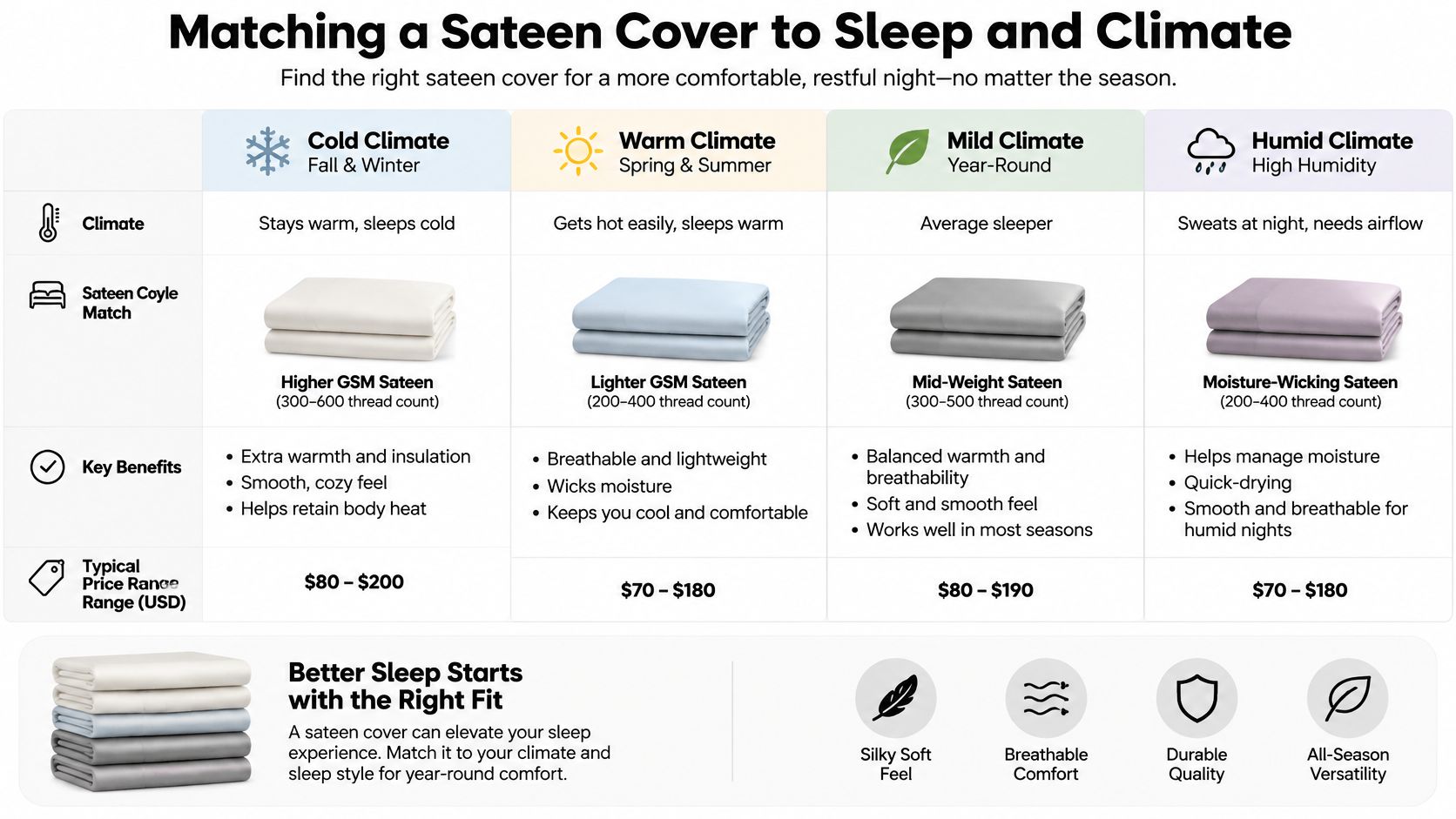
This chart lays out the pairings so you can match fabric weight and insert loft to how you sleep.
The System That Decides Warmth
Five things interact while you sleep. Fiber content shapes moisture handling. Yarn density and fabric weight shape how much air moves through. Finish can change the surface feel. Room temperature sets the baseline. And your insert's insulation does most of the actual warming.
That last point surprises people. A duvet cover is a shell, not the insulation. Pair a heavyweight sateen cover with a high loft winter insert in a warm bedroom and you'll overheat, then blame the word cotton on the label. The label didn't trap that heat. The combination did. If breathability is your main worry, these notes on breathable bed sheets for warmer sleep cover the base layer under the duvet too.
Pairings That Work in Practice
- Warm sleepers: Choose a lightweight cotton sateen and pair it with a breathable, low fill insert. You keep the smooth hand without building a winter system in July.
- Cold sleepers: A midweight or heavier sateen over a loftier insert gives you drape that settles close and holds warmth where you want it.
- Mixed sleepers and shared beds: A midweight cotton sateen with a moderate insert is the flexible middle, and swapping the insert seasonally changes the system without replacing the cover.
The short video below shows how the cover and insert work together as layers rather than a single blanket.
Cotton's reputation helps explain why shoppers start here. In a 2024 survey of 7,163 consumers across China, Germany, Mexico, the U.K., and the U.S., 64% preferred cotton bedding, and respondents associated cotton most with reliability at 79%, softness at 78%, comfort at 78%, and sustainability at 76%, per the Cotton Incorporated bedding supply chain insights. That's perception across cotton bedding generally, not proof that every sateen product performs alike.
So name your specs before you shop. Fiber, weight, weave, finish, and insert loft predict your night far better than the word luxurious.
Getting Duvet Cover Fit Right on Real Beds
Most duvet cover frustration isn't about the weave. It's about fit. The insert bunches in one corner, the cover hangs long on one side and short on the other, or the whole thing looks flat and skimpy on a bed that seemed standard in the store.
Size names are the root of it. Queen, king, Full/Queen, and King/California King aren't standardized, and those shared labels overlap. Guidance on how to choose a duvet by finished dimensions rather than size names makes the same point. Two covers with the same name on the package can differ enough to change how your bed looks and sleeps.
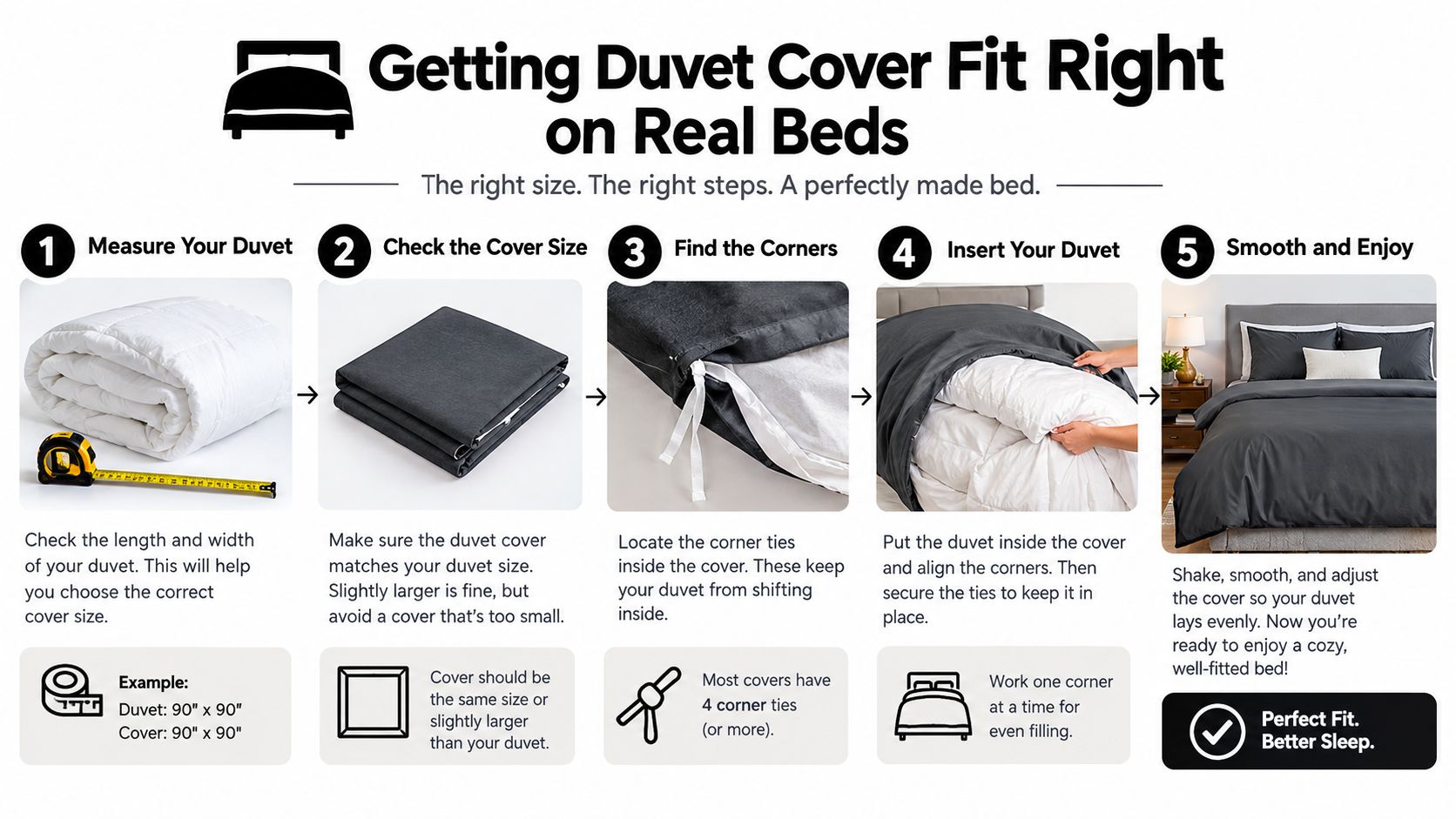
This five step guide shows the measuring and inserting sequence in order.
Measure in This Order
- Record your insert's actual width and length. Lay it flat and measure edge to edge. Don't trust the size word you bought it under.
- Measure your mattress width and depth. Depth matters because a tall pillow top eats up coverage that would otherwise hang over the side.
- Decide the side drop you want. A hotel style look needs the cover to fall well past the mattress edge. A minimal look needs less.
- Compare finished cover dimensions to both numbers. The cover has to fit the insert and cover the bed. Those are separate checks, and this guide to sizing a duvet cover breaks the math down further.
- Check the anchors. Corner ties or loops keep the insert from crawling, which matters even more on an adjustable base that bends the bed.
What Each Mismatch Feels Like
A cover that's too large for its insert lets the fill drift. You get empty corners, a lumpy middle, and that nightly shake and tug routine. A cover that matches the insert exactly can still fail the second check. On an extra deep mattress it may end right at the side seam, exposing the mattress edge and looking unfinished.
A quick clarification: a duvet cover won't fix a fitted sheet that pops off a deep mattress. Sheets grip the mattress. Covers drape over it. They're separate fit systems, and each needs its own measurements.
Shop by inches or centimeters and by the drop your room needs. Labels are a starting guess. Measurements are a decision.
How to Choose a Sateen Duvet Cover
You're on a product page now, and the photos all look smooth and inviting. A checklist beats impressions. Work through it in order and you'll filter out most disappointments before anything ships.
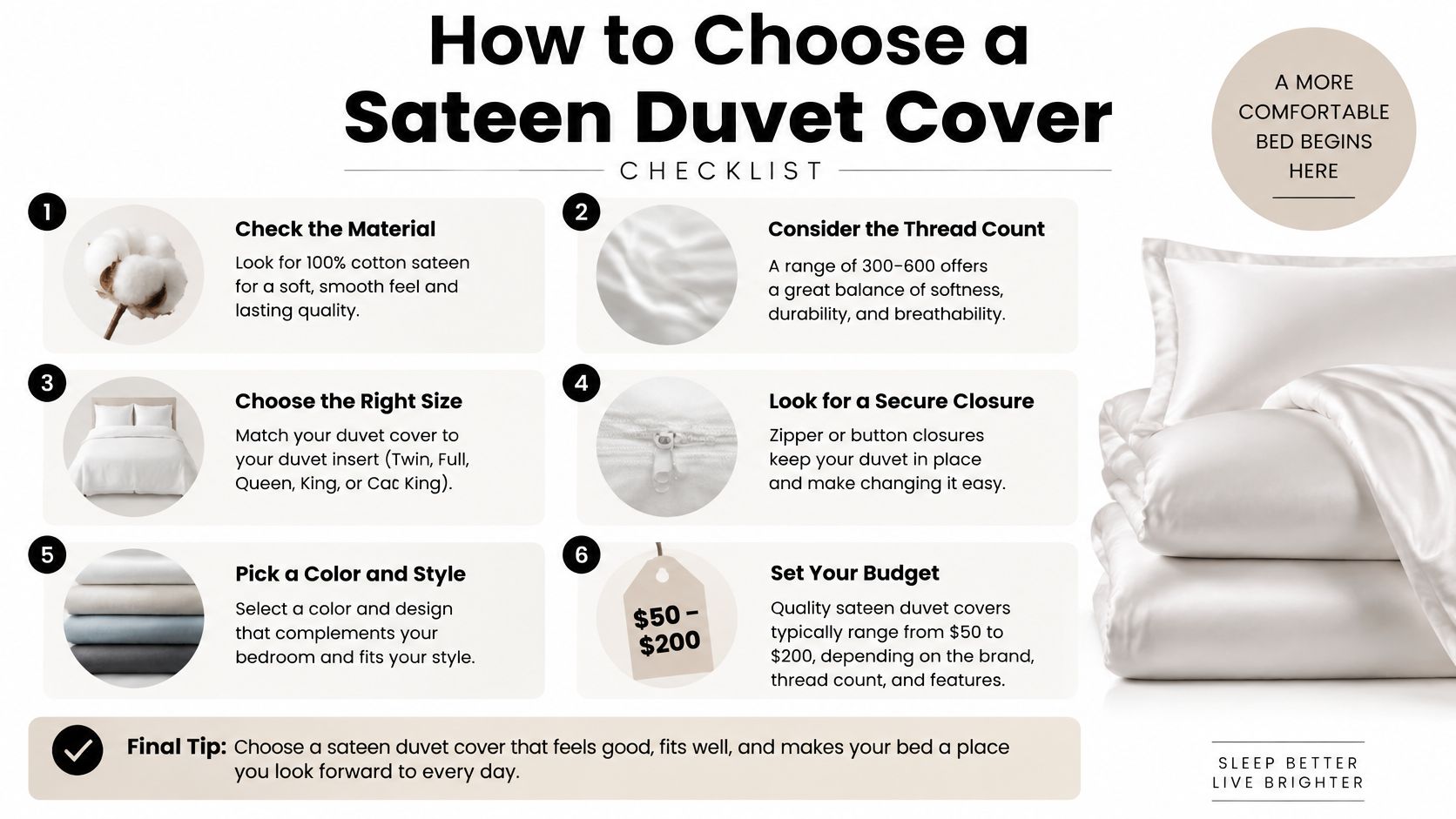
This checklist condenses the checks below into a quick reference you can keep open while you shop.
The Product Page Checklist
- Verified fiber content: Look for cotton stated plainly on the label, not just a satin look in the photo. Fiber decides moisture handling and heat response.
- Fiber quality cues: Long staple or extra long staple wording, when stated, points toward smoother yarns and a cleaner surface.
- Fabric weight: Match it to your sleeper type and insert, using the pairings from the climate section above.
- Seams and closure: Reinforced seams, plus a zipper, buttons, or flap you'll use without a fight on laundry day.
- Corner ties: Confirm they're there, especially for a restless sleeper or an adjustable base.
- Care instructions: Guidance that limits high heat and hard mechanical action protects those long floats you paid for.
What Certification Does and Doesn't Say
For bedding that sits against your skin for hours, OEKO-TEX STANDARD 100 is a chemical safety screen, and it's worth understanding precisely. The system tests the finished textile and its components, including thread, buttons, and zippers, against a catalogue of more than 1,000 potentially harmful substances, and bedding is evaluated under close contact requirements, as set out in the OEKO-TEX STANDARD 100 certification overview.
Two limits matter. Certification has to be on the finished duvet cover, not assumed because a fiber or fabric supplier held it. And it isn't proof against pilling, shrinking, color loss, or seam failure, nor is it a complete sustainability certification. It answers the safety question well. It doesn't answer the durability question.
This is the territory Southshore Fine Linens works in, as a premium home textiles brand focused on oversized bedding for modern deep mattresses, with attention to craftsmanship, wash after wash durability, and OEKO-TEX certified textiles where noted. That's a sensible fit for homeowners, rental hosts, and gift buyers who want hotel level comfort without guessing at dimensions.
Run the checklist, check the finished product certification, and the smooth photo becomes a verifiable spec sheet.
Your Next Step Toward a Better Made Bed
Don't start by browsing more photos. Start with a tape measure tonight. Measure your insert flat, edge to edge. Then measure your mattress width and depth, and decide how far you want the cover to drop over each side.
That takes a few minutes, and it changes every choice after it. You'll know whether a standard size covers your bed or whether you need an oversized cut. You'll know if corner ties are optional for you or essential. And you'll stop paying for a size name that was never a promise.
Put the Three Decisions Together
With measurements in hand, pick the system as a whole. Choose a cotton sateen duvet cover whose weight matches how warm you sleep and whose insert pairing makes sense for your room. Confirm the closure is one you'll use happily every laundry day, because a cover that's annoying to close ends up half fastened and shifting.
Two small habits protect the result. Wash gently and limit high heat, since that care protects the long floats that create the sheen you liked in the first place. And treat certification on the finished cover as what it is, a safety check for prolonged skin contact rather than a softness claim.
Where This Matters Most
This approach pays off fastest on the beds that frustrate people most. Oversized and extra deep mattresses stop looking underdressed. Guest rooms get a cover that still looks composed after frequent washing. A housewarming or wedding gift lands as something the couple can use on their real bed, not just admire in the wrapping.
None of this requires expertise. It requires three honest inputs: how the fabric is woven, how warm you sleep, and what your bed measures.
When those three line up, the cover looks lustrous in daylight, stays put through the night, and feels like the best part of the day. That's not the word sateen doing the work. That's you choosing weave, climate, and fit together, on purpose.
Measure your insert and mattress tonight, then browse the oversized, deep fitting bedding at SouthShore Fine Linens, where cotton sateen duvet cover sets come with practical closures and corner ties for beds that don't fit standard labels. Bring your dimensions and your sleeper type, and you'll leave with a cover that's sized to your bed and weighted for your night, not just pretty in a photo.


