
Oversized King Bedding Dimensions: The Essential Size Guide
You've found the perfect oversized comforter, ordered the matching sheets, and waited for delivery. Then you spread the fitted sheet across the mattress and discover that the corners won't reach, the flat sheet leaves exposed fabric at the sides, or the comforter looks strangely undersized. The problem usually isn't the quality of the bedding. It's the assumption that “oversized king” describes one universal mattress size.
For a reliable fit, treat the phrase as a category, not a measurement. The mattress's actual width, length, and height determine which sheets, quilts, duvet covers, and comforters will work.
The Oversized King Bedding Dimensions Trap
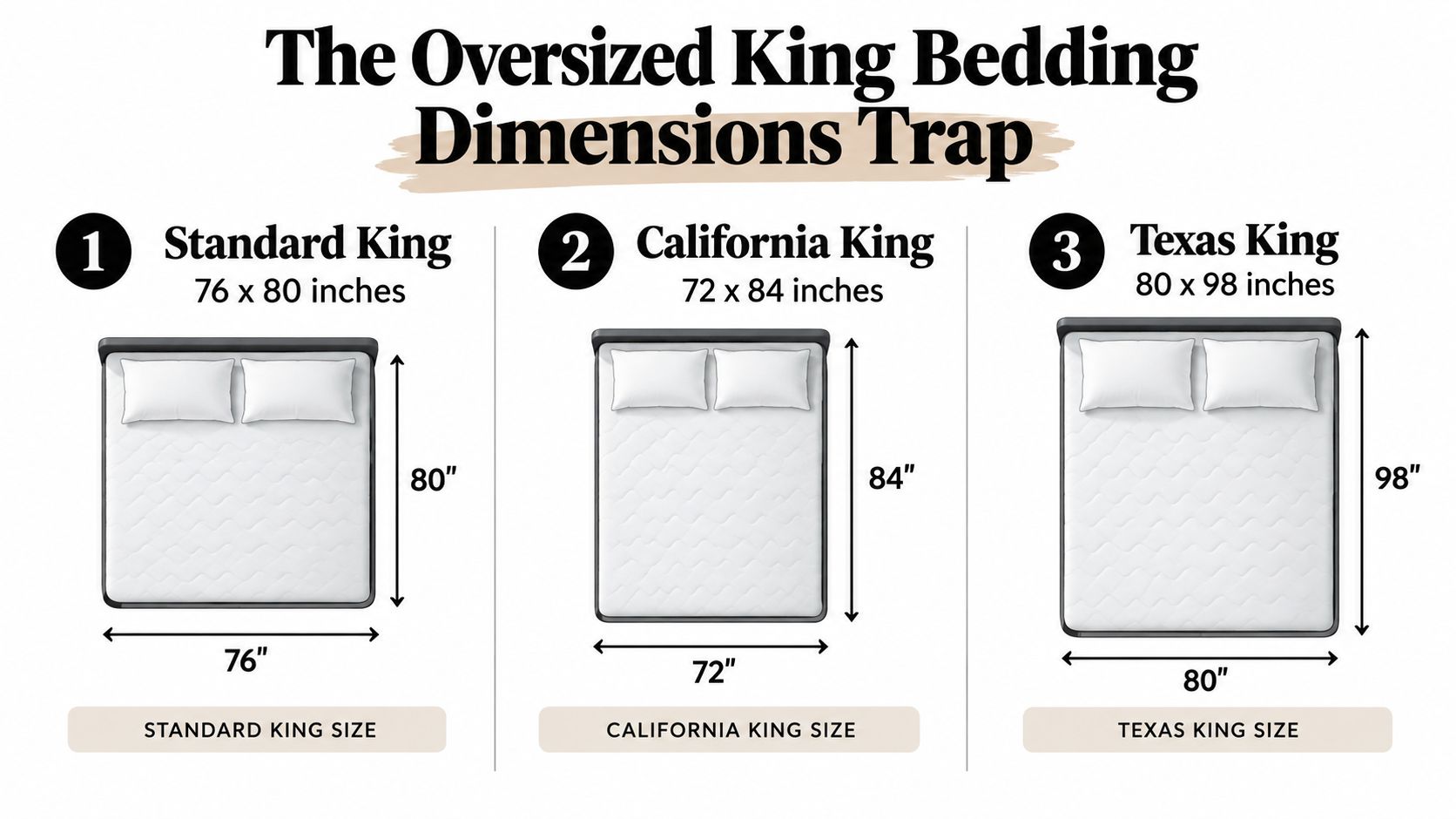
The phrase oversized king sounds specific enough to guide a purchase. In practice, it can describe several very different footprints. A standard U.S. king is commonly listed at 76 by 80 inches, while oversized formats may be square, unusually long, or larger in both directions, as shown in this mattress size guide from NCOA.
That difference becomes painfully obvious when a fitted sheet arrives. A sheet designed for a conventional king mattress has a fixed shape and perimeter. It isn't a stretchy blanket that can absorb a major difference in width or length. If the mattress is longer than expected, the sheet may pull away from the head or foot. If it's wider, the corners can strain, loosen, or pop free during the night.
Why the name causes expensive mistakes
Retailers and manufacturers don't always use oversized terminology in the same way. Common names include Wyoming king, Vermont or Alberta king, Texas king, and Alaskan king, but those names don't guarantee an identical finished mattress size across every maker. A shopper who orders by name alone may receive bedding that technically says “king” on the packaging but doesn't suit the bed in the room.
The visual consequences matter, too. Bedding that's too small exposes the mattress edges and interrupts the layered appearance many people want from a large bed. Bedding that's too large can drag, bunch, or create excessive fabric around the sleeper. Both problems can lead to exchanges, custom alterations, or an expensive purchase that never looks settled.
Practical rule: If a product page doesn't publish the finished bedding dimensions and the intended mattress dimensions, don't order based on the phrase “oversized king” alone.
Some shoppers also compare oversized formats with less familiar regional names. A resource such as this guide to Florida King sales can help broaden your vocabulary, but the purchasing decision should still come down to the measurements of your own mattress. The label can help you search. It shouldn't replace a tape measure.
The safest approach is simple. Measure the mattress surface, measure its depth with the topper in place, and then compare those measurements with the product specifications. That habit prevents the most common mismatch before money changes hands.
Standard vs Custom Mattress Dimensions
An oversized king mattress isn't defined by one official footprint. It's better understood as a group of unusually large mattress formats that differ in shape as well as size. Some are square, while others extend the length for sleepers who want more room from head to foot.
The familiar standard king provides a useful reference point. From there, the oversized formats below show why a single “king” sheet category can't serve every bed.
The dimensions and calculated floor areas in this chart are based on the NCOA mattress size reference. Square footage is calculated from the listed mattress width and length, so it describes the mattress surface rather than the amount of fabric needed for bedding.
| Mattress Type | Width (Inches) | Length (Inches) | Square Footage |
|---|---|---|---|
| Standard King | 76 | 80 | 42.2 |
| Wyoming King | 84 | 84 | 49 |
| Vermont or Alberta King | 96 | 96 | 64 |
| Texas King | 80 | 98 | 54.4 |
| Alaskan King | 108 | 108 | 81 |
Shape changes the bedding decision
A Wyoming king and an Alaskan king are both square, but they aren't interchangeable. Their surface proportions are similar in shape, yet their overall dimensions are materially different. A fitted sheet cut for one won't automatically fit the other, and a flat sheet designed for the smaller square mattress may not provide the coverage or tuck needed on the larger one.
The Texas king creates a different problem. Its length makes it a long rectangle rather than a square. That means a comforter or quilt that looks balanced on a square mattress may not distribute its side and foot drop evenly on a Texas configuration. The textile needs to follow the bed's proportions, not just its general category.
A larger label doesn't guarantee a better fit. A square mattress and a long rectangular mattress need different textile proportions, even when both are sold as oversized kings.
Before planning the room, use a practical guide to sizing a mattress for your home to consider access, circulation, and furniture placement. A mattress that fits on paper may still dominate the room once a frame, foundation, bedding, and walking space are added.
For a closer look at how these formats affect shopping decisions, use SouthShore's oversized bed sizes guide. The central lesson remains the same: identify the actual mattress footprint first. Only then should you choose a sheet set or top layer.
How to Measure Your Bed Accurately
Measure the bed as it will be used, not as it looked when it arrived in the room. A topper, pillow-top layer, mattress protector, or adjustable base can change the fit that bedding needs to accommodate.
Start with a firm tape measure, a notepad, and another person if the mattress is difficult to reach. Remove loose blankets and pillows, but leave any permanent topper or pad that will remain under the sheets.
Record the mattress footprint
Measure the mattress from one finished side edge to the opposite side edge. Keep the tape straight across the surface rather than following a curve or compressing a rounded border. Record the width.
Next, measure from the head edge to the foot edge. Again, measure the finished surface, not the bed frame or the exposed platform. Record the length separately from the width, even if the mattress appears square.
Those two measurements identify the footprint. They also reveal whether the bed is a square oversized format or a longer rectangular one, which affects the proportions of flat sheets, quilts, and comforters.
Measure the usable depth
For fitted sheets, measure from the top of the sleeping surface down to the bottom edge of the mattress. Include the topper, mattress pad, or protector that will sit beneath the sheet. Don't measure only the mattress label or the visible sidewall if another layer adds height.
A useful reference is this step-by-step guide to measuring mattress depth. The important point is to measure the complete stack, because the fitted sheet must travel over every layer before its elastic can secure beneath the mattress.
If the mattress sits on a foundation, don't add the foundation height to the sheet depth. Sheets fit around the mattress stack, not around the entire bed assembly. For a quilt or comforter, however, the foundation and frame influence the finished appearance because they affect how far the top layer hangs visually.
Write down the shopping specifications
Keep a short record with three separate details:
- Mattress width and length: Use the measured sleep surface, not just the product name.
- Total sheet depth: Include the topper, pad, and protector that stay on the bed.
- Desired drop: Decide how much fabric you want to hang over the sides and foot.
This record turns an ambiguous search into a clear product comparison. It also gives a retailer the information needed to recommend a custom size when a standard oversized option doesn't match.
Selecting Proper Sheet Pocket Depths
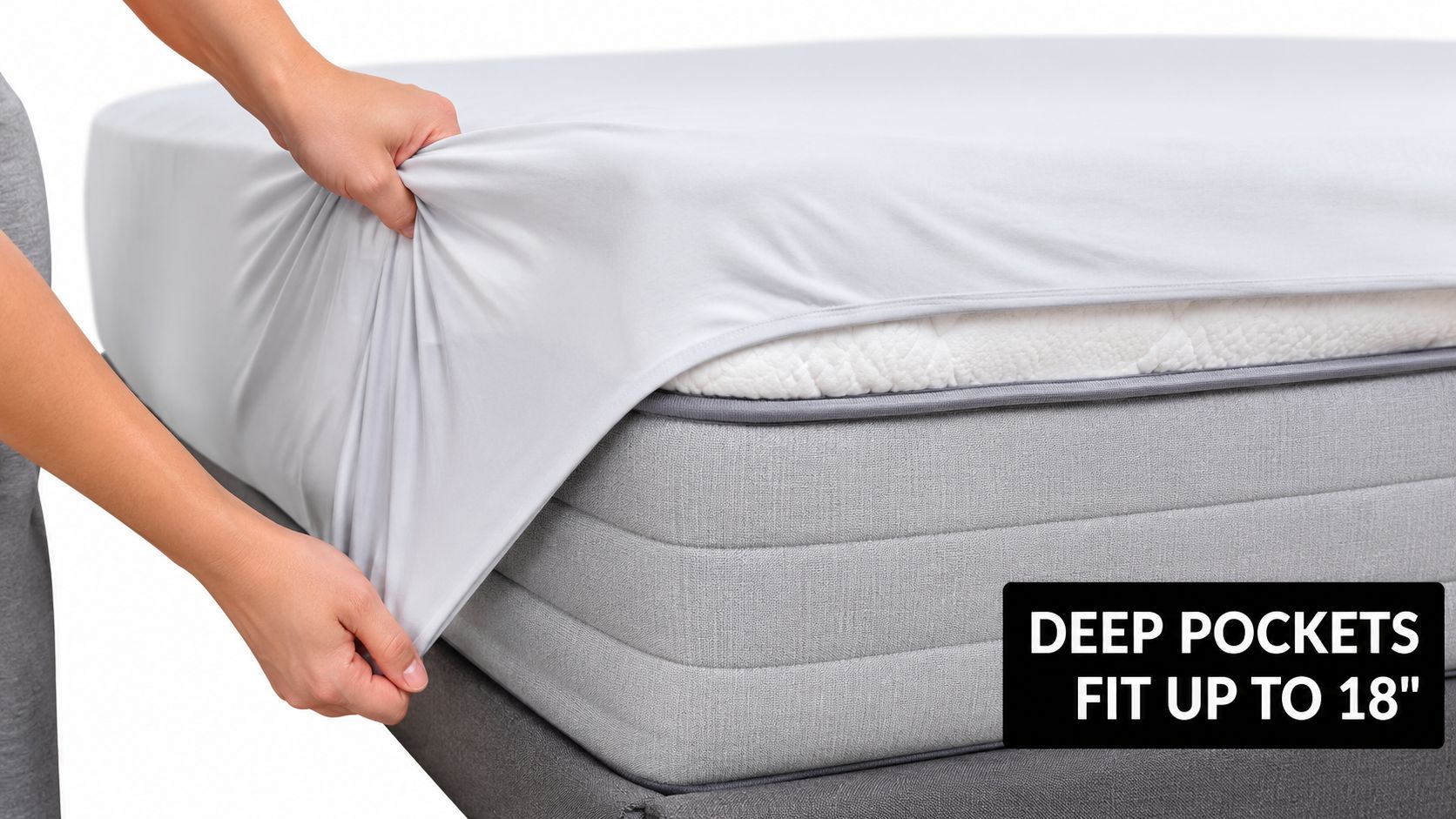
A fitted sheet succeeds or fails at the mattress edge. Its pocket must be deep enough to pass over the complete mattress stack and tuck beneath the lower edge without pulling the corners upward.
The calculation is straightforward in principle. Start with the mattress depth, add the height of the topper and any substantial pad, then allow enough fabric to reach beneath the mattress. The extra allowance isn't decorative. It gives the elastic somewhere to grip and leaves room for movement when sleepers get in and out of bed.
Match the pocket to the full stack
A sheet can have the correct oversized king footprint and still be the wrong product if its pocket is too shallow. The width and length determine whether the sheet reaches the corners. The pocket depth determines whether it stays there.
This is why a mattress protector matters during measurement. If you buy the sheet before adding the protector, the final layer may increase the stack enough to create tension. The sheet may look acceptable when first installed, then pull loose as the fabric shifts overnight.
Avoid choosing the deepest available pocket automatically. Excess fabric can fold beneath the mattress, create ridges, and make corner alignment harder. The right pocket is the one that covers the actual stack with a secure, smooth tuck.
Inspect the construction, not just the label
Elastic design affects performance. A fitted sheet with elastic around the full perimeter generally has more consistent control than one with elastic only at the corners, particularly on a very large mattress. Corner bands can add useful reinforcement, but they won't correct a footprint that is too small or a pocket that lacks depth.
Fabric behavior matters as well. A woven sheet needs enough give and usable cut dimensions to move over the mattress without excessive strain. Stretch can help with installation, but it can't make an incompatible footprint fit. A sheet built for a smaller width won't become an oversized sheet because the fabric has some elasticity.
Look closely at the corners and seams. Strong, clean stitching helps the sheet withstand repeated removal and washing. If the seam puckers sharply when the corner is stretched, the construction may be working too hard even if the sheet initially fits.
Fit test: Install the fitted sheet with the topper and protector in place, then check every corner after the mattress has been slept on. A correct fit stays anchored without forcing the sheet into a strained, diagonal position.
For a difficult-to-source mattress, compare standalone fitted sheets with complete sets. Buying pieces separately can make sense when the fitted sheet needs a specialized pocket but the flat sheet or pillowcases can follow a more flexible specification. The best choice depends on the measured footprint and the way you use the bed, not on whether a package looks convenient.
Choosing the Right Comforter and Duvet Size
Top layers need a different measurement logic from fitted sheets. A fitted sheet must grip the mattress. A comforter or duvet must cover the sleeping surface, fall over the sides, and often extend toward the foot of the bed with an intentional drop.
Drop is the distance from the top of the mattress to the lower edge of the comforter or quilt. It includes the mattress height and the amount of fabric you want to hang below it. A top layer sized only to the sleep surface can leave the sides exposed, especially when the mattress is tall or sits on a prominent foundation.
Choose coverage before decoration
Start with the mattress width and length. Then consider the height of the mattress stack and the desired side and foot coverage. A square mattress may need a broad square or carefully proportioned rectangular top layer, while a long Texas configuration needs enough length to cover the extended foot without making the sides look skimpy.
The most common mistake is to select a standard king comforter because the bed contains the word “king” in its description. On an oversized mattress, that top layer may sit like a narrow rectangle across a much larger surface. It can cover the sleeper while still looking visually incomplete.
A larger comforter isn't automatically better either. Excess fabric can pool on the floor, obscure a footboard, or become difficult to wash and fold. The right size balances practical coverage with the room's furniture and the sleeper's preference for a tucked or relaxed finish.
Build a layered, balanced bed
Designers often create scale by combining a primary comforter or duvet with a quilt or coverlet. The lighter layer can provide a structured foundation, while the fuller top layer adds softness and volume. On an oversized bed, each piece should relate to the mattress proportions rather than appear as a small accent placed in the middle.
A duvet cover also needs to accommodate its insert. If the cover is noticeably smaller than the insert, the filling can bunch and leave thin areas near the edges. If the cover is much larger, the insert can shift inside it. Check the finished cover dimensions and the insert dimensions independently.
For more guidance on selecting a proportionate top layer, consult this king duvet size guide. Use it as a starting point, then compare its recommendations with your own mattress measurements and preferred drop.
Let the room determine the finish
A large bed can support a generous, relaxed drape in a spacious room. In a tighter room, a more controlled drop may protect walkways and keep the bedding from visually overwhelming the frame. The bed's height, headboard, footboard, bench, and nearby furniture all affect the final result.
For a polished appearance, center the top layer by the mattress, not by the room. Check that the side drops look reasonably even, then assess the foot coverage from the doorway and from the sleeping position. A comforter can be technically large enough yet still look unbalanced if its shape doesn't suit the mattress.
Application for Homeowners and Designers
Correct oversized king bedding dimensions improve more than the way a bed looks. They affect nightly comfort, laundry decisions, room planning, and the experience of anyone who sleeps on the bed. When the fitted sheet stays anchored and the top layer has an intentional drop, the bed feels finished rather than improvised.
Homeowners should begin with the same information a designer or hospitality manager needs: the actual mattress footprint, the complete mattress depth, and the desired appearance. A product name can narrow the search, but it can't replace those details.
Make the room work around the mattress
An oversized mattress affects circulation and furniture scale. Leave enough room to make the bed, remove fitted sheets, and walk around the sides without catching the bedding on a nightstand or bench. A generous comforter drop can make the mattress feel larger still, so evaluate the full dressed bed rather than planning around the bare mattress.
Designers should also consider visual weight. Square mattresses often benefit from bedding that emphasizes their broad footprint, while long rectangular mattresses look more settled when the top layer follows their length. Neutral quilts, textured covers, and contrasting throws can add depth, but decorative layers won't solve an incorrect base size.
Hospitality settings have an additional concern. Guests don't install bedding carefully every morning, and housekeeping teams need linens that can be removed, washed, and replaced without a struggle. A fitted sheet that barely reaches the corners creates avoidable work. A comforter that shifts or exposes the mattress can make a room look poorly maintained even when every other detail is right.
Use this purchasing checklist
Before ordering any oversized bedding, confirm each point:
- Measure the mattress surface: Record the finished width and length independently.
- Identify the shape: Decide whether the bed is square or longer in one direction.
- Measure the complete depth: Include the topper, pad, and protector used beneath the sheet.
- Choose the fitted-sheet pocket: Match the pocket to the full stack, with enough material to tuck securely.
- Check finished product dimensions: Don't rely on “oversized king,” “king,” or a regional name without measurements.
- Plan the drop: Decide how far a quilt, comforter, or duvet should fall at the sides and foot.
- Review the return terms: Custom or specialized bedding may have different exchange conditions.
- Consider separate pieces: A fitted sheet, flat sheet, quilt, and duvet cover may each need a different specification.
- Check care requirements: Make sure the finished bedding can be washed and dried using the equipment available.
Precision is part of comfort. The right fabric cannot compensate for the wrong dimensions.
SouthShore Fine Linens offers oversized king flat sheets, quilts, comforters, and extra-deep-pocket bedding with stated product dimensions, giving shoppers another option to compare against their measured mattress and preferred coverage. For designers and hosts, that dimension-first approach makes it easier to coordinate layers without treating every oversized bed as if it had the same footprint.
Take the measurements before browsing colors. Once the width, length, depth, and desired drop are written down, you can compare products with confidence and avoid buying a beautiful set that never fits the bed.
SouthShore Fine Linens offers oversized and extra-deep-pocket bedding designed for large mattresses, toppers, and layered bedroom setups. Visit SouthShore Fine Linens to compare stated dimensions and choose sheets, quilts, and comforters that match your measured bed.


