
Modern Quilt Bedding Sets: The Ultimate Guide
You've found the quilt you like. The color is right, the stitching looks considered, and the bed in the product photo appears calm and inviting. Then you put it on your own mattress and discover the actual problems: the fitted sheet pulls loose, the quilt barely reaches the sides, and "all-season" tells you nothing about whether you'll wake up hot.
Modern quilt bedding sets work best when you treat them as functional sleep systems, not decorative purchases. The fabric, fill, stitching, mattress depth, sheets, sleepwear, and bedroom temperature all influence how the bed feels. Get those details right, and the result is a room that looks intentional and a bed you'll want to use every night.
Why Modern Quilt Bedding Sets Transform Your Sleep Space
A bed can look finished in a showroom and still sleep poorly at home. The problems usually appear after the first night: a quilt that stops short of the mattress edges, layers that bunch under the sleeper, or insulation that feels too warm for the room. A modern quilt bedding set earns its place by working as a complete sleep system, with fit, fabric, fill, and warmth considered together.
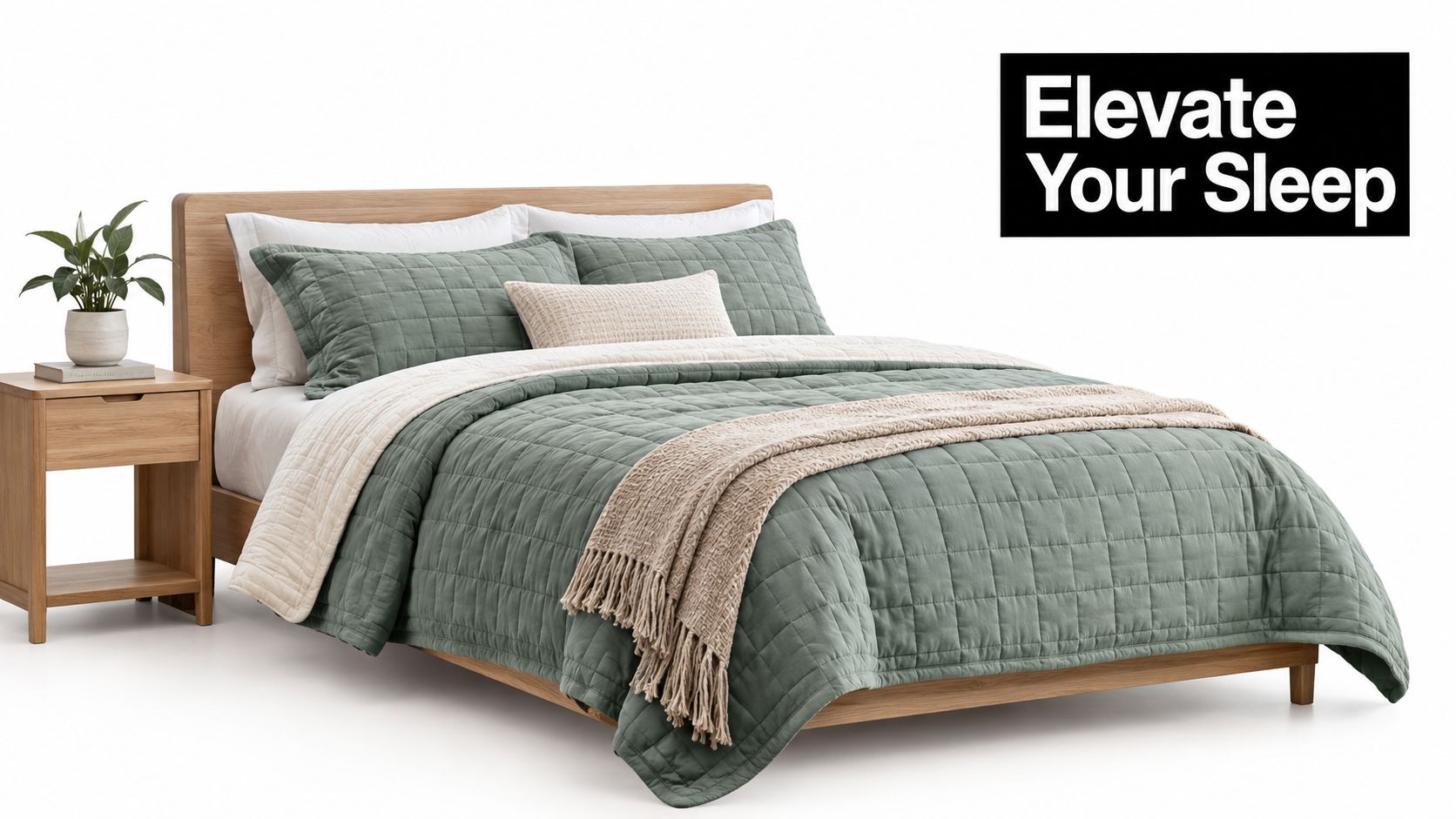
The practical difference is in the layering
A quilt provides a stable top layer with texture built into its construction. It can cover a sheet on mild nights, fold at the foot of the bed, or sit beneath a warmer blanket when temperatures fall. The stitched layers also keep the fill distributed, so the surface feels more consistent than a loose, shifting coverlet.
Warmth depends on the whole setup. Match the quilt's fill and clo rating to your bedroom temperature, sleep habits, and other layers rather than choosing by appearance alone. A lightweight quilt may suit warm sleepers or a heated room, while a denser option can reduce the need for several separate blankets. Mattress depth matters too. A set that does not provide enough drop will pull upward when you move, leaving the sides exposed.
Quilting also has a meaningful design history. During the late twentieth century, it developed from primarily domestic craft into recognized modern art and design practice. The U.S. quilting revival helped establish quilting as a major cultural activity, with more than 20 million people participating in the United States alone, as reported by PBS North Carolina's account of the American quilt revival.
That history remains visible in current bedding through minimalist palettes, oversized proportions, machine quilting, and fashion-oriented patterns. These choices give a set visual character without making it impractical for regular use.
Practical rule: Choose the quilt for your sleep temperature and mattress first, then select the color and pattern.
A coordinated set can also simplify furnishing a bedroom or choosing a practical housewarming gift. A new home gift registry guide can help organize bedding alongside other household items. The useful choice is the set that fits correctly, washes well, and stays comfortable night after night.
Quilt vs Duvet Cover What You Actually Need
A quilt is a finished, stitched textile made from a top layer, batting, and backing. The stitching holds those layers together, giving the piece structure and preventing the inner material from shifting freely. A duvet cover is a removable shell, usually shaped like an oversized envelope, that houses a separate duvet insert.
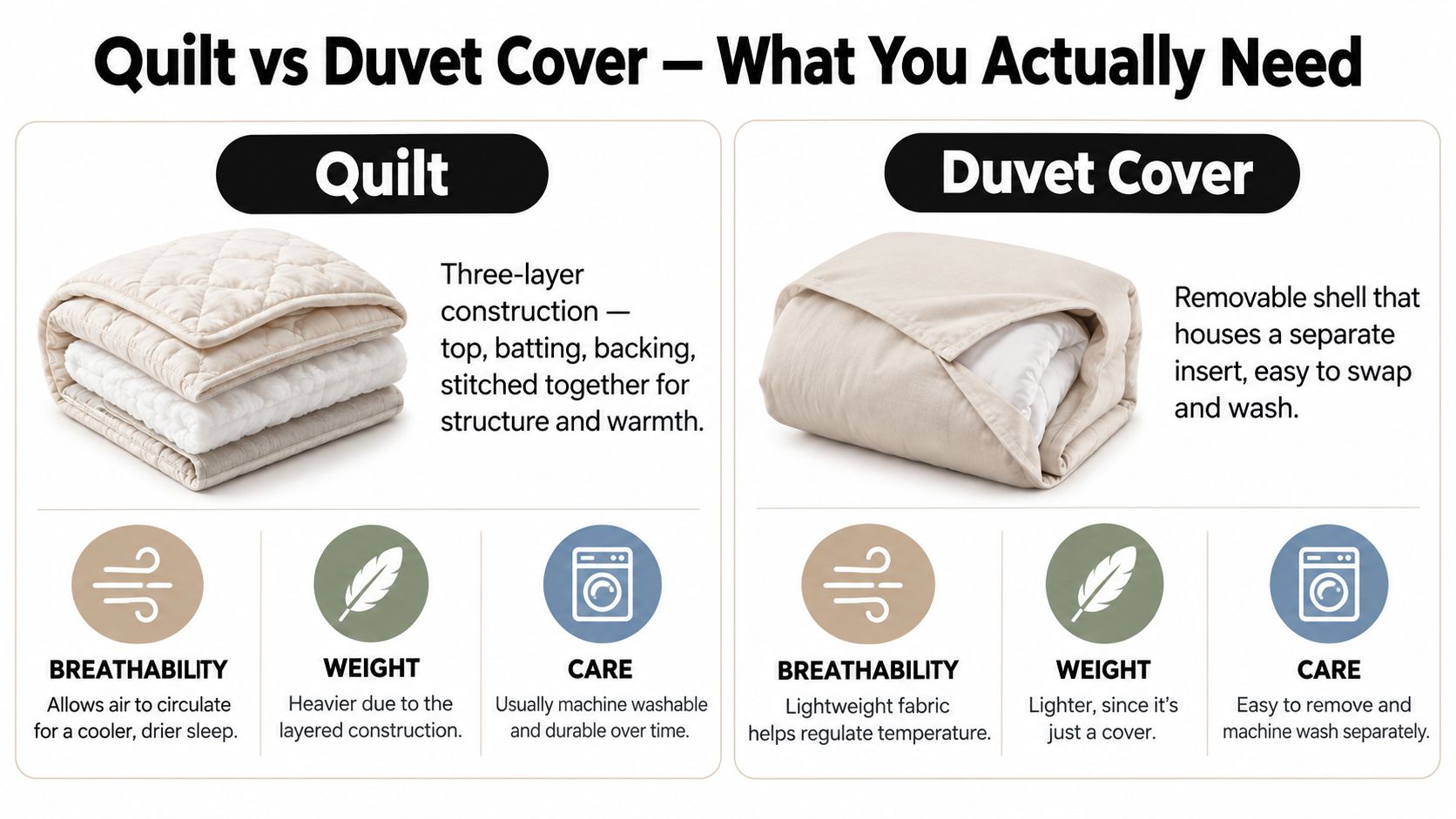
The distinction changes how you build and maintain the bed.
| Feature | Quilt | Duvet cover |
|---|---|---|
| Construction | Top, batting, and backing stitched together | Removable shell around a separate insert |
| Daily use | Ready to place on the bed | Requires an insert to provide most of its warmth |
| Layering | Adds controlled texture and moderate insulation | Lets you change inserts for different conditions |
| Care | The complete textile is washed | The cover is washed separately from the insert |
| Best fit | Simple, structured beds and easy layering | Flexible warmth and frequent style changes |
When a quilt makes more sense
A quilt suits sleepers who want a bed covering that's easy to spread, fold, and combine with other layers. Its stitched construction keeps the surface orderly, while the lower profile often feels less cumbersome than a large duvet insert. It's also a practical choice for guest rooms, children's rooms, and households that prefer a straightforward laundry routine.
The trade-off is flexibility. You can't change the fill inside a quilt when the seasons change, so you'll need to add or remove layers instead. A quilt may also feel too light for someone who wants a lofty, enveloping cover.
When a duvet cover earns its place
A duvet cover works well when you want to keep several inserts available or change the bedroom's appearance without replacing the main blanket. The shell can be washed independently, but putting the insert back inside takes more effort, and the cover can bunch if its internal ties or corner fit aren't secure.
A quilt and duvet aren't competing versions of the same product. They solve different problems. For a broader explanation of how mattress protectors, comforters, and bedding layers interact, consult this bedding and mattress protectors guide.
Fabrics Fills and the Science of Comfort
Material labels tell you what a quilt contains, but they don't tell you exactly how it will feel on your bed. Cotton remains commercially important in quilt bedding, particularly for residential use. One global quilt market estimate identified cotton as the largest material segment, accounting for 38.4% of 2025 revenue, or approximately $2.61 billion, as reported in Grand View Research's home-textiles market analysis. That figure is a market indicator, not a guarantee that every cotton quilt will feel breathable or durable.
The weave, finish, batting, and stitch density matter just as much. A tightly woven cotton shell can feel smooth and substantial. A looser weave may feel more relaxed but can require gentler handling. Cotton batting tends to create a flatter, more natural hand, while loftier synthetic or blended fills can produce a puffier appearance and a warmer feel without necessarily making the quilt heavier in proportion.
Read the construction, not just the fiber label
Look for a shell that feels even and stable, with stitching that holds the batting in place without creating stiff ridges. Very dense quilting can reduce loft and produce a firmer hand. Wider quilting channels may allow more loft, but they also make the fill's stability and wash performance more important.
The practical material questions are simple:
- Shell: Does it feel smooth, crisp, brushed, or textured against the skin?
- Fill: Is the goal a flatter layer, visible loft, or flexible warmth?
- Stitching: Does the pattern secure the interior without making the surface rigid?
- Care: Can the complete quilt be washed in the equipment you have?
For a closer look at selecting a shell based on hand feel, weave, and use, read this guide to choosing quilt fabric.
Warmth belongs to the whole bed
“Lightweight” and “all-season” are useful starting labels, but they aren't precise sleep instructions. Bedding research examined 84 combinations involving posture, sleepwear, quilt type, room temperature, and body coverage. Total thermal insulation ranged from 1.06 to 5.71 clo, showing that the quilt alone doesn't determine warmth. The findings are summarized in research on how bedding insulation affects sleep comfort.
Use your bedroom conditions as the starting point. A warm room, heat-retaining mattress, flannel sheets, pajamas, and full-body coverage can make a moderate quilt feel much warmer than it does in a cooler room with breathable sheets and partial coverage. A seasonal system using quilts of approximately 1, 2, and 5.5 clo has been proposed as a way to cover changing conditions, but you should treat those values as part of a system rather than a promise about one product.
The useful question isn't “Is this quilt all-season?” It's “What other layers will be on my bed when I use it?”
Sizing Guide for Deep Pockets and Mattresses
A quilt and a fitted sheet have different sizing problems. The fitted sheet must stretch over the mattress and remain anchored beneath it. The quilt must provide enough width and length to cover the mattress, clear the sides, and create the amount of drape you prefer.
Measure before you buy
Start with the mattress, not the label on the old sheet set.
- Measure the mattress width and length. Record the actual dimensions rather than relying only on Twin, Queen, or King terminology.
- Measure the mattress height. Include a topper or pillow-top layer if it stays on the bed.
- Measure the foundation or adjustable-base position. This affects how much side coverage looks balanced.
- Check the fitted-sheet pocket range. “Deep pocket” isn't a universal measurement. Compare the stated range with your mattress height.
- Decide on quilt drop. A narrow drop looks clean and fitted, while a fuller drop hides more of the mattress and foundation.
The most common mistake is buying a sheet with a pocket range that technically reaches the mattress but has no working allowance for movement. If the elastic is stretched to its limit, the sheet may pull loose when someone sits on the edge or changes position during the night.
Match proportions to the bed
Twin and Twin XL beds often need different lengths, so check the product dimensions rather than assuming the same quilt will work for both. Full and Queen sets may share a category, but their mattress widths and preferred drape can differ. King and California King also require careful attention to orientation, since the longer California King shape changes how the quilt falls at the foot and sides.
For a larger bed, the quilt should look generous without dragging on the floor or exposing the fitted sheet. A guide to king-size quilt measurements can help you compare the quilt's finished dimensions with your mattress and desired drop.
Fit check: If the quilt looks strained at the corners, sizing is the problem. Don't try to correct insufficient width by pulling the fabric tighter.
Styling Ideas for Every Bedroom Aesthetic
A modern quilt can anchor the room without forcing the entire design into one style. Begin with the bed's largest visual area, then limit the supporting layers to a small group of related colors and textures.
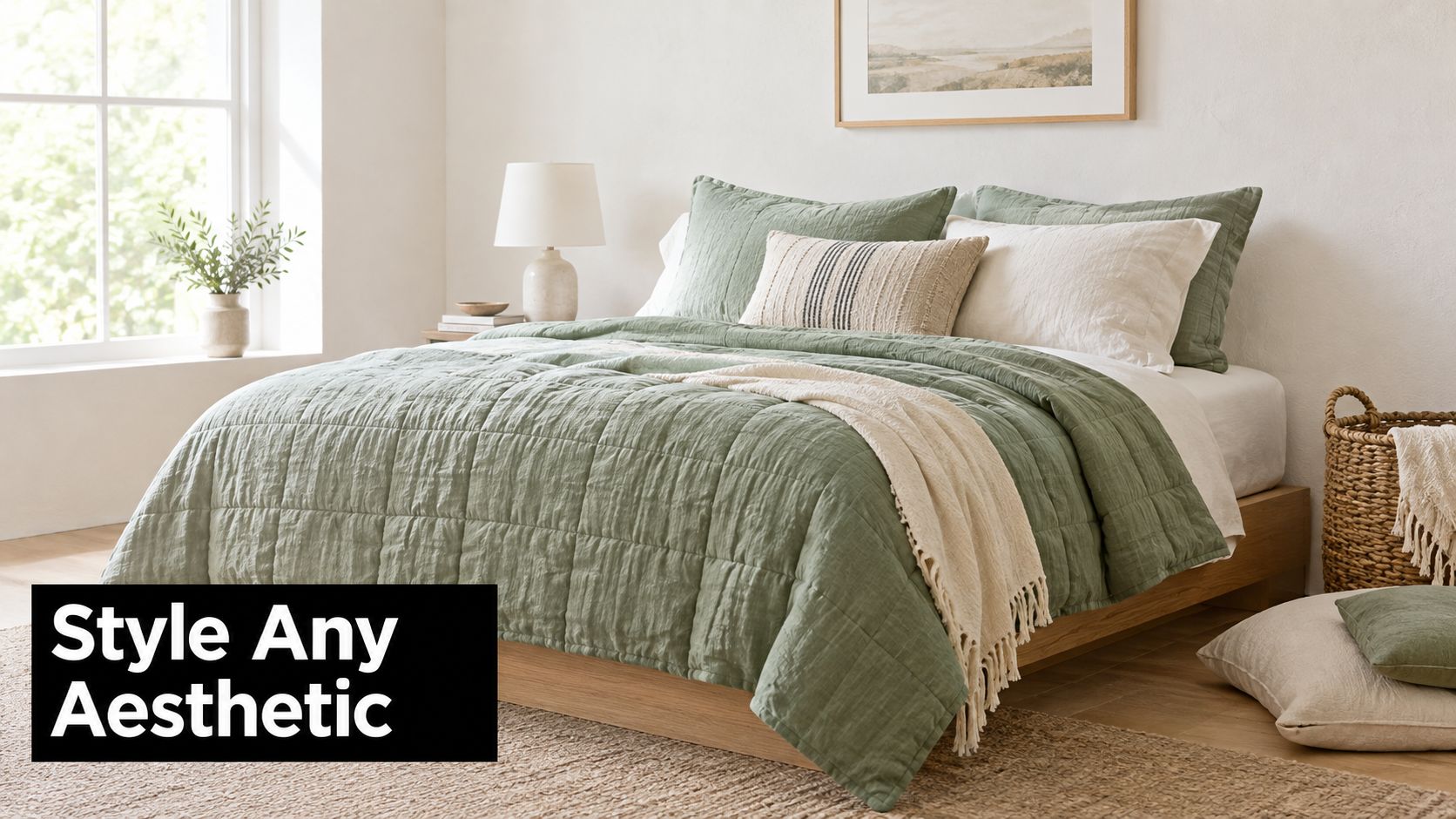
Build the palette around one decision
For modern minimalism, choose a quiet solid or restrained geometric quilt and let the stitching provide the visual interest. Pair it with plain sheets, one textural throw, and pillows in nearby tones. The room feels finished because each layer has a job, not because every surface carries a pattern.
For a relaxed coastal bedroom, use washed neutrals, muted blue-green tones, natural wood, and an open quilt fold at the foot of the bed. Keep the contrast gentle. Too many nautical motifs can make the room feel themed rather than calm.
Cottage-inspired rooms can handle a small-scale floral or traditional block pattern, especially when the surrounding furniture is simple. A contemporary quilt with a familiar structure can preserve warmth without making the bed look dated. For more guidance on combining hues and contrast, explore this modern quilt color schemes guide.
Add texture without losing order
Use a folded throw to introduce a second texture, not a competing pattern. Pillows should repeat one or two colors already present in the quilt, while a lumbar pillow can break up a row of square shapes. If the quilt has bold geometry, keep the throw plain. If the quilt is solid, a nubby or woven throw can add depth.
The SouthShore guide to quilts and bed covers offers another useful way to think about the top layer, particularly when deciding whether the quilt should cover the full bed or remain folded for seasonal flexibility.
The video below shows how a quilted layer can support a broader bedroom arrangement without becoming visual clutter.
Care Tips to Keep Your Quilt Looking New
A quilt lasts longer when washing, drying, and storage match its construction. Before cleaning, read the care label, inspect the stitching for loose threads, and close fasteners that might catch the surface.
Wash with the construction in mind
Use a gentle cycle, mild detergent, and a machine large enough for the quilt to move freely. An overloaded drum can twist the textile and strain the stitching. Wash with similar colors, and avoid bleach unless the manufacturer permits it.
Follow the label when drying. If a tumble dryer is suitable, choose a controlled setting and remove the quilt while it remains slightly damp. Finish drying it flat or across broad support. Excessive heat can cause shrinkage, weaken fibers, and leave some finishes brittle.
Small handling choices protect the bed's feel and appearance:
- Rotate the quilt: Turn or reverse it periodically so wear is distributed across the surface.
- Handle wet fabric carefully: Support the entire quilt instead of lifting a saturated corner.
- Treat spills promptly: Blot the area, then follow the care label rather than scrubbing.
- Store by season: Fold it loosely in a breathable fabric bag, away from sunlight and moisture.
Allow the quilt to dry completely before storage. Damp folds can encourage musty odors and affect the fabric or fill. Avoid compressing it under heavy items, since prolonged pressure can flatten the loft and leave permanent creases.
Modern construction methods have made durable bedding more accessible, but washing and storage still determine how long a quilt holds up. Accurate piecing, repeatable stitching, and suitable materials support longevity. Care keeps those advantages working through regular sleep, laundering, and seasonal changes.
Debunking Myths About Machine-Quilted Bedding
Machine quilting isn't automatically a shortcut, and hand quilting isn't automatically a guarantee of better performance. The relevant questions are whether the stitching is accurate, whether it secures the batting appropriately, and whether the finished textile suits the way you'll wash and use it.
Computerized sewing machines can repeat a pattern with consistent spacing. Longarm systems can cover a large surface efficiently while maintaining controlled tension. That consistency matters in bedding because uneven stitching can create weak areas, distort the surface, or allow the interior layers to shift.
Luxury comes from the finished experience
A luxurious quilt feels balanced in the hand, lies smoothly, and keeps its shape through ordinary use. Those qualities can come from thoughtful fabric selection, appropriate batting, careful edge finishing, and a quilting pattern that supports the intended drape. They don't depend solely on whether every stitch was made by hand.
Machine quilting also makes certain geometric and contemporary designs practical at production scale. That suits modern quilt bedding sets, which often combine traditional visual references with clean lines and repeatable construction.
The common failure is not machine quilting itself. It's poor material selection, loose finishing, rough seams, or a fill that doesn't match the intended warmth. Judge the completed quilt, not the romantic story attached to its production method.
How to Choose the Right Quilt for Your Lifestyle
A quilt can look right on the bed and still sleep poorly. Start with the conditions that are difficult to change later: measure the mattress, include any topper, note the bedroom temperature, and decide whether you usually sleep hot, cold, or somewhere between. Then match the quilt's warmth, construction, and care requirements to your routine.
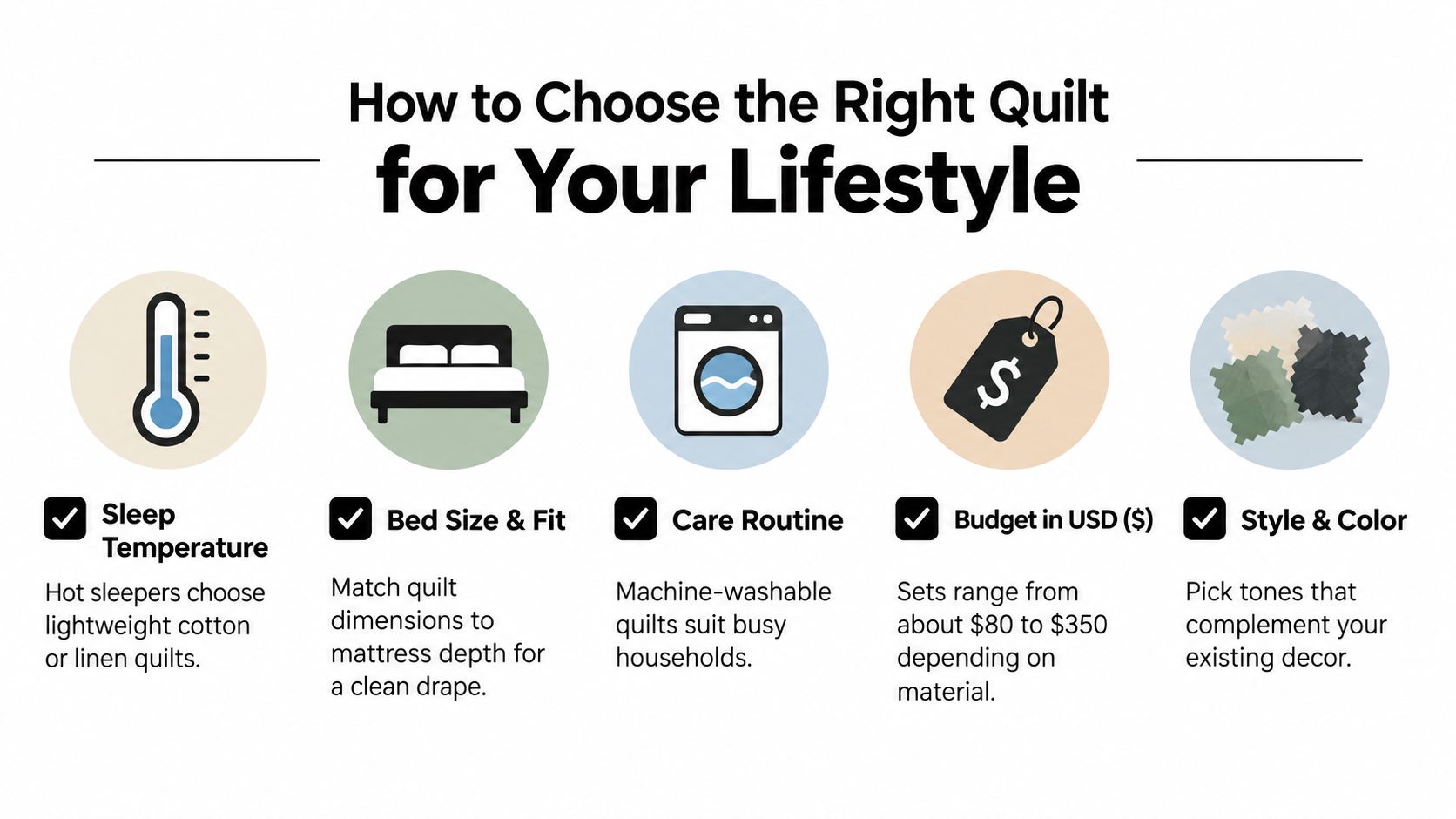
Use this buying sequence
- Set the warmth target. If you wake overheated, start with lower loft and breathable sheets. If you sleep cold, choose a quilt that leaves room for an additional blanket instead of immediately selecting the bulkiest fill.
- Measure mattress depth. Include toppers and protectors when checking fitted-sheet pocket ranges. Choose the quilt by its finished dimensions and the drop you want at the sides.
- Inspect fabric and fill. A smooth cotton surface, textured weave, flatter natural batting, and higher-loft easy-care fill create different sleeping experiences. Judge hand feel, breathability, weight, and expected drape together.
- Match care to the household. Machine-washable construction suits busy homes, guest rooms, children's rooms, and short-term rentals, provided the washer and dryer can handle the quilt without crowding.
- Read safety and sustainability claims precisely. Chemical-safety certification, organic-fiber certification, recycled-content verification, and labor or supply-chain claims address different concerns. “OEKO-TEX certified” does not mean “organic,” and natural fiber does not automatically have the lowest impact across its full lifecycle.
Market estimates also reflect quilts' role as everyday home textiles rather than occasional craft pieces. One estimate placed the global quilt market at $6.8 billion in 2025, with a projection of $16.2 billion by 2034. A separate estimate placed the broader home-textiles market at $137.8 billion in 2025. These estimates use different scopes and methods, so treat them as directional context rather than directly comparable figures. Online sales accounted for 41.3% of the quilt market estimate, making dimension, material, and care checks especially important before ordering.
Choose a set for your actual nights, not the most impressive product photograph. SouthShore Fine Linens offers machine-washable sets with coordinated pillow shams, modern patterns, and sizes including Twin/Twin XL, Full/Queen, and King/California King.
SouthShore Fine Linens offers modern quilt bedding sets focused on practical fit, coordinated styling, and everyday care, including options for deeper contemporary mattresses. Visit SouthShore Fine Linens to compare collections against your warmth preference, bed dimensions, and maintenance routine.


