
Microfiber Queen Sheets: Comfort, Care, and Quality
Microfiber queen sheets are a soft, affordable, durable synthetic bedding option, typically made from polyester, and global synthetic-fiber production reached approximately 62 million metric tons by 2019. They can deliver a smooth, hotel-like feel with easy care, but their comfort, fit, durability, and environmental trade-offs depend on how the fabric is constructed and laundered.
You've upgraded the mattress, arranged the pillows, and now the old sheets look strangely out of place. The queen-size bed deserves something that feels polished without demanding a complicated laundry routine or a premium budget. That's where microfiber queen sheets often enter the search.
The label sounds technical, but the buying decision doesn't need to be. You mainly need to understand what microfiber means, how the weave affects comfort, which fit details matter, and how your washing habits influence the fabric over time.
The Quest for the Perfect Queen Sheets
Maya had a familiar problem. Her new queen mattress felt supportive, but the sheets she already owned slipped at the corners and left a loose ridge across the middle of the bed. She wanted the smooth appearance of a hotel room without learning an entirely new system of bedding care.
At the store, she compared cotton, linen, and microfiber. Cotton felt familiar, linen looked relaxed, and microfiber felt immediately soft beneath her hand. The microfiber set also promised the practical features she cared about most: simple washing, quick everyday upkeep, and a surface that looked neat without ironing.
That combination explains the appeal of microfiber queen sheets. The material is usually made from very fine polyester fibers, which can be woven and finished to create a smooth or gently brushed surface. For a homeowner, renter, guest-room host, or hospitality operator, the attraction is straightforward: the sheets feel comfortable, fit a common mattress size, and don't require elaborate maintenance.
The right choice still depends on the sleeper. A person who prefers a cozy, smooth layer may enjoy microfiber immediately, while someone who sleeps hot may prioritize a more open construction or a different fiber. A deep mattress also changes the decision because a soft sheet that won't stay anchored becomes frustrating by morning.
Practical rule: Choose sheets by the complete specification, not by the word “microfiber” alone.
A successful purchase starts with a realistic question: what do you want the sheets to do every night? If the answer is “feel soft, look tidy, cost less, and wash easily,” microfiber deserves serious consideration. If your priority is maximum airflow, you'll need to inspect the weave, fabric weight, finishing, and care instructions rather than assuming every microfiber set performs alike.
Understanding Microfiber Queen Sheets
Microfiber is a construction category, not one universal performance grade. The fibers are extremely fine synthetic filaments, most commonly polyester. Their broader textile context is substantial. By 2019, global synthetic-fiber production had reached approximately 62 million metric tons, according to The Nature Conservancy's analysis of pre-consumer microfiber emissions.
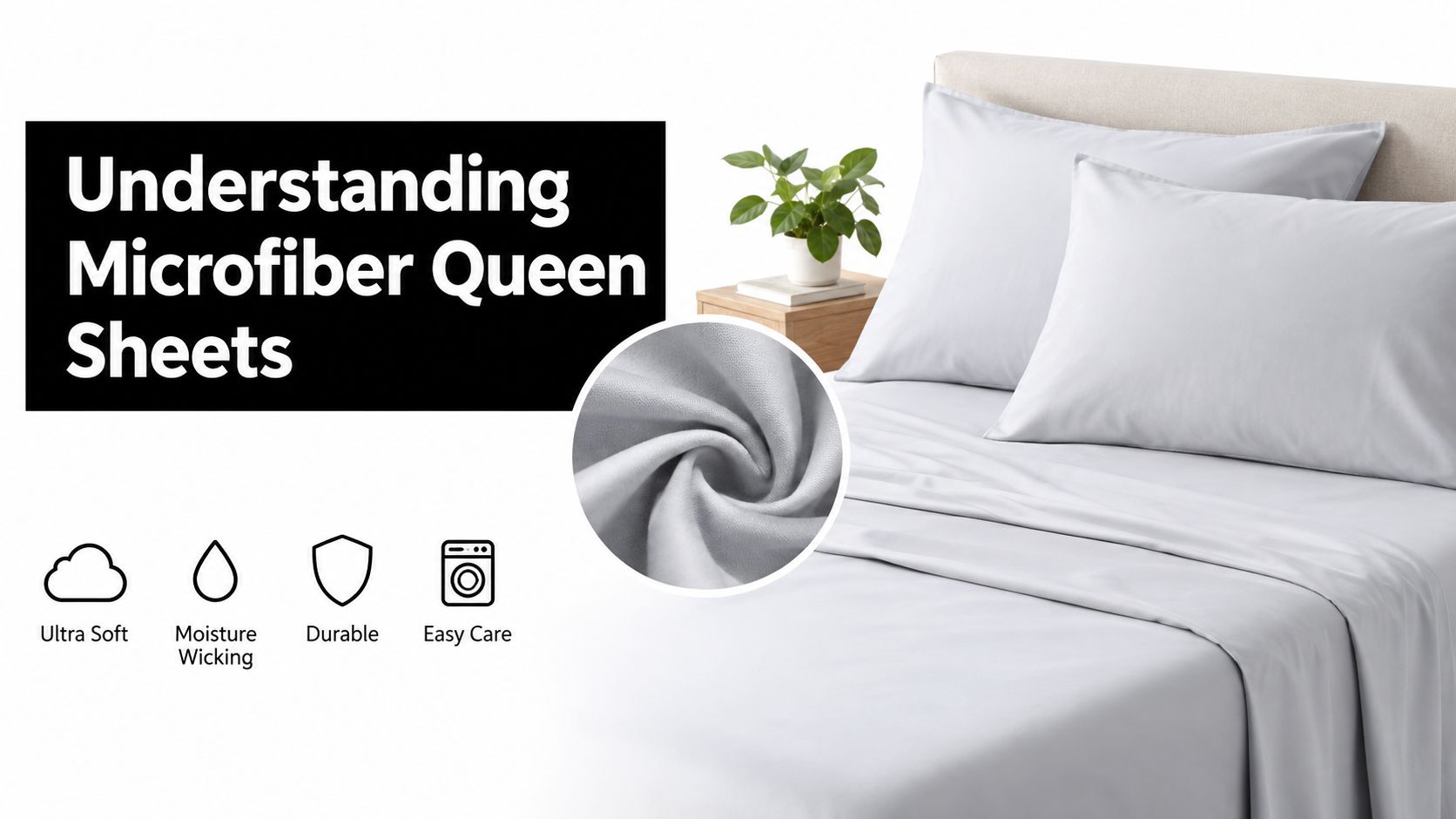
The fine filaments create yarn with a high surface area. Manufacturers can arrange that yarn in a dense weave and may brush or finish the surface to change its hand. That helps explain why one set can feel sleek and cool to the touch while another feels velvety and warm, even though both use the microfiber label.
What the label tells you
The label usually tells you that the sheet uses very fine synthetic fibers. It doesn't, by itself, tell you the exact fabric weight, yarn density, weave, finishing method, dimensional stability, pilling resistance, or seam strength. Those details influence how the set feels on the first night and how it behaves after repeated laundering.
Microfiber can spread liquid along capillary pathways and create a low-lint surface, but a product listing shouldn't turn those general properties into an unsupported moisture-wicking promise. Filament geometry, yarn density, weave, finish, and fabric weight all affect the result. A “microfiber” label cannot establish a specific wicking rate, thread-count equivalent, or abrasion life.
How it differs from cotton
Cotton is a natural fiber, while microfiber queen sheets are generally synthetic. That difference affects the way manufacturers engineer the fabric and the way shoppers should compare products. Thread count alone isn't a reliable substitute for construction details, and a higher-sounding number doesn't prove that one sheet will be softer, cooler, or longer-lasting.
Look for practical specifications instead. A useful product description should identify the fiber composition and provide information about fabric weight, fit, laundering, and color care. For higher-turnover bedrooms, ask whether the manufacturer evaluates dimensional change, colorfastness, pilling, abrasion, and seam performance.
This approach gives you a more accurate picture than treating microfiber as a single fixed experience. Two queen sets can share the same fiber category while offering noticeably different surface textures, warmth, drape, and resistance to wear.
Pros and Cons of Microfiber Queen Sheets
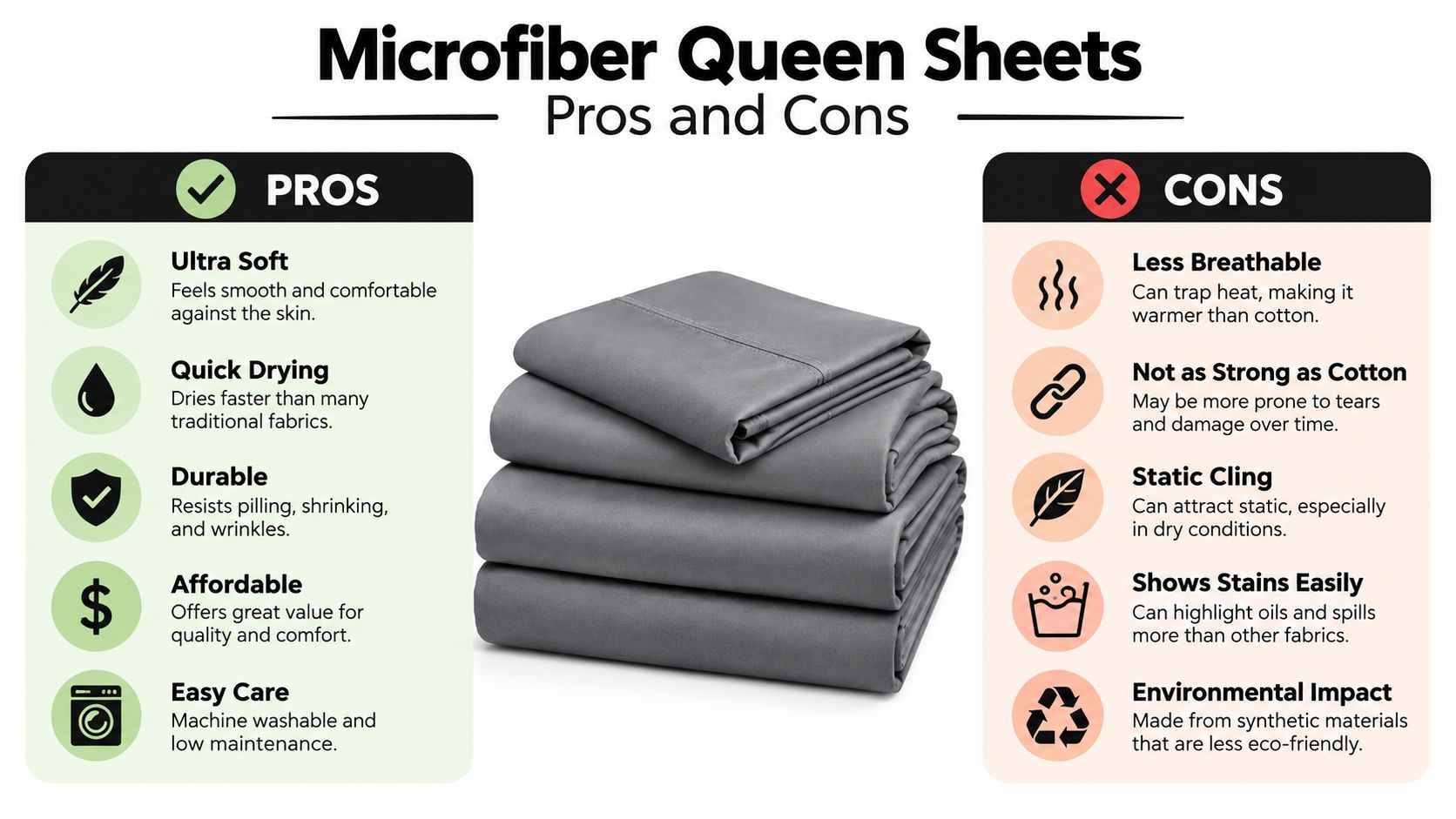
Microfiber queen sheets make a strong case for shoppers who value softness and convenience. Their fine synthetic fibers can create a smooth hand, while a dense construction can give the bed a tidy, uniform appearance. Many people also choose them because they fit a practical household routine, especially when sheets need to be washed often and returned to the bed without extensive pressing.
The limitations are just as important. A dense synthetic construction may feel warmer or less airy than a more open natural-fiber fabric, although the weave and finish determine the actual experience. If you regularly wake up hot, look beyond the fiber name and examine how the fabric is made.
Where microfiber performs well
| Priority | Why microfiber can appeal |
|---|---|
| Softness | Fine filaments and surface finishing can create a smooth, brushed, or velvety hand. |
| Upkeep | The fabric is often easy to wash and less demanding than materials that need careful pressing. |
| Value | Synthetic construction supports a budget-conscious bedding upgrade. |
| Everyday appearance | A smooth surface can help the bed look orderly after routine laundering. |
| Versatility | The material can suit primary bedrooms, guest rooms, rental properties, and other spaces where practical care matters. |
These advantages don't apply identically to every product. A poorly finished set may feel thin, develop surface changes, or fit poorly even if the fiber content is technically the same as a better-made set.
Where the trade-offs appear
Breathability is the first comfort question. Polyester doesn't automatically make a sheet uncomfortable, but a tight weave, heavy finish, or warm surface can reduce the airy feeling some sleepers prefer. If your bedroom runs warm, choose a construction with clear fabric information and follow the care label rather than relying on broad marketing language.
Environmental questions also belong in the comparison. The European Environment Agency's overview of microplastics from textiles estimates that synthetic textiles contribute 0.2 to 0.5 million tonnes of microplastics to the world's oceans each year. It also notes that synthetic fabrics often release their highest amounts during the first 5 to 10 washes.
Those figures are not measurements of a specific queen-sheet set. They provide context for a frequently washed, relatively large textile surface. A peer-reviewed laundry study summarized by the agency estimated average microfiber loss across synthetic fabrics at 131 milligrams per kilogram of textile per wash and approximately 514,400 fibers per kilogram per wash. Construction, abrasion, detergent, temperature, and cycle length all matter, so don't use a general average to predict the behavior of one product.
The balanced conclusion is simple. Microfiber can be a sensible comfort and value choice, but softness isn't the whole evaluation. Consider sleep temperature, fabric construction, expected washing frequency, and the product information available before you buy.
Choosing Microfiber Sheets for Modern Mattresses
A queen sheet can be the correct nominal size and still fail on the bed. Modern mattresses may include thick comfort layers, pillow tops, mattress protectors, or adjustable-base accessories that increase the total height. The fitted sheet needs enough pocket depth and usable elastic to cover that combination without pulling loose.
Start with the mattress itself. Measure from the top sleeping surface to the bottom edge, then include the height of any protector or topper that will remain underneath the sheet. Don't estimate based on the mattress label alone. A “queen” designation describes the bed's width and length category, not the depth of the finished setup.
Measure before you shop
Use the product listing to compare your measurement with the stated pocket range. Look for language such as deep pocket, extra deep pocket, or a specific maximum mattress depth, but treat the number as a specification to verify rather than a guarantee. Elastic placement matters too. An elastic band that runs around the entire fitted-sheet edge usually anchors differently from elastic placed only at the corners.
The flat sheet needs attention as well. If it barely reaches the sides, it may pull free when you move, especially on a taller mattress. An oversized flat sheet can offer more practical tuck-in room, while generously sized pillowcases help keep the finished bed looking neat.
Check the construction details
A secure fit is only part of the decision. Product information should identify fiber composition, care instructions, fabric weight, and any testing or certification offered for the finished article. If you're equipping a guest room or short-term rental, also consider whether the seams and elastic are built for frequent handling.
For a more detailed discussion of measurements and mattress profiles, use this guide to sheets that fit a pillow top mattress. The same principle applies to microfiber queen sheets: measure the complete bed, not just the mattress category.
A sheet that stays in place usually feels more luxurious than a softer sheet that needs constant adjustment.
Color and finish are practical choices, too. Dark colors can create a polished look but may show lint or surface changes more readily, while pale neutrals can make a room feel lighter and coordinate easily with quilts and comforters. Choose a finish that matches your habits, then confirm that the care label supports the routine you can realistically maintain.
Caring for Your Microfiber Queen Sheets
Good care starts before the first wash. Separate new sheets from rough garments, towels, or items with zippers that can increase friction. Read the manufacturer's label because finishes and elastic can differ between sets, even when both are sold as microfiber.
Use a gentle cycle and a suitable amount of detergent. Excess detergent can leave residue that changes the hand of the fabric, while harsh treatment can place unnecessary stress on fine fibers and color. Follow the label's temperature guidance, and avoid choosing a hotter or longer cycle just because the sheets appear durable.
A simple laundry routine
- Wash with similar lightweight bedding. Keep microfiber away from towels and abrasive items when possible. This reduces lint transfer and limits rough contact during agitation.
- Skip unnecessary bleach and softener. Bleach can affect color and fibers, while fabric softener can coat the surface and alter the original feel. Use the care label as the final authority.
- Choose moderate drying. Remove the sheets when they're dry rather than leaving them tumbling for an unnecessarily long period. Excess heat and extended friction can work against surface softness and elastic recovery.
- Fold after cooling. Shake the sheets out, smooth the seams, and fold them once they've cooled. Store them in a dry, ventilated space instead of compressing them under heavy items.
The Suburban Furniture sheet care guide offers useful household context for building a regular bedding routine. Changing and washing sheets consistently helps you manage body oils, perspiration, and everyday debris without waiting until the fabric looks visibly soiled.
Laundry choices and fiber shedding
Washing affects more than appearance. Research summarized in a peer-reviewed systematic review found microfiber loss can range from 9.6 milligrams to 1,240 milligrams per kilogram of textile per wash, depending on the fiber, construction, and treatment, as reported in the textile durability and microfiber review. That range doesn't predict the result for every queen set, but it shows why fabric structure and care conditions matter.
Avoid unnecessarily long, hot, or abrasive cycles. Treat “low shedding” as a claim that requires supporting product information, not as an automatic result of polyester content. For a more detailed routine focused on this fabric, consult this guide to laundering microfiber sheets properly.
Buyer's Guide to Microfiber Queen Sheets
A good purchase comes down to four checks: material, construction, fit, and care. Start with the fiber content. Most microfiber queen sheets use polyester, but the product page should make the composition clear rather than relying on a vague “luxury microfiber” description.
Next, inspect the construction information. Fabric weight can help you compare products within the same range, but it isn't a complete quality score. Ask whether the manufacturer provides details about dimensional change after laundering, colorfastness, pilling, abrasion, and seam strength. Those tests are more useful for long-term expectations than an isolated thread-count claim.
Use this decision filter
- For a soft, low-maintenance bed: Prioritize a smooth or brushed finish, clear washing instructions, and a fitted sheet with reliable elastic.
- For a warm sleeper: Look for construction details that support airflow, and don't assume that every microfiber fabric feels the same. If the listing provides no information about weave or finishing, treat breathability claims cautiously.
- For a deep mattress: Measure the full mattress-and-topper height, then compare it with the fitted sheet's pocket specification. Check the flat sheet dimensions too.
- For sensitive-skin households: Verify certification for the finished sheet set when available. OEKO-TEX STANDARD 100 testing can cover the fabric as well as sewing thread, labels, elastic, coatings, and other components. The OEKO-TEX STANDARD 100 requirements are updated at least annually, and buyers should verify a current identifier for the exact product rather than accepting a broad supplier statement.
- For frequent laundering: Choose transparent care instructions and inspect the seams, hems, and elastic. A product that looks attractive but provides no construction information is harder to evaluate.
You can compare available styles and set configurations through the SouthShore Fine Linens microfiber collection. Treat any collection as a starting point, then match the specific set to your mattress measurements and sleep preferences.
Elevating Your Sleep Experience with Microfiber
A better bed doesn't require the most complicated fabric. It requires a set that matches the way you sleep, wash, and use the room. Microfiber queen sheets can provide a soft surface, a tidy appearance, and practical upkeep for shoppers who want a comfortable upgrade without a demanding routine.
The material also rewards careful evaluation. “Microfiber” doesn't guarantee a particular cooling level, moisture-wicking performance, or abrasion life. Those outcomes depend on the yarn, weave, finishing, fabric weight, seams, and laundering conditions.
Match the sheet to the sleeper
A guest room may benefit from a smooth, easy-care set that looks presentable between visits. A family bedroom may need durable elastic and clear care instructions because the sheets will face frequent washing. A person who sleeps warm should pay close attention to construction and surface finish instead of choosing solely by softness at the point of purchase.
Environmental responsibility requires the same practical mindset. Synthetic bedding forms part of a wider textile system, and washing can release fibers. The latest research emphasizes that shedding depends on yarn structure, fabric construction, abrasion, detergent, water temperature, and cycle duration, rather than whether a product carries the microfiber label. A 2025 study reported an extremely strong relationship between protruding yarn hairiness and polyester microfiber release, with R² = 0.997, in its research on yarn hairiness and microfiber release. That finding reinforces the value of asking manufacturers for meaningful construction and care information.
The smartest sheet purchase balances nightly comfort with the work required to keep the fabric performing well.
Before checkout, confirm the queen dimensions, pocket depth, fabric composition, finish, return policy, and care label. Once the sheets arrive, wash them according to the instructions, inspect the fitted corners, and notice how the fabric feels after laundering. Those simple checks tell you more about the match than a product title alone.
Microfiber queen sheets remain a practical option for a bedroom refresh because they combine approachable comfort with uncomplicated maintenance. Choose based on verified specifications rather than assumptions, and your new bedding is far more likely to feel right on the first night and remain useful through regular care.
SouthShore Fine Linens offers queen-size microfiber sheet sets with coordinated bedding components and practical care features for modern bedrooms. Visit SouthShore Fine Linens to compare microfiber options and find a set that matches your mattress fit, comfort preferences, and everyday laundry routine.


