
How Deep Are Deep Pocket Sheets? Sizes by Mattress Height
Deep pocket sheets generally cover a mattress stack of about 12 to 16 inches, and extra-deep designs are built for roughly 17 to 22 inches. What decides which one you need is the total stack height, the mattress plus any topper and pad, not the word printed on the package.
So how deep are deep pocket sheets in practice, and why does a set sold as deep pocket still peel off a bed that measures 13 inches? Because a pocket has to travel down the sidewall, tuck under all four corners, and then stay there through washing, drying and every shift of your body. A number that describes only how far the fabric reaches tells you half the story.
Three things move that number after you buy. The stack grows when you add a topper, the fabric contracts when you dry it, and a moving base pulls the corners in directions a static bed never does. Treat pocket depth as a fit specification you keep checking, and the guesswork mostly disappears.
Typical Pocket Depths by Mattress Stack Height
Deep pocket sheets typically cover stacks of 12 to 16 inches, and extra-deep sheets cover roughly 17 to 22 inches. Sellers place those boundaries in slightly different spots, so the working rule is to match the pocket to your measured stack rather than to the adjective on the box.
| Total stack height | Standard pocket | Deep pocket | Extra-deep pocket |
|---|---|---|---|
| Up to 10 in | Standard fitted sheet | Not needed | Not needed |
| 10 to 12 in | Standard fitted sheet | Optional, for reserve | Not needed |
| 12 to 14 in | Borderline standard | Deep pocket (12-14 in) | Not needed |
| 14 to 16 in | Not reliable | Deep pocket (14-16 in) | Extra-deep (15-17 in) for reserve |
| 16 to 18 in | Not suitable | Deep pocket at top of range (16-18 in) | Extra-deep (17-20 in) |
| 18 to 22 in | Not suitable | Not reliable | Extra-deep (18-22 in) |
| Over 22 in | Not suitable | Not suitable | Check the maker's maximum stack |
Rows one and two are simple. Under 10 inches, a standard fitted sheet has plenty of fabric to wrap under the mattress. Between 10 and 12 inches, a standard sheet still works, though a deep pocket buys you slack that survives the first few washes.
The 12 to 14 inch row is where most shoppers get caught. A mattress alone at 13 inches sits at the very edge of what a standard sheet is cut for, and it leaves almost nothing to tuck. Add a quilted pad and you're past the limit.
At 14 to 16 inches you're in deep-pocket territory, and the choice is between a deep pocket cut for that exact range or an extra-deep sheet that gives you a couple of inches of reserve. I'd take the reserve on a bed that gets washed weekly, because the fabric will lose some of its reach over time.
The 16 to 18 inch row asks for a deep pocket at the top of its stated range or an extra-deep cut. Above 18 inches, extra-deep is the only honest answer, and above 22 inches you need to read the maker's maximum stack figure rather than assume.
Retail ranges reflect how loose these categories are. In 2024, Mattress Firm described deep-pocket sheets as commonly fitting mattresses about 14-16 inches thick, while extra-deep sheets may accommodate mattresses 18-24 inches thick. Find your stack height in the table above, then measure it properly, because a guessed height is how most bad sheet purchases start.
How to Measure Your Mattress Stack for the Right Pocket
The label describes a product. Your measurement describes your bed. Only one of those two things can be wrong, and it isn't the bed.
Consumer Reports recommends choosing a fitted sheet rated roughly 2-3 inches deeper than the mattress, because repeated washing and drying reduce usable dimensions through shrinkage, and its testing found sheets advertised for mattresses up to 18 inches that measured shorter before laundering even began.
- Strip the bed and measure the bare mattress. Run a tape from the top of the foundation or platform to the top surface of the mattress, at its thickest point, and read it in inches. Measure at the middle of a long side rather than at a corner, since corners are often rounded or compressed and read short.
- Add every layer that stays under the sheet. A topper adds its full thickness, a quilted pad adds a little, and a waterproof protector adds minimal height but changes how the sheet grips. Measure the topper uncompressed at the edge, not squashed where you sleep, because the sheet has to stretch over the tallest point.
- Add a 2 to 3 inch reserve. The elasticated hem has to travel beneath the mattress while keeping downward tension, so a pocket that stops flush with the bottom edge has nothing to hold onto. This is the difference between a sheet that stays and one that pops at 3 a.m.
- Compare your total against the stated pocket depth, and round up. If the number lands between two ranges, take the next pocket up by one step. Two steps up leaves slack that bunches underneath and works itself loose.
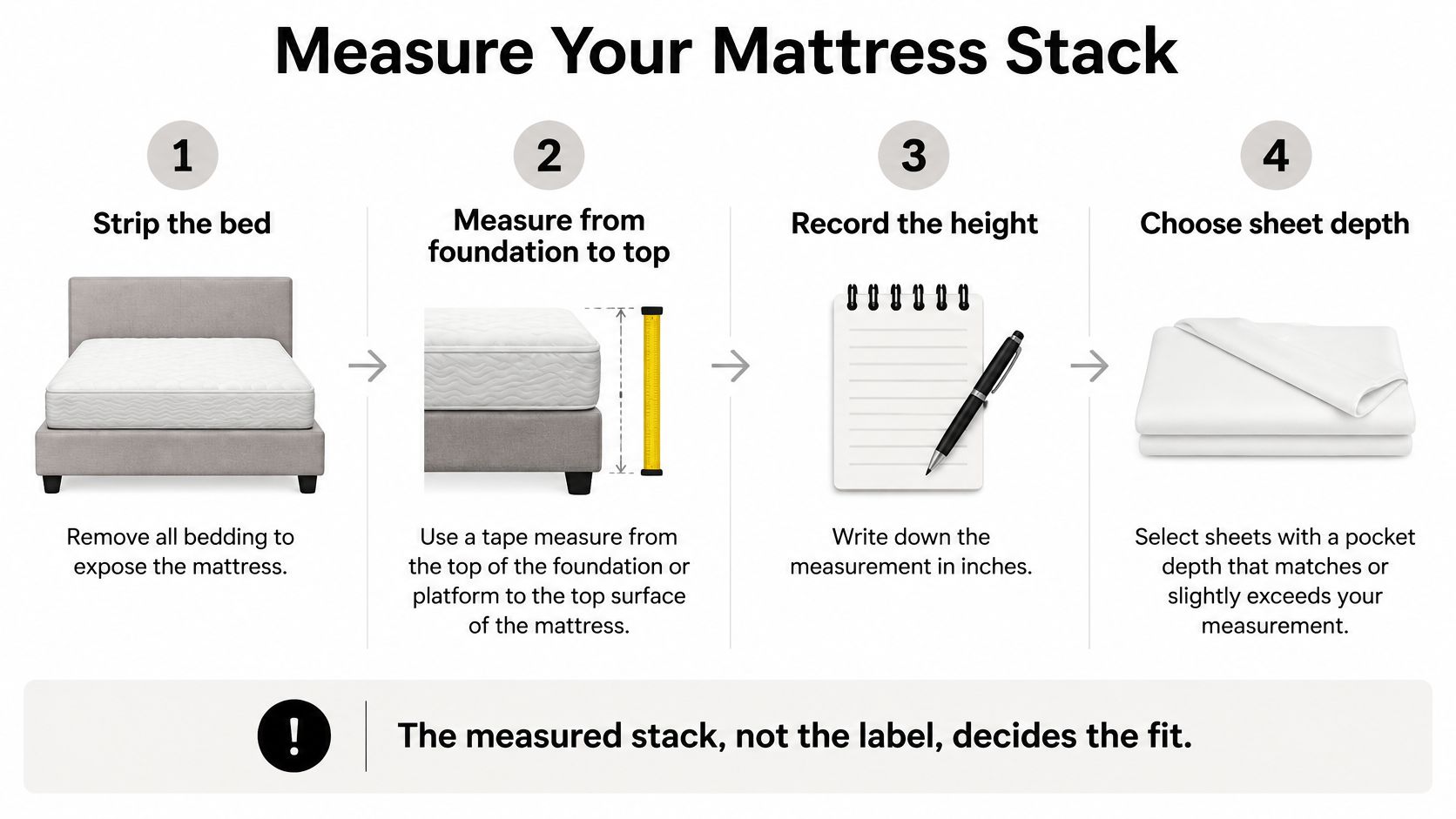
A worked example makes the arithmetic concrete. A 12-inch mattress with a 2-inch topper produces a 14-inch stack, so the target is about a 16 to 17 inch pocket, not a nominal 14-inch pocket. The extra two inches are what let the hem pass under the corners and stay tensioned.
Where the measurement goes wrong
The most common slip is measuring the mattress alone and forgetting the topper you added two months ago. The second is measuring while someone sits on the bed, which compresses foam and reads an inch or more short.
The reserve rule: measure the stack, then buy a pocket 2 to 3 inches deeper than the number you wrote down.
When you're done, do the check that matters. Pull the fitted sheet over all four corners and run a hand along the hem. It should sit several inches under the mattress on every side with no gap and no loose fold. If a corner lifts while you're smoothing the top, the pocket is short. Our walkthrough on how to measure mattress depth covers the same routine step by step if you want it alongside the tape measure.
Why Mattress Thickness Drives Pocket Depth
Beds got taller and sheets didn't. A 1992 New York Times report on the thickening mattress described the former standard as approximately 7 inches and noted that newer models were reaching 16 inches, more than twice that earlier benchmark.
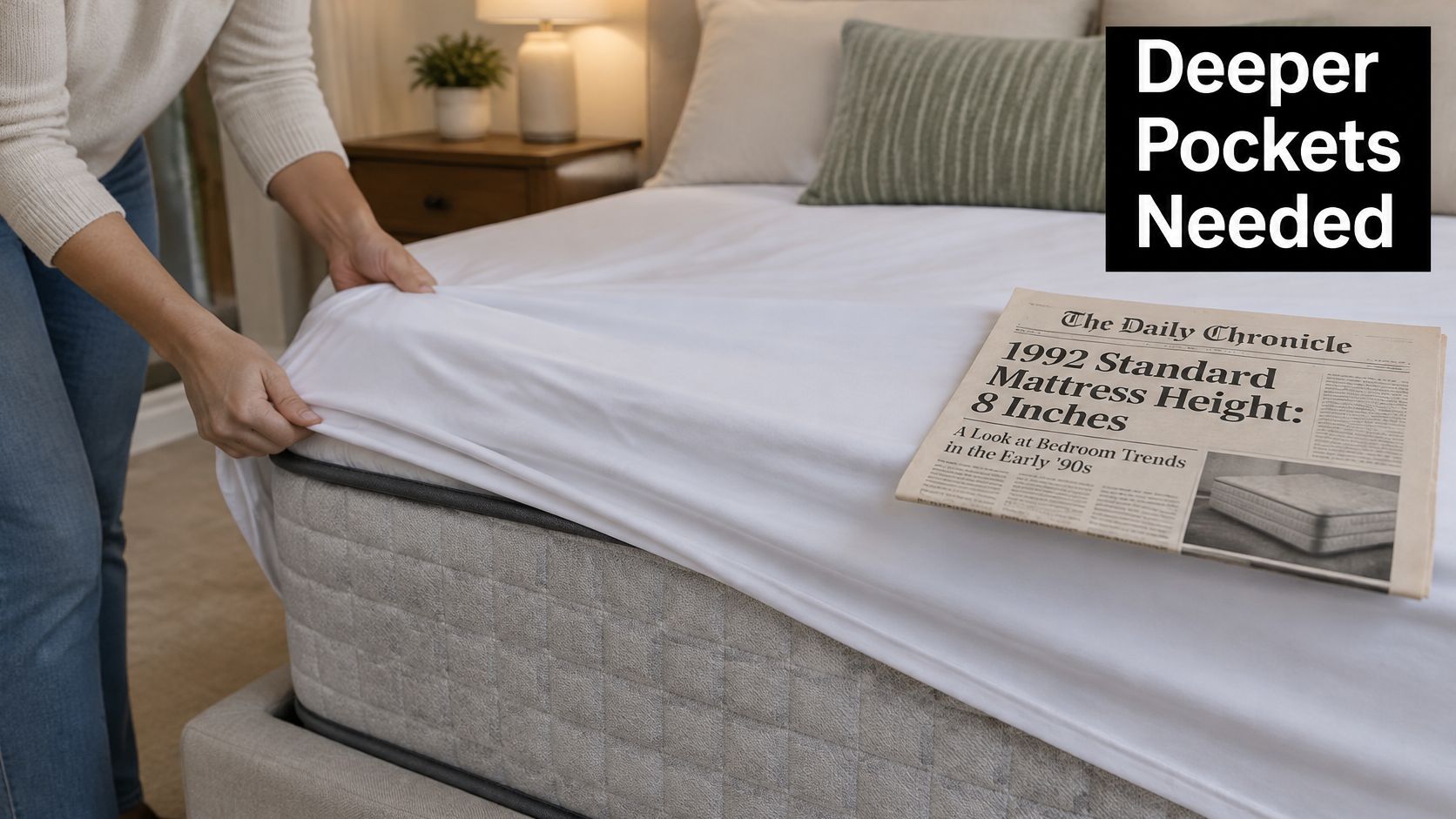
Heights now vary widely by construction type. Foam, innerspring and adjustable-air models each cluster at different thicknesses, and a pillow-top innerspring can stand several inches taller than a plain foam bed on the same showroom floor. What matters for sheets is where your own stack lands inside that spread.
| Mattress type | Typical thickness | Pocket to consider |
|---|---|---|
| Foam mattress | Usually the thinner end of the range | Deep pocket once the stack tops 12 in |
| Innerspring mattress | Usually the taller end, and pillow-tops run higher still | Deep pocket (14-16 in) |
| Adjustable-air mattress | Middle of the range | Deep pocket (14-16 in) |
| Any mattress plus a topper | The tallest stack in most bedrooms | Deep for most; extra-deep above 16 in |
A fitted sheet cut to the old 7-inch standard has nothing to grab on a mattress twice that height, so the corners lift the first time you sit on the edge. Pillow-tops and hybrids make it worse because they flare outward at the top, and the sheet has to clear that bulge before it even starts down the side.
The practical conclusion is blunt. A mattress that fits a deep pocket on its own can tip into extra-deep territory the moment a topper goes on, because the sheet has to wrap the whole stack and still tuck underneath. That is arithmetic, plain and simple. If you're also changing the base under the bed, the Meliusly guide to mattress support bases explains how the support layer changes the height you're measuring from.
If you want to see the tuck-and-lift problem in motion, this short demonstration is worth two minutes before you buy.
Pocket depth is a fit specification shaped by how beds changed. The fabric didn't get worse. The mattress got taller.
How to Read Pocket Depth Labels on Packaging
There's no industry body defining these terms, so a label reflects one maker's catalogue. In 2024, U.S. News & World Report defined deep-pocket sheets as fitting mattresses 16-18 inches thick, with extra-deep sheets generally fitting 19-22 inch mattresses, and the products it reviewed carried pocket depths of 16 and 20 inches.
Compare that with the ranges in the table earlier and you can see the problem. The same phrase, deep pocket, can mean a 12-inch pocket at one seller and an 18-inch pocket at another. Neither is lying. They're describing their own catalogue.
Run three checks on any package before you commit.
- The stated pocket depth in inches. This is the only hard number. If a listing says deep pocket and gives no measurement, treat the depth as unknown rather than deep.
- The maximum recommended mattress or stack height. A good label tells you the tallest bed the sheet is built for. That figure, not the adjective, is what you compare against your tape measure.
- Whether that maximum includes toppers and protectors. Some makers quote mattress thickness only, which assumes a bare bed. If yours has a topper, you need the stack figure.
A 10-inch pocket is technically deep under the loosest definition and will still fail on a 15-inch bed. That's why a deep pocket from one brand can be an extra-deep from another, and why a label with no number is weaker evidence than a label with one.
A word on a package is a starting point. A measurement is a specification.
I'd also separate pocket depth from drop. Drop is how far the fabric hangs down the side. Pocket depth is how much mattress the sheet is designed to hold underneath. A listing that quotes only drop, or only a thread count and a size name, hasn't told you whether the sheet will fit.
The rule to follow is short. Trust the measured pocket figure and the stated maximum stack, then match them against the number you wrote down. When two products look identical except for that figure, the figure is the entire difference.
Shrinkage After Washing Changes the Fit
Here's the finding that should change how you shop. Consumer Reports testing found that some queen cotton sheets marketed with deeper pockets could not cover a 10-inch mattress after less than a year of repeated washing and drying, per its sheets buying guide. A sheet that fits on day one and fails by month ten hasn't solved the problem, it has deferred it.
Nominal pocket depth is what the packaging promises. Usable depth is what survives the dryer. Heat does two things at once: it contracts cotton and it degrades the elastic core, so the sheet gets shorter exactly as the grip gets weaker.
The first-wash measurement test
After the first wash and dry, lay the fitted sheet flat on the bed and measure the corner depth from the seam to the hem. Compare it with the stack measurement you took. If the sheet has lost more than a half inch of corner reach, it's already on the way to popping off.
What to check before you buy, in this order:
- The manufacturer's measured pocket depth, not the category name.
- Fiber and construction. All-cotton percale behaves differently from a stretch-woven blend, and a fabric with some give conforms to the corners instead of transmitting every movement to them.
- Care temperature limits. Follow them. Hot washing and hot drying are what shorten the life of the elastic band fastest.
- The return policy. You cannot test shrinkage in a shop, so the policy is your only safety net.
The contrarian point is worth stating plainly: buying a deeper sheet is not automatically safer. Excess fabric bunches under the mattress and works loose, while shrinkage and tired elastic can make a nominally adequate sheet fail anyway.
Buy for the wash cycle, not the showroom. Compare fit before and after laundering and you'll know more than any label tells you.
This matters most in households where sheets go through the machine weekly, and in rental and hospitality settings where the same set is laundered far more often than a home set ever would be. Fit is a wash-cycle performance question. Our notes on whether cotton shrinks when washed explain the fiber side of that trade-off.
Deep Pocket Sheets on Adjustable Beds
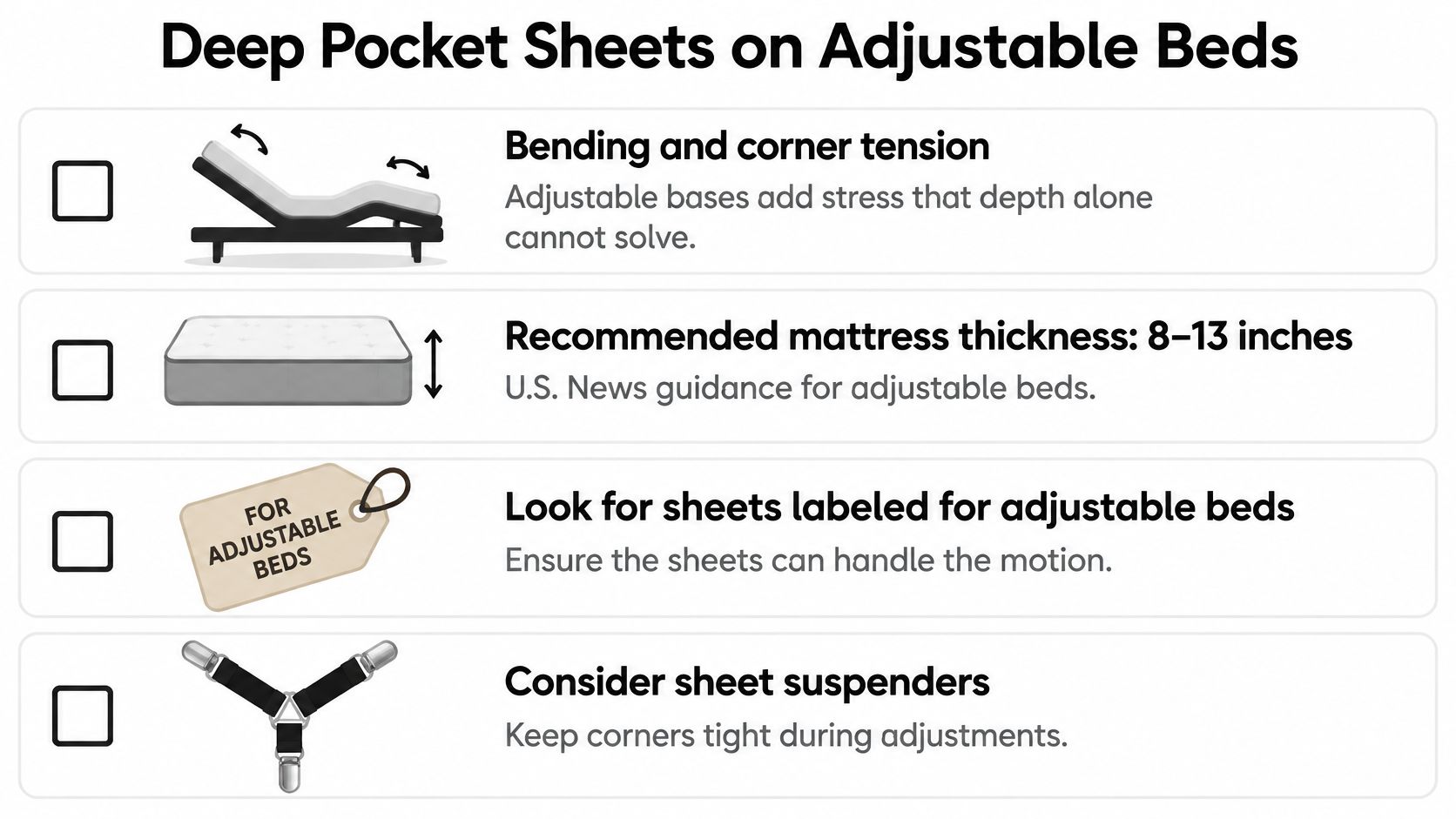
An articulating base breaks the simple depth model. As the platform hinges, the sheet has to bend with it, keep the corners engaged and hold tension on a surface that changes shape through the night. Depth alone can't do that.
U.S. News guidance on mattresses for adjustable beds puts the recommended range commonly between 8 and 13 inches, and notes that overly thick mattresses can make bending difficult when the bed changes position. That's the opposite instinct from a fixed bed, where taller usually means more comfortable.
The engineering answer is a reserve. On an articulating base, an additional 2-3 inches of sheet depth is a practical target, which means a 10-14 inch mattress may perform better with a 15-18 inch pocket than with a pocket cut tight to its static height, according to this measurement guide from California Design Den. The extra fabric absorbs the fold at the hinge.
What to look for instead of the biggest number on the shelf:
- Full-perimeter elastic, not four corner bands, so the sides pull the hem under the mattress as the bed moves.
- Flexible corner construction with a bit of stretch in the weave, which lets the corner ride the hinge without releasing.
- Optional sheet straps or suspenders, a cheap fix that holds a good sheet in place on a moving base.
- A stated maximum stack, so you can tell whether the maker accounted for a protector and a topper.
The three-position test
Fit the sheet and check it in three positions: flat, head raised, then foot raised. In each position, run a hand around all four corners and along each side. If a corner lifts at the head end when the base is raised, the pocket is too tight regardless of what the label promised.
Then reverse the warning. Buying the deepest pocket available creates slack, and slack on an articulating bed bunches at the hinge and walks free at the corners. Extra depth stops being a safety margin past about two or three inches.
Measure the whole setup, protector and topper included, and choose secure movement over maximum nominal depth. A sheet that fits a tall stationary mattress but releases mid-articulation is a worse buy than one with an inch less pocket and proper elastic. Our guide to sheets for adjustable beds goes further into base-specific fit.
Confirm Your Pocket Depth Before You Buy
The decision runs in a fixed order. Measure the total stack, add the 2 to 3 inch reserve, pick the range from the depth table, confirm the wash performance, then check movement compatibility if the base articulates.
Before you order, tick these off:
- Stack height in inches, measured at the thickest point.
- Reserve added, two to three inches on top of the stack.
- Pocket depth stated on the package, in numbers rather than adjectives.
- Maximum stack given by the maker, and whether toppers are included in it.
- Care instructions, especially drying temperature.
- Return policy, because post-wash fit is the only fit that counts.
Then match the numbers to a set. Our extra deep pocket sheet sets are tagged as Briteyarn 300 thread count 100% cotton sheet sets, and the Southshore Basics standard bed sheets come in 7 bed sizes, including twin XL and split king, which matters when a split adjustable base needs two fitted sheets rather than one. Write your stack measurement down and keep it with your order confirmation, so a return or an exchange starts from a number instead of a guess.
A fitted sheet is a piece of engineering sized to a specification. When the specification is yours, the sheet stays on.
SouthShore Fine Linens makes extra deep pocket sheet sets for the beds that standard sheets give up on, including thick mattresses, topper stacks and split adjustable bases. Start with your measured stack height, then match it to a set in cotton that holds its fit through regular washing. Visit SouthShore Fine Linens to compare pocket depths and bed sizes before you order.


