
King Size Deep Bed Sheets: Fit, Fabric and Care Guide
You bought king sheets for a king bed, washed them, wrestled the last corner into place, and found it loose by morning. That's rarely a width problem. It's usually a pocket depth problem, because the mattress, protector, topper, and any other layer under the sheet form one stack that the fitted sheet has to wrap and grip.
Treat that whole stack as the fit specification for king size deep bed sheets, not the mattress label alone. The deepest pocket isn't automatically the right one, either. A pocket with too much slack can bunch and slide just as a shallow one pops off.
King and California King Dimensions and Pocket Depth Ranges
A shopper buys a set marked king, fits it to a king bed, and the corners pop off within a week. The footprint can be right while the sidewall fabric is still too short to stay tucked under. Start with the numbers before you trust any label word.
| Category | Dimensions or pocket depth | Best for | Watch for |
|---|---|---|---|
| Standard king | 76 x 80 in mattress | Standard king beds | Fitted sheet is built around a slightly smaller footprint |
| California king | 72 x 84 in mattress | California king beds | Not interchangeable with standard king sheets |
| Standard pocket | 7-9 in pocket depth | Thin mattresses with no topper | Often pulls free on pillow-top or layered beds |
| Deep pocket | 12-15 in (one source) or 15-18 in (another) | Medium-height and layered mattresses | Ranges vary by brand, so compare against measured stack |
| Extra-deep pocket | 16-22 in or 18-24 in, depending on source | Tall hybrids, toppers and protectors | Too much depth can leave loose fabric on a standard-height mattress |
What the Footprint Numbers Mean
In the United States, a standard king mattress measures 76 inches wide by 80 inches long, while a California king measures 72 inches wide by 84 inches long, according to the Grand View Research U.S. home bedding market report. That four-inch swap in width and length is why the two fitted sheets aren't interchangeable, even though both get called king size. A standard king fitted sheet is typically manufactured around a 78-by-80-inch surface area before the elasticized pocket construction is added.
Width and length only tell you which king you own. They don't tell you whether the sheet will hold.
Why Pocket Labels Disagree
The same source lists typical pocket categories as approximately 7 to 9 inches for standard-pocket sheets, 12 to 15 inches for deep-pocket sheets, and 16 to 22 inches for extra-deep-pocket sheets. Other published guidance places deep and extra-deep ranges higher, which is why the table shows the disagreement side by side. Don't treat "deep" as a standard, because it isn't one across brands.
The defining feature of a deep-pocket sheet is the amount of fabric designed to wrap down the mattress sides. Modern beds stack a thick comfort system with toppers, protectors, and adjustable-bed accessories, so a buyer who measures only the top can pick the correct footprint and still get corner slippage.
Shortlist rule: Confirm standard king or California king first, then shortlist only the pocket category that sits above your measured stack height.
I would ignore the word on the front of the pack until you've compared a stated depth range with your own measurement. A precise range gives you a compatibility standard. "Extra deep" on its own gives you marketing.
Measuring Your Mattress Stack With a Tape Measure
The number you need is the total height of everything that will sit under the fitted sheet. That includes the mattress itself plus any topper, pad, or protector you sleep with every night. Our step-by-step notes on how to measure mattress depth for a fitted sheet follow the same stack principle.
Measure with a firm tape held vertically against the side, not draped over a soft edge. Soft pillow tops compress under pressure, so read to the highest uncompressed point.
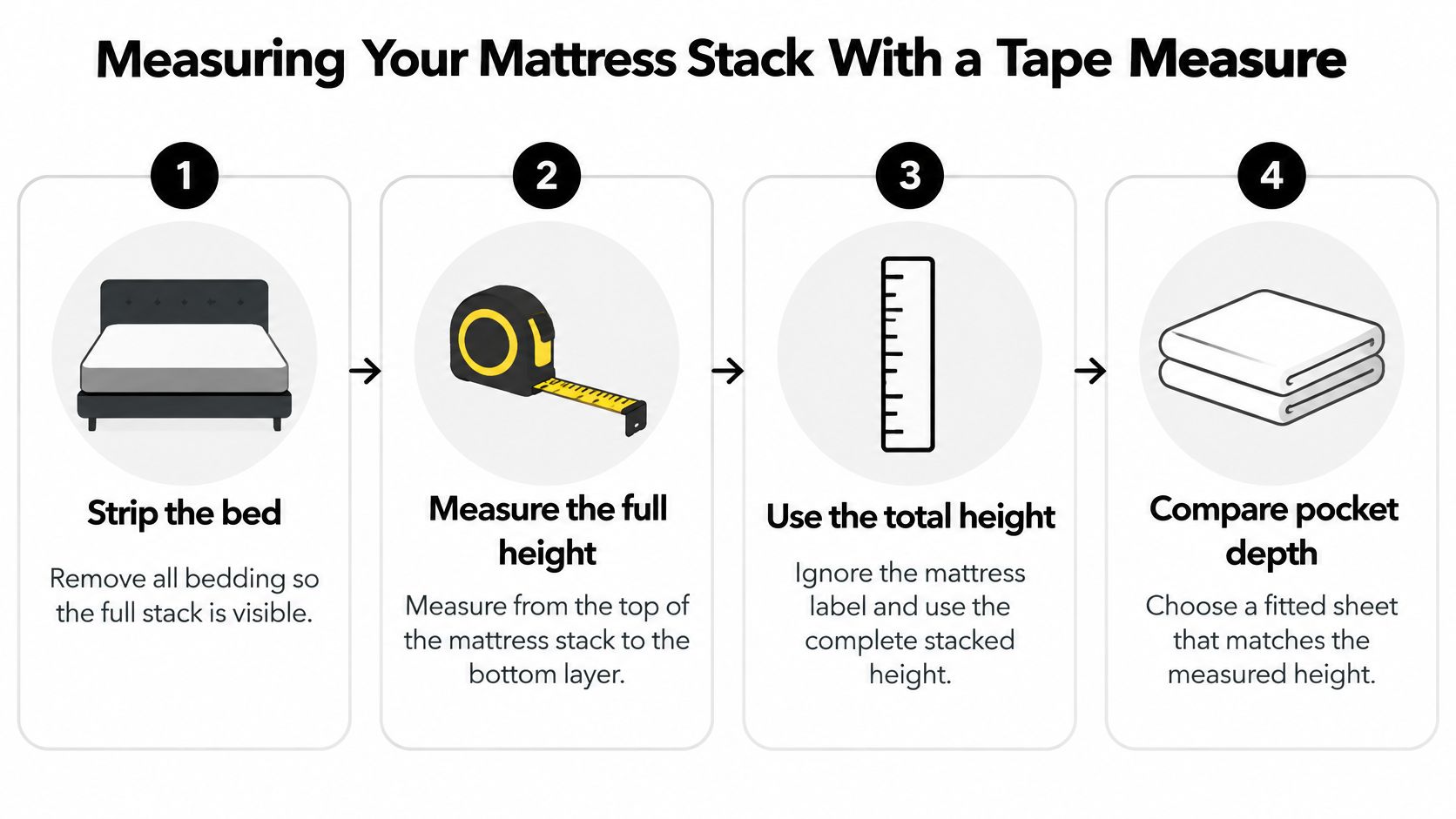
Six Steps to One Usable Number
- Strip the bed to a bare mattress: Remove sheets, blankets, and loose layers so you can see the full sidewall. A clear top surface stops you guessing where the mattress ends.
- Measure both long sides: Go from the highest point of the mattress surface down to the underside of the mattress on the left and right. One side often sits higher because of settling or a pillow-top crown, and the larger reading governs fit.
- Measure each stay-under layer separately: Check a topper or pad on its own rather than trusting the height printed on its box. Foam and fiber layers rarely match their nominal loft after use.
- Add the heights together: Mattress plus each layer gives you the total stack. That's the figure the pocket has to clear and still tuck under.
- Add a small allowance: Leave room for seam turn-under and overnight movement, then test the result against the pocket depth on the label. A pocket that only equals your stack will work at its limit and pull upward at the corners.
- Repeat with an adjustable base raised: Lift the head and foot and note the larger figure the fabric path demands. Articulation stretches the sheet diagonally and increases corner stress.
Record It Before You Shop
Sheets can shrink, so check whether a stated pocket is measured before or after laundering. If the product page doesn't say, assume the first wash costs you a little room and don't buy an exact match.
Write the final stack number on a note you can take to the shop or keep beside your screen. Every buying decision after this point refers back to that one recorded figure.
Why Corners Pop Off and How to Diagnose the Cause
It's 3 a.m. and one corner has come loose, the sheet is riding up under your shoulder, and the foot of the bed is bunched. The sheet felt fine at bedtime, which tells you the failure happened under movement, not during fitting. Match the symptom to its pattern before you blame the elastic.
| Symptom | Likely cause | Check | Fix |
|---|---|---|---|
| Corners lift diagonally at night | Pocket shallower than total stack | Compare measured stack with pocket depth | Move up one pocket category |
| Fabric bunches at the foot or sides | Pocket deeper than stack, leaving slack | Look for loose fabric along the long sides | Choose a shallower pocket or a set with firmer elastic |
| Corners release only with head raised | Adjustable base stretches the fabric path | Re-measure with the base raised | Follow the raised-base guidance in the next section |
| Sheet slides after washing | Elastic relaxed or fabric shrank | Compare fit before and after one wash | Rewash in cool water, air-dry, or replace |
| Sheet pulls off over a protector | Protector friction and slippage | Check whether the protector is slick | Choose reinforced corners or a grip-backed protector |
Reading the Direction of Failure
A corner lifting diagonally usually means the pocket is shallower than the total stack. The fabric can't reach far enough under the mattress, upward tension builds across the diagonal, and the corner with the least grip lets go first. Loose fabric bunching along the sides points the opposite way, toward a pocket deeper than the stack.
For orientation, the 2025 sizing guide from TheSize.net defines deep-pocket sheets as having a 15 to 18-inch pocket and fitting mattresses approximately 13 to 16 inches thick. That gap between pocket depth and mattress thickness is the tuck-under margin doing the work. Place your measured stack against that kind of range and you can see whether you're inside it or beyond it.
One Worked Example
Say your stack measures 15 inches and the sheet pocket is 12 inches. The corners will pop because the fabric never gets securely under the bottom edge. Flip it around, put a 14-inch pillow-top stack into an 18-inch pocket, and you may get bunching instead, because slack fabric has nowhere to go.
Don't judge a new set on night one. Re-test the fit after one week of normal use, including a wash, before you decide whether to return it.
Adjustable Bases and Layered Beds Need Different Pockets
Deeper is not automatically better. On a standard-height mattress, a very deep pocket leaves slack that wrinkles, shifts under your body, and can detach more easily than a correctly sized one. The right choice depends on total stack height and elastic construction, not the largest advertised depth.
The close-up below shows what you're judging, the sidewall fabric and how far it wraps before the elastic turns under.
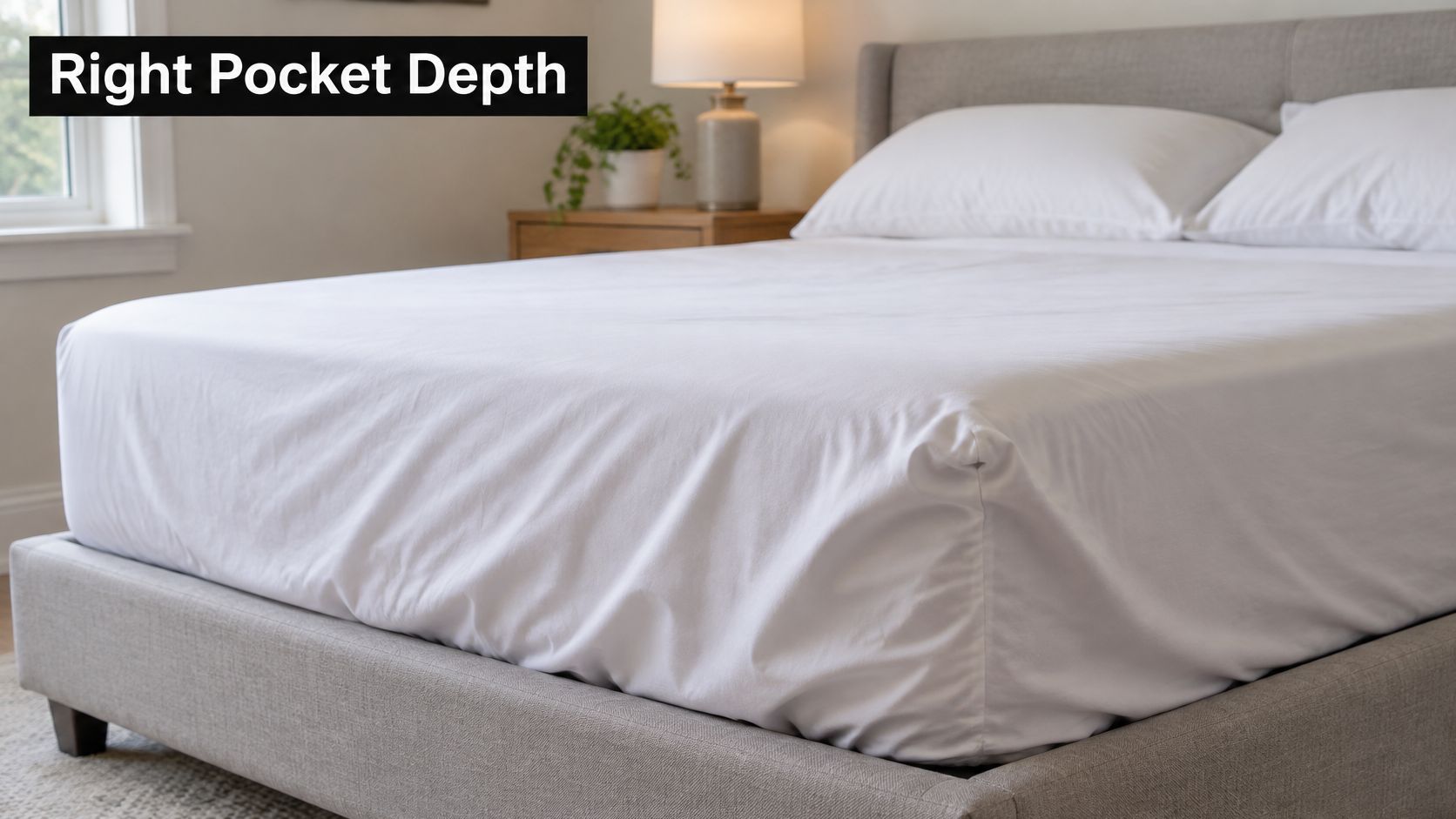
Four Setups, Four Different Answers
- Flat, thin mattress, no topper: Say the stack measures low with nothing added. A standard or shallow deep pocket usually works, and an extra-deep set would only add loose fabric.
- Medium pillow-top with a topper: The added layer pushes the stack into deep-pocket territory. I would choose a deep pocket with a clear margin over the measured total, not an exact match.
- Adjustable base: Pick a pocket that holds with the head and foot raised, with reinforced corners. Our guidance on sheets for adjustable beds and bases that move covers flex and corner stress in more detail.
- Tall hybrid with a protector: A protector adds height and a slick surface. An extra-deep pocket with grip-backed or reinforced corners suits that combination better.
Hospitality buyers face the same stack logic at scale. If you're comparing how properties present bedding and room comfort to guests, it helps to know what to expect from hostel facilities before you assume a domestic setup translates directly.
The short video below shows the sheet being fitted and moved, which is the test that matters more than a flat-bed photo.
Test any new set with the base at its highest articulation and hold that position while you check each corner. A sheet that works flat can still release the moment the head rises.
Fabric Choices for Deep-Pocket King Sheets
Fabric choice is a trade-off between feel and heat. A deep pocket solves fit, but the fiber and weave decide whether you sleep cool, wake clammy, or spend Sunday ironing a king flat sheet. Our overview of sheet materials and how each fiber behaves goes deeper on weave construction.
Pick for your sleep temperature first. Softness claims on packaging are hard to compare, while breathability differences between these options are real and repeatable.
| Fabric | Feel | Breathability | Wrinkles and pilling | Best for |
|---|---|---|---|---|
| Cotton percale | Crisp and matte | High, cool | Wrinkles more, durable | Hot sleepers who like a crisp hotel feel |
| Cotton sateen | Silky with sheen | Moderate, warmer | Resists wrinkles, can pill | Smooth feel in cooler months |
| Bamboo viscose | Soft and drapey | High | Moderate wrinkling, pilling varies | Sensitive skin and humid climates |
| Tencel lyocell | Smooth and cool to touch | High | Resists wrinkling, good drape | Hot sleepers wanting a premium feel |
| Microfiber polyester | Soft and slightly slick | Low to moderate | Resists wrinkles, can pill | Budget buyers and rental or hospitality use |
How to Use the Table
Cotton percale breathes well and suits hot sleepers who like a matte, crisp surface. Cotton sateen has a silky feel with a lustrous sheen, but it runs warmer and can pill, so I would save it for cooler rooms. Bamboo viscose feels soft and drapes closely, which helps sensitive skin in humid climates, while Tencel lyocell feels smooth and cool and resists wrinkling. Microfiber polyester is inexpensive and wrinkle-resistant for rental and hospitality use, but it traps heat and can pill, so hot sleepers should be cautious.
None of these fibers fixes a shallow pocket. A breathable sheet that pops off at 2 a.m. still fails.
What Certification Does and Doesn't Cover
OEKO-TEX STANDARD 100 classifies bed linen as Product Class 2 because it has direct skin contact, and certification requires testing of the complete textile article, including thread, buttons, coatings, and other accessories, against more than 1,000 harmful substances. Verify the certificate number and confirm the certified color and construction match the sheet you're buying. That certification doesn't establish pocket depth, tensile strength, pilling resistance, shrinkage control, or long-term elastic recovery, so judge safety, fit, and durability as three separate questions.
Construction Details That Keep the Pocket Snug
Two sets can state the same pocket depth and behave differently by the third night. Construction explains the gap. Use this as a shopping checklist, with a physical test for each item where you can.
The infographic below summarizes the four checks to run before you buy.
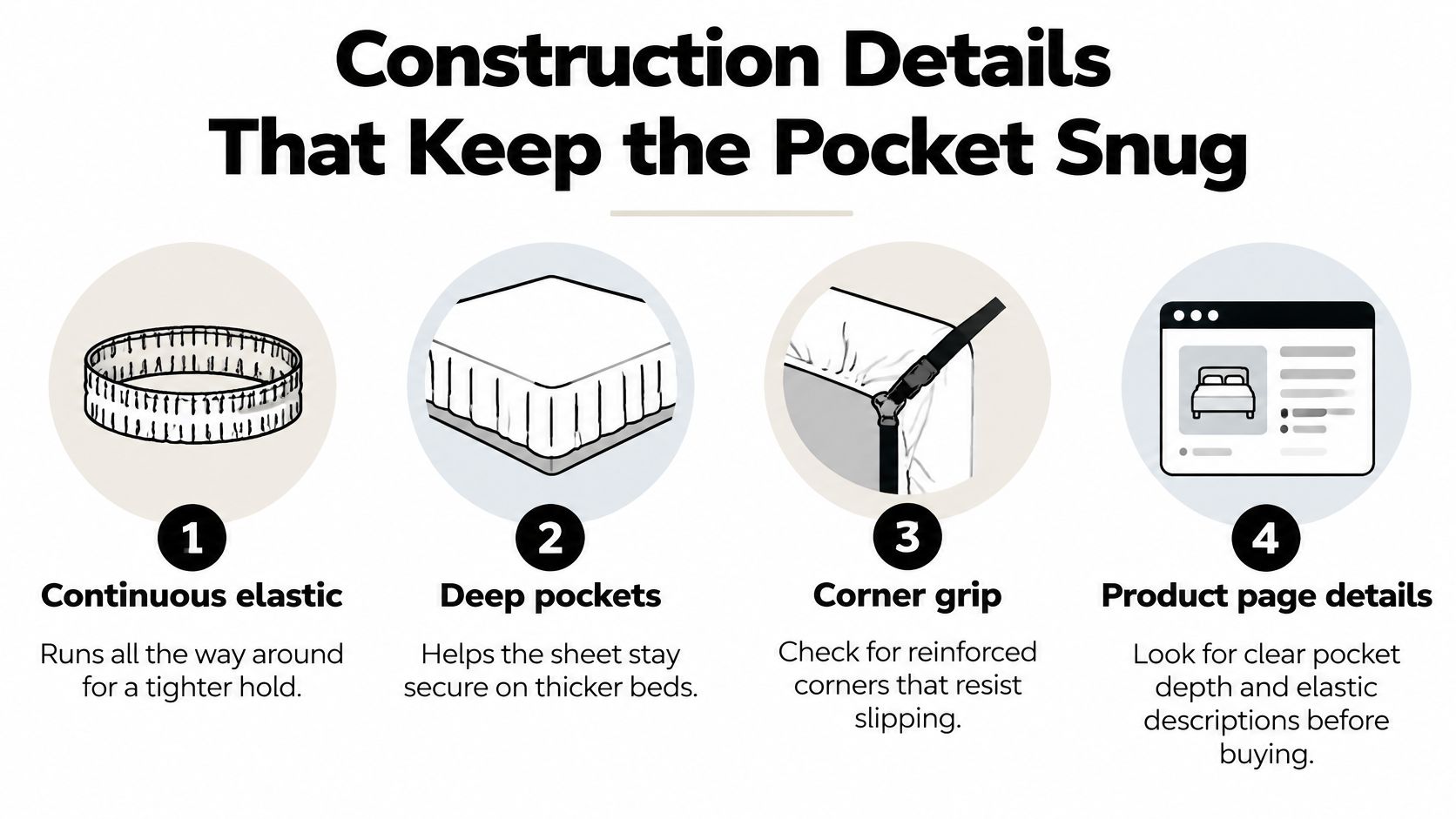
The Checklist
- Continuous elastic: Elastic that runs around the full perimeter, or is reinforced at the corners, holds tension evenly. Corners carry the most stress, so check that the product page states the elastic layout rather than just saying "elasticized."
- Corner construction: Look for double-stitched or gusseted corners that give the pocket a shaped box instead of a pinched point. In store, turn the corner inside out and inspect whether the seam is bar-tacked or overlocked.
- Elastic casing: The casing should hold its shape when you stretch it and let go. If the elastic twists inside a loose channel or returns slowly, it'll return worse after repeated washing.
- Seam finish along the pocket: Run your fingers along the sidewall seam and look for skipped or loose stitching. A weak seam lets the pocket open gradually, and the sheet starts failing weeks later for no obvious reason.
- Stated depth, stated timing: Pocket depth should appear separately from the sheet's width and length, with a note on whether it's measured before or after laundering. If only footprint dimensions are listed, you don't have the number that decides fit.
Thread count is not a fit indicator. A high count can still have a shallow pocket, weak elastic, and corners that release. Don't let a big thread count number substitute for the construction details.
Stretch one corner firmly, then release it. The elastic should snap back to shape, and the pocket depth you measure with a tape should match the label.
Washing and Drying to Protect the Elastic and Fit
The goal is simple, keep the elastic and corner fit intact so the pocket still grips after months of washing. King size deep bed sheets are bulky, and most damage happens through crowding and heat rather than detergent choice.
- Use a large enough machine: Avoid overloading, because a crowded drum stretches elastic and tangles corners. If your home machine is small, wash and fold laundry services with commercial drums can handle a king set without that strain.
- Choose the shortest effective cycle: Longer cycles abrade pocket seams and work the elastic harder than the soil level requires.
- Wash in cool water: Follow the care label for detergent and temperature, and default to cool when the label allows it.
- Avoid high dryer heat: Heat weakens elastic recovery and makes the pocket shrink unevenly.
- Air-dry when feasible: Otherwise tumble on low and remove the set while slightly damp, then fit it or fold it straight away.
- Re-check after three washes: Compare the pocket against your measured stack so you catch shrinkage early.
On shedding, the evidence doesn't support a simple natural versus synthetic verdict. Cited in a 2025 review in the Textile Research Journal, one wastewater analysis found 62% of fibrous microplastics were of natural origin and 37% synthetic, while a separate 2025 household study found wash-cycle duration materially affected microfiber emissions, measuring an average of 5,849,943 microfibers per liter across sampled household wash trials. Shorter, colder cycles and air-drying reduce release either way.
A durable sheet used for years usually beats a lower-impact fiber that wears out quickly. Treat broad sustainability claims skeptically unless they rest on product-specific testing.
Choose Your King Deep Set and Confirm the Fit
Work through four decisions in order and the choice gets small quickly.
- Confirm your king type: Standard king and California king aren't interchangeable, so settle the footprint first.
- Compare stack to pocket: Put your measured total stack against the stated pocket depth and leave a margin rather than accepting an exact match.
- Pick fiber for temperature: Choose for sleep temperature and skin sensitivity, using breathability rather than softness claims as the deciding factor.
- Check construction and certificate: Confirm corner reinforcement, elastic recovery, and seam finish, plus a verifiable certificate for the finished article.
To see how a listing reads against that sequence, SouthShore's extra deep pocket sheet sets are tagged as Briteyarn 300 thread count 100% cotton sheet sets. That confirms fiber and count, but not fit, so the stack check still applies before you order. Southshore Basics standard bed sheets come in 7 bed sizes, including twin XL and split king, which matters if your setup turns out not to be a one-piece king at all.
Do one thing today. Measure your stack, write the number on a note, choose the pocket category above it, and log how the sheet fits after the first week of normal use.
Measure your stack first, then shop SouthShore Fine Linens for oversized and extra-deep-pocket sets built for modern mattresses, toppers, and adjustable bases. You'll find clear pocket depths and durable construction that hold up wash after wash, so visit SouthShore Fine Linens and match a set to the number on your note.


