
Fitted Sheet Size Guide: Measure Depth for a Perfect Fit
You wake up, turn over, and feel the fitted sheet pull tight beneath you. By morning, one corner has slipped free, the fabric is bunched under your back, and the mattress is showing at the edge. The package said “Queen,” so the problem seems mysterious, but the label only confirms the surface size. It doesn't confirm whether the sheet can reach around the full height of your mattress and bedding layers.
A reliable fitted sheet size depends on three measurements, width, length, and pocket depth. The third is now often the deciding factor, especially when a mattress includes a pillow-top, protector, topper, or adjustable base. Measure the entire sleep setup, then choose a sheet with enough depth to tuck securely underneath without forcing the elastic.
Why Your Fitted Sheet Size Matters More Than You Think
A fitted sheet can match your mattress perfectly across the top and still fail during the night. The usual scenario is familiar: the width and length are correct, but the corners sit under constant strain because the pocket is too shallow. Movement pulls the elastic upward until one corner pops off, then the fabric wrinkles across the sleeping surface.
Mattress construction has made this problem more common. A bare mattress may have one profile, while a pillow-top, mattress protector, and topper create a much taller bed stack. The sheet must fit over the combined height, not just the mattress label printed on the box.
Practical rule: Treat “Queen” or “King” as the starting point for width and length. Treat measured stack height as the deciding factor for pocket depth.
A shallow sheet also creates a false sense of fit. It may stretch over the mattress during bed-making, but movement, laundering, and added layers reduce the available slack. Pulling hard on the corners can place unnecessary stress on elastic and seams, while excess fabric from an oversized pocket can bunch beneath the mattress.
For households using a protector or looking for a basic layer beneath other bedding, practical buying guidance such as this resource on cheap mattress covers UK can help clarify how additional coverings affect the finished setup. The key decision remains the same: measure everything that will stay on the bed, then match the sheet to that total.
How to Measure Your Mattress for the Perfect Fit
Accurate measurement takes only a flexible tape measure and a few minutes. Measure the bed in the condition you sleep on it, including any protector or topper that will remain beneath the fitted sheet.
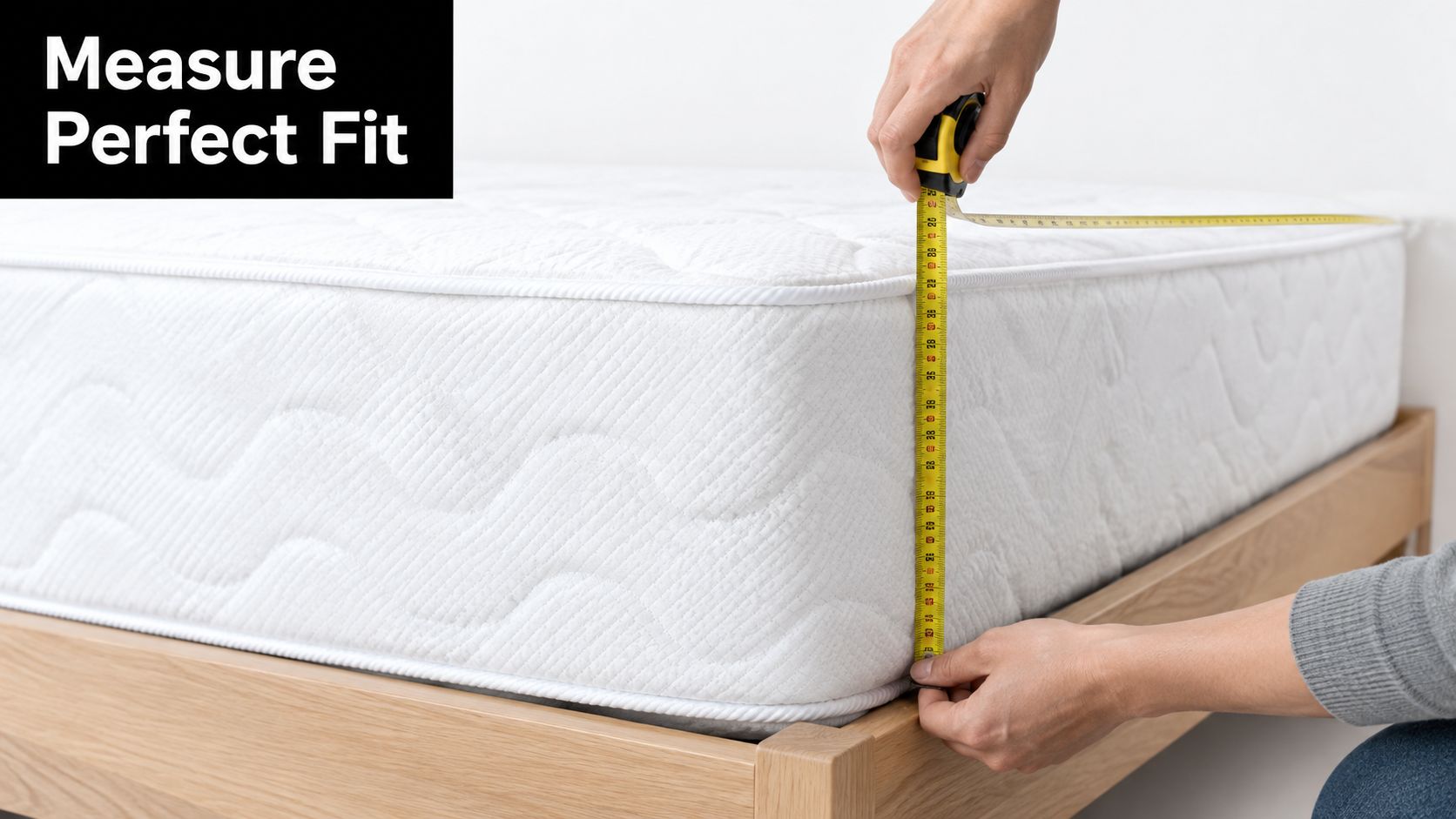
Measure the surface
- Measure the width. Run the tape across the broadest part of the mattress, from one side to the other. Keep the tape straight and measure the mattress itself, not the surrounding bed frame.
- Measure the length. Measure from the head to the foot, following the central line of the mattress. Don't assume two mattresses with the same name have identical dimensions, because manufacturing tolerances and regional standards can differ.
- Measure the total depth. Start at the bottom edge of the mattress base and extend the tape to the highest sleeping surface. If a protector or topper sits on top, include it. A pillow-top should also be included because its height is part of the stack the sheet must cover.
Write the measurements down in the same unit shown by the retailer. If you're comparing products from different markets, record both inches and centimetres to avoid converting hurriedly while shopping.
For beds with a pronounced pillow-top or multiple layers, the guidance in this resource about sheets that fit a pillow-top mattress is useful because it treats the upper layers as part of the fit calculation.
A visual demonstration can reinforce where the tape should sit and why the top layer matters:
The number you need for shopping is the total stack height. Compare it with the manufacturer's stated pocket depth, then leave room for the elastic to tuck below the mattress.
Understanding Standard Fitted Sheet Dimensions
Width and length establish whether a fitted sheet covers the mattress surface. In the United States, common mattress dimensions include Twin at 38 × 75 inches, Twin XL at 38 × 80 inches, Full at 54 × 75 inches, Queen at 60 × 80 inches, King at 76 × 80 inches, and California King at 72 × 84 inches, as listed in this international bed sheet size chart.
| Size | Dimensions (Inches) | Standard Pocket Fit |
|---|---|---|
| Twin | 38 × 75 | Around 12–14 inches |
| Twin XL | 38 × 80 | Around 12–14 inches |
| Full | 54 × 75 | Around 12–14 inches |
| Queen | 60 × 80 | Around 12–14 inches |
| King | 76 × 80 | Around 12–14 inches |
| California King | 72 × 84 | Around 12–14 inches |
These surface dimensions are useful, but they don't describe the vertical clearance. Contemporary guides commonly place standard pocket depths around 12–14 inches, deep pockets around 15–17 inches, and extra-deep pockets around 18–22 inches. Those ranges are summarized in this fitted-sheet sizing reference.
A Queen sheet with the correct 60 × 80 inch footprint can still be unsuitable if the bed stack is taller than its pocket. Conversely, selecting a very deep pocket for a low mattress may leave loose fabric at the corners. The right fitted sheet size combines the correct surface dimensions with a pocket selected for the actual vertical profile.
Regional naming adds another risk. UK and European mattresses commonly use metric dimensions, including UK Single at 90 × 190 cm, UK Double at 135 × 190 cm, UK King at 150 × 200 cm, EU Double at 140 × 200 cm, EU King at 160 × 200 cm, and EU Super King at 180 × 200 cm. A US Queen therefore isn't directly interchangeable with a UK King or an EU 160 × 200 cm mattress.
Standard Versus Deep Pocket Sheet Categories
Pocket categories describe how much sidewall fabric a fitted sheet has available. Retail labels vary, so use the ranges as a guide rather than treating “deep” as a universal measurement.
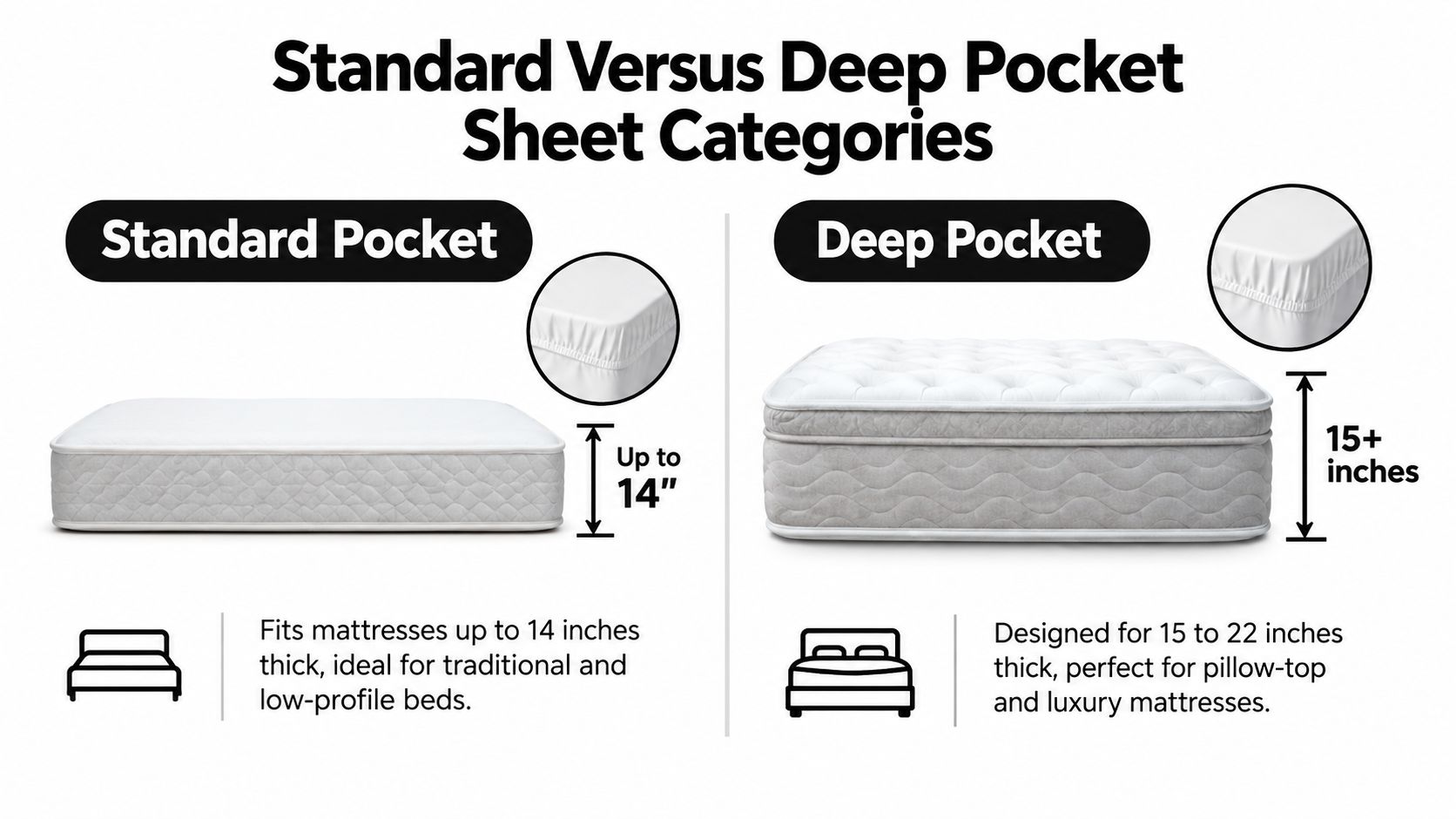
Standard pockets
Standard options commonly measure around 12–14 inches deep. They're generally suited to thinner traditional mattresses without substantial added layers. They can work well when the measured stack stays within that range and the elastic has enough room to tuck beneath the mattress.
Deep pockets
Deep-pocket sheets commonly cover 15–17 inches. They're a practical choice for hybrid mattresses, pillow-tops, Euro-tops, or a mattress combined with a protector that adds noticeable height. A sheet in this category often solves the familiar problem of corners lifting because the sidewall reaches farther down the mattress.
Extra-deep pockets
Extra-deep options commonly measure 18–22 inches. They're intended for taller memory-foam beds, substantial layered setups, and some adjustable-base arrangements. Specialty products may go beyond this range for unusual profiles, which is why the stated pocket measurement matters more than the category name.
The trade-off is important. A shallow pocket can pull against the elastic, expose the mattress, and pop free. An excessively deep pocket can leave surplus fabric under the corners, causing bunching and uneven tension. The most useful discussion of the category differences appears in this guide to everything you need to know about deep-pocket sheets.
Choose from the measured stack, not from the assumption that every modern Queen or King needs the deepest available option.
The Importance of Pocket Depth and Elastic Tension
Pocket depth works only when it leaves enough fabric for the elastic to grip beneath the mattress. A practical fitting rule is to choose a pocket about 1–3 inches deeper than the measured mattress or bed stack, as explained in this fitted-sheet buying guide. That extra space creates a working margin instead of forcing the sheet to sit at its absolute limit.
Consider a sheet whose pocket depth exactly matches the stack. It may cover the sides, but the elastic has little material left to wrap underneath. When you move, wash the sheet, or add another thin layer, the tension changes and the corner can release. A modest buffer lets the elastic seat below the edge while keeping the fabric stretched smoothly across the surface.
Why exact matching often fails
The label “fits up to” doesn't always describe how secure the sheet will feel. A sheet designed for a maximum depth may technically cover that mattress, yet provide less retention than the same sheet used on a slightly shorter stack. Fit depends on pocket construction, elastic placement, mattress firmness, and whether the base moves.
A useful selection process is:
- Measure the full stack. Include mattress, protector, topper, and any permanent comfort layer.
- Add a working buffer. Look for roughly 1–3 inches beyond that measurement.
- Check the construction. A continuous elastic edge or well-seated corner elastic can improve grip, but it can't compensate for a pocket that's too shallow.
- Avoid excess deliberately. If the pocket is much deeper than needed, test the corners for slack and bunching.
The best sheet is not the one with the largest pocket. It's the one that leaves enough room to tuck while maintaining even tension.
Modern mattresses often measure 10–14 inches or more, so bed size alone can't determine vertical fit. A Queen is a horizontal specification. Pocket depth is a separate performance specification.
This approach also helps with adjustable bases. As the bed changes position, the fitted sheet needs extra fabric and dependable elastic to move with the mattress. A shallow pocket may fit when the base is flat and fail as soon as the head or foot rises.
SouthShore Fit Recommendations for a Secure Sleep
A secure sheet starts with the same measurement process regardless of brand. For SouthShore Fine Linens customers, that means recording the mattress width and length, then measuring the full stack before choosing among fitted sheet options. The useful product distinction is not just Queen, King, or California King. It's whether the pocket depth suits the construction beneath it.

Match the setup to the sheet
For a lower-profile mattress without bulky layers, a standard pocket may be appropriate. A hybrid or pillow-top setup generally calls for a deep-pocket option, while a mattress with a substantial topper, protector, or moving base may need an extra-deep design.
SouthShore Fine Linens offers fitted sheet collections with oversized and extra-deep pocket options. That makes the brand one option for shoppers whose main problem is insufficient coverage around a modern mattress, but the stated pocket measurement should still be compared with your own recorded stack height.
A reliable fitting strategy looks like this:
- Measure before selecting the color or fabric. A beautiful sheet that can't stay on the bed isn't a successful purchase.
- Use the pocket specification as the filter. Sort out unsuitable depths before comparing finish, feel, or style.
- Leave the buffer. Aim for the practical 1–3 inch allowance so the elastic can tuck underneath.
- Recheck after layering. If you add a topper later, recalculate the stack rather than assuming the original sheet will continue to fit.
The same logic applies to adjustable bases. Look for enough sidewall to accommodate movement, then seat each corner beneath the mattress rather than leaving the elastic resting against the side.
Quality construction can improve durability, but it doesn't override measurements. A sheet with strong elastic still needs adequate depth, and an extra-deep pocket still needs enough tension to avoid loose folds.
Final Steps to Ensure Your Sheet Stays in Place
Correct selection is only half the job. Installation determines whether the fitted sheet uses its pocket depth and elastic properly.
Start at one corner and pull the pocket fully over the mattress edge. Move diagonally to the opposite corner, then fit the remaining corners. Press the elastic beneath the mattress rather than leaving it perched along the side. This creates the downward grip that keeps the sheet anchored.
Check the finished fit
Run your hand across the surface after all four corners are seated. The fabric should feel smooth without being stretched so tightly that the seams strain. Look underneath each corner for equal coverage. One corner sitting higher than the others usually indicates uneven installation, an insufficient pocket, or a stack that wasn't measured in its final form.
After washing, inspect the fit again. Natural-fibre fabric can change during laundering, and repeated heat or rough handling can affect elastic recovery. Follow the care instructions, avoid forcing a tight sheet onto the mattress, and let the fabric dry according to the manufacturer's guidance.
If the sheet still slips, use the troubleshooting advice in this guide on how to keep bed sheets from slipping. Frequent readjustment is useful evidence. It usually means the pocket depth, elastic tension, or total stack measurement needs another look.
Keep a written record of your final width, length, and stack height. That note makes future purchases faster, especially when you're replacing only fitted sheets or shopping across US, UK, and European size systems.
SouthShore Fine Linens offers fitted sheet options with oversized and extra-deep pockets for modern mattresses, layered beds, and adjustable-base setups. Measure your complete bed stack, compare it with the pocket specifications, and visit SouthShore Fine Linens to choose bedding designed around a secure, polished fit.


