
Bedding Layers Guide: Order, Materials and Sizing
The bed looks right. The duvet is smooth, the quilt is folded at the foot, the pillows are stacked the way the photos show. Then you get in, and within an hour you're too warm, or a corner of the sheet has popped, or you're lying there trying to work out whether the blanket under the duvet should have come off first.
None of that is a taste problem. A bed is a temperature system built from parts you can move, and most bedding frustration traces back to three things: layers in the wrong order, fabrics that hold moisture against the skin, and covers that were never sized for the mattress underneath them. This bedding layers guide works through them in that order, so that by the end you can look at any bed you sleep in and see exactly what to change.
Bedding Layers in Order, From Skin to Top
The table below lists the six layers in the order a sleeper meets them, starting at the mattress and working up. Read it as a job description for each part rather than a styling plan.
| Layer | Job | Typical materials | Best season |
|---|---|---|---|
| Fitted sheet | Anchors the bed and holds the layers in place | Cotton, bamboo viscose, Tencel | Every season |
| Mattress protector | Shields the mattress from spills, dust and allergens | Cotton top over waterproof membrane | Every season |
| Flat sheet | First fabric against the skin and easy to change | Cotton percale, cotton sateen, linen | Every season |
| Quilt or coverlet | Adjustable mid-weight warmth and visual layer | Cotton, microfiber with batting | Spring and autumn |
| Blanket | Removable extra warmth on cold nights | Wool, fleece, cotton knit | Winter |
| Duvet and cover, or comforter | Main insulation for cold conditions | Down, down alternative, polyester fill | Winter |
The fitted sheet does the structural work. Everything above it stays where you put it only because the sheet beneath is gripped to the mattress, which is why a fitted sheet that lets go at 2 a.m. feels like a whole-bed failure rather than a small one.
The protector sits between the sheet and the mattress and exists for the things you can't wash out of a mattress: sweat, spills, dust mite allergen. A cotton face over a thin waterproof membrane breathes better than a plastic-backed pad, and it's the layer that protects the warranty.
The flat sheet is the fabric your skin spends the night against. It's also the cheapest layer to replace and the easiest to wash weekly, so it carries most of the hygiene load, and in summer it can be the only cover you need.
The quilt or coverlet is the layer touched most often. Folded at the foot, it adds mid-weight warmth and gives the bed visual weight without committing anyone to a full duvet. The blanket is pure function, warmth you can pull up at 4 a.m. and kick off without rebuilding the bed. The duvet or comforter provides the main insulation, and it's also the heaviest and hardest layer to move out of the way.
Duvet, quilt and comforter aren't interchangeable
Stores use these words loosely, which is where half the confusion starts. A comforter is one finished piece with the fill stitched inside; it goes on bare and gets washed whole. A duvet is an insert, usually down or a down alternative, that needs a cover because it isn't built to be washed often. A quilt is thinner and flatter, two fabrics with light batting between them, and it works best as a mid layer or a summer top.
The rule underneath the table: the more easily a layer can be removed, the more control the sleeper has, so the layers that change most often belong highest in the stack.
For a walk through how protectors and comforters fit into a whole-home setup, including guest rooms and rentals, this guide to bedding advice for Columbus homeowners covers the practical build room by room.
Why Layers Control Warmth, Not Just Looks
It's 3 a.m. and the comforter that felt perfect at bedtime is the reason you're awake. You push a leg out, then an arm, and the heat still won't clear. That moment is the argument for layering in miniature: a bed with one heavy cover gives you nothing to take off except the cover itself.
Bedding builds a microclimate between your body and the room. The layers decide how much heat and moisture stay trapped in that pocket, which is why two beds with identical duvets can sleep completely differently depending on what's underneath. The National Sleep Foundation's bedroom poll found that 85% of respondents rated comfortable sheets and bedding as important for a good night's sleep, just behind comfortable mattresses at 92% and comfortable pillows at 91%.
Temperature runs through the same poll. About 69% of respondents said bedroom temperature had a major impact on how well they slept in the previous two weeks. Bedroom warmth and sleep quality move together, so a stack you can adjust in the dark matters more than any single cover marketed as "warm" or "cooling."
A thermostat you hold in your hand
Every removable layer works like a small dial. The base sheet can't do much about warmth, but the quilt, the blanket and the duvet each let you turn the setting without standing up, opening a window or arguing with anyone about the heating.
That gives three clear jobs. The base is breathable and stays put against the body. The middle is adjustable warmth, light enough to remove half-asleep. The top handles the coldest hours and is the first thing to go when the room warms up. Fabric weight matters here as much as the number of layers, because a heavy cotton quilt and a lightweight wool blanket sitting at the same spot in the stack behave nothing alike.
Bedding doesn't have to be decorative to work. It has to be changeable.
So when you wake up too warm, which layer comes off first? Work from the top down. The duvet or comforter exists for the coldest hours, so it goes first. If the heat still sits, the middle quilt or blanket is next, precisely because it was chosen light enough to move without thinking. The sheet stays until the end, because once it's gone you have no cover left and the next problem is cold. A stack built with that order in mind turns a 3 a.m. wake-up into a thirty-second fix instead of a lost hour.
Build a Modular Stack for Every Season
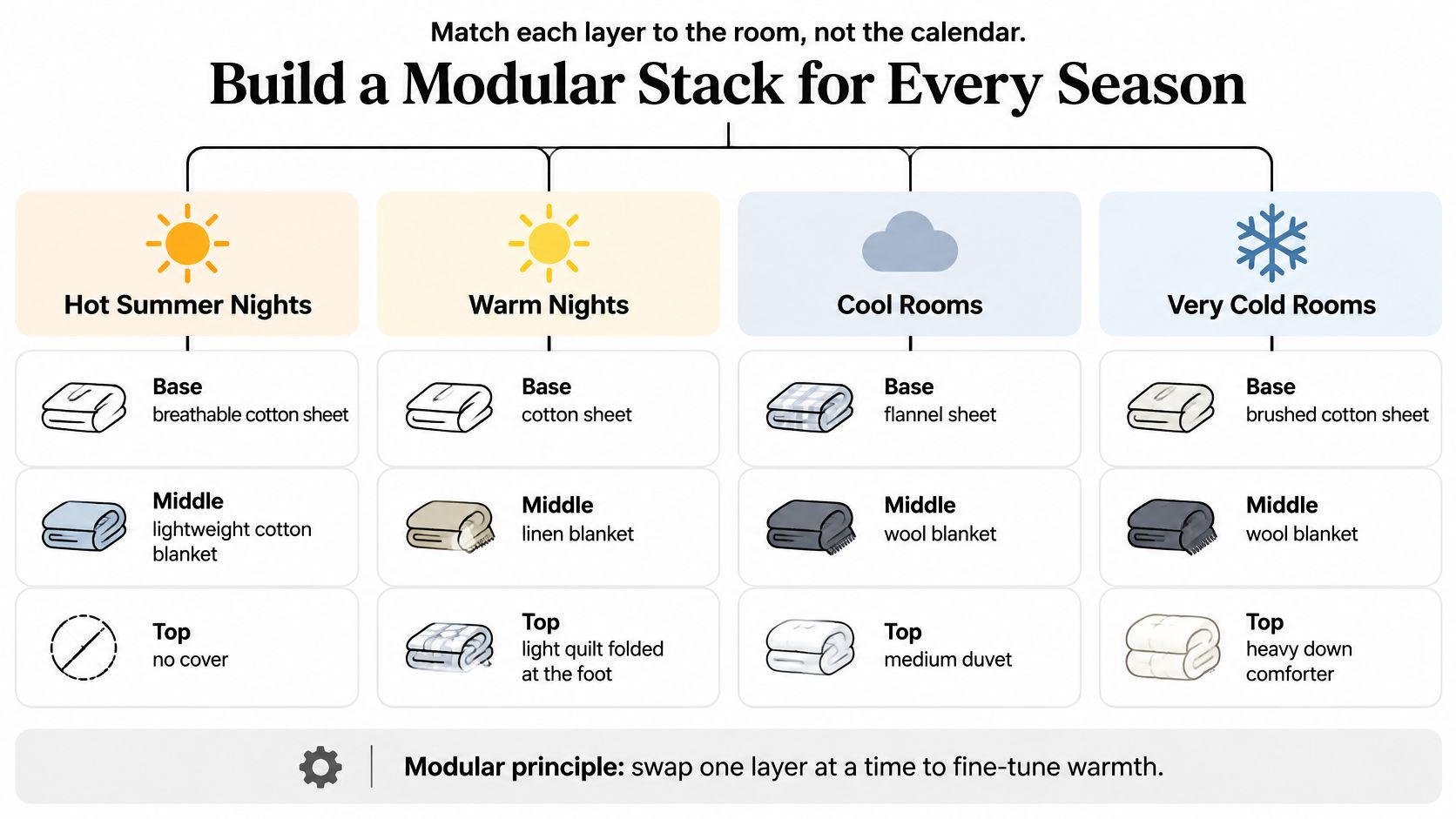
The stack is a room-temperature decision, not a calendar one. The same bedroom that needs a duvet in January may need nothing but a sheet in July, and the layers in between do most of the work across the year.
| Conditions | Base | Middle | Top layer |
|---|---|---|---|
| Hot summer nights | Fitted and flat sheet | None or light cover | None or lightweight blanket |
| Mild spring or autumn | Fitted and flat sheet | Quilt or coverlet | Light blanket if needed |
| Cold winter room | Fitted and flat sheet | Quilt or coverlet | Blanket plus duvet or comforter |
| Very cold room or drafty bedroom | Fitted and flat sheet | Quilt | Blanket plus duvet, with the duvet added last |
The numbers behind modular layering are bigger than expected. A climate-chamber study using a heated thermal manikin tested 84 combinations of sheets, blankets, duvets, sleepwear, body coverage and sleeping positions, reported by Medical Xpress. Total bedding-plus-sleepwear insulation ranged from 1.06 to 5.71 clo, so changing coverage and construction can multiply warmth more than fivefold. The same study found that two setups with similar whole-body insulation could produce noticeably different local skin temperatures, because heat moves differently by body region, posture and mattress contact.
That range is why one very heavy comforter is a poor control system. It gives you maximum warmth or nothing.
Four steps to set up the stack
- Put on the breathable fitted and flat sheets first, and leave them there all year. They touch your skin and don't need to change with the season, so they're the constant the rest of the stack is built on.
- Add a medium quilt once nights turn cool. Warmth arrives in steps rather than all at once, which is the whole point of a modular system.
- Keep a removable blanket within reach for the coldest hours. You can add it at 4 a.m. without remaking the bed or waking anyone.
- Add the duvet or comforter only when the lower layers aren't enough. It's the hardest layer to remove quickly, so it should be the last one in.
Starting point, not standard: add the quilt when the room stops holding heat overnight. Quilt weight, draughts and how warm you sleep all move that line.
If you're deciding which mid layer earns the spot, this comparison of how to choose a blanket for the seasons is a useful second opinion on fabric weight. Plan the stack for the season you're in and the one coming next, so the switch is a five-minute job rather than a shopping emergency.
Sizing Each Layer to Your Mattress Depth
A fitted sheet works like a shower cap: the elastic only holds when the cap is bigger than what it wraps. Every layer above the mattress has to cover the same three measurements, width, length and height, and the first two are printed on the label. Height is the one that decides whether your removable stack stays removable or peels off the corner at 3 a.m.
| Bed size | Width by length (in) | Layer note |
|---|---|---|
| Twin | 39 x 75-76 | Fitted sheet must match the length and depth, not only the width |
| Full | 54 x 75-76 | Common for guest rooms and smaller adult beds |
| Queen | 60 x 80 | Most common size, so the widest range of bedding is sold for it |
| King | 78-79 x 80 | Quilts and flat sheets need extra width for tucking on both sides |
| California king | 72 x 84 | Narrower and longer, so check length-specific sheets |
Those figures are modern, and the standard behind them is younger than many assume. In 1922 the U.S. Bureau of Standards convened bed and mattress manufacturers after finding mattresses ranging from 6 feet to 6 feet 5 inches long and 3 feet to 4 feet 6 inches wide, then adopted four basic widths and one 73-inch standard length, as recorded in this history of mattress sizing. Today's beds are more generous and considerably thicker, which is why a tape measure beats a label.
The five measurements that decide fit
- Measure the mattress width and length. Use the surface you sleep on, not the frame.
- Measure height at the thickest point. Pillow-tops and quilted covers are rarely flat, and this walkthrough on how to measure mattress depth shows exactly where to place the tape.
- Add every permanent layer. A topper and a protector each add height, and the fitted sheet has to clear all of it.
- Compare the total with the sheet's pocket depth. The pocket has to exceed the combined thickness so the sheet can tuck underneath, as this guide to fitted sheet pocket depth sets out.
- Add tolerance for movement and shrinkage. Sheets shift with a restless sleeper and tighten slightly after washing, so a fit that's exact on day one often isn't exact by month three.
Pillow-top and hybrid beds need deeper pockets than their labels imply. Compression changes the answer, so measure with weight on the bed rather than on bare foam. Adjustable bases and split mattresses are their own problem: a raised head section changes how a sheet sits along the length, and split configurations need each half fitted separately.
A sheet that pops a corner does more than look untidy. It drags the flat sheet with it, bunches the quilt, and turns a system you could adjust in seconds into one you have to remake. Depth is what keeps every layer liftable.
When a flat sheet or quilt is the better top layer
Active households, guest rooms and short-term rentals often do better with a flat sheet or a quilt as the top layer than with a fitted sheet alone. Tucking is unreliable when the bed gets used hard, and a quilt that folds back neatly survives turnover better than a fitted cover that gets pulled at the corners.
For mattresses outside the five common sizes, check the size list before anything else. Our Southshore Basics sheet sets come in 7 bed sizes, including twin XL and split king, which covers the less common mattresses that standard ranges miss.
Tonight, measure the bed at its thickest point and write down four numbers: width, length, total height including topper and protector, and the pocket depth of the sheet currently on the bed. That single card answers most fit questions before you spend anything.
Choosing Fabrics That Breathe Without Losing Warmth
Fabric choice is where thread count marketing does the most damage. A high count tells you how densely a cloth is woven; it says nothing about how the cloth handles moisture or heat, and those are the two things your body notices.
| Fabric | Breathability | Warmth | Care |
|---|---|---|---|
| Cotton percale | High | Moderate | Machine wash, tumble dry on low |
| Cotton sateen | Moderate | Moderate | Machine wash, tumble dry on low |
| Linen | Very high | Low to moderate | Gentle cycle, may soften with washing |
| Bamboo viscose | High, moisture-wicking | Low to moderate | Cold gentle cycle, low or air dry, avoid bleach |
| Tencel lyocell | High | Low to moderate | Gentle cycle, low heat |
| Microfiber polyester | Lower | Moderate to high | Machine wash, low heat |
Notice that the breathable fabrics cluster at the top and the warmest one sits at the bottom. That's not a coincidence, and it's why the layer closest to your skin should be the most breathable thing on the bed, while warmth comes from what sits above it.
Why moisture decides comfort before warmth does
A technical review summarized for bedding buyers found that discomfort can begin with only about 3% to 5% added moisture at the skin and textile interface. That's a very small amount of dampness to turn a bed uncomfortable, and it explains why a heavy sheet can feel clammy while a lighter one at the same room temperature feels fine.
Comfort depends on air permeability, moisture regain, ambient humidity, fabric temperature and pressure against the body. Which of those dominates shifts with conditions: when the room is cooler than your skin, air permeability matters more to your core thermal response, and when your skin is warmer than the surroundings, moisture regain takes over. The practical specification falls out of that.
Specification: most breathable textile against the skin, quilt or blanket as the adjustable insulation, and no low-permeability barrier trapped under dense top layers.
That last point catches people out. A waterproof crib pad or a synthetic mattress cover placed high in the stack blocks moisture from escaping, and no amount of breathable sheeting above it will fix the problem. Keep the barrier directly on the mattress, under everything else.
Fabric softener is the other quiet saboteur. It coats fibres and can reduce breathability over time, so follow the care label rather than the habit. For a closer look at how the three most common sheet fibres compare, this breakdown of bamboo, linen and cotton sheets covers the trade-offs in more detail.
On safety claims, OEKO-TEX STANDARD 100 is a useful screening signal because certified textiles are tested for harmful substances from yarn through finished product, as the OEKO-TEX standard explains. It confirms material safety. It does not by itself prove better breathability, warmth, durability or sleep performance, so don't let a certification badge stand in for the fabric facts.
Fixing Overheating, Cold Feet and Stuck Layers
Waking up overheated usually gets blamed on the duvet, and the duvet usually isn't the culprit. The better question is what a cooling product can change, and what only rearranging the stack can fix.
The marketing around cooling bedding has run well ahead of the evidence, and the most careful recent study is a useful corrective. A 2025 randomized crossover trial of 34 adults, indexed on PubMed, found that a temperature-controlled mattress cover significantly improved perceived sleep quality and thermal comfort, but produced no significant improvement in objective sleep measures. The authors noted that expectancy or placebo effects may partly explain the result.

A second 2025 study, run in a hot climate without randomization, reported fewer heat-related sleep complaints among participants after they switched to cooling sheets. A design like that can't separate the sheets' effect from expectation, the weather, or anything else that changed at the same time. Subjective comfort and measured sleep performance are two different claims, so keep them apart when you're spending money.
What works reliably is order of removal.
When you overheat: take off the top removable layer first, then the blanket, and leave the breathable base sheet where it is.
The stack works like a thermostat with manual steps: each removable layer is one notch cooler, and the base sheet is the part that keeps moisture moving away from your skin. When you're cold, run it in reverse. Add the quilt or blanket over the base rather than swapping the sheet for something heavier, because the sheet does the moisture work and replacing it resets the whole system. Cold feet and the spots pressed against the mattress often feel colder than the rest of you, so check them before assuming the whole stack is too thin.
Humidity, sleepwear and the mattress protector all shift the result, which is why the same stack can feel different on consecutive nights. Change one thing at a time, give it a week, and note what helped.
Here's a quick walkthrough of adjusting a stack through the night.
One last diagnosis that saves a lot of pointless swapping: a fitted sheet that rides up or pulls off the corners overnight is a pocket-depth or fit problem, not a sign that the layers above it are wrong. Re-run your fit measurements before you blame the blanket or the duvet.
SouthShore Fine Linens builds bedding for the beds people own, from extra-deep pocket sheet sets that stay put on pillow-top and topper-equipped mattresses to quilts, blankets and comforters you can layer one at a time as the seasons shift. Many of our textiles are OEKO-TEX certified, so the layer against your skin is one you don't have to second-guess. Start with your measurements, then visit SouthShore Fine Linens to build a stack that fits the bed you have rather than the one the label assumes.


