
Bed Cover Design Ideas: 8 Styles and Real-Room Looks
Why do some beds look effortlessly curated while others look cluttered, even when the linens cost about the same?
The gap is not a secret color palette. It is three levers: texture, pattern, and layering. Smooth sateen against a raised weave looks finished. Two loud prints on the same plane look noisy. A second heavy cover piled on the first hides the mattress instead of dressing it.
Those levers are old. The Metropolitan Museum of Art records that Indian embroidered quilts were already entering England by the late sixteenth century. A 1601 inventory belonging to Bess of Hardwick listed two quilts described as Indian textiles embroidered with birds and animals, and similar Indian quilts appeared more often in London sales during the 1620s. By the eighteenth century, export covers often used a central medallion with smaller corner medallions, stylized vegetation, serrated leaves, birds, and animals. Copy that logic. Give the eye one hero, repeat a quieter edge, and stop before the surface turns into a collage.
Below are eight bed cover designs, from a crisp duvet cover to vintage tufted chenille. Each one names the texture, the pattern, and the layering move you can rebuild with pieces you already own.
1. Duvet Cover
A duvet cover is a removable shell, not the warmth. Buttons, snaps, or a zipper close it around the insert, so you change color and pattern without replacing the fill. The name comes from the French word for down feathers. The design job is simpler. The cover is the flat plane you see. The insert is the loft you do not have to show every day.
This comparison is the practical case for a shell versus a bare insert.
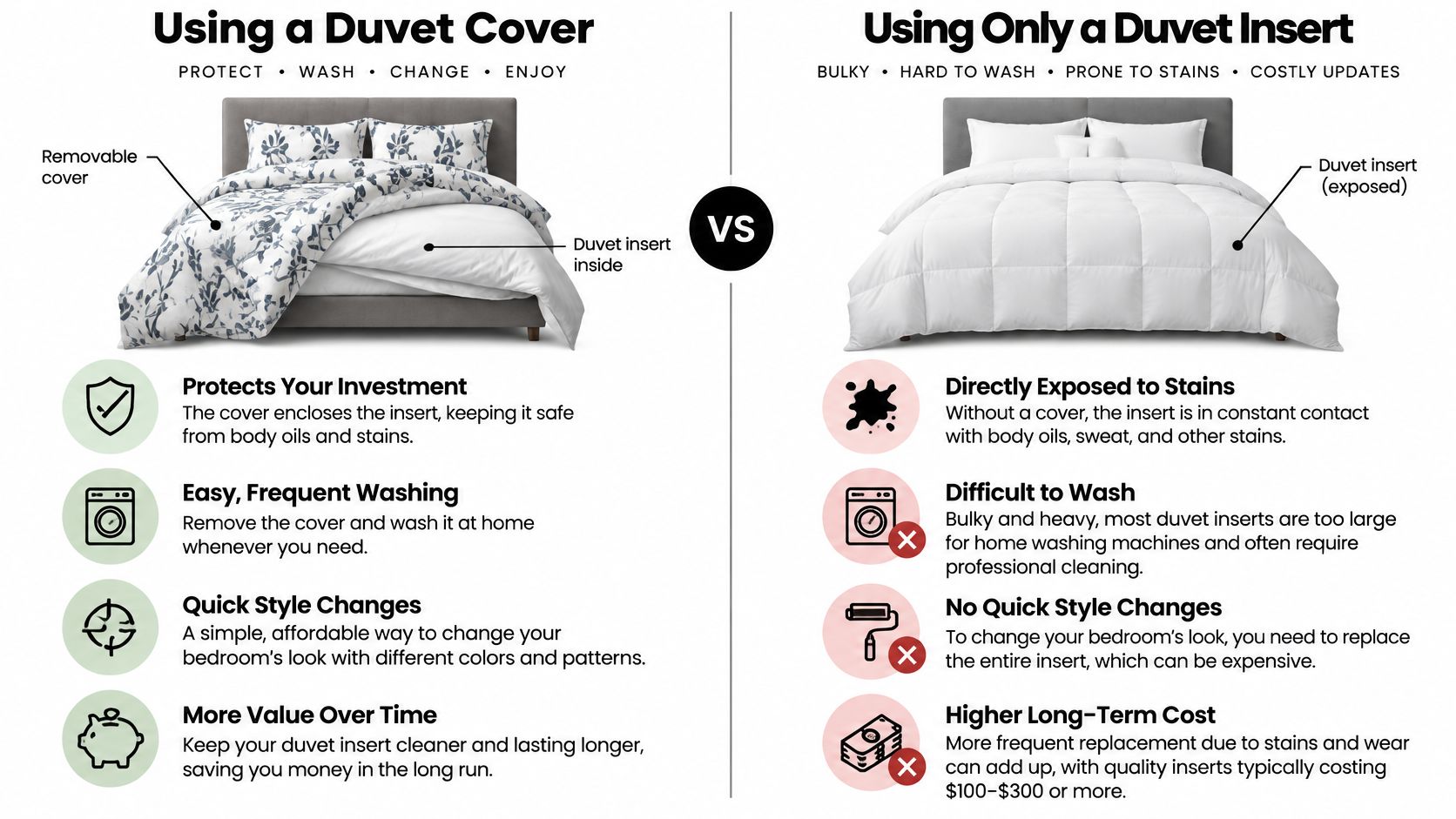
Say you already own a white percale cover and a flax linen one. Sleep in percale when you want a crisp, cool hand. Switch to linen when you want a relaxed coastal look with a little wrinkle. A stripe or small print handles a seasonal update. Keep the cover neutral and the shams patterned, or reverse that, so you are not buying a full new set.
Match the cover to the insert in a small room. Extra fabric reads as clutter, not luxury.
- Size with intent: Go one size larger than the insert for a fuller puff. Match the insert exactly for a crisp edge.
- Stop the drift: Use corner ties or a duvet clip so the fill does not slide to the foot.
- Wash the shell, not the loft: Cold or warm water on a gentle cycle keeps dyes and fibers calmer.
The clip-in takes about a minute once the corners make sense. This walk-through shows the sequence.
2. Quilt
A quilt is three layers stitched into one cover: a decorative top, batting, and a backing. That stitch is the texture. It also keeps the fill from shifting. Use it alone over a sheet, stack it on a lighter blanket, or fold it in thirds at the foot to add pattern without changing the sleep layer.
Whole-cloth quilts, often a single cloth where the stitching carries the pattern, sit alongside pieced styles in museum collections. The Louisiana State Museums costume and textile holdings include approximately 80 quilts, quilt tops, and fragments dating from about 1800 to 2006, among them piecework, whitework, crazy quilts, and strip quilts. That range gives you a styling menu. Solid geometry, like many Amish quilts from Pennsylvania and Ohio, reads calm. Improvisational blocks, in the spirit of Gee's Bend, can be the single pattern on the bed. A modern grid in neutral cloth is the same idea with less contrast.
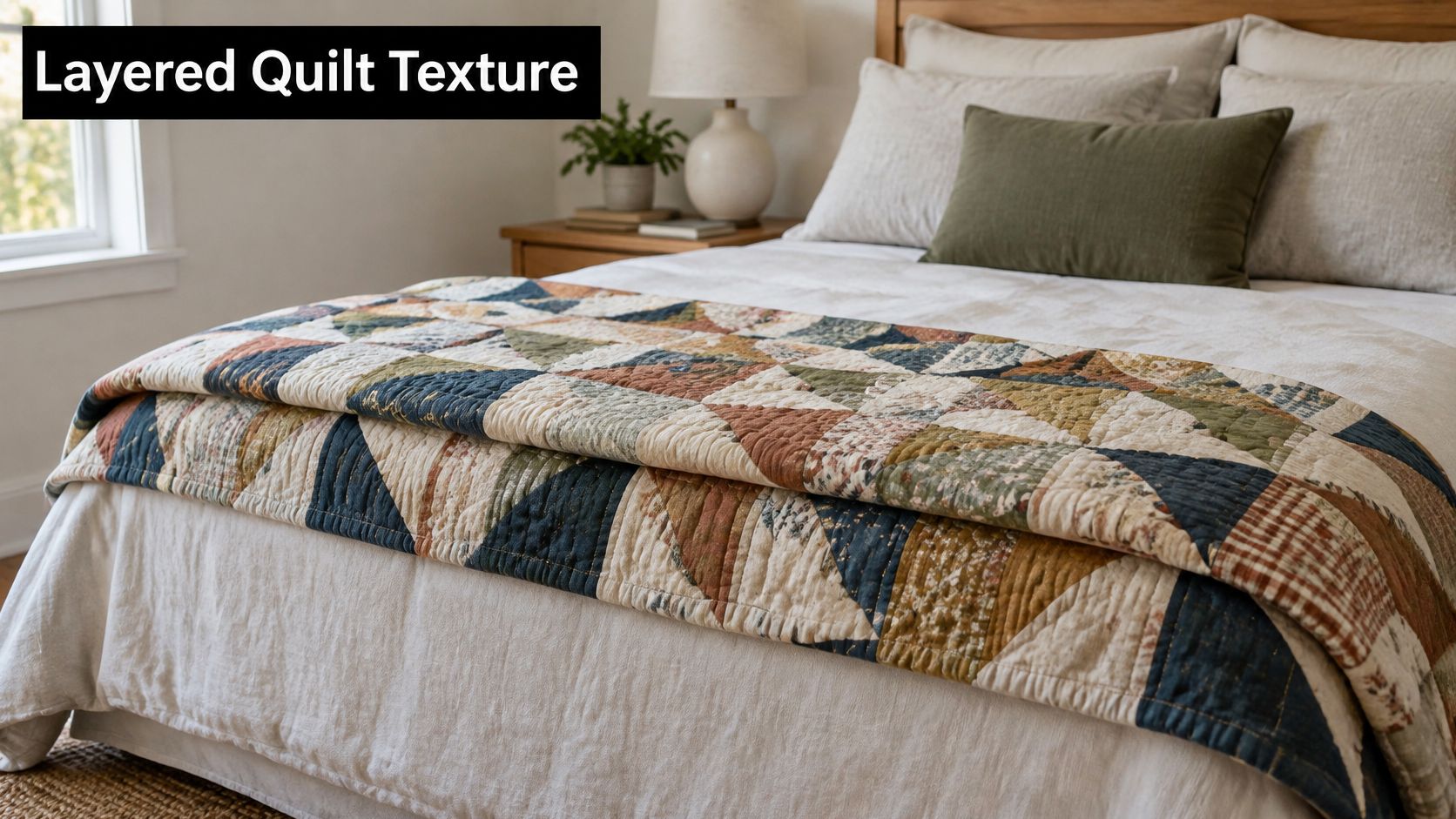
Stitch density changes the look before color does. Close stitching reads as texture and wears better, because the batting moves less. Wide channels read as soft volume and need more careful washing. A lighter quilt works year-round; add a blanket only in winter. Wash cold and dry flat so stitch lines do not pull. If the quilt is the pattern hero, keep sheets and shams quiet. Construction differences are laid out in this guide to quilts and bed covers.
3. Comforter Set
A comforter set stitches the fill between a top and a bottom cloth, then usually adds matching shams and sometimes a skirt. You get a finished bed with almost no styling. You also get less freedom. The pattern, the weight, and the size are locked together.
Warmth is a measurement problem, not a season label. In a controlled whole-night study of 16 adults, people reported thermal comfort when mean skin temperature was about 34.6 to 35.2°C and bedding temperature was 31.2 to 32.7°C, and silk supported higher comfortable air-temperature limits than down, followed by polyester, at equivalent insulation, as reported in Indoor Air. I do not buy one "all-season" comforter and hope. I pick fill weight for the room.
Practical rule: Specify warmth by fill weight and room temperature, not by an all-season label.
- Microfiber sets cover everyday beds when budget and easy care come first.
- Down-alternative fills suit allergy-conscious households that still want loft.
- Oversized cuts matter on deep mattresses so the sides stay covered.
Choose a comforter slightly larger than the mattress so both sides drape evenly. Heavy fills need a large-capacity washer, or a laundromat machine. Fluff on low heat with clean tennis balls to bring loft back. For a lighter summer edit, drop bulk the way summer decorating advice from Critelli Furniture swaps heavy cloth for something more comfortable. Fill types are compared in this overview of comforter types.
4. Coverlet
A coverlet is the light layer stylists reach for when a comforter would cook the room. It is often woven or lightly quilted, and it sits over the top sheet and, in cool weather, a blanket. Jacquard florals and geometrics carry traditional rooms. Cotton overshot patterns borrow from early American weaving. A plain lightweight cotton coverlet is the same mechanic with the pattern turned down.
Warmth you can take off
A 2024 systematic review of human studies found that linen bedsheets improved sleep quality for young adults in warm conditions, while goose-down-filled duvets increased slow-wave sleep in cool conditions. Separately, adding bedding produced an almost 4°C heating effect, the strongest passive step tested, and removing bedding cooled things by about 1°C. A coverlet is how you use that. In a warm bedroom, it is the top. In a cool one, fold it over a blanket so you add pattern without another full-weight comforter.
Fold the coverlet in thirds across the foot when you want a neat band of pattern and a clear view of the sheets. Hand wash, or use a delicate cycle, so woven motifs do not abrade. Cut it slightly longer than the mattress so the sides drape, but not so long that it puddles and trips an adjustable base.
5. Matelassé Bedspread
What makes matelassé read as quilted when there is no quilt inside? The raised pattern is woven into a double cloth. There is no separate batting to shift, slump, or go flat in the wash. That sculpted surface carries the look. Keep the print count at zero, or at most one quiet motif, or the puff fights the pattern.
Fit is where good texture goes wrong. A spread that exposes the mattress side, drags the floor, or jams an adjustable base is a measuring miss.
- Measure mattress height, topper depth, and the drop you want.
- Leave a movement allowance on split beds and articulated bases so the cloth does not bind.
- Skip automatic oversize. Extra length bunches at the corners and means more laundry.
Hotel-style cotton matelassé in cream or white, including Italian and French motif cloth, looks formal because the texture does the decorating. Pair it with linen shams so the bed is not one shiny plane. Use it as the only pattern in a neutral room, then add a solid throw at the foot if you want color. Wash gentle, or dry clean, to keep the raised design. Floor length reads complete only when the corners stay square.
6. Kantha Quilt
Kantha is hand work from Bengal, in India and Bangladesh. Makers layer old saris or cotton and join them with running stitches. The stitch is wavy, soft, and slightly puckered. That lived-in texture is the look. You do not need a vintage piece to copy it. A contemporary kantha-inspired throw at the foot does the same job.
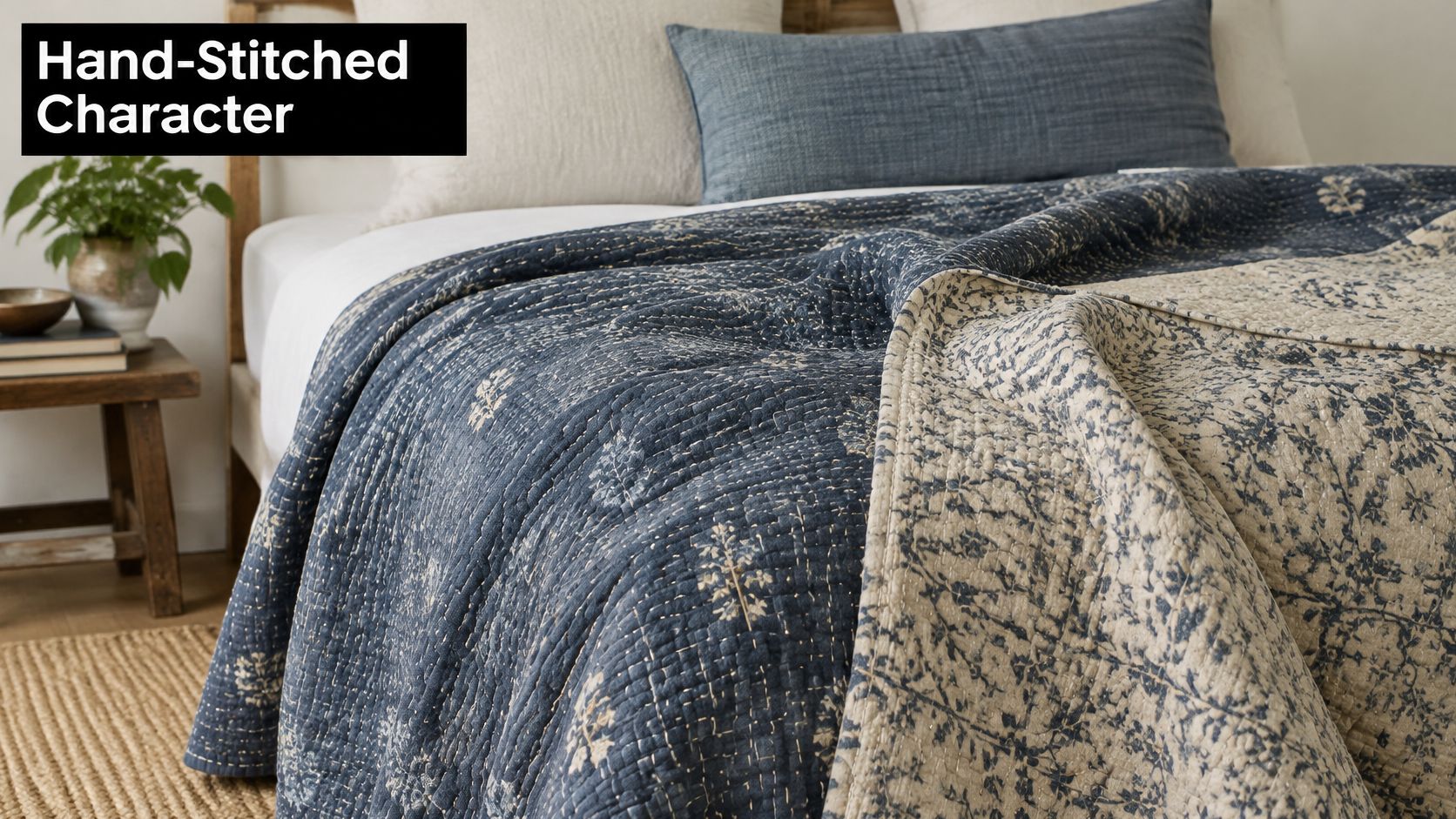
One cloth, two roles
Use it as a layer over a plain duvet when you want color without printing the whole bed. Place it at the foot as the focal point, the way a boutique hotel uses one strong textile against quiet walls. A neutral-toned kantha keeps a coastal room calm. A bold motif should be the only pattern in the stack. Spot clean, or hand wash in cold water, so the running stitch does not snap. Skip the dryer heat. The puckers are the design, and high heat flattens them.
Shared beds are where this layer earns its keep. One sleeper can pull the kantha up. The other stays under the lighter base cover. You are tuning warmth with cloth you can move, not arguing over one heavy comforter.
7. Marseille Quilt (Boutis)
A Marseille quilt, or boutis, is the crisp white or cream counterpoint to kantha's color. Stitching outlines the motif, then cords or padding raise it. The surface is sculpted, not printed. Classic French bedrooms and a lot of European hotel beds use that pale relief as the whole composition. Modern rooms do the same with a white raised quilt and almost nothing else on the plane.
Contrast without a second pattern
I put color in the pillows, not in a second bedspread. Two or three accent pillows are enough. A floral sham plus a printed duvet plus a boutis is how formal turns fussy. The raised white cloth is already the pattern.
Launder in cold water with a mild detergent. Air dry flat, or tumble on low, so the padded motifs keep their shape. Choose a length that drapes to the floor when you want a full, formal skirt of cloth. In a small bedroom, stop the drop at the mattress edge so the floor stays visible and the bed looks lighter. The texture still reads from the doorway.
8. Tufted Chenille Bedspread
What gives a tufted chenille bedspread its cottage look without making the bed feel dated? The texture does most of the work. Yarn is stitched into a cotton base, then cut and fluffed so the surface becomes a field of soft raised tufts. Dalton, Georgia, built a regional trade on that tufting, and the cottage and farmhouse versions still follow the same recipe: a pastel ground, a simple floral tuft, and often a pleated skirt to the floor. Keep the color quiet. The tufts are the pattern.
A plush face is not a cooling system. Chenille adds warmth because the pile traps air, and a bedspread that feels cozy in January can feel heavy in July. OEKO-TEX certification is harmful-substance testing, not proof of cooling, durability, or insulation, as this report on bedding labels and certification explains. That distinction matters when you are choosing a top layer for a bed that runs warm.
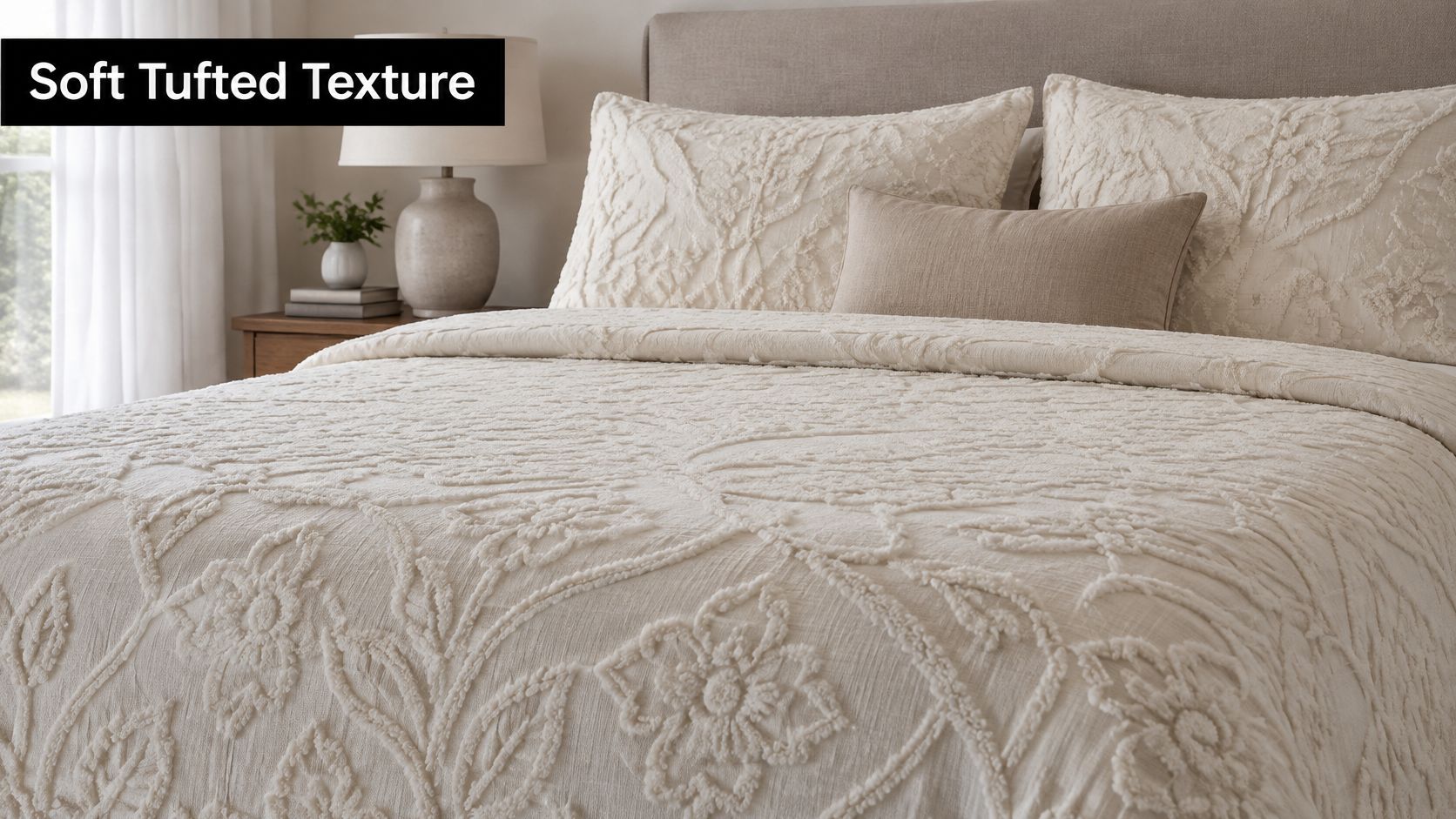
Wash cold on gentle and air dry flat so the tufts do not mat. Vacuum with a brush attachment; dust lives in that pile. For year-round use, put a lightweight blanket or quilt underneath and let the chenille be the top layer you can peel back. A pleated skirt gives a full drape. If the mattress is deep, measure the frame and confirm the skirt drop before you commit, because vintage lengths often fall short. Treat the floral tuft as the single pattern in the room; add color through pillows or a quilt underneath, not through a second print. That same one-pattern logic applies to a floral quilted bedspread.
8 Bed Cover Types at a Glance
| Item | Weight & Warmth | Signature Texture | Best Design Style | Layering Role |
|---|---|---|---|---|
| Duvet Cover | Adds little warmth without an insert | Varies by fabric, from crisp percale to relaxed linen | Flexible, easy-to-refresh styles | Encloses and protects the duvet insert |
| Quilt | Lightweight to medium warmth | Stitched layers with decorative patterns | Handmade, patchwork, or modern | Standalone cover or seasonal layer |
| Comforter Set | Warmth varies by fill and weight | Smooth, evenly stitched fill | Coordinated, low-effort interiors | Main bed covering with matching shams |
| Coverlet | Lightweight with minimal warmth | Woven patterns, often with fringe | Traditional or collected | Decorative top layer or light cover |
| Matelassé Bedspread | Medium weight; breathable for its structure | Raised, quilted-looking woven motifs | Formal or traditional | Structured top layer with subtle warmth |
| Kantha Quilt | Lightweight, suitable for year-round layering | Hand-stitched running stitches | Artisanal, eclectic, or coastal | Decorative layer over a duvet or at the bed's foot |
| Marseille Quilt (Boutis) | Heavier and warmer than a standard quilt | Sculpted, raised motifs | Classic French or minimalist | Formal bedspread or substantial top layer |
| Tufted Chenille Bedspread | Heavier, with added warmth | Soft, raised tufts | Vintage, cottage, or farmhouse | Textured top layer over lighter bedding |
Build Your Own Bed Cover Design: Key Takeaways and Where to Start
Every look above uses the same build. Pick one texture hero, one pattern, and two layering pieces, then change weight with the season. The texture hero might be matelassé, chenille tufts, kantha stitch, or a smooth percale shell. The pattern might be a watercolor floral, a waffle grid, a stripe, or the raised motif itself. The two layers are usually a sheet plus a cover, or a cover plus a fold you can remove at 2 a.m. without remaking the bed.
What fails is stacking two heroes. A printed comforter, a busy quilt, and four patterned pillows do not look collected. They look unfinished. What also fails is treating "oversized" as a style. Measure height, topper, and drop first. Then decide whether you want a crisp edge or a floor-length skirt.
Season is a subtraction, not a shopping trip. Warm rooms want a breathable coverlet, linen, or a light quilt. Cool rooms can take higher loft, with the decorative cloth folded at the foot so you are not sleeping under every layer you styled for a photo. Couples with different temperatures do better with two lighter layers than one heavy shared cover.
If you want a ready-made base, Southshore Fine Linens covers these mechanics in a few specific sets. The reversible Grand Symphony Duvet Cover Set in blue is cotton sateen with a watercolor floral print, matching shams, a button closure, and insert corner ties. It also comes in grey, on 300 thread-count sateen, in Twin/Twin XL, Full/Queen, and King/California King. The King/California King duvet cover measures 106 in x 92 in and includes two shams at 20 in x 36 in. The grey King/California King set is $99.99, and the grey Full/Queen set is $89.99. The Vilano Oversized Quilt Set supplies the texture hero as a waffle geometric pattern with rounded corners and matching shams. Bamboo bedding carries OEKO-TEX certification, which is a substances check, not a promise that the cloth will sleep cool. Start with one of those as the hero, keep the second layer plain, and you can restyle the bed without replacing it.
SouthShore Fine Linens makes oversized duvet covers, quilts, comforters, extra-deep pocket sheets, and throws built for deep mattresses, adjustable bases, and beds you sleep in. Use those pieces as the texture, pattern, and layer stack in this bed cover design, from a reversible floral duvet set to a waffle quilt you can fold back by season. Visit SouthShore Fine Linens and choose the foundation that fits the mattress first, then style only what you can wash and live with.


