
Why Do Bed Sheets Pill? Causes and How to Stop It
If cotton is supposed to be a quality choice, why can cotton sheets still develop those scratchy little balls? And why doesn't buying a higher thread count reliably solve the problem? The missing piece is fiber anchoring, how securely the fabric holds its fibers during sleeping, washing, and drying.
Understanding why bed sheets pill means looking beyond the label. The fiber matters, but so do the yarn, the fabric's construction, and the rubbing it experiences. Pilling isn't proof that your sheets are dirty, and it doesn't automatically mean you bought cheap bedding.
Friction Pulls Loose Fibers Into Pills
Bed sheets pill when everyday friction pulls loose fiber ends out of the yarn and tangles them into small balls that remain attached. The process starts with surface fuzz, not with the finished pill you feel against your skin.
Say you slide your knees across the fitted sheet while turning over. That movement rubs the fabric against both your body and the mattress. Repeated contact can lift exposed fiber segments and loops from the yarn.
A sweater under a shoulder-bag strap offers a familiar comparison. The strap repeatedly rubs the same patch until it grows fuzzy. A sheet experiences a similar process wherever your body moves against it.
From Fuzz to Attached Balls
The Textile Research Journal paper on the mechanism of pilling describes the progression through fuzz formation, entanglement, and pill wear-off. These stages explain why a sheet can keep developing new rough spots even after some older pills disappear.
- Fuzz forms: Rubbing draws exposed fiber segments outward, leaving a raised, hairy surface.
- Fibers entangle: Once enough neighboring fibers protrude, they twist together into compact balls.
- Some pills wear away: Continued abrasion breaks supporting fibers, releasing some pills while exposing fresh ends.
The diagram shows how everyday rubbing becomes visible surface pilling.
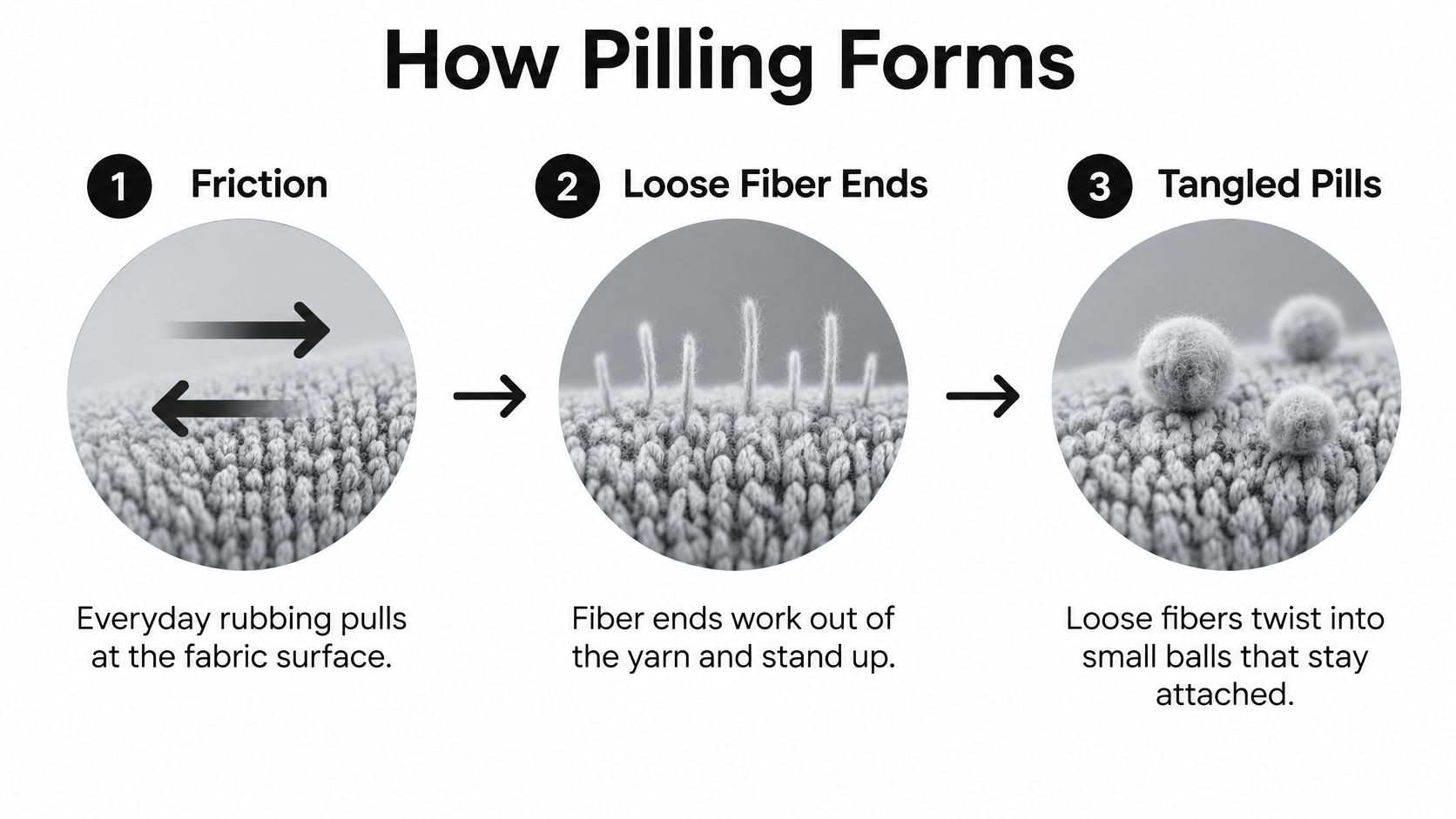
Pilling often becomes noticeable in the center of the bed, around knees and feet, or near fitted-sheet corners where tension and rubbing meet. An uneven pattern makes sense because you don't apply the same pressure everywhere.
Keep this distinction: Pilling is a change in the fabric's surface, not a measure of cleanliness.
For practical examples of reducing unnecessary rubbing, The Fabric Company's pilling prevention tips offer a useful companion resource.
The important balance is between fibers escaping and fibers breaking. A fabric that releases little fuzz has less material available to tangle. Another fabric may form pills readily but lose them quickly, while a third retains them stubbornly. That's why construction matters as much as the fiber name.
Fiber, Yarn and Weave Decide Resistance
Fiber and construction factors that change pilling
| Factor | Lower pilling risk | Higher pilling risk | Why it matters |
|---|---|---|---|
| Fiber length | Long-staple or filament yarns | Short-staple fibers | Short, loose fiber ends migrate to the surface |
| Yarn twist | Tight, well-twisted yarn | Low-twist yarn | Loose twist lets fibers escape |
| Fabric density | Compact weave or knit | Open or raised construction | More loose ends reach the surface |
| Fiber blend | Single durable fiber, when well constructed | Cotton blended with polyester, particularly for persistent pills | Stronger synthetic fibers can hold pills in place |
| Surface finish | Well-anchored fibers | Poorly anchored protruding fibers | Loosely held fibers keep forming fuzz |
These are risk indicators, not guarantees. ASTM International's D4970/D4970M standard identifies fiber dimensions, yarn and fabric construction, blends, and finishing as influences on pilling behavior.
What Each Construction Choice Changes
Fiber length affects how much of each fiber can remain secured within the yarn. Longer staple fibers offer more length to hold in place. Shorter fibers provide more opportunities for exposed ends, even when the package identifies the material as pure cotton.
Yarn twist binds those fibers together. Think of a securely twisted bundle compared with a loosely gathered one: the loose bundle gives individual strands more freedom to move. A soft initial feel doesn't tell you how well the yarn will retain its fibers.
Fabric density controls how firmly the yarns sit within the cloth. Compact construction limits movement, while open or raised surfaces leave more material exposed. A cozy, fuzzy finish can be appealing, but that surface also offers fibers for friction to catch.
Fiber blends introduce a less obvious trade-off. Cotton fibers can break during rubbing while stronger polyester fibers remain attached and hold the tangled material. However, a single-fiber sheet isn't automatically pill-resistant, and a blend isn't automatically poorly made.
Surface finishing also matters. A sheet can feel smooth when new yet develop fuzz if protruding fibers aren't securely held.
Why Thread Count Can Mislead
A bigger thread-count number can't compensate for yarns that release fibers easily.
Thread count doesn't independently describe fiber length, yarn hairiness, twist, or finishing. Our explanation of thread count versus thread quality helps separate the package number from the construction behind it.
For a sewing comparison, More Sewing's guidance on pre-shrinking white cotton before sewing highlights why fabric preparation deserves attention alongside material selection. Shrinkage and pilling are different issues, so preparation alone isn't proof of pill resistance.
On a product page, look for fiber length or yarn type, weave information, and a documented pilling result. Missing details don't prove poor quality, but they leave you with less evidence than a large thread-count claim suggests.
How Martindale Testing Grades Pilling
A Martindale tester rubs a fabric specimen in a repeated, looping Lissajous pattern. Assessors examine the resulting surface changes at specified checkpoints rather than judging the fabric only when it's new.
The TextileTuts guide to ISO-based Martindale pilling assessment describes a 1-to-5 appearance scale, with higher grades indicating better visual resistance, and reports the comparative cotton and polyester results below.
Martindale pilling grades for cotton and polyester
| Martindale checkpoint | Cotton grade | Polyester grade |
|---|---|---|
| 125 cycles | 4-5 | 3-4 |
| 500 cycles | 4 | Not reported in the available comparison |
| 2,000 cycles | 3-4 | 2-3 |
Read the opening row as an early surface assessment: the cotton specimen received the higher appearance grade. At the middle checkpoint, cotton retained a relatively favorable grade, but there isn't a stated polyester result to compare. At the final listed checkpoint, both materials showed a less favorable appearance than at the beginning.
The missing cell matters. It shouldn't be filled by assuming that polyester declined at a steady rate. Fabric changes don't have to follow a straight line.
Compare Conditions, Not Just Grades
These results describe the specimens tested, not every cotton or polyester sheet. They don't establish a universal winner because yarn construction, finishing, and other fabric characteristics influence the outcome.
Two relevant standards are ASTM D4970/D4970M and ISO 12945-2. The ISO method evaluates pilling, fuzzing, and matting using a modified Martindale procedure. The ASTM procedure permits evaluation before or after laundering or dry-cleaning, an important distinction when you want evidence of wash durability.
A useful test claim should identify:
- The method: Which pilling procedure was used?
- The checkpoint: How much rubbing occurred before assessment?
- The condition: Was the specimen tested new or after cleaning?
- The result: What appearance grade did it receive?
A pilling grade without a test checkpoint gives you only part of the comparison.
Don't convert laboratory cycles into nights of sleep. A sleeper, mattress, washing machine, and dryer apply different kinds of stress. The test is useful for comparing controlled results, not predicting an exact replacement date for your sheets.
Washing Speeds Pilling and the Routine That Stops It
Your laundry routine can increase pilling even when it cleans the sheets well. Washing combines wet flexing, fabric-to-fabric rubbing, detergent exposure, and drying stress, so preventing unnecessary abrasion is more useful than choosing a different detergent.
Wet sheets bend, fold, and move repeatedly. Adjacent layers rub together, while other items in the load can add rough surfaces or snagging points. Each movement creates another opportunity for exposed fibers to loosen.
Temperature and cycle duration also affect the stress fabrics experience. A Coloration Technology study discussing pilling behavior includes comparative evaluations involving cotton, polyester, and viscose washed at 40°C. That test condition isn't a universal washing recommendation, it illustrates why fiber type and wash history need to be considered together.
What the Washer and Dryer Add
Detergent belongs in the cleaning process, but its chemistry and the wash program both affect textile performance. Adding more product isn't a targeted way to prevent pills. Use a measured dose appropriate for the detergent, load, and machine.
Tumble drying adds another round of movement after washing. Excessive heat or unnecessary drying time adds stress without making already-dry sheets cleaner. Choose the gentlest drying method the care instructions permit.
The broader discussion of textile care in Wiley's chapter on laundering and fiber release identifies agitation, temperature, duration, detergent, loading, and drying method as relevant variables. No single setting can compensate for every other source of abrasion.
A Lower-Friction Laundry Routine
- Separate sheets from abrasive items. Wash them alone or with soft, similar fabrics, rather than towels, jeans, or zippered clothing, because rough surfaces add rubbing and exposed hardware can catch yarns.
- Leave room for movement. Load the drum loosely and distribute the bedding evenly so the sheets aren't tightly packed against one another. If the load is compressed before washing starts, split it rather than forcing everything into the drum.
- Contain loose details. Turn pillowcases and duvet covers inside out, and fasten their closures or ties so they don't trail through the load. A flat sheet has no meaningful inside-out orientation, so focus on sorting and loading rather than trying to reverse it.
- Choose lower agitation and avoid unnecessarily long cycles. Use a gentle program when it meets the care instructions and cleaning needs, because extended mechanical action adds opportunities for abrasion. Bedding that needs more thorough cleaning still needs an appropriate wash, not an underpowered cycle chosen solely to protect its surface.
- Match water temperature and detergent to the label. Measure the detergent instead of pouring freely, and avoid bleach unless the care instructions permit it. Don't assume that hotter water or a stronger chemical treatment will remove attached pills.
- Use low dryer heat or line dry where permitted. Remove sheets when they're dry instead of leaving them tumbling through extra time. Shake them out before drying to loosen tightly bundled sections.
- Treat existing pills separately. If the fabric is sound and its care guidance allows it, use a fabric shaver rather than pulling pills off by hand. Lay the sheet flat, smooth out folds, test a hidden area, and make light passes without pressing the cutting head into the cloth.
Our guide to how to wash bedding can help you build a care routine around the particular bedding you own.
Prevention and removal aren't the same job. Gentler laundering limits additional stress; it doesn't untangle attached pills or rebuild yarn. Shaving improves the feel temporarily, but it can't correct weak fiber anchoring.
If pills continue appearing in the same places despite careful washing, don't keep changing detergent indefinitely. Consider both everyday contact and the fabric's construction, especially if fresh fuzz returns soon after removal.
Telling Pills From Normal Wear
A pilled sheet isn't automatically defective. Location, timing, and the condition of the underlying fabric offer better clues than the mere presence of small balls.
Where Are the Pills?
Localized pilling often fits a pattern of repeated contact. Say a dog sleeps at the foot of the bed: movement against that patch can produce more fuzz there than near the pillows. Rough clothing or different sleeping habits can also explain why one side changes faster.
An all-over pattern deserves a different check. If the entire sheet becomes rough after careful washing, review the laundry load and care settings, but also consider whether the yarn or finish releases fibers too readily.
How Soon Did They Appear?
Early pilling can raise a reasonable concern about construction, particularly when you've followed the care instructions. It isn't proof of a defect on its own.
For example, a rental host using a loosely constructed blend may notice persistent roughness while the sheet is still otherwise serviceable. Frequent use and laundering contribute, but the fabric's ability to retain fibers remains part of the explanation.
Before deciding, distinguish attached pills from loose lint and general fuzz. Lint that brushes away isn't the same as a ball secured to the sheet.
Use the pattern as a clue, not a verdict. Handling and construction can contribute at the same time.
Your practical options are:
- Shave the pills: Suitable for a sound sheet with surface roughness, though new pills may form.
- Accept localized wear: Reasonable when the sheet remains comfortable and you don't mind its appearance.
- Replace the sheet: More sensible when widespread roughness returns quickly, or when thinning, holes, or snagged areas make further shaving risky.
Photograph the affected areas and keep the care label if you're discussing unexpectedly early pilling with the seller. That gives the conversation something more useful than a general complaint about softness.
Choose Sheets That Hold Up to Pilling
Buy for the way you'll use and wash the bedding, not just how it feels in the package. Start by checking the fabric and fit together.
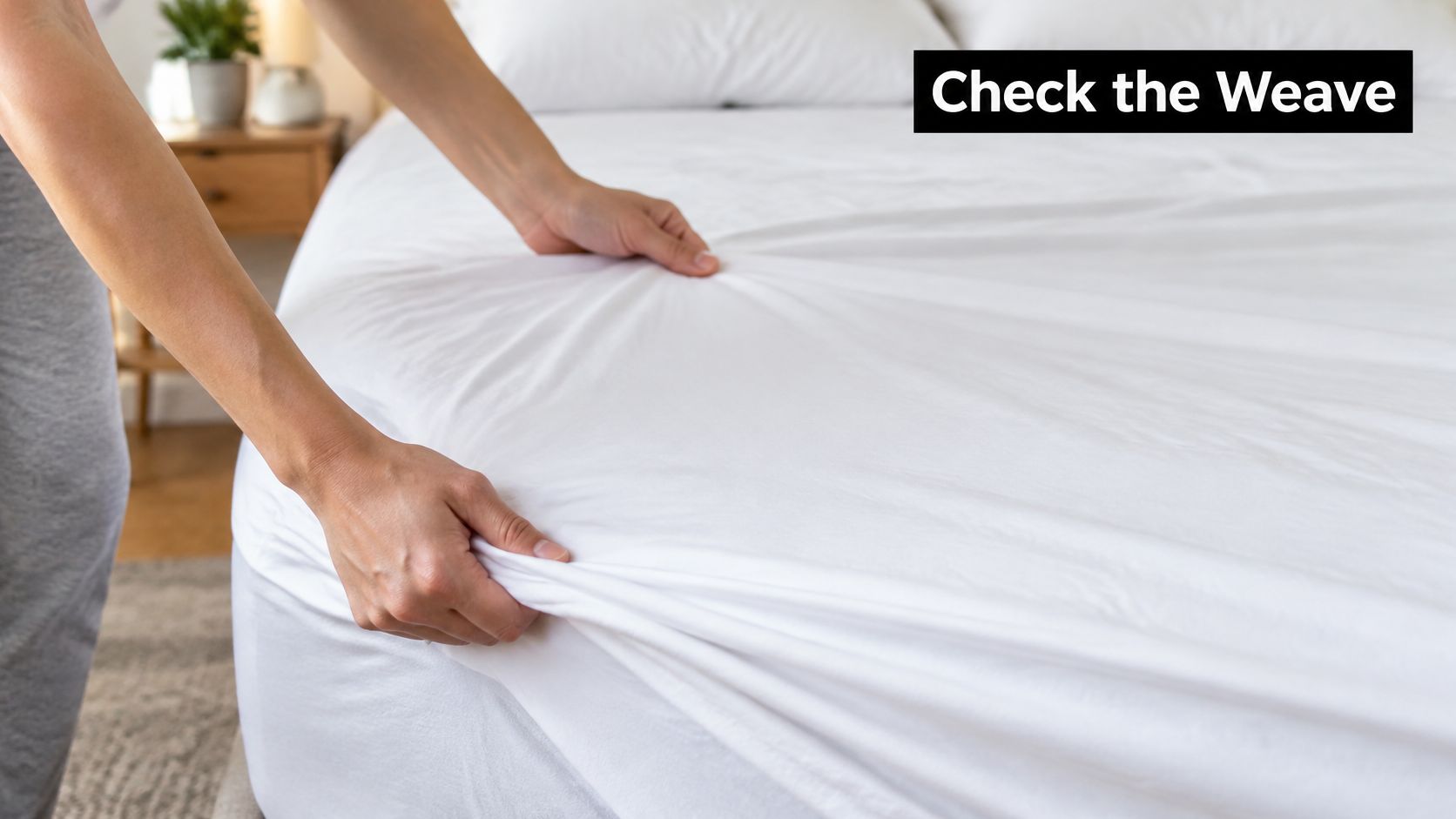
A Practical Buying Checklist
- Look for yarn information: Favor clearly described long-staple or filament-rich yarns over an unexplained softness claim.
- Check the construction: Seek a compact, stable weave or knit, while recognizing that raised surfaces involve a different wear trade-off.
- Read testing details: A documented appearance grade is more useful when it includes the method, checkpoint, and whether laundering preceded testing.
- Consider the blend in context: Read fiber content alongside construction rather than treating either a blend or a single fiber as a guarantee.
- Match the care requirements: Choose bedding you can wash correctly with your household equipment and routine.
Our bed sheet buying guide helps bring fit, feel, and fabric choices into the same decision.
For readers who also make bedding, Linda's Electric Quilters offers a quilting technique course online. That's a separate learning route for construction skills, not evidence of a finished sheet's pilling resistance.
This video offers an additional bedding reference.
Our microfiber products will not pill or shrink and are wrinkle and fade resistant. That's SouthShore Fine Linens's product claim, not a general statement about all microfiber; distinguish it from a documented laboratory grade when comparing evidence.
Choose a set against the checklist, save its care instructions, and note any changes after washing. Recording where roughness appears will help you judge comfort and durability without relying on memory.
SouthShore Fine Linens offers sheet collections, including deep-pocket options, alongside quilts, comforters, and other bedding essentials. Visit SouthShore Fine Linens to compare fabrics, fit, and care requirements, and choose bedding that suits both your comfort preferences and your laundry routine.


