
Should You Wash New Bed Sheets? a First-Wash Guide
Yes, wash new bed sheets once before the first night, at the temperature the care label lists, and dry them completely before you make the bed. One cycle does the work for most cotton, bamboo and microfiber bedding, so you don't need a soak, a double wash or a special detergent.
What almost every first-wash guide skips is that the question isn't only about hygiene. It's a three-way decision that involves the fabric in your hands, the skin that will spend eight hours pressed against it, and the water and energy one cycle costs. Get that balance right and the first wash is a twenty-minute habit. Get it wrong in either direction, by skipping the wash or by blasting new sheets through a hospital-grade hot cycle, and you either sleep on manufacturing residue or you shrink, fade and thin a set you just paid for.
The honest answer sits between those two failures. Wash once, follow the label, dry fully, and stop treating a retail sheet as if it were surgical linen. Where the picture gets more complicated is with sensitive skin, with treated finishes, and with the fiber shedding that every extra cycle releases into your drain.
Yes, Wash New Sheets Before the First Night
The verdict is yes, and one wash is enough. New sheets pass through manufacturing, packaging, transport, retail display and delivery before they reach your bedroom, and a single cycle with detergent lifts surface residues, dust and loose fibers before your skin spends the night against them. The CDC's guidance on when and how to clean and disinfect your home sets the process plainly: use detergent, select the warmest water setting appropriate for the fabric, and dry items completely.
Most cotton bedding is machine washable and can be tumble dried, which is why this job feels like ordinary laundry rather than a project. Nothing about a new sheet requires a special detergent, a presoak or a separate trip to the laundromat.
Two limits keep the habit honest. First, washing does not sterilize sheets. The CDC describes laundering as making textiles hygienically clean for use, not sterile, and household bedding isn't treated like hospital laundry. Second, the agency sets no fixed washing interval for newly purchased sheets, which tells you prewashing is a sensible default rather than a rule with an enforcement date.
Where it matters most: a first wash earns its place in any home, but it earns it fastest where skin is most reactive or most vulnerable.
The households that should never skip it:
- Babies and toddlers, whose skin sits directly on the fabric for long stretches and who mouth the corners of everything.
- Anyone with eczema, allergies or chemical sensitivities, where a visible reaction is the whole point of prewashing.
- People with respiratory sensitivities, since dust and loose fiber from packing and shipping is exactly what a wash removes.
- Anyone recovering from illness, who benefits from a clean, fresh set rather than one that has been in a warehouse.
Wash once, dry completely, then sleep.
First-Wash Settings and Why Home Sheets Are Not Hospital Laundry
Fabric decides the setting, and the care label decides the fabric. Read the table as a starting position, then let the sewn-in tag overrule it if the two disagree.
| Fabric | Water temperature | Cycle | Drying |
|---|---|---|---|
| Cotton, percale and sateen | Warmest the care label allows (cold if unclear) | Normal | Tumble dry on low until fully dry |
| Bamboo | Cold | Gentle | Tumble on low or air dry; no bleach or fabric softener |
| Microfiber | Follow care label | Normal | Home dryer on low until fully dry |
| Brushed flannel cotton | Per care label | Gentle | Tumble dry on low until fully dry |
The label is the ceiling, not a suggestion
Treat the printed temperature as the hottest water the sheet will tolerate, not a target to beat. When a label is faded or missing, cold water is the safe default, because cold is the setting that damages nothing. Load the drum loosely enough that the sheets can tumble past each other, and keep light and dark colors apart on the first wash. New dye can travel in warm water, and a white pillowcase is a miserable place to discover it.
Why 160°F hospital water doesn't transfer to your bed
Hospital linen has a benchmark that gets quoted at home far too often. CDC infection-control guidance on laundry and bedding describes healthcare textiles as capable of carrying substantial numbers of pathogenic microorganisms, and notes that hot-water washing at 160°F (71°C) for at least 25 minutes has commonly been recommended in those settings, with chlorine bleach added where the fabric allows. The same guidance notes that reports of healthcare-associated disease linked to contaminated fabrics are so few that transmission risk during laundry is considered negligible when controls are followed.
That is a story about institutional infection control, not about a sealed packet of sheets from a store. Sheets sold for home use vary in fiber, dye and finish, and very few of them are built to shrug off a 25-minute hot wash. Run those numbers at home and you get shrinkage, color loss and tired elastic long before you get a meaningful hygiene gain. The hospital standard also carries a second half that matters here: textiles come out free of vegetative pathogens but are not sterile, even under conditions no home washer reaches.
Practical rule: match the cycle to the fabric and the soil. A regular care-label wash with complete drying is the home standard, and sterilizing is not the goal.
What tells you the setting worked
Judge the first wash by what comes out of the dryer. The fabric should look unchanged in color and size, the hand should feel softer than it did in the packet, and nothing should smell faintly damp when you unfold it. If the sheets feel rougher than before, you either overdosed the detergent or overdried them. Our own cotton bedding carries a care line of cold water and a low tumble, and it's tagged machine washable, which is the same instruction the table gives you for a label that reads "machine wash cold, tumble dry low."
Step-by-Step First Wash and Final Verdict
Seven steps, each with a reason and the slip that undoes it. The infographic below condenses the same sequence for anyone who wants it at a glance.
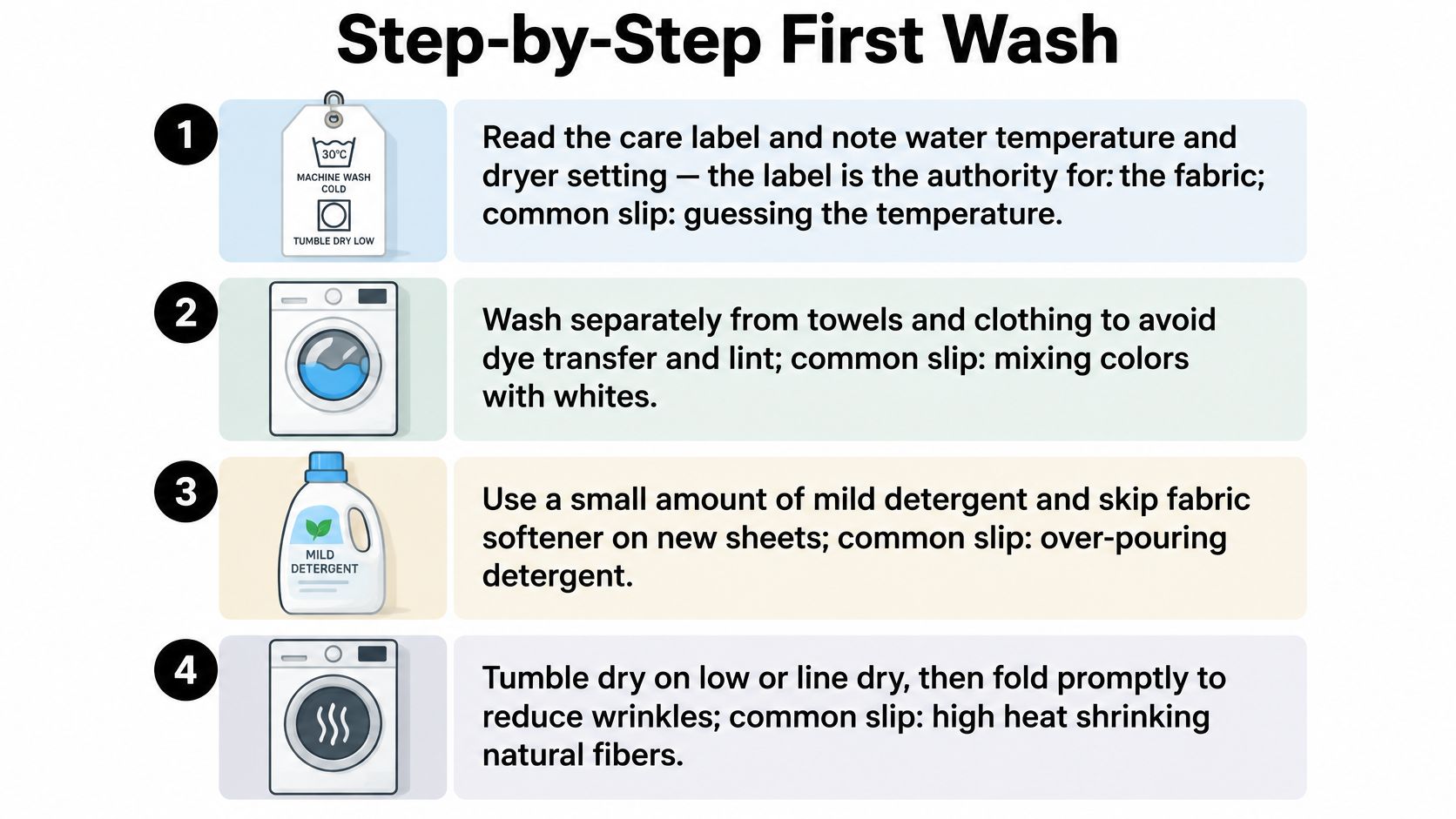
- Read the care label before anything goes in the drum. You're looking for water temperature, bleach permission and the dryer setting. A hand-wash tag overrides your normal routine, and guessing the temperature is the mistake that ruins more new sets than any detergent.
- Strip the packaging. Pull out cardboard inserts, paper bands, pins and plastic clips, and shake each piece open. A stray pin snags fibers in the drum, and a fitted sheet still packed in its corners never gets clean.
- Wash new sheets only with colors that match. New dye runs, so a fresh dark set goes in alone or with other darks the first time. Towels, denim and anything with a zipper stay out, since rough fabric adds friction and lint to a soft weave.
- Load loosely and dose the detergent properly. Sheets need room to move, and more detergent doesn't mean cleaner. Excess detergent leaves residue that a single rinse may not lift, which is the opposite of what you're trying to achieve.
- Choose the cycle the label suggests, then add a rinse if skin is sensitive. An extra rinse is the cheapest intervention available when someone in the house reacts to detergent.
- Dry until the fabric is fully dry, not until it's nearly dry. A damp sheet that sits in the drum or the basket holds odor and gives mildew a start. CDC laundry guidance also steers you away from leaving damp textiles sitting in the machine.
- Make the bed and check the result. You're looking for fabric that looks unchanged, feels softer and smells of nothing in particular.
The temperature mistake deserves its own warning, because the temptation to "go hot once" is strong. Excessive heat speeds up shrinkage, color loss and elastic fatigue, and it's hard on cotton blends and specialty finishes. For flame-retardant or otherwise treated bedding, thorough rinsing matters specifically because detergent residue can affect how the treatment performs.
If you want the full routine in one place, including how the same steps carry into every wash after the first, our guide to how to wash bedding walks through the cycle settings and drying habits in order.
The verdict stays simple: wash once before the first night, dry completely, then sleep.
Sensitive Skin, Allergies and Chemical Finishes
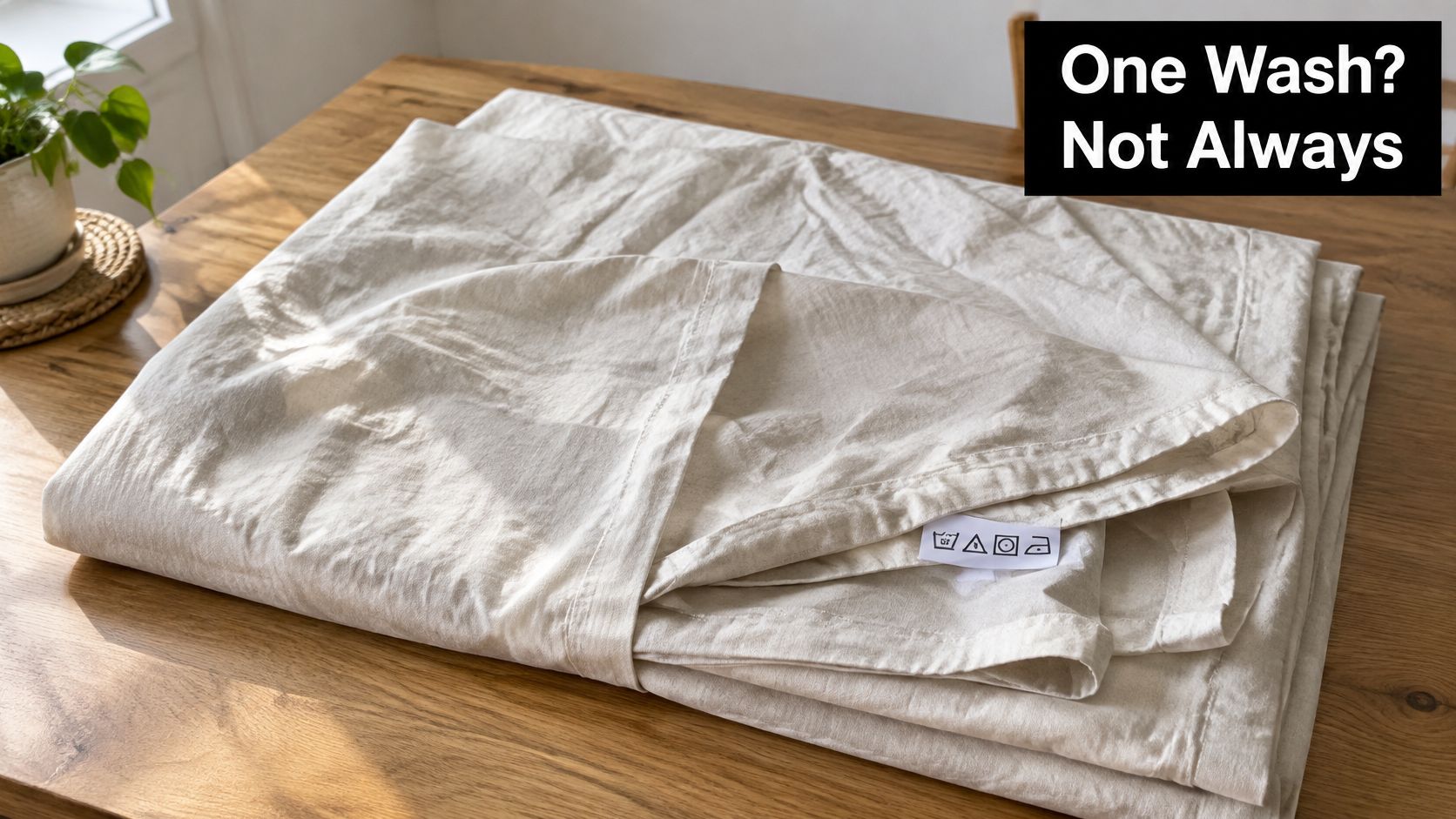
Here's the assumption worth testing: that one wash removes everything. It doesn't. Wrinkle-resistant and easy-care finishes can contain formaldehyde, and laundering lifts only the surface-available residues, as The Spruce's guide to washing new sheets sets out. Heavily treated fabric may need an additional wash or a day of airing out before it stops announcing itself.
Natural fiber doesn't rescue you either. Cotton and other plant fibers are still dyed, finished, folded and packed before sale, so "natural" describes the source of the yarn, not the state of the sheet in the bag.
What certification does and doesn't buy you
OEKO-TEX STANDARD 100 tests for substances that may be present in finished textiles or released during normal use, and its limits tighten as skin contact becomes more intensive and the user more sensitive. That makes it a useful screening signal when you're standing in a store. Two things it doesn't do: it can't promise that a specific person won't react, and it can't replace washing, because certification concerns test limits and conditions rather than how clean a sheet is after manufacturing and distribution. Our bamboo bedding carries OEKO-TEX certification and is made for allergy-prone sleepers, and I'd still wash it before the first night.
A sensitive-skin first-wash protocol
- Inspect the label for finish claims, fiber content and any certification.
- Wash the set separately from other laundry, especially towels.
- Use a fragrance-free detergent at the measured dose.
- Add an extra rinse to pull detergent residue out of the weave.
- Skip fabric softener entirely, since it coats fibers rather than cleaning them.
- Air treated fabric for a day, then dry it completely before use.
Stop rule: if a rash, spreading itch or any breathing symptom appears after the sheets go on the bed, take them off and get medical advice. More hot washing is not the next step.
Laundering is not a universal decontamination process. A reaction that persists after a proper gentle wash is telling you something about the fiber or the finish, and the answer is a different sheet, not a hotter cycle. If this is a deciding factor for you, our guide to OEKO-TEX certified bedding explains what the certification covers.
Lower-Impact Washing and Microfiber Shedding
The first wash carries a second cost beyond clean sheets: every cycle releases fiber, and the settings decide how much. One 2025 laboratory washing study measured cotton releasing an average of about 617.34 ± 85.2 mg of fibers per kilogram per wash, found that longer washing combined with detergent increased shedding, and recorded that adding a laundry ball raised release by roughly 10% to 60% across the fabrics tested. Machine laundering and tumble drying sit at the center of how this kind of persistent textile-fiber pollution leaves a home.
The counterintuitive finding is the fiber ranking. Under those test conditions, cotton shed more microfiber mass than the synthetics, so picking a "natural" sheet is not automatically the lower-impact laundry decision. Organic cotton earns that label at the farm, since it is grown without harmful chemicals or pesticides, and none of that changes what the fabric releases in a washer. Bamboo sits in a friendlier position: its care label already calls for cold water, a gentle cycle and a low tumble or air dry, which is close to the settings profile that keeps mechanical stress, and therefore shedding, down.
Settings that cut the cost without skipping the wash
- Use the label temperature, not maximum heat. Hot water costs energy, and a new sheet does not need it.
- Pick a normal or gentle cycle rather than a long intensive one, and skip the prewash, since longer washing is what pushed shedding up in testing.
- Wash once, not twice. A second cycle buys little beyond more fiber release.
- Don't add a laundry ball to a first wash hoping for agitation. On this evidence it works against you.
- Treat the dryer as half the decision. A full line-dry or a low, timed tumble avoids the second half of the shedding pathway.
- Consider a filter or capture product if your machine or local water system supports one.
The same principle of fiber capture shows up elsewhere in cleaning, where microfiber mops and microbial removal depend on fiber structure and density rather than brute force. Laundry works on that logic: thoughtful mechanics beat aggressive settings.
The balanced takeaway: wash once thoughtfully, then tune the routine to the fabric, the finish, who sleeps in the bed and what your local water treatment can handle.
How Often to Wash Sheets After the First Wash
Once the first wash is done, the question shifts from "should I" to "how often." A weekly rhythm suits most households, and it should tighten when sweat, pets, illness or a humid bedroom add to the load. Pillowcases belong in the same cycle as the sheets, since they take the most direct contact with skin and hair.
The rotation habit: keep two or three sets in use and let each one rest between washes, which spreads the wear across more fibers instead of grinding one set through every cycle.
A few adjustments keep the schedule sensible without turning it into a chore:
- Wash a sheet after one night only if it's visibly soiled. Repeated hot or long cycles wear fabric and add to the shedding load.
- Reserve the hot cycle for heavily soiled bedding or illness in the house, and only where the care label allows it.
- Avoid overdrying. It accelerates wear, and it's the difference between a set that lasts years and one that pills in months.
- Store sheets dry. A sealed plastic bin traps moisture, so a linen closet shelf or a breathable cotton bag is the better home.
- Know when to retire a set. Thin patches, pilling, fitted corners that no longer grip and a sheet that still smells stale after washing are all replacement signals.
For the longer version of this schedule, including how fabric type and season change it, our guide to how often to wash bedding breaks the timing down.
One rule covers all of it: wash on a regular rhythm, match the cycle to the fabric and the soil, and let each set rest between uses.
If your next set is going on the bed this week, start it right with bedding built to survive the routine, from extra-deep pocket sheet sets that stay put on modern mattresses to OEKO-TEX certified bamboo and crisp cotton percale that softens with every wash. SouthShore Fine Linens stocks cotton, bamboo, microfiber, Clipped Jacquard and 500 thread count Tencel collections, all tagged machine washable so the first wash is routine. Browse the collections at SouthShore Fine Linens and pick the weave that suits how you like your bed to feel.


