
Quilt Sets Queen Sale: How to Find a Real Deal
You're scrolling a quilt sets queen sale with two tabs open, a tape measure on the nightstand, and a mattress that already ate one set that looked fine in the photo. The tag says queen. The cart says 30% off. Neither number tells you whether the quilt will clear the sides of a deep hybrid or puddle on the rug.
A real deal is a quilt that fits the bed you own, survives the washer you own, and still costs less once shipping is on the receipt. Price comes last.
Match the Queen Quilt to Your Mattress First
A standard U.S. queen mattress measures 60 × 80 inches, but queen quilts vary. Published sizes range from about 88 × 88 inches to 96 × 102 inches, a difference of more than a foot in length. That spread makes the listed dimensions more useful than the size label, as the Sierra Dreams quilt bedding buying guide illustrates.
Measure the mattress depth, topper, foundation height, and desired side drop. A queen quilt set size chart can help compare those measurements with a listing. For frame proportions, consult the Woodstock Furniture & Mattress Outlet size guide.
To estimate the end overhang, subtract the mattress length from the quilt length and divide by two. A 96-inch quilt on an 80-inch mattress hangs about 8 inches past each end. For the sides, compare quilt width with the 60-inch mattress width, then account for mattress depth. If the drop is less than the mattress thickness, the quilt may stop above the foundation.
| Fit category | Typical queen quilt size | Best fit for |
|---|---|---|
| Minimal drop | about 88 × 88 in | Platform beds, slim mattresses, tucked look |
| Standard drop | about 92 × 96 in | Most residential beds with a standard mattress |
| Oversized drop | about 96 × 102 in | Deep hybrids, layered toppers, relaxed draped look |
Choose enough overhang to cover the mattress and achieve the look you want. Excess fabric can hide the frame, drag near the floor, or bunch on an adjustable base when the head lifts.
Practical rule: Match the quilt's drop to the mattress depth and the finish you prefer. Extra inches you cannot style are fabric you paid to fold back.
Check sham dimensions separately. A queen set may include shams sized for standard pillows, so confirm they suit the pillows you plan to use.
Choosing Construction for Your Use Case
Home and furniture goods show an estimated 19–23% online return rate, above the 19.3% all-category average, according to the EightX furniture and home return rate benchmarks. A markdown does not fix a set that pills, won't dry, or was built for a room it will never see. Judge ownership cost: purchase price, how often you'll wash it, drying time, and how soon you'd replace it.
| Use case | Main priority | Construction to favour | Common mistake |
|---|---|---|---|
| Guest room | Appearance and low wear | Lighter quilt, neutral colour, cotton or cotton blend | Ignoring sham dimensions |
| Everyday primary bedroom | Washability and drying time | Stitched quilt, cotton or poly-cotton, medium weight | Buying dry clean only for daily use |
| Short-term rental | Durability and frequent laundering | Polyester blend, dense stitching, colourfast dyes | Choosing thick batting that dries slowly |
| Gift | Correct size and presentation | Verified dimensions, neutral palette, clear care card | Assuming queen means the same size everywhere |
Premium does not mean heaviest, and it does not mean the highest thread count. A lighter, washable quilt can outlast a thick decorative coverlet for hot sleepers, children's rooms, rentals, and weekly laundry. Dense stitching keeps fill from migrating. A lofty, loosely quilted coverlet looks rich on day one and shifts into cold spots after a few cycles.
The everyday test is the machine in the laundry room. If the set won't fit a standard residential washer, or the care label says dry clean only, it fails a primary bedroom no matter the discount. Thick batting can sit damp for hours. Guests rarely wash a quilt, so colour and a calm pattern matter more than turnaround speed. Rentals flip between stays, so colourfast dyes and a blend that dries on a normal cycle beat a heavy cotton batt. Gifts fail when the box says queen and the bed in the new house doesn't match. Verified inches and a neutral palette prevent most of those returns. A guide to queen size quilts and comforters is worth a pass when you're sorting quilt weight against comforter loft for that room.
Sun-facing bedrooms fade dyes first. A deep navy on a west wall will show wear at the fold long before the stitching gives out. Pick a colour you can live with once it softens, or keep the strongest tones for rooms that stay shaded.
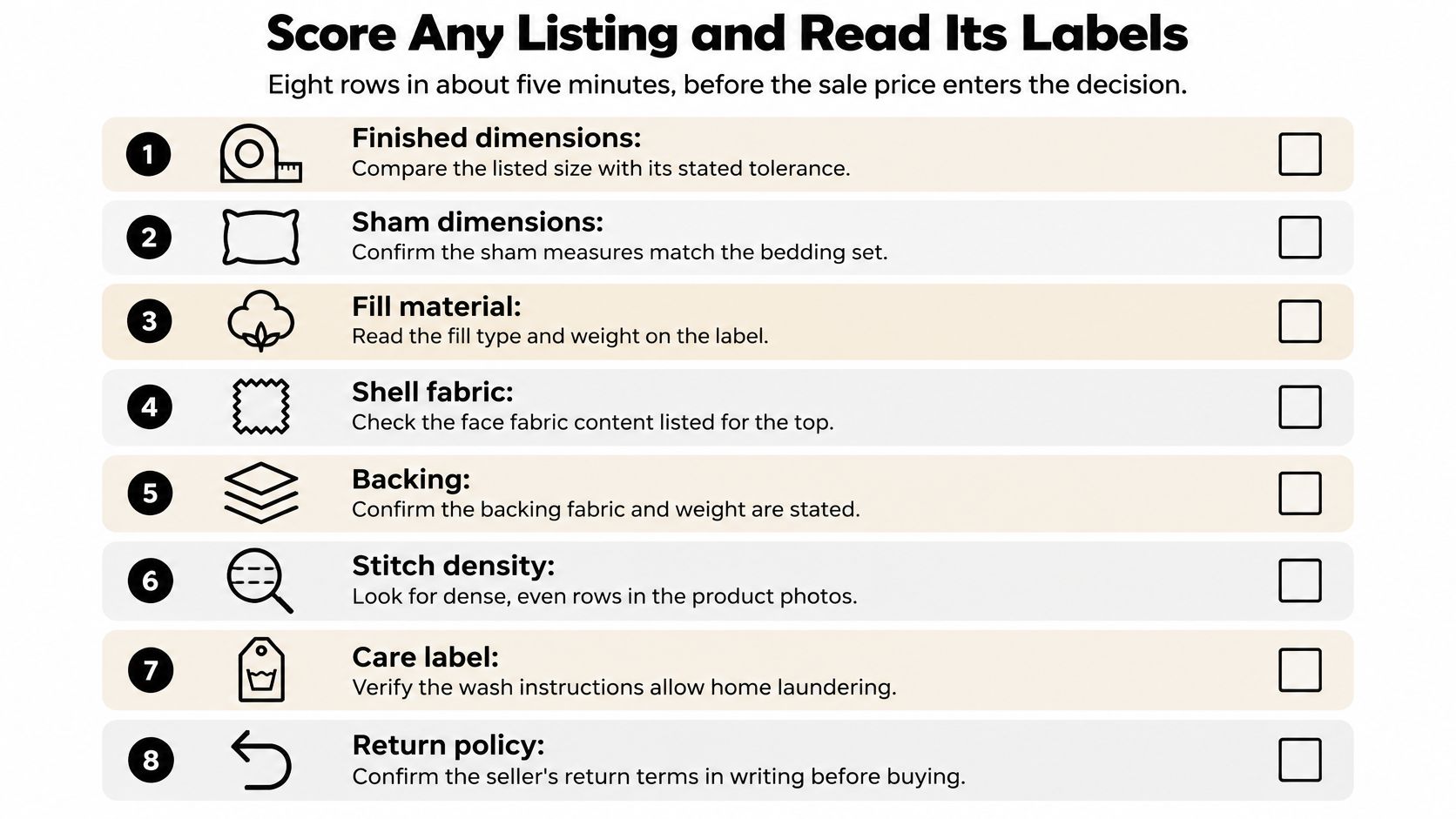
Score Any Listing and Read Its Labels
Run this scorecard in about five minutes, before the sale price enters the decision. Words like premium or luxury carry no measurable content. A fill weight, a fiber split, and a certificate number do.
| Criterion | What to verify | Good sign | Red flag |
|---|---|---|---|
| Finished dimensions | Length and width with tolerance | Both listed in inches with a stated tolerance | Only the word queen |
| Sham dimensions | Separate size for each sham | Standard sham size such as 20 × 26 in listed | Shams absent or described vaguely |
| Fill and batting | Material and weight | Named material and weight in ounces or grams | No fill information |
| Fabric composition | Fiber percentage for each layer | Fiber split by percentage, such as 100% cotton | Premium blend with no percentages |
| Stitching | Quilting pattern in close-up photos | Even, dense rows and no loose threads at seams | Sparse lines or puckering |
| Care and drying | Wash temperature and dryer setting | Machine washable with a stated dryer setting | Dry clean only on an everyday quilt |
| Certification | Third-party test label | OEKO-TEX Standard 100 with a checkable number | Only generic eco or natural claims |
| Return terms | Window, condition and who pays return postage | Clear return window with stated conditions | No return terms visible before checkout |
How to score a candidate
Work the rows in order. Dimensions and fiber percentages come first because they cause most sizing and care disputes. A listing missing either is incomplete.
A set that fails the sizing row or the fiber row is out, regardless of the discount. A set that passes everything except certification is a judgement call: you can still buy it if care, fill, and returns are explicit. Don't average a missing size into a passing grade. One hole in the first two rows ends the comparison.
What U.S. labels actually require
U.S. FTC guidance treats quilts, bedspreads, blankets, sheets, and related bedding as covered textile products. The FTC textile labeling guidance requires fiber-content labeling, and covered products must also identify country of origin and the responsible business. Those rules are U.S.-specific. They are not universal law. For a listing aimed at U.S. shoppers, I still want five things on the page: finished dimensions with a tolerance, fiber content by percentage, origin and the marketer, permanent care instructions, and components listed separately.
A queen set may mean a quilt alone or a quilt plus shams and pillowcases. If the page doesn't split those pieces, you're guessing at the carton.
OEKO-TEX Standard 100 is a third-party test for harmful substances. It is not a fiber-content label and it is not a durability grade. Check the certificate number on the brand site rather than trusting a logo in a lifestyle photo. The same skepticism applies to thread count on sheets. A clear explanation of how to compare sheet weaves beyond thread count shows why a single marketing number never replaces fiber, weave, and construction. Quilt shells work the same way.
When the label is missing
Ask the seller, in writing, for three facts before you pay.
- Exact size: Finished length and width, plus the tolerance, in inches.
- Fiber split: Percentage for the face, the backing, and the fill or batting.
- Returns: The window, the condition the item must be in, and who pays postage.
Paste each answer into a note next to the scorecard so two candidates stay comparable. A friendly chat reply that still won't state ounces or inches is the same as a blank row.
How to Check Fabric, Fill and Stitching
A close-up of the quilting often tells you more than a styled bedroom photo. Check the product page first, then inspect the actual fabric and seams when the parcel arrives.
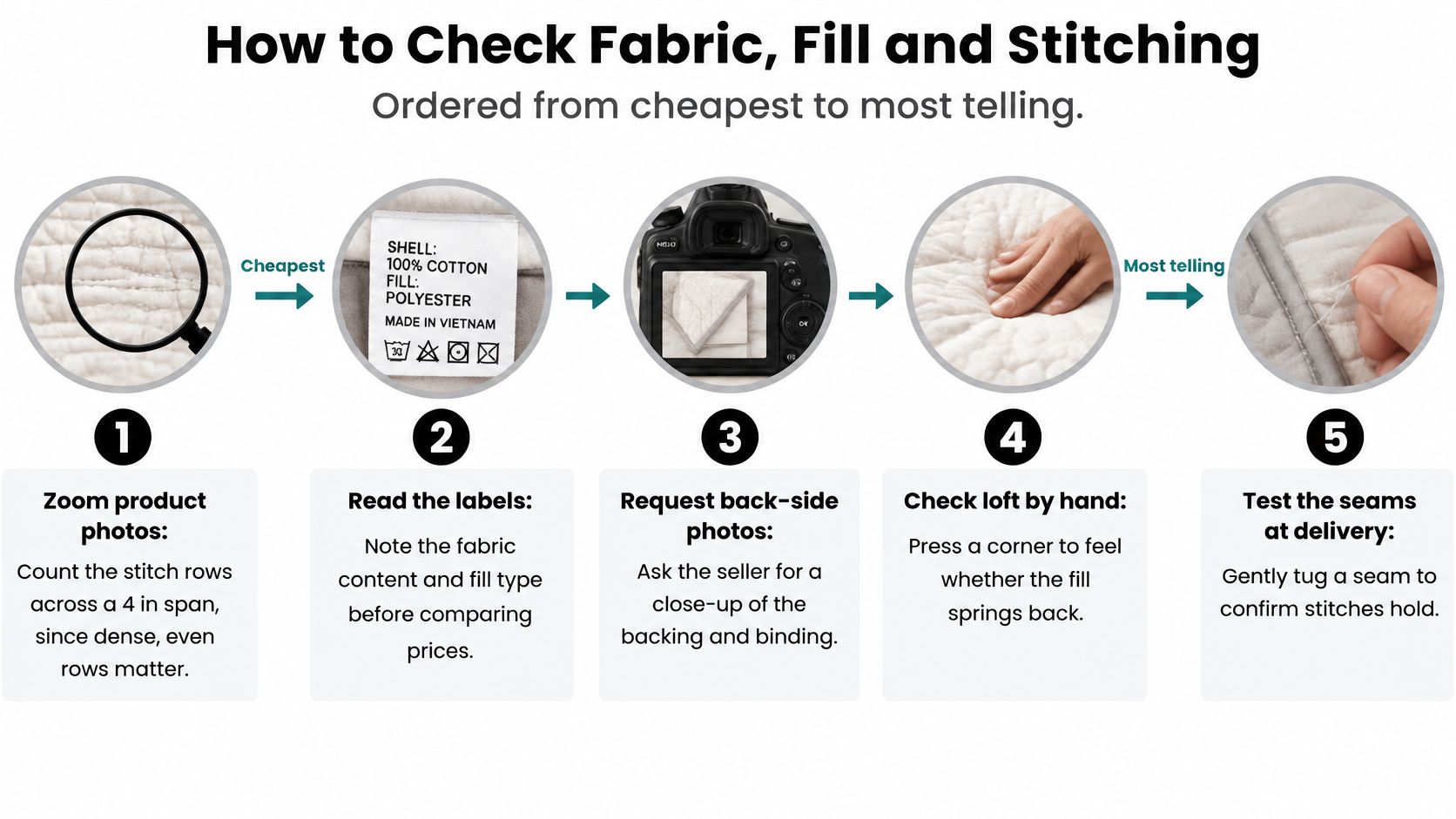
- Zoom in on the stitch lines. Look for even quilting that holds the fill in place. A busy pattern can hide uneven rows in an overhead photo, so check a close-up.
- Check the backing. Look for an even weave and ask for a corner photo if the listing shows only the front. Fabric choice affects how a quilt looks and wears; this guide to choosing quilt fabric explains what to look for in different fabrics.
- Identify the fill. Cotton batting tends to drape flatter and dry slowly. Polyester dries quickly and can suit home-dryer care. Wool may work well in a cooler room, but check the label for its care requirements.
- Match weight to your routine. A lighter quilt is easier to wash frequently. A heavier one may suit a cold bedroom, but can be harder to fit in a standard washer.
- Inspect the edges and corners. Check that the binding is secure and the corners are neatly finished. Rounded corners, such as those on the Vilano Oversized Quilt Set, can catch less on bed frames.
- Compare the shams. Check that their fabric and stitching coordinate with the quilt. Differences in fabric or finish may become more noticeable with washing.
A cotton quilt face may pill, shrink, or remain stable depending on the fiber and how it is cared for. Follow the care label rather than assuming home bedding can handle the same routine as keeping kitchen towels hygienic during service.
A short handling check can help when comparing two quilts:
Press a corner to see whether the fill springs back. Gently tug a seam; if the stitches open under light pressure, they may loosen further in the wash.
Heavier does not mean better made. A thick decorative coverlet can be harder to wash than a lighter quilt with secure quilting.
Time the Sale and Calculate the Landed Price
Bedding promotions cluster around Presidents' Day, Memorial Day, the Black Friday to Cyber Monday stretch, and January clearance. A red tag in between those windows is often a return to a price the item already held. Track the product for two or three weeks with a price tracker or a saved cart. If the “was” price only existed for a weekend, the percent off is theater.
Build the landed price: sale price, plus shipping, plus sales tax where it applies. Say one quilt is $79.99 with $12 shipping. Landed merchandise cost is $91.99 before tax. An $89.99 quilt with free ground shipping is cheaper, even though the tag looks higher. The Vilano Oversized Quilt Set is $79.99 in Full / Queen and ships free by ground on all orders, so its tag and landed merchandise price match. That makes it a clean baseline when another listing buries a delivery fee.
Hidden totals cost sales as well as money. Baymard's checkout usability research places average online cart abandonment at about 70.19%, and 16% of U.S. online shoppers abandon because they cannot see total order cost before initiating checkout. Another 17% leave because checkout is too long or complicated. Read the total on the product page or in the first cart step, not on the payment screen.
Compare landed prices only among quilts that already pass your measurements. A cheaper carton in the wrong drop is a return, not a bargain.
I would rather pay a few dollars more for free shipping and a stated size than chase a deeper percent off that resets at checkout.
Decide and Keep the Packaging Until the First Wash
Pick the candidate with the highest scorecard result first and the lowest landed price second. A cheaper set that fails sizing or fiber is not a deal.
Before you order, confirm three terms. You need the return window, whether a mis-sized item is accepted, and who pays return postage. Those lines set the cost of a wrong guess. A 30-day window you pay to ship is a different risk from a prepaid label.
Keep the packaging, tags, and care card until the quilt has been washed once and dried on the cycle you intend to use. Then compare the result with the listing.
- Dimensions: Lay it flat and see whether length and width held.
- Stitching: Look for rows that opened or fill that slid.
- Colour: Check the tone against the tag and the photo, especially at folds.
If it shrinks, fades, or pills, write down what the listing claimed and what arrived. Use that note to score the next page before you buy again.
SouthShore Fine Linens designs oversized quilts and bedding meant to fit modern mattresses and still look composed after washing. If you're sorting a queen quilt by drop, fiber, and landed price rather than by the size of the discount, start with our quilt collections and the fit details on each product page. Visit SouthShore Fine Linens to compare current sets against the measurements on your own bed.


