
Patchwork Quilt Bedding Sets: Sizes, Care and Fit
You've made the bed, smoothed the quilt into place, and one side still shows bare mattress. The label said Queen. Your bed is a Queen. It still looks short, especially after you add a topper or raise the head of an adjustable base.
That's the usual problem with patchwork quilt bedding sets. Buyers shop by size name and pattern, then discover fit, shrinkage, and color loss later. Measure first, read the shell and fill separately, and treat the first wash as a test. You'll avoid most returns.
Patchwork Quilt Bedding Set Sizes Compared
Start with finished inches, not the size name. Quilt width equals mattress width plus twice the desired drop.
| Bed size | Mattress W x L (in) | Typical quilt W x L (in) | Min quilt width, 12 in drop each side (in) |
|---|---|---|---|
| Twin | 38 x 75 | 68 x 88 | 62 |
| Twin XL | 38 x 80 | 68 x 92 | 62 |
| Full | 54 x 75 | 84 x 88 | 78 |
| Queen | 60 x 80 | 90 x 90 | 84 |
| King | 76 x 80 | 108 x 92 | 100 |
| Cal King | 72 x 84 | 104 x 96 | 96 |
How to read the last column
The last column is a floor, not a target. It gives you a 12 inch drop on each side, with nothing extra for a thick protector, a topper, or shrinkage. If a listing falls below that floor, it won't look finished on a standard bed, however good the pattern looks in photos.
A 16 inch pillow-top needs more. The quilt has to travel down a taller side before it can hang straight, so a width that works on a 10 inch mattress can end high and tight on a taller one. Length matters too, but width is where most short-looking beds fail.
Practical rule: Compare the listing's finished width against your floor. Don't compare one maker's Queen label against another maker's Queen label.
Two quilts marked Queen can differ by several inches. One may give you a generous drape, the other may barely clear the side rail once sheets and a protector are on. The same applies to King and Cal King, which people often treat as interchangeable. They aren't. A Cal King is narrower and longer, so swapping sizes trades side drop for foot length.
Your one action before you shop
Find your bed row, write down the minimum quilt width, then check every listing against it. You can cross-check your measurements against the quilt set size chart before you order. Once a quilt clears the floor, move on to fiber choice, because a generous quilt that shrinks badly won't stay generous.
Materials and Construction That Decide How a Set Wears
A patchwork set isn't a printed cover. It's a pieced top sewn from cut blocks, a middle batting, a backing, and quilting stitches holding the layers together. Each join is a place where wear, pulling, or uneven shrinkage can show.
That construction has a long history. The Victoria and Albert Museum silk patchwork bedcover from fabrics dating about 1680 to 1700 was probably assembled between about 1700 and 1720, which shows how established the form already was. Modern sets use different fibers, but the weak points are the same.
| Shell and fill | Feel and drape | Wash behavior | Best fit |
|---|---|---|---|
| 100% cotton shell, cotton batting | Breathable, substantial drape | Shrinks most on first wash; cool or warm wash, air dry | Warm bedrooms and a lived-in look |
| Cotton shell, polyester fill | Lighter, holds loft and shape | Fill dries fast; shell still shrinks | Hot bedrooms and frequent laundry |
| Cotton-polyester blend shell | Softer hand, fewer wrinkles | Shrinks less than all-cotton; check the fill | Busy households and rentals |
| Wool fill, cotton shell | Warmest and loftiest | Gentle cycle or hand wash; felting risk | Cold rooms and winter layering |
Read shell and fill separately. A quilt sold on its cotton face can still carry a polyester fill, and that changes weight, drying time, and warmth. Quilting density matters too. Closer stitching holds batting in place through washing. Sparse stitching feels softer at first, but it lets fill shift and bunch.
Pick for your room and laundry habits, not the product photo. All-cotton suits a warm room if you like a relaxed drape. Polyester fill suits hot sleepers who wash often. A blend is the easier workhorse for busy homes and rentals. Wool fill earns its extra care only in genuinely cold rooms.
Making a Patchwork Quilt Fit Deep and Pillow-Top Mattresses
Take a common case. A Queen pillow-top stands 16 inches tall, then the owner adds a 2 inch topper. A quilt with a 12 inch drop looks tidy while the bed is flat. Raise the head of the adjustable base and the quilt catches, pulls toward the foot, and bunches at the bend.
The size label didn't fail. The drop plan did. Guidance on finished quilt dimensions varying substantially between sets points to the same fix. Measure the dressed bed, then choose drop by how the bed moves and where the quilt needs to hang.
This photo shows the measurement that decides the whole fit.
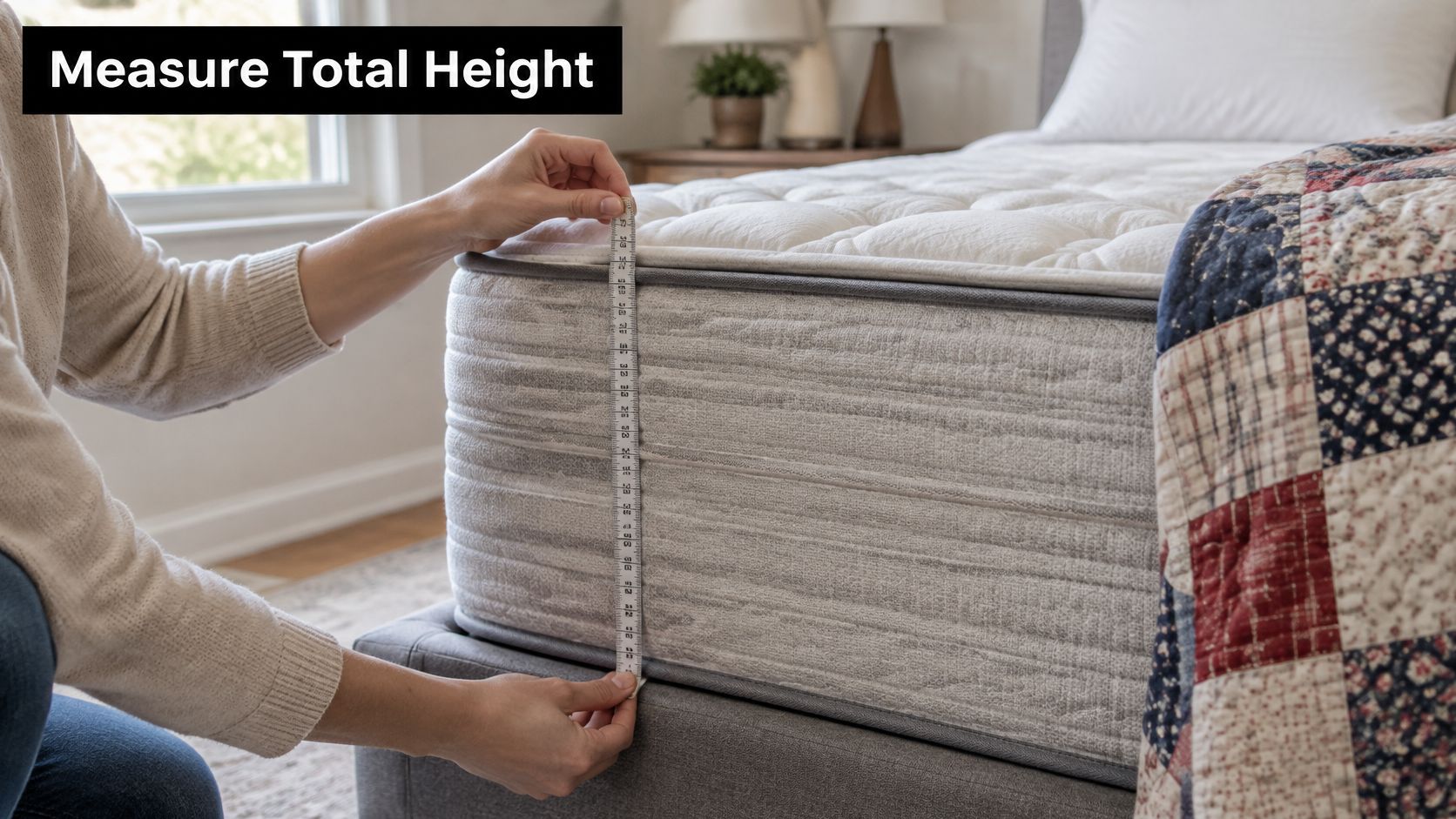
Count every layer before you choose a drop
Standard mattresses usually run 9 to 12 inches. Deep models run 14 to 16 inches, a pillow-top can add 2 to 3 inches, and a topper can add another 2 to 3 inches. Measure from the top of the dressed mattress to where you want the quilt to end. Don't measure the bare mattress and guess the rest.
If you need the method, follow the steps for how to measure mattress depth with protector and topper already fitted. That total height tells you whether a standard drop will cover the side or stop halfway down it.
| Bed type | Height | Side drop | Notes |
|---|---|---|---|
| Standard mattress | 9 to 12 in | 12 in each side | Full length; check against the sizing table floor |
| Deep or pillow-top | 14 to 16 in, plus layers | 12 in on floor side; 8 to 10 in at adjustable head | Full length at foot only; use 16 to 18 in deep pocket sheets or sheet suspenders |
| Platform bed | Frame height varies | 6 to 10 in each side | Keeps the quilt off the frame |
Adjustable and platform beds need restraint
On an adjustable Queen like the case above, keep 8 to 10 inches of drop at the head and save floor length for the foot. That gives the base room to bend without dragging the quilt with it. On a platform bed, 6 to 10 inches is enough. More fabric hides the frame and pools where it shouldn't.
Sheets cause the second problem. A quilted topper or thick protector can lift corners and pull a fitted sheet loose during the night. Use 16 to 18 inch deep pocket sheets, or sheet suspenders if your current sheets are otherwise in good shape.
Oversized isn't automatically better. Excess overhang drags, wrinkles, catches under an adjustable base, and makes a neat bed look unfinished.
Buy enough width to cover the dressed mattress. Don't buy so much that the quilt fights the bed every time you move it.
Layering and Styling a Patchwork Set in Real Bedrooms
A rental bedroom is a good test. Beige walls you can't paint, a rattan headboard, plain flooring, and a navy and cream patchwork quilt. In that room, the quilt has to do the visual work without making the bed look crowded.
This room shows the quilt carrying the pattern while the frame stays simple.

Build the bed in order. Fitted sheet first, then the quilt as the top covering in warm months. In cool months, add a throw or light blanket at the foot. Put a duvet under the quilt only when the room is too cold for the quilt alone, then finish with pillow shams and a bolster if the bed needs structure at the head. The order in this guide to how to make a bed with a quilt follows that same practical sequence.
Three rules keep the rental room calm.
- Pick one dominant color: Let navy lead, and repeat it in one small item rather than across every cushion.
- Pair print scales carefully: Put one large scale print with smaller pieced blocks, not two busy patterns at the same scale.
- Match visual weight: A bold quilt suits the plain rattan frame. A carved or upholstered headboard needs a quieter quilt.
Patchwork has been used on beds for centuries, including examples from the eighteenth through twentieth centuries, so it can sit comfortably in a plain modern room. Let it anchor the bed, let the throw add a second texture, then stop. Stand at the doorway and check that the quilt reads as the focal point before you add another print.
How to Wash a Patchwork Quilt Set Without Losing Color
The first wash tests two things at once: whether dye transfers and whether the quilt keeps its size. Start with the care label and the fiber mix, which set the limits for water temperature, agitation, and drying. On a patchwork quilt, check a dark print beside a pale patch, since one piece can release dye onto another.
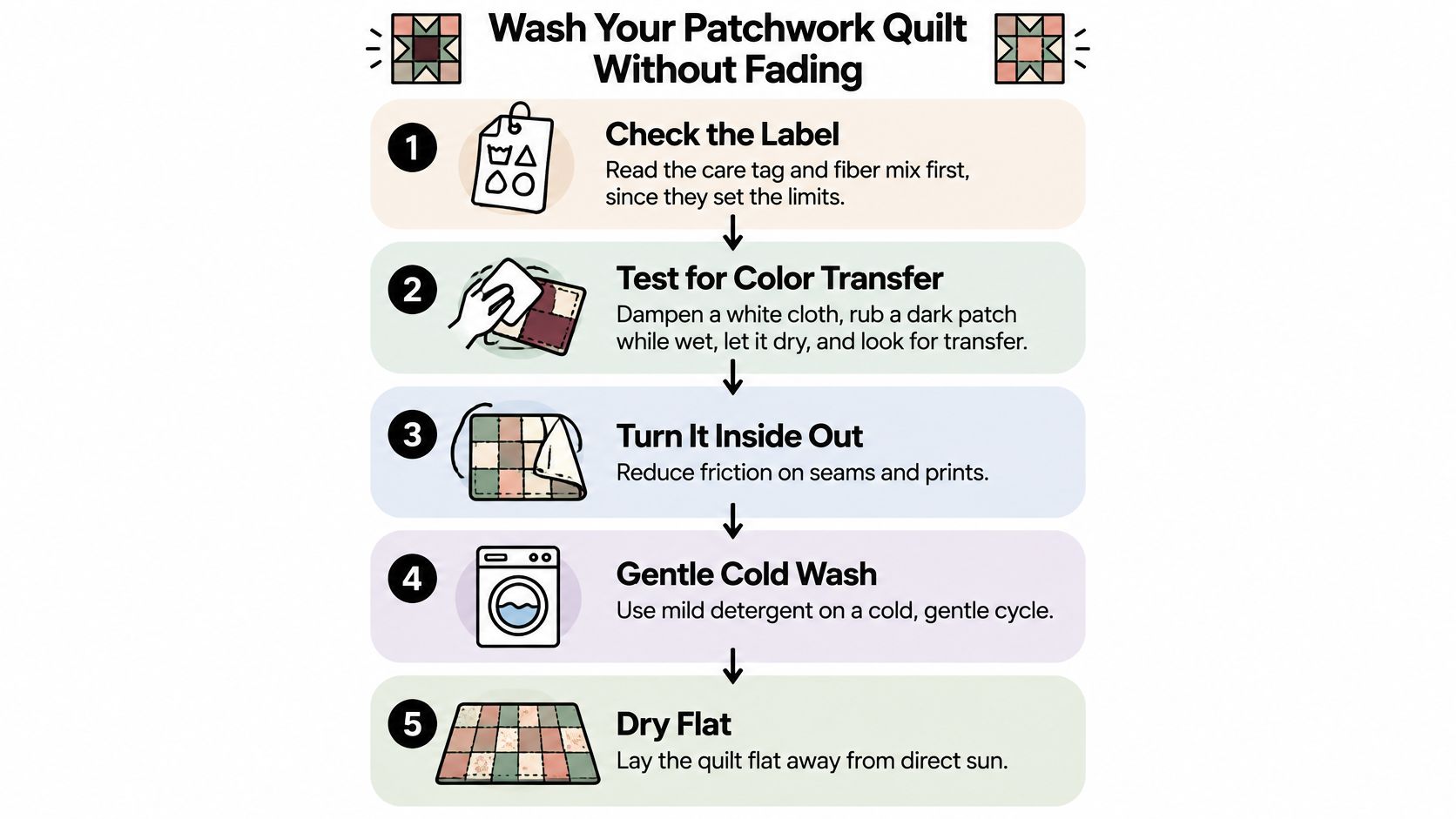
Six steps that protect color and seams
- Test for transfer: Dampen a white cloth and rub a dark patch. Let the cloth dry before checking for color. Try a dry rub too, as friction along quilting lines can lift dye.
- Turn it inside out: Close ties and protect loose edges. Use a mesh bag only for a vulnerable edge, and leave enough room in the drum for the quilt to move.
- Choose cool water: Research on water hardness and temperature under ISO 105-J03 conditions examined their effects on color change. The controlled laundering research supports treating both water conditions and temperature as factors to consider. If your home has hard water, use a softener or a soft-water setting if your machine offers one.
- Wash gently: Use mild detergent and a gentle cycle. A crowded drum makes blocks rub together and puts extra stress on seams and printed areas.
- Dry flat or on low heat: Take the quilt out while it is slightly damp. Heat can change its dimensions, while accelerated washing and drying can cause more color loss than gentler home laundering.
- Store it loosely: Fold the quilt without compressing it, and keep it in a dry closet. Tight storage can stress the same fold lines and compress the batting.
The video below shows how a quilt moves in the machine and how to handle it when wet and heavy.
A single good test does not prove the quilt is colorfast. A new quilt tested only in soft water may still show first wash contrast shifts, dye migration from dark patches onto pale ones, or fading where quilting lines rub. Use the white-cloth test, then watch the colors and dimensions through a cool first wash.
Checks to Run on a Set Before and After Washing
A quilt can look wide enough on the bed and still come up short after laundering. Measure its length and width before the first wash, then repeat the measurements at the same points afterward. Follow the care label for this test, so the result reflects the routine you plan to use.
Do the shrinkage math
Calculate dimensional change as 100 times (postwash dimension minus prewash dimension), divided by prewash dimension. The laundering research using AATCC based procedures and that dimensional change formula measured cotton fabric specimens, not finished patchwork quilts assembled with batting, backing, and binding. It reported average shrinkage of 6.8 ± 0.7% after the first wash and 7.6 ± 0.7% across repeated washes. Treat 6.8% only as a rough fabric-level reference, not a quilt prediction or pass/fail limit.
Set your own acceptable change by comparing the quilt's measured postwash width with the minimum width for your bed in the sizing table. That margin is what determines whether the set still covers the mattress. Washing method also matters: regular home laundering and accelerated procedures can produce different length and width results, so test the care routine you will use in practice.
| Check | How to test it | Warning sign |
|---|---|---|
| Length and width | Measure the same points before and after one wash | Postwash width falls below your minimum |
| Block joins and binding | Pull gently at junctions and along the binding edge | Exposed seam allowance or loose binding |
| Quilting lines | Inspect the stitching after one wash | Broken stitches or thread pulling out |
| Corners and edges | Lay flat and look for curl | Edge torque or puckering |
| Fiber content | Read shell and fill separately on the label | Cotton-only claim with polyester fill |
Inspect joins after the fabric relaxes
Patchwork layers may shrink at different rates. Printed pieces, batting, backing, and thread can pull against one another, causing puckering, edge torque, or reduced drop. Run your fingers over the block junctions, check for gaps along the binding, and lay the quilt flat to see whether its corners curl.
Repeat these construction checks after the first and second wash. Some faults appear only after sizing washes out and the fabric relaxes.
Return a set with broken quilting stitches or exposed seam allowances, even if its measurements still meet your fit requirement. Those construction faults are likely to worsen with use.
Use this inspection to judge fit and construction, not color transfer. Check how the quilt sits on the bed, whether the joins remain secure, and whether the edges lie flat.
Choosing Your Size and Care Plan Before You Order
Make the decision in order. Measure mattress width and dressed height, pick the drop for your bed type, find your minimum width, then choose shell and fill for room temperature and laundry frequency. Confirm the care plan before you pay, not after the first wash.
Three setups cover most buyers.
- Guest room: A 10 inch mattress with weekly visitors suits a cotton-polyester blend and a 12 inch drop. It's forgiving, presentable, and easy to launder between stays.
- Primary bed: A 16 inch pillow-top on an adjustable base needs an 8 to 10 inch head drop, fuller length at the foot, and deep pocket sheets that stay on over added layers.
- Short-term rental: Frequent turnover favors a blend shell, a cool wash routine, and enough spare width that normal shrinkage doesn't expose the mattress side.
Finish with three checks on the listing itself. Compare finished width against your minimum, read shell and fill separately, and plan the white cloth color test before the first wash. If any answer is vague, choose a different set. A patchwork quilt should fit after washing, not just in the package.
If your mattress is deep, layered, or mounted on an adjustable base, shop SouthShore Fine Linens for oversized quilts and extra-deep pocket sheets made for those exact fit problems. Bring your dressed mattress height and minimum quilt width with you, pick the drop your bed can actually use, and choose a set you can wash cool and keep in service.


