
Oversized Bed Sheets King: How to Get the Perfect Fit
You wake up, turn over, and feel the fitted sheet pull tight. A corner has slipped free again, leaving a bare patch of mattress and a ridge of fabric under your shoulder. If your king bed includes a pillow-top, protector, topper, or adjustable base, the problem probably isn't that you move too much in your sleep. The sheet may be trying to fit a taller and more complex bed than its label suggests.
Oversized bed sheets for a king mattress solve more than a width problem. They address the full sleep stack, the combined height of your mattress and every layer placed on top of it, while giving flat sheets enough fabric for reliable coverage and an intentional drape. The right purchase isn't automatically the biggest set on the shelf. It's the set whose dimensions, pocket depth, fabric, and care requirements match the way your bed is built.
The Modern Mattress Problem and the Oversized Solution
A fitted sheet can look perfect when you first make the bed and still fail overnight. You stretch one corner into place, secure the opposite side, and pull the remaining fabric until the elastic is under tension. After a few hours of turning, the sheet loses its grip and snaps off the tallest or most heavily loaded corner.
That failure usually points to a fit mismatch, not poor bed-making. A mattress with a plush top already sits higher than a simpler mattress, and a protector or topper adds another layer. An adjustable base creates a second challenge because the mattress changes position while the sheet must continue covering the corners.
Why standard labels aren't enough
“King” tells you the intended mattress footprint, but it often says little about vertical capacity. A fitted sheet can match the bed's width and length yet lack enough fabric to wrap underneath the mattress. A flat sheet can cover the surface but leave too little material for a secure tuck, especially when the mattress is tall.
That's why oversized king sheets have become a practical response to modern bedding construction. They add usable fabric where it matters, around the sides, at the foot, or across the top layer. The extra material works like the allowance in a well-cut garment. It gives the sheet room to move without pulling the seams or exposing the bed.
Practical rule: Treat the mattress, topper, and protector as one sleep system when you shop for fitted sheets.
An oversized set can improve the experience in two different ways. A generously cut flat sheet offers more coverage and a deeper tuck, while a deep-pocket fitted sheet provides the vertical reach needed to hold the bed's entire height. Those functions overlap, but they aren't identical. Bigger flat-sheet dimensions won't compensate for a fitted sheet with shallow pockets, and an extra-deep fitted sheet won't create the elegant side drape you want from a top layer.
The useful question is therefore not, “What is the largest king sheet I can buy?” Ask instead, “What does my complete sleep stack require, and how much drape do I want?” That shift prevents the most common oversized-bedding mistake, buying more fabric without solving the actual point of failure.
Decoding King Sheet Measurements and Dimensions
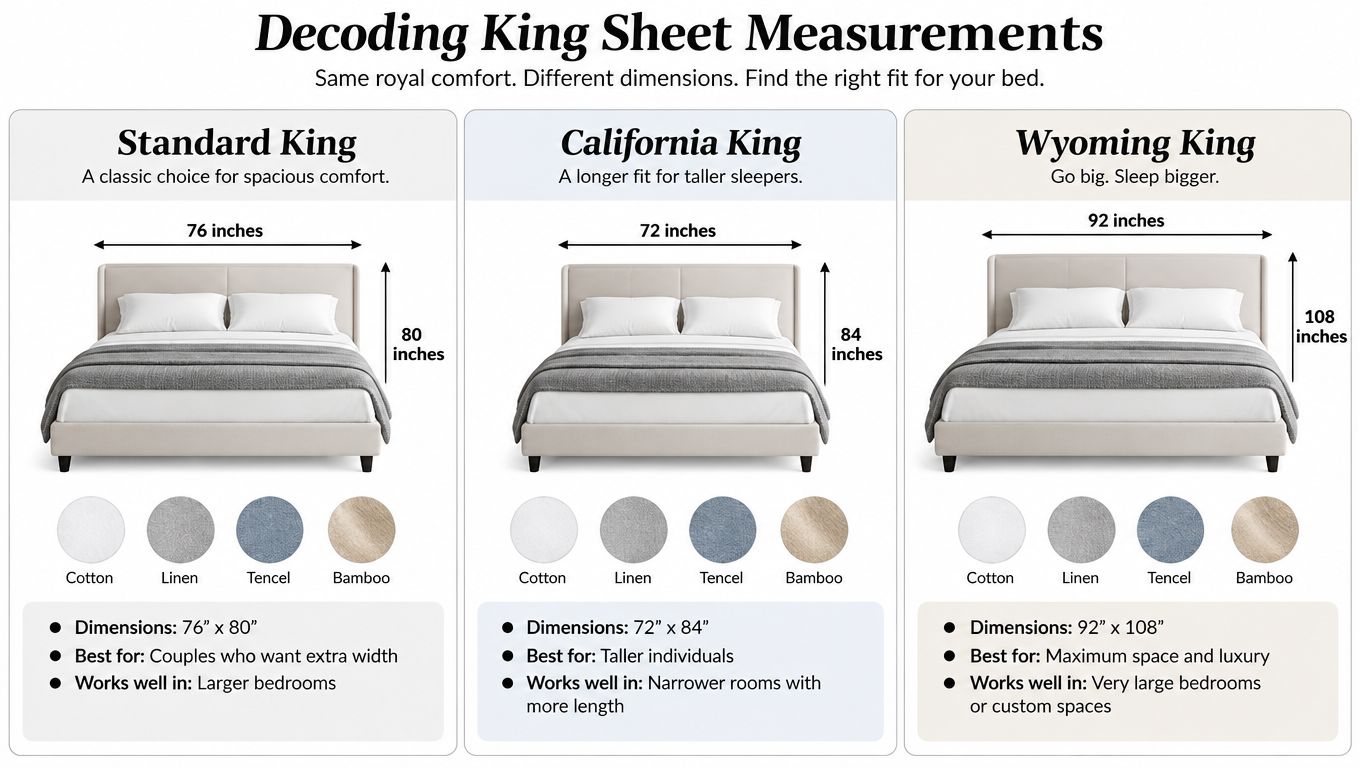
Start with the mattress footprint. A U.S. king mattress is typically 76 inches wide by 80 inches long, according to Saatva's bed sheet size guide. That measurement describes the mattress itself, not the fabric needed to cover it, wrap around its sides, and tuck underneath.
A fitted sheet is shaped to follow that footprint, with elasticated corners and a pocket depth for the vertical sides. A flat sheet is a rectangle, so it needs additional width and length to fall over the edges and remain available for tucking. Think of the mattress as a tabletop and the flat sheet as a tablecloth. A cloth cut exactly to the tabletop would never stay in place once you moved anything across it.
Read the three dimensions separately
Product listings often show width by length, then provide pocket depth in a separate field. Read those measurements in order:
- Width and length tell you which mattress footprint the sheet is designed to cover.
- Pocket depth tells you how much vertical mattress height the fitted sheet can accommodate.
- Finished dimensions reveal how much extra fabric a flat sheet provides beyond the mattress surface.
Independent bedding guides commonly place king flat sheets around 102 by 112 inches, 105 to 115 by 100 to 110 inches, or 114 by 114 inches. These variations aren't necessarily errors. They show that “king flat sheet” isn't one universal finished size, and that oversized formats are built with a deliberate allowance.
For oversized king flat sheets, that allowance can add roughly 26 to 38 inches of extra fabric in one or both directions beyond the mattress dimensions, improving coverage and tuck-in stability. The Tip Top Furniture sheet guide is useful for comparing the measurements printed on different bedding products rather than relying on the size name alone.
Keep king varieties distinct
A standard king and a California king aren't interchangeable. The standard U.S. king is wider, while the California king is narrower and longer. A sheet can be generously sized and still be the wrong shape for the mattress, so check the actual product dimensions before buying.
You may also encounter specialty labels such as Wyoming king. These describe a substantially larger mattress footprint, not a regular king with deeper pockets. For everyday shopping, focus first on the dimensions printed by the manufacturer, then confirm whether the product is a fitted sheet, flat sheet, or complete set.
For a visual explanation of how king measurements translate into usable bedding, see this guide to the size of king sheets in inches. It can help you compare a product page with your own mattress measurements before you place an order.
The key distinction is simple. Flat-sheet size controls coverage and drape. Fitted-sheet size controls grip and fit. Oversized bedding works best when you evaluate both instead of assuming one large dimension solves every problem.
Mastering Pocket Depth for Thick Mattresses and Toppers
A fitted sheet has to cover more than the mattress top. It must descend along the sides, wrap beneath the mattress, and keep enough elastic tension to hold the corners. That vertical measurement is the sheet's pocket-depth requirement, and it depends on the complete sleep stack, not the mattress shell alone.
A pillow-top mattress with a protector, topper, and pad can be far taller than a traditional mattress. Each permanent layer uses part of the sheet's available depth. Measure only the mattress and the fitted sheet may appear suitable on the product page, then fall short when the bed is made.
Measure the complete sleep stack
Use a tape measure with the bed arranged exactly as you sleep on it.
- Place the mattress on its base and add the protector, topper, pad, or other layers that remain on the bed.
- Measure from the mattress's bottom edge to the highest sleeping surface.
- Record the full height of that stack.
- Compare it with the seller's stated maximum pocket depth.
- Choose a pocket with a 1 to 2 inch buffer above the measured stack, following the guidance in Consumer Reports' sheet buying guide.
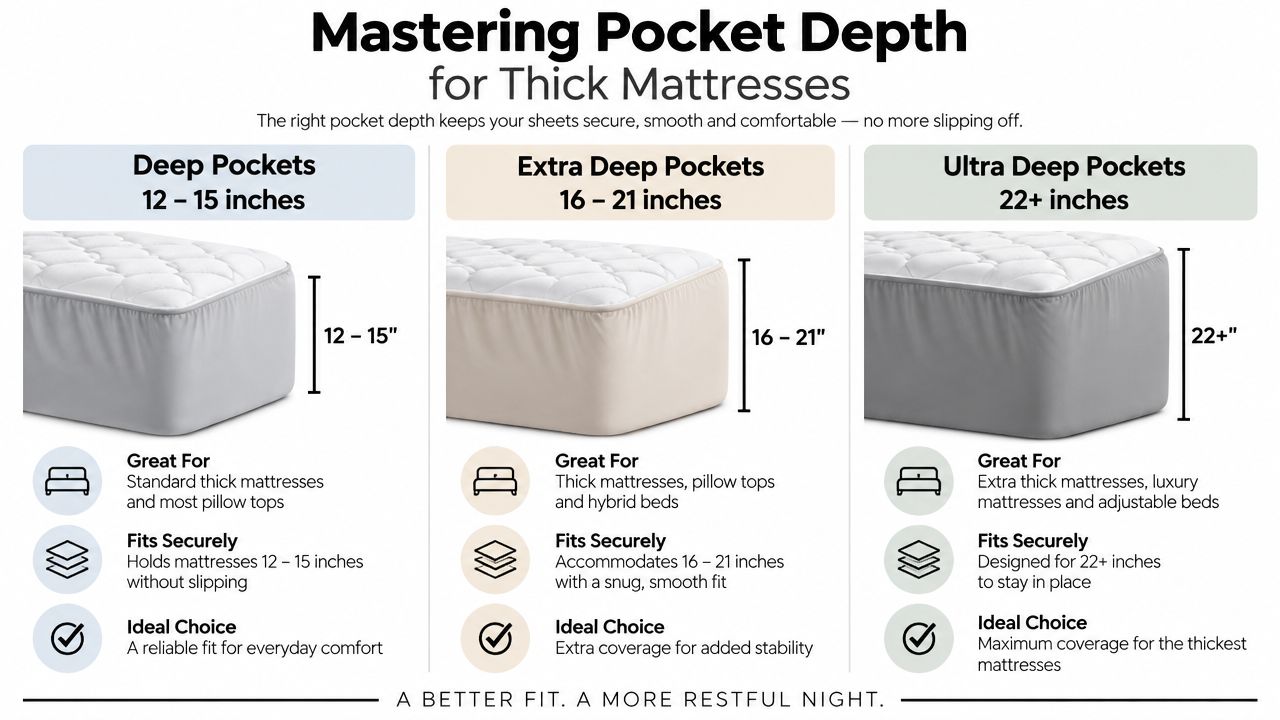
That extra room lets the fitted sheet wrap under the mattress instead of stopping at the edge. It also allows for slight dimensional change after the first wash, particularly with natural-fiber fabric. For a visual reference, use the image below to compare pocket-depth options.
Translate deep and extra-deep labels carefully
Pocket-depth labels are not standardized. One retailer's “deep pocket” may represent another seller's maximum regular-sheet depth, so treat the label as a starting point and verify the actual measurement.
Buying guidance commonly places deep-pocket sheets around mattresses 15 to 18 inches thick, while extra-deep sheets are designed for mattresses 18 inches or more. With a topper and other layers, a pillow-top system can reach up to 20 inches in total depth. That explains why a fitted sheet that works on a conventional mattress may not stay secure on a plush hybrid.
A shallow pocket pulls the elastic upward and can make the corners pop off. An excessively deep pocket leaves fabric to fold beneath the mattress, bunch at the corners, or loosen across the sleeping surface. The right choice is the pocket that extends beneath the measured stack with enough allowance to stay anchored, not just the deepest option available.
On an adjustable base, movement redistributes tension across the four corners. Choose continuous elastic and dimensions matched to the bed's actual height. Before comparing product specifications, follow this mattress-depth measuring guide.
Evaluating Fabric Weaves and Construction Quality
Once the measurements work, fabric determines how the sheet feels and how it behaves after repeated washing. Oversized dimensions are valuable only if the textile remains comfortable, stable, and manageable in daily use.
Cotton is a familiar choice because it can feel breathable and adaptable across seasons. Its hand depends on the fiber quality, finishing, and weave, so don't judge a sheet by the fiber name alone. Cotton can also shrink during laundering, which makes generous sizing and careful care especially important.
Compare the main weave options
Percale uses a crisp, plain-weave structure with a fresh hand and an airy feel. It suits sleepers who prefer a lighter, less glossy surface and a sheet that feels cool against the skin.
Sateen has a smoother, more lustrous finish. It tends to feel softer and more draped, which can support a polished bedroom style, though its warmer hand may not suit every hot sleeper.
Linen brings visible texture and a relaxed appearance. It can look especially effective when you want oversized bedding to feel deliberate rather than perfectly precise.
Cotton blends can offer easier care and dimensional stability, depending on the fibers and construction. They're worth considering for guest rooms, busy households, or anyone who values reduced maintenance over a purely natural-fiber feel.
Inspect the details beyond softness
Run your hand over the fabric, but also inspect the construction. A fitted sheet should have elastic that feels continuous and resilient rather than concentrated only at the corners. Look for clean seams, secure hems, and a pocket shape that doesn't appear shallow relative to the claimed depth.
Sensitive sleepers may also want to check for textile certifications. OEKO-TEX certification can help identify products tested for harmful substances, though certification doesn't tell you whether the weave feels crisp, silky, or textured. Use it as a safety and manufacturing checkpoint, not as a substitute for reading the dimensions and care label.
The best fabric choice follows your routine. Choose percale or linen if airflow and texture matter most, sateen if you prefer a smoother finish, and a blend if repeated laundering and easy upkeep dominate your decision. Fit remains the first filter. Comfort becomes meaningful only after the sheet stays where you put it.
Care Instructions to Prevent Shrinkage and Preserve Fit
A king sheet can fit on the first night and become difficult to anchor after laundering. Cotton can shrink during washing and drying, leaving less fabric to tuck beneath a deep mattress or topper. The tighter your sleep stack, the less room that change leaves at the corners. For a closer explanation, see this cotton shrinkage guide.
Before the first wash, read the care label and check whether the sheet is preshrunk or pre-washed. Keep large king pieces away from heavy garments that can twist them together. They also need enough space in the washer and dryer to move, rinse, and dry evenly.
Use a low-stress laundry routine
- Wash with cool water: Lower temperatures place less stress on cotton fibers and help limit dimensional change.
- Choose mild detergent: Strong formulas and excess detergent can leave residue, affect softness, and encourage unnecessary rewashing.
- Avoid overloading: A crowded drum twists oversized sheets and makes even rinsing harder.
- Use low heat: High dryer temperatures can increase shrinkage and weaken elastic, especially around fitted corners.
- Remove promptly: Taking sheets out soon after the cycle reduces deep creases and makes reshaping easier.
- Reshape while damp: Pull the corners and seams into alignment before folding or returning the sheet to the bed.
Laundry rule: If a fitted sheet already sits close to its maximum pocket depth, avoid combining a hot wash with a high-heat dry.
Preshrunk construction lowers the risk, but it does not stop repeated heat from changing the fabric. Cool washing and low-temperature drying remain sensible habits. If the label permits line drying, gentler handling can help preserve the fabric and elastic. Make sure the sheet is fully dry before storing it.
Protect the fitted corners
Oversized fitted sheets need careful handling during bed changes. Lift the mattress slightly, guide each pocket over its corner, and check that the elastic rests evenly beneath the edge. Pulling hard on one corner can strain the elastic and leave the opposite side loose.
If a loose section appears after washing, compare the sheet with the original mattress and topper measurements before assuming the product is defective. Shrinkage, uneven reshaping, or an overfilled sleep stack can all reduce the available grip.
The goal is straightforward: preserve enough length, width, and pocket depth for the sheet to hold its position after laundering. A gentle routine protects that working margin, much like leaving extra clearance around a moving part.
Styling Your Bedroom with Intentional Fabric Drape
Oversized bedding isn't only a response to thick mattresses. It also changes the visual proportion of the bed. Extra fabric can soften the hard lines of a platform, conceal the side of a tall mattress, and create the relaxed abundance associated with hotel-style rooms.
Recent interior-design coverage describes oversized bedding as part of layered looks that intentionally exceed the mattress footprint for visual impact, as discussed in this bedding-trend overview. That styling direction works best when the added fabric looks controlled rather than accidental.
Separate functional layers from decorative layers
Use the fitted sheet to solve containment. It should follow the mattress closely, with enough pocket depth to stay anchored and enough elastic tension to remain smooth. Use the flat sheet, quilt, coverlet, or duvet to create the visual drape.
That separation gives you more control. You might need an extra-deep fitted sheet because of a topper, but you don't necessarily need an enormous flat sheet if you prefer a crisp appearance. Conversely, you might choose an oversized flat sheet for a generous tuck or a relaxed edge even when the fitted sheet is a conventional deep-pocket design.
A simple layering approach works well:
- Keep the fitted sheet smooth and mostly hidden.
- Pull the flat sheet evenly across the bed, leaving consistent side coverage.
- Fold the top edge over a blanket or duvet to create a visible band of texture.
- Add a quilt or coverlet across the lower portion of the bed.
- Finish with pillows that repeat one color or texture from the layers.
Control the amount of overhang
Drape should relate to the room. On a low platform bed, too much fabric can collect near the floor and make the bed appear heavy. On a tall frame, additional side coverage can prevent the mattress from looking exposed.
Color affects the result too. Pale neutrals make generous fabric feel airy, while darker solids give the bed more visual weight. Percale can support a crisp, hotel-inspired finish, sateen can add a polished glow, and linen can make a larger sheet look intentionally relaxed.
The contrarian point matters here: oversized does not mean unstructured. A thoughtful drape has even sides, a controlled foot edge, and layers that stay aligned. If the fabric pools, twists, or drags, reduce the decorative volume or choose a better-matched size.
Avoiding Common Sizing Mistakes and Final Buying Tips
The biggest shopping mistake is treating “oversized” as a guarantee of quality or fit. It isn't. A flat sheet can be wider than expected while the fitted sheet still has inadequate pockets, and a fitted sheet can have excessive depth that leaves loose fabric beneath you.
There is no shared industry definition for deep pocket and extra deep pocket, as explained by this mattress-depth guide. Sellers use those labels differently, so the product description must provide actual dimensions and a maximum mattress depth.
Check the listing in this order
- Confirm the mattress type: Standard king and California king require different footprints.
- Measure the complete stack: Include the protector, topper, pad, and any permanent layer.
- Separate sheet functions: Check flat-sheet dimensions for drape and fitted-sheet pocket depth for grip.
- Look for a buffer: Choose enough pocket capacity to wrap beneath the stack without leaving excessive slack.
- Review the construction: Inspect elastic, seams, hems, fabric composition, and certification information.
- Read fit-focused reviews: Look for comments about corner retention, bunching, washing, and thick mattresses rather than relying only on softness ratings.
- Check care instructions: A low-stress wash routine helps preserve the dimensions you paid for.
A sheet that's slightly generous in the flat-sheet direction can be useful for tucking and coverage. A fitted sheet should be more precise. If it pulls hard at the corners, it's too small. If it creates folds under your body, it may be too deep or too loose. The goal is a smooth surface with secure corners, not maximum fabric everywhere.
Measure your bed before shopping, save the numbers on your phone, and compare them with the listing's finished dimensions. For a modern king mattress, that small habit does more than the word “oversized” ever can.
If your king bed includes a thick mattress, topper, protector, or adjustable base, explore SouthShore Fine Linens for oversized flat sheets and deep-pocket sheet options designed around modern bedding setups. Use your sleep-stack measurement to choose the collection and dimensions that will give you secure coverage, comfortable fabric, and the drape you want.


