
Jersey Fitted Sheet Full: The Complete Fit and Fabric Guide
A full-size jersey fitted sheet is forgiving because its knit fabric stretches, but pocket depth matters more than fabric choice when you're trying to stop corners popping off a deep mattress. The nominal full mattress footprint is 54 by 75 inches, yet a sheet with pockets that are too shallow can still pull loose overnight.
You've probably experienced the problem: the sheet looks perfectly fitted when you make the bed, then one corner slips free after a night of turning, or the fitted edge gathers beneath a thick topper. Jersey can reduce that frustration, but it can't compensate for a poor depth match. The reliable approach is to measure the complete mattress setup, including protectors and toppers, then choose a pocket depth with enough working room to stay tensioned.
Why Jersey Sheets Feel Different on Your Mattress
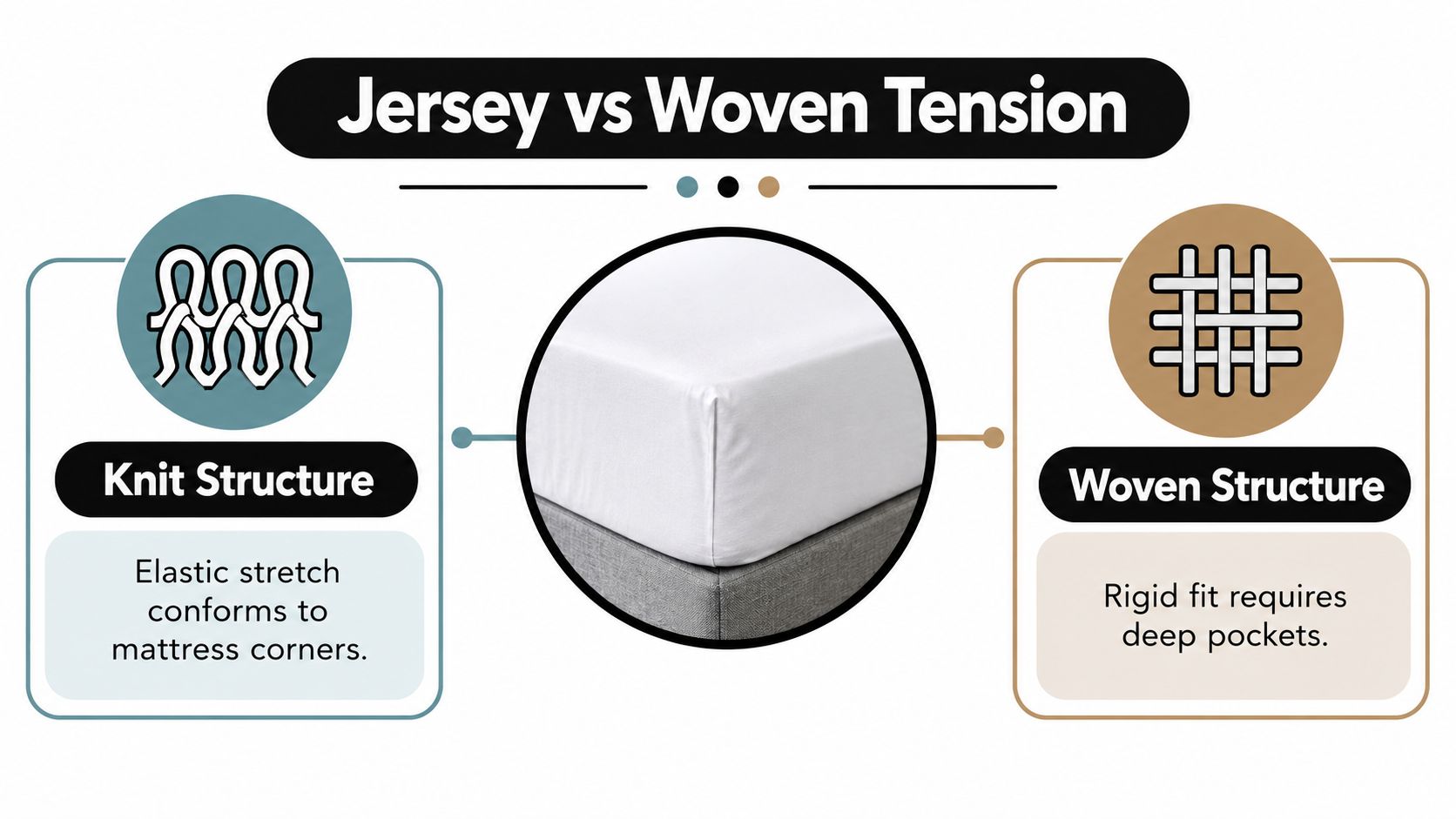
Readers searching for a jersey fitted sheet full expect a soft, T-shirt-like surface. That comfort is real, but the more useful distinction appears when you pull the sheet over a mattress corner. Jersey is knitted, so its interlocking yarn structure stretches and recovers. A woven sheet has a more fixed structure and depends heavily on accurate dimensions, deep enough pockets, and careful tucking.
That flexibility makes jersey more forgiving when the mattress dimensions are not perfectly uniform from corner to corner. It can conform around rounded edges, accommodate modest movement, and hold the fitted edge against the underside of the mattress more easily than a rigid woven fabric. The benefit is practical, not decorative: fewer loose corners when the mattress falls within the sheet's intended pocket-depth range.
What stretch can and can't fix
Stretch helps with corner conformity, but it doesn't create extra pocket depth. If the mattress and topper together are taller than the pocket can reach, the elastic has to work under excessive tension. The sheet may appear secure at bedtime, then release when someone sits on the edge or shifts during sleep.
A useful way to think about the purchase is to separate two jobs:
- Fabric stretch helps the sheet adapt across the mattress surface and around the corners.
- Pocket depth gives the fitted edge enough material to pass over the mattress and tuck underneath.
- Elastic recovery helps the sheet return to shape after movement and laundering.
The fitted-sheet category itself is relatively modern. schlafgut identifies 1963 as the year it introduced the first fitted sheet with integrated elastic all around, and 1990 as the year it introduced jersey bed linen, as described in its history of fitted-sheet development. That sequence explains why jersey feels like a functional solution rather than merely a softer fabric choice.
For a deeper look at how hand feel, fiber, and construction interact, compare this guide with what makes sheets soft. Softness affects first impressions. Fit determines whether you stay comfortable after the bed is used.
How Jersey Entered the Fitted Sheet Market
A full jersey fitted sheet can feel secure at bedtime and still pop off after someone sits on the edge. Its history explains why. The fitted-sheet format solved the holding problem through shaped corners and elastic edging, while jersey later added stretch to the fabric itself.
Two Technologies, Two Jobs
The fitted-sheet design provides the framework. Elastic around the edge helps grip the mattress, and the pocket carries the fabric beneath it. Jersey knit adds flexibility, softness, and resistance to some wrinkling. Those functions work together, but they do not solve the same problem.
That distinction matters on modern full mattresses with toppers. Jersey can spread over rounded corners and adjust to small changes in the surface. It cannot create extra fabric below the mattress. If the combined mattress and topper height exceeds the pocket depth, the elastic remains under strain and a corner may release during sleep.
The category therefore developed through two separate technologies. Fitted construction improved how sheets stayed in place. Jersey made installation more forgiving and gave the surface a softer, more flexible hand.
A practical demonstration of fitted-sheet construction would show the elastic edge being pulled around each corner, then reveal how much material remains beneath the mattress. It would also make the limitation clear: stretch helps the sheet conform, while pocket depth determines whether it can stay anchored.
For shoppers, the useful lesson is straightforward. Choose the full-size jersey sheet for its knit flexibility, but measure the installed bed, including any topper, before relying on that stretch to hold the corners.
Knit Construction Versus Woven Fabric Performance
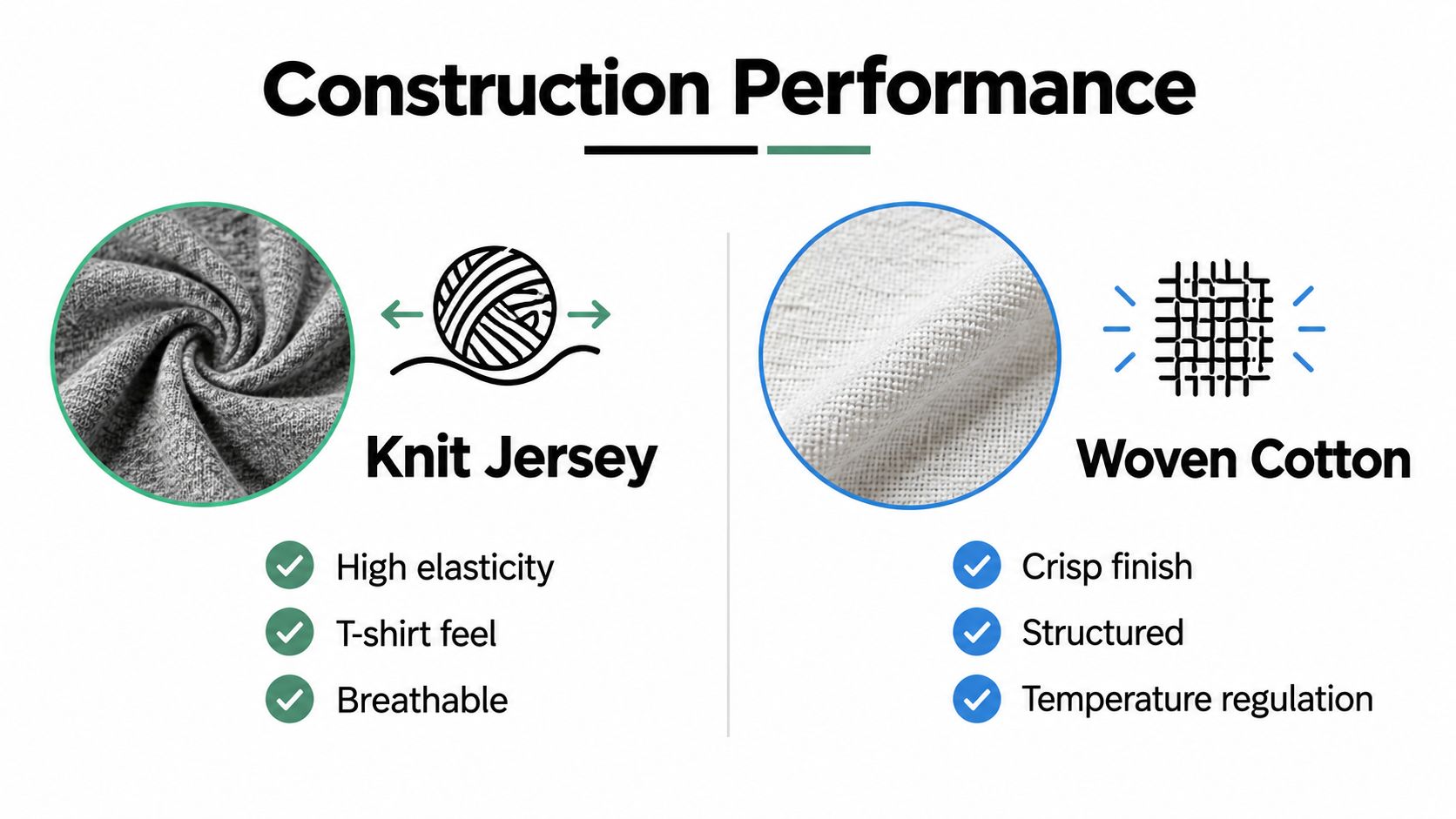
A full-size jersey fitted sheet behaves differently the moment you pull it over a mattress with rounded corners or a topper. Jersey uses looped yarns that stretch and recover. Woven cotton interlaces threads into a more stable grid. That structural difference affects surface feel, wrinkle formation, installation, and the tension carried by each corner.
During installation, jersey can stretch across the mattress and settle around the edge even when alignment is not perfect. Woven fabric offers less tolerance. If its pocket is shallow or one corner is pulled tighter than the others, the fitted edge can work free. This difference matters most on modern beds where a topper increases the total height and puts more strain on the elastic.
Where jersey has the advantage
Jersey is a knit, not a woven fabric, so its natural stretch helps it follow mattress corners and resist some visible wrinkling. Jersey knit sheet construction guidance describes this construction and its practical effect. The benefit is real, but only when the sheet has enough pocket depth for the mattress and topper together. Stretch can accommodate shape. It cannot replace missing fabric beneath the mattress.
For a full bed, jersey tends to be useful when:
- The mattress has rounded or uneven edges: Stretch follows small changes in shape without leaving a tight, exposed corner.
- You want less ironing: The knit surface generally shows fewer sharp creases.
- You change bedding often: A flexible edge makes removal and refitting easier.
- The bed has a topper: Stretch helps with installation, provided the pocket reaches below the combined mattress height.
The broader differences between common bedding fabrics are outlined in this guide to bedding fabric types. Woven cotton still suits sleepers who prefer a crisp percale surface or the smoother drape of sateen. Those fabrics can feel cooler or more structured, but they usually demand closer pocket-depth matching and give less when a corner is under tension.
The demonstration below shows how fabric construction changes bedding behavior.
Jersey is more forgiving during fitting, not universally better. Woven fabric offers a firmer, more structured feel. For either choice, correct pocket depth determines whether the corners remain anchored after the bed is slept on and the sheet is washed.
Understanding Pocket Depth for Full Mattresses
A full-size jersey fitted sheet is generally designed around a 54 by 75 inch mattress footprint, but those surface dimensions tell you only whether the sheet is the right size across and lengthwise. The number that determines corner security is pocket depth, measured from the sheet's edge toward the mattress center.
Measure the bed as it's used. Include the mattress, protector, and topper. A sheet that fits the bare mattress may become too shallow once a thick comfort layer is added.
Use the installed height, not the label
Buying guidance commonly recommends allowing roughly 1 to 3 inches more pocket depth than mattress depth, because the pocket measurement follows the seam and doesn't represent all of the usable vertical reach. The Company Store's jersey sheet guidance explains why that extra margin matters when the sheet must pass over the side and tuck beneath the mattress.
A basic full mattress may fall within the standard range, while a mattress-plus-topper setup can reach 14 to 16 inches. In that situation, a 10-inch pocket is likely to underfit. A pocket measuring 15 to 16 inches is materially more suitable for preserving corner tension when the bed is used and laundered repeatedly, provided the combined height falls within that range.
| Mattress Height | Recommended Pocket Depth | Fit Risk Level |
|---|---|---|
| 9 to 11 inches | Standard pocket suited to the measured height, with working room | Lower when the mattress has no substantial topper |
| 12 to 14 inches | Deep pocket with extra reach beyond the installed height | Moderate if the protector or topper adds bulk |
| 14 to 16 inches | Pocket depth around 15 to 16 inches | Lower when the complete setup is measured accurately |
| Above 18 inches | Extra-deep construction designed for the full installed height | High if the product lists only standard depth |
These ranges align with the fit guidance summarized by Dan River's jersey sheet specifications, which places basic pockets around 10 inches and deep-pocket versions up to 16 inches. Use the mattress-depth measuring guide before ordering, especially if the bed has an adjustable base or pillow-top profile.
Practical rule: If you're deciding between fabric types, start with the installed height. A well-matched woven sheet can outperform an under-depth jersey sheet, because stretch can't replace missing material.
Too-shallow pockets pull the corners upward and release under movement. Excessively deep pockets can leave loose fabric bunching underneath, so “deeper” isn't automatically better. The target is enough depth to tuck securely without forcing the sheet into a permanent fold.
Softness Versus Long-Term Performance Trade-offs
Softness is the reason many shoppers choose jersey, but it's a poor measure of long-term success on its own. A sheet can feel excellent when first opened and still disappoint if it overheats the sleeper, pills under frequent washing, or loses corner recovery after repeated stretching.
Jersey's comfort comes with a different surface character from woven percale. It feels relaxed rather than crisp, and its stretch can make the bed look less sharply fitted. Sleepers who prefer a cool, structured hotel finish may find percale more satisfying, while people who value easy handling often prefer jersey.
Evaluate the whole use pattern
Ask how the sheet will perform in the room, not just how it feels in your hand.
- Hot sleepers should treat jersey's cozy hand and insulating knit structure as possible drawbacks, then compare it with a lighter, more open woven option.
- Frequent washers should inspect care instructions and fiber quality rather than assuming all jersey has identical recovery.
- Thick-mattress owners should prioritize pocket depth before choosing between soft finishes.
- People who want a crisp appearance may prefer woven cotton, even if it requires more smoothing after laundering.
Search results show shoppers filtering for deep-pocket jersey sheets that fit 15 to 16 inch mattresses, while broader fitted-sheet coverage emphasizes deep-pocket performance, eco-friendly materials, and textured fabrics such as jersey knit, as reflected in this deep-pocket jersey sheet listing. That behavior points to a practical shift in priorities. Buyers aren't only asking whether the fabric feels soft. They're trying to avoid the nightly inconvenience of a sheet that won't stay installed.
Pilling and stretch retention depend on the yarn, knit quality, finishing, and wash routine. Don't treat “jersey” as a complete quality specification. Look for clear fiber details, stated pocket measurements, safety certifications where offered, and care instructions that fit your household.
The right choice depends on what you value most. Jersey is persuasive for relaxed comfort and adaptable fit. Woven cotton remains a sensible choice when cooler feel, crisp structure, or a more formal appearance outweighs stretch.
Choosing a Jersey Fitted Sheet Full for a Secure Fit
A sheet can feel soft in the shop and still pull loose at home. The usual cause is a mattress setup that includes a protector or topper, making the installed height greater than the product page suggests. Start with the specifications, not the photographs. A full-size jersey fitted sheet should match the 54 by 75 inch mattress footprint and state its pocket depth clearly, as shown in Dan River's product details.
Use this checklist before ordering:
- Measure the complete setup. Include the mattress protector and topper. Record the tallest point rather than relying on the mattress label.
- Compare pocket depth with installed height. Leave enough fabric for the fitted edge to pass underneath without lifting the corner.
- Inspect the elastic path. Elastic around the fitted edge usually holds more consistently than elastic placed only at the corners.
- Read the fabric specification. Check fiber content, knit description, and laundering instructions. “Luxury” and “premium” do not describe construction.
- Check for OEKO-TEX certification where relevant. It can offer a useful safety signal, but it does not confirm fit or elastic performance.
- Match the finish to your preference. Jersey suits stretch and relaxed softness. Woven fabric gives a crisper, more structured surface.
Pocket depth deserves priority on adjustable bases, pillow tops, and beds with toppers. A listing that says only “full” leaves you guessing about the measurement most likely to determine whether the corners stay down.
SouthShore Fine Linens offers full-size sheet sets built around the full mattress footprint, along with deeper fitted-sheet options for modern bedding configurations. The same comparison habit applies to any detailed product category. For example, a breeches and show coats guide shows how clear specifications make products easier to compare, even outside bedding.
The strongest choice is not automatically the stretchiest or softest sheet. Select the one whose pocket depth, elastic design, fabric behavior, and care requirements suit the bed you use every night.
Caring for Jersey Fitted Sheets to Preserve Fit
Jersey's stretch is useful only if the knit keeps recovering after laundering. Follow the care label first, use a gentler cycle when possible, and avoid treating high heat as a shortcut for cleanliness. Excessive heat can place unnecessary stress on knit loops and elastic, especially when the sheet is removed from the dryer while hot and stretched over the mattress immediately.
Wash jersey sheets with similarly smooth bedding rather than rough items that can create abrasion. Remove them promptly from the dryer, reshape the fitted corners, and fold them without compressing the elastic edge into a tight, permanent crease. If the fabric feels damp, finish drying it before storage to avoid trapping moisture in the folds.
A simple routine helps preserve both appearance and fit:
- Before washing: Turn the fitted sheet inside out and close any fasteners on other items in the load.
- During drying: Use the care-label setting and avoid leaving the sheet tumbling after it's dry.
- After drying: Pull the corners into shape and store the sheet loosely folded.
- Before remaking the bed: Check that the pocket hasn't twisted, then place the corners evenly.
Care can preserve stretch recovery, but it can't correct a pocket that was too shallow at purchase. For a full-size jersey fitted sheet, fit engineering still matters more than fabric feel. Measure the complete bed, select the right depth, and then use a wash routine that protects the construction.
SouthShore Fine Linens offers full-size fitted sheet sets and bedding designed for modern mattresses, including deeper configurations where clear pocket specifications matter. Visit SouthShore Fine Linens to compare options built around dependable fit, comfortable fabrics, and everyday care.


