
Extra Long Full Size Bedding: How to Get the Right Fit
You've washed the new sheets, stretched the fitted sheet over the first three corners, and the fourth corner won't stay down. The tag said Full. Your mattress said Full. Yet the foot is exposed, the elastic is straining, and by morning the sheet has popped loose. That frustration is rarely a laundry mistake. It's usually a length mismatch, and it's exactly why extra long full size bedding exists as its own size, not just a marketing variation on standard Full.
Why Standard Full Bedding Falls Short
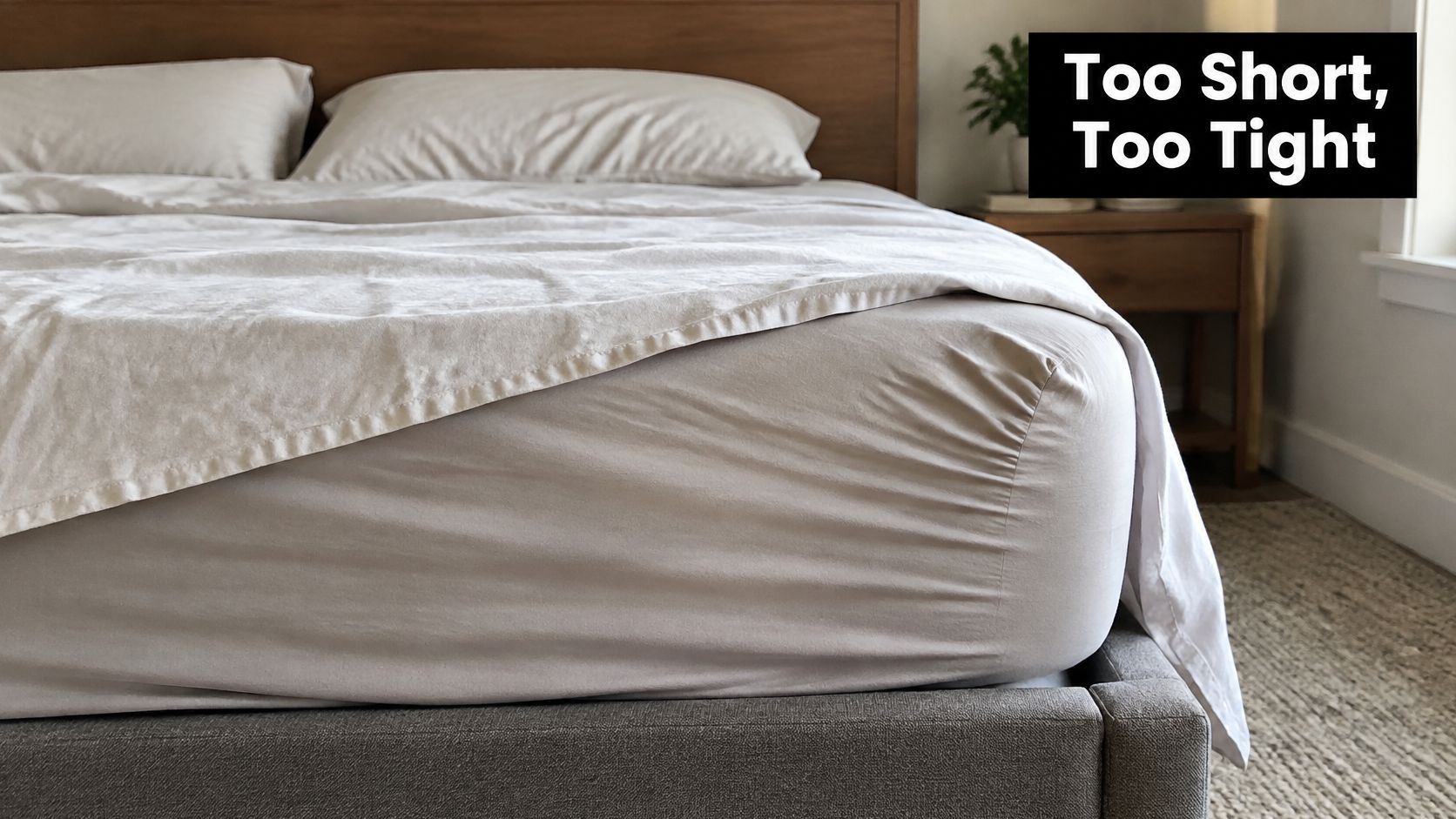
A shopper I helped last spring had bought a Full XL mattress for a tall teenager, then ordered a standard Full set because the store shelf didn't distinguish between the two. The width looked right. The problem showed up at the foot, where the fitted sheet pulled tight, lifted at the corners, and left no tuck at all for the flat sheet. Reordering the same fabric in the correct length fixed it immediately.
The Five Inches That Change Everything
The distinction is simple but easy to miss. Published U.S. mattress-size charts identify the Full, also called a double, at approximately 54 inches wide by 75 inches long, while Full XL keeps that 54-inch width and extends to 80 inches long, adding 5 inches, or about 6.7%, to the sleeping length. A standard Full provides about 28.1 square feet of sleeping surface, and a Full XL provides roughly 30 square feet, an increase of about 6.8% on that same chart.
That added length is the whole point of the bed. It serves taller sleepers whose feet hang off a standard platform, guest rooms that need to accommodate different heights, dormitory-style housing, and compact rooms where a Queen would take too much width. If the bedding doesn't preserve it, you've paid for length you can't use.
Practical rule: If you have to force the fourth corner, don't keep tugging. Check the length first. Forced elastic rarely holds through a night of movement.
Why Width Alone Misleads You
Because both sizes share the same nominal width, a standard Full sheet can look plausible for the first minute. It spreads across the top, the sides seem to line up, and only the foot end reveals the shortage. Flat sheets fail differently. They cover the top but run out before you can tuck them securely, so they creep up overnight.
True extra long full size bedding is cut for that longer platform from the start. The fitted sheet has the length to engage all four corners without strain, the flat sheet has enough drop to tuck, and quilts and comforters proportioned for Full XL don't end abruptly above the foot. Treating the size name as interchangeable is the most common route to returns, exposed corners, and bedding that shifts no matter how carefully you make the bed.
How to Measure Your Full XL Mattress
Don't shop from the label on the mattress corner alone. Measure the mattress you sleep on, with whatever sits on top of it, and write the numbers down before you look at a single product page. That habit prevents most fit problems.
A Five Step Measurement Protocol
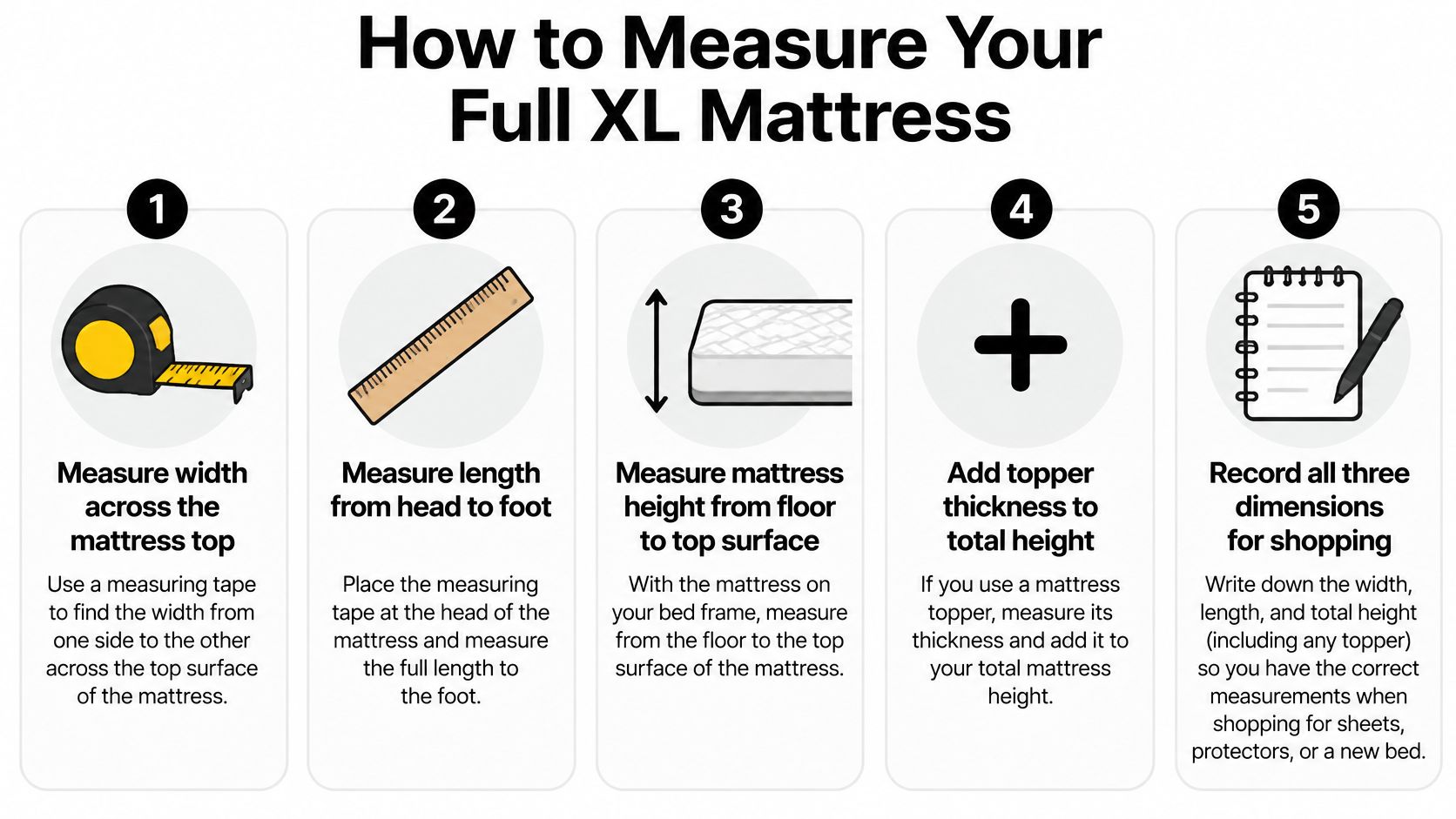
- Measure width edge to edge: Run a tape straight across the top surface, not down around the sides. Note the actual number, even if it differs slightly from what you expected.
- Measure length head to foot: Measure along the center, where the mattress is least likely to be compressed by bedding or a frame.
- Measure height at the side: Go from the bottom of the mattress to the top surface. If you're unsure where to start and stop, this walkthrough on how to measure mattress depth shows the technique clearly.
- Add topper and protector thickness: Measure those layers separately, then add them to the mattress height. Your fitted sheet has to cover the total stack, not the mattress alone.
- Record your base type: Note whether you're on a platform, a foundation, slats, or an adjustable base, and keep all the numbers together for shopping.
Why Actual Dimensions Matter More Than Nominal Ones
Nominal labels hide real variation. Finished mattress dimensions can vary, with some specialty models measuring approximately 53 inches wide, and mattress height, toppers, protectors, and adjustable-base movement all affect fit, so a fitted sheet must match width, length, and total depth. Manufacturing tolerances and material compression add small differences on top of that.
An adjustable base deserves special attention. When the head or foot rises, the sheet flexes and the corners work harder. A sheet that's barely deep enough on a flat platform may pull loose the first time you raise the bed to read. Note the base type so you can prioritize secure elastic and adequate pocket depth.
A standard Full fitted sheet is generally too short for this platform, no matter how deep its pockets are. Queen bedding can supply length, but its extra width tends to shift and bunch across a narrower mattress. Your recorded measurements tell you which problem you're solving, so you don't trade a length problem for a width problem.
Full XL vs Queen vs Twin XL at a Glance
Before you invest in a full set of bedding, confirm that Full XL is the right platform for the sleeper and the room. The wrong mattress decision makes even perfectly sized bedding feel like a compromise.
What Each Size Actually Gives You
| Size | Width | Length | Best For |
|---|---|---|---|
| Full | Same width as Full XL | Shorter than Full XL | Solo sleepers who don't need extra legroom |
| Full XL | 54 inches | 80 inches | Tall solo sleepers, compact rooms, guest rooms |
| Queen | Wider than Full XL | Long length | Partners who need shared space |
| Twin XL | Narrower than Full XL | Long length | Tall solo sleepers in very narrow rooms, dormitory-style setups |
The table clarifies the trade-off. Full XL adds length without adding width, which is ideal when the room can't absorb a wider bed but the sleeper needs the legroom. If you move in your sleep or share the bed, width may matter more than length, and that's where a Queen earns its footprint. Twin XL solves length in the narrowest footprint, but it gives a solo sleeper noticeably less room to turn than the wider Full XL.
Sharing, Room Size, and Availability
Full XL is less common than Full, Queen, or Twin XL, and its 54-inch width may suit a tall solo sleeper or compact room but doesn't create the partner space of a Queen. Two adults can physically fit, but most couples find the width tight for nightly use. Be honest about whether this is a solo bed, an occasional guest bed, or a shared bed before you commit.
Room planning goes beyond whether the frame fits through the door. A Full bed is commonly planned for a room around 10 × 10 feet, and you still need walking paths, door swing, drawer clearance, and space to make the bed without climbing over it. Sketch the footprint with tape on the floor if you're furnishing a small rental or a spare room that also holds a desk or dresser.
Availability is the quieter consideration. Because Full XL is the least common of these sizes, replacement sheets, protectors, and quilts take more deliberate sourcing. That isn't a reason to avoid it. It is a reason to buy bedding that's sized for it and to keep a spare set on hand, rather than assuming you can grab a replacement anywhere. Choose Full XL when length is your constraint and width isn't, and you'll likely be satisfied. Choose it hoping it will feel like a Queen, and you won't.
Choosing Sheets Quilts and Comforters That Fit
Once you have your three measurements plus topper thickness, shopping becomes a verification exercise. You're checking each product against numbers you trust, not hoping a size name will work out.
Fitted Sheets and the Deep Pocket Trap
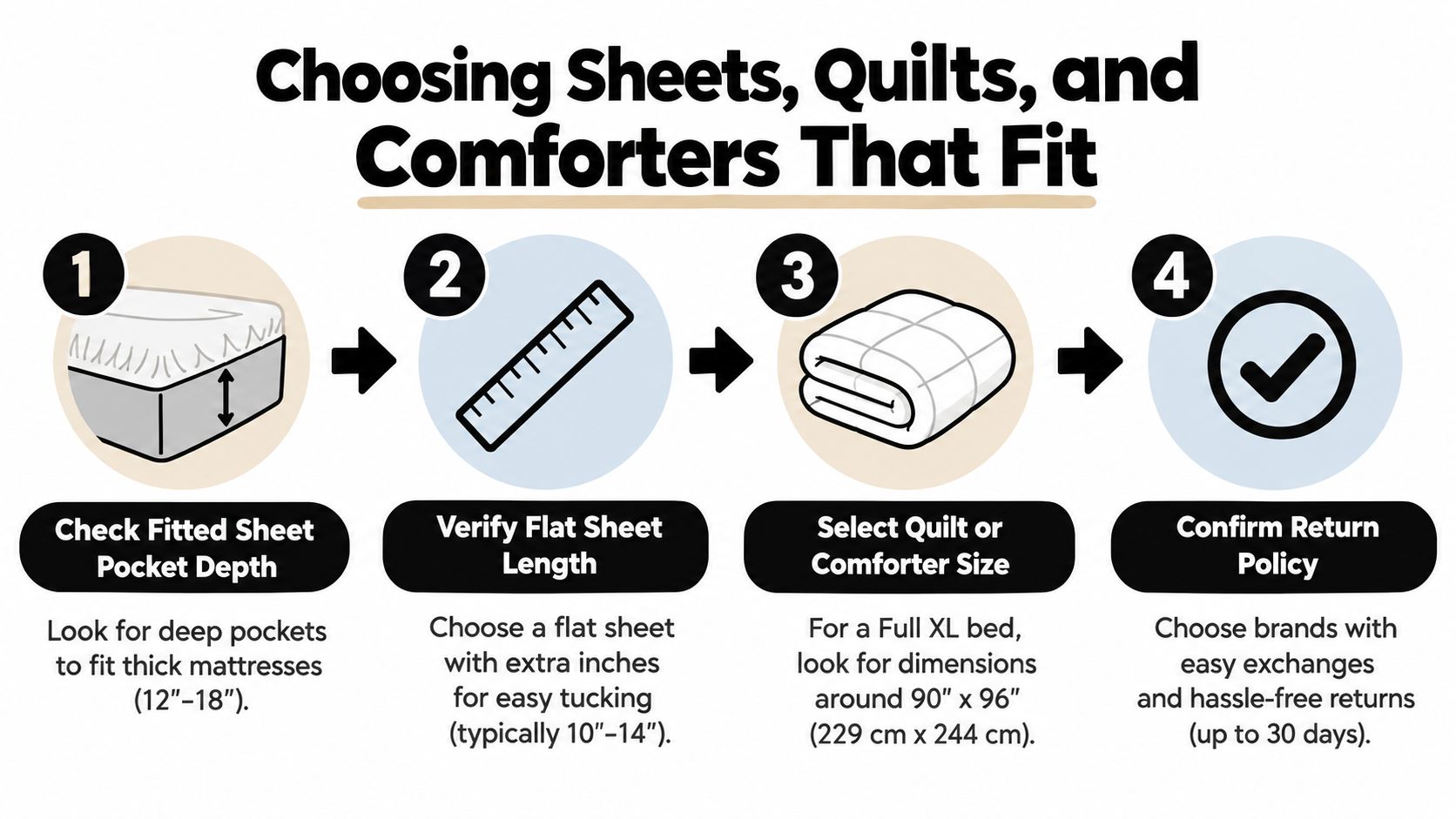
Deep pocket is the phrase shoppers lean on most, and it guarantees less than you'd think. Extra depth helps on a tall mattress with a topper, but on a thinner mattress it leaves loose fabric that wrinkles, shifts, and feels sloppy. Match the stated pocket depth to your measured total height, with a little allowance for tuck and corner engagement, rather than buying the deepest option available.
Elastic construction matters just as much. All-around elastic grips along every side and holds better through movement and adjustable-base use. Corner-only elastic can work on a still sleeper and a shallow mattress, but it gives the sheet more freedom to creep. If you want a fuller framework for fabric, weave, and construction choices, this guide on how to choose bed sheets is a useful companion. For furnishing ideas that keep a compact sleeping space comfortable rather than cramped, it's also worth taking time to browse comfy living options before you finalize the room around the bed.
Flat Layers, Quilts, and Post Wash Dimensions
Flat sheets, quilts, and comforters are more forgiving than fitted sheets, but they still need enough length to tuck at the foot and drape evenly on the sides. An oversized flat layer can be a flexible workaround when an exact size is hard to find. Fitted pieces can't be improvised the same way, because the corners either engage or they don't.
The detail most shoppers skip is shrinkage. A rigorous fit-validation method treats post-laundering dimensions, not packaging dimensions, as the acceptance criterion, and ASTM D4231 specifies evaluating dimensional change after five launderings, where negative values indicate shrinkage and positive values indicate growth. Length and width can change at different rates, which matters enormously when the extra length is the feature you bought.
A sheet that fits perfectly out of the package but shrinks past the corners after a few washes never really fit. Look for finished dimensions and wash before you judge.
Buy for the size after washing, confirm the return or exchange policy before you remove tags, and verify that protectors follow the same dimensions as your sheets. A protector that's too short underneath will bunch and undermine an otherwise correct fitted sheet above it.
Layering and Styling Your Full XL Bed
Correct fit is the foundation, but layering is what makes the bed look finished and sleep comfortably across seasons. The narrower Full XL platform rewards restraint. Oversized everything quickly overwhelms both the bed and a compact room.
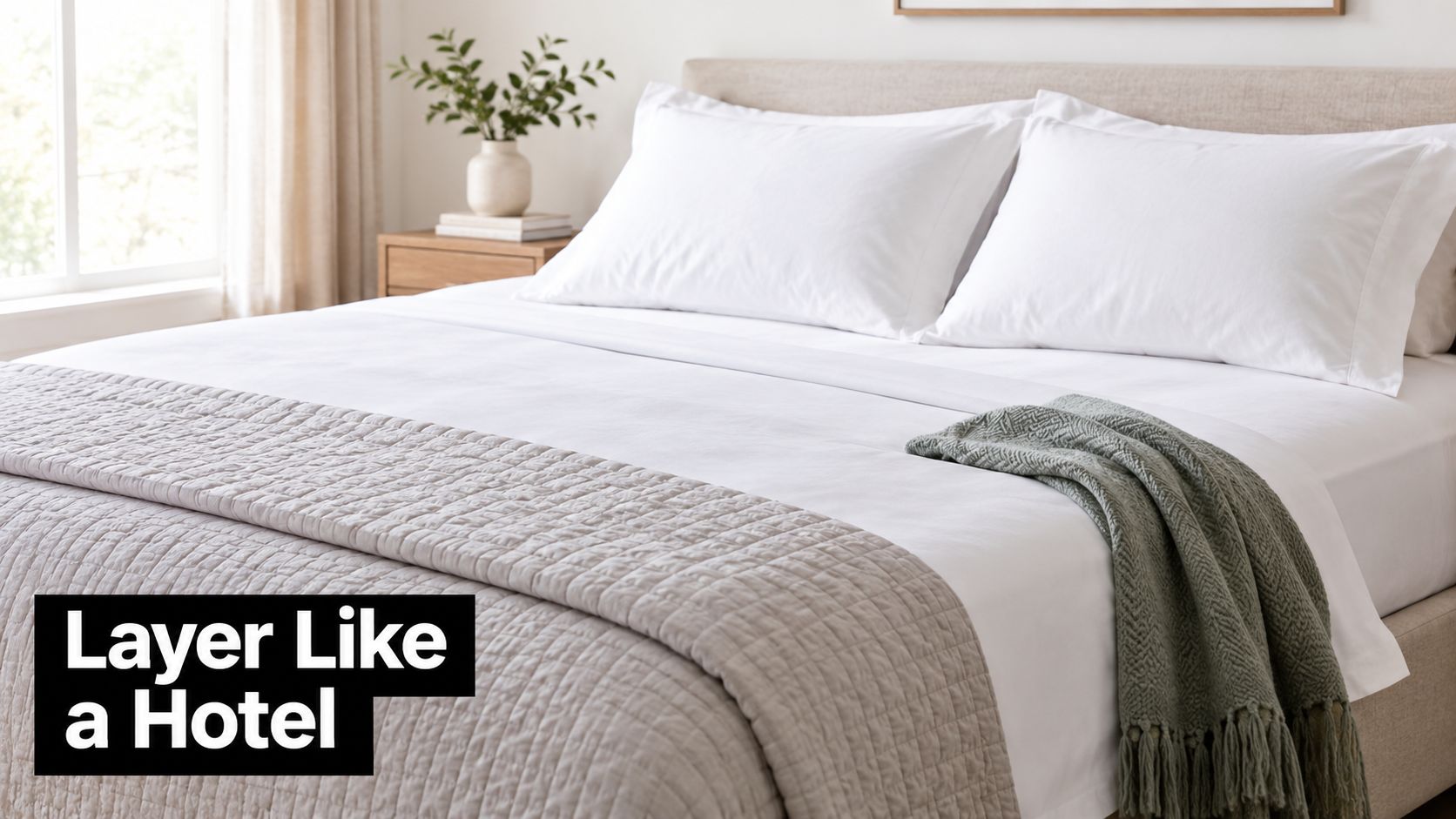
A made bed with clean proportions shows how little excess you need.
Building Layers in the Right Order
Start with the fitted sheet, smooth and fully engaged at the corners. Add the flat sheet with the top hem aligned at the head, tuck it firmly at the foot, and fold the top down so the hem shows. Follow with a quilt for warmer months or a comforter when you want more loft, then finish with sleeping pillows, one or two accent pillows, and a throw folded across the foot. If you want more layering sequences for different seasons and looks, this breakdown of how to layer bedding gives you repeatable formulas to adapt.
Proportion is where Full XL styling succeeds or fails. A comforter cut for a much wider bed drapes to the floor, hides the frame, and makes a small room feel smaller. Sized correctly, the drop should look even on both sides and clear the floor. Timeless neutrals give you a calm base you can refresh with a seasonal throw or patterned pillows, which is far cheaper than replacing the whole set. Families styling a child's room around a longer bed may also enjoy this practical guide for magical kids' bedrooms for playful finishing touches that don't fight the bedding.
Watching a bed being layered in real time often clarifies the tuck and fold better than any written description.
Keep the routine repeatable. If making the bed takes ten fussy steps, you won't do it on a weekday morning. A fitted sheet that stays put, a flat layer tucked once at the foot, and a top layer you can shake straight is a system you'll maintain, and it looks intentional every time.
Troubleshooting Common Fit Problems
When bedding misbehaves, the cause is almost always identifiable. Work through the symptom before you replace anything, because several common problems have cheap fixes.
Sheets That Shift, Bunch, or Pop Off
- Corners pop off overnight: The pocket is likely too shallow for your total stack, or the sheet is too short for the platform. Re-measure height including the topper, and check length against your recorded dimension.
- Fabric bunches across the middle: Excess width or excess depth is the usual culprit. Queen bedding on a Full XL mattress does exactly this, and so does a very deep pocket on a thin mattress.
- Sheet creeps toward the head: The flat sheet may lack tuck length at the foot, or the fitted sheet's elastic has weakened. Test corner engagement by tugging each corner after making the bed. A secure corner resists without straining.
- Wrinkles return immediately: Loose fabric from an oversized fit won't smooth out, no matter how carefully you pull it. That's a sizing issue, not an ironing issue.
Shrinkage and the Larger Size Temptation
Bedding that fit on day one and fights you after a few washes has probably shrunk, and length is usually where you feel it first on an extra long platform. Wash new bedding before judging fit, follow care instructions on heat, and be skeptical of products that only publish nominal size names. As noted in the earlier section, post-laundering dimensions are the number that matters.
Diagnostic shortcut: Smooth the fitted sheet by hand. If the surface lies flat but the corners strain, you have a length or depth problem. If the corners sit easily but the surface ripples, you have too much fabric.
Resist the urge to size up to Queen as a universal fix. It can solve length on flat layers, where extra drape is manageable, but on fitted pieces the surplus width shifts under you all night. Fix the specific mismatch instead. If a product is labeled Full XL but your measurements say it shouldn't fit, trust your tape measure and return it. Labels vary, and your recorded numbers don't.
Final Checklist for Buying Extra Long Full Size Bedding
Take this list to the store or keep it beside you while shopping online. If an item fails a line, don't buy it and hope.
Your Pre Purchase Checklist
- Measured actual width, length, and height: You have real numbers from your mattress, not just a size label.
- Added topper and protector thickness: Your depth figure reflects the full stack the sheet must cover.
- Noted the bed base type: You know whether adjustable movement or a platform edge affects how the corners need to grip.
- Verified pocket depth and elastic: The fitted sheet matches your total height and uses construction that will hold through movement.
- Checked post-laundering dimensions: You're buying for the size after washing, and you've confirmed the exchange policy.
- Matched every component: Sheets, protector, quilt, and flat layers all follow the same Full XL dimensions, with no standard Full or Queen substitutions in fitted pieces.
- Confirmed safety documentation where it matters: For skin-contact bedding, certification should cover the complete finished article, including elastics, threads, and finishes, not just a roll of base fabric. Check that any certificate matches the exact finished product you're buying.
Measure first, then buy once. Prioritize verified fit over a familiar brand name or an appealing photo, because a beautifully made sheet in the wrong length will frustrate you every single night. Quality materials and honest dimensions hold up wash after wash, and that's what turns extra long full size bedding from a hard-to-find specialty purchase into a bed you stop thinking about, because it works.
When you're ready to shop with your measurements in hand, SouthShore Fine Linens offers extra-deep pocket sheet sets, oversized quilts, and layered bedding designed for modern mattresses, toppers, and adjustable bases. Browse the collections, match the pocket depth and dimensions to your checklist, and choose the set that will still fit beautifully after washing.


