
Top Quilts for Beds: A Practical Guide to Choosing Well
You buy a quilt, wash it once, make the bed, and immediately regret it. The corners ride up, the foot of the bed shows, and if you share the bed, somebody ends up tugging for more coverage by midnight.
That problem usually gets blamed on the quilt. Most of the time, the problem is the buying criteria. People shop by color, pattern, and sale price first, then act surprised when the quilt sleeps too hot or hangs too short.
If you want one of the top quilts for beds, ignore the marketing fluff. Focus on two things first: GSM and fit. Warmth weight tells you how the quilt will sleep. Oversized proportions tell you whether it will cover a modern mattress with any dignity.
A quilt is worth buying because it solves a real need, not just a styling one. Quilts sit inside a huge and growing category. One market report valued the global quilt market at USD 5.32 billion in 2024 and projected nearly USD 9.26 billion by 2034, with a 5.70% CAGR from 2025 to 2034, according to Expert Market Research's quilt market report. That scale makes sense. Quilts work as a main cover, a layer, a guest-room staple, and a visible design piece all at once.
The Quilt That Barely Covers the Foot of the Bed
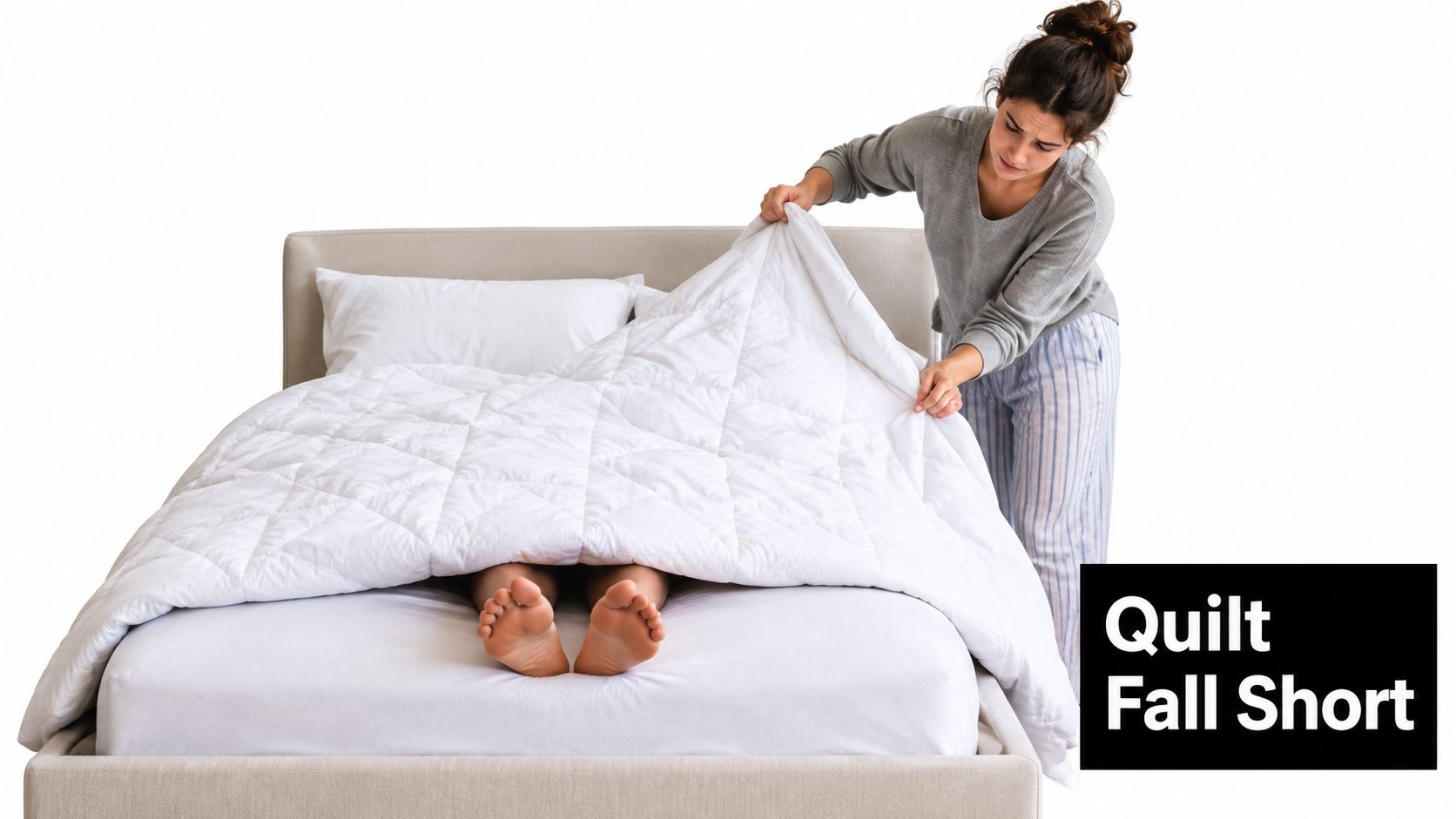
You know the exact moment. You spread the quilt across the bed, pull it up neatly, smooth the sides, and then notice the foot is exposed again. If you bring it lower to cover your toes, the top edge drops and the whole bed looks unfinished.
That's not bad luck. It's a sizing mismatch, and it happens constantly on deep mattresses, pillow-tops, and hybrid beds that sit taller than the old standard.
Why most quilt shopping goes wrong
Most shoppers make two mistakes.
- They buy for appearance first. The stitching looks nice, the color works, and the label says all-season. None of that tells you whether it will feel right at night.
- They trust nominal bed size. “King” or “queen” sounds precise. It isn't. Quilt dimensions vary, and mattress depth eats usable overhang fast.
- They ignore how they sleep. A hot sleeper in a mild room needs a different quilt than a cold sleeper in a drafty bedroom.
Practical rule: If your quilt barely covers the mattress when the bed is empty, it will feel worse once two people are under it.
The two decisions that matter
For me, quilt buying starts with a blunt checklist:
- How warm does the room sleep?
- How warm do you sleep personally?
- How tall is your mattress with topper included?
- Do you want the quilt to be the main cover or a visible layer?
Quilts have been doing practical work for centuries. Britannica notes quilting became known in Europe during the Crusades, when people learned that Turks wore layers of quilted fabric under armor, and that insulation value moved into bedcovers and clothing in northern Europe, as described in Britannica's history of quilting. This isn't a trendy bedding gimmick. It's a long-standing solution for warmth, layering, and durability.
If your current quilt falls short at the foot, sleeps clammy, or looks skimpy on the sides, you don't need more options. You need better filters.
What Makes a Quilt a Quilt
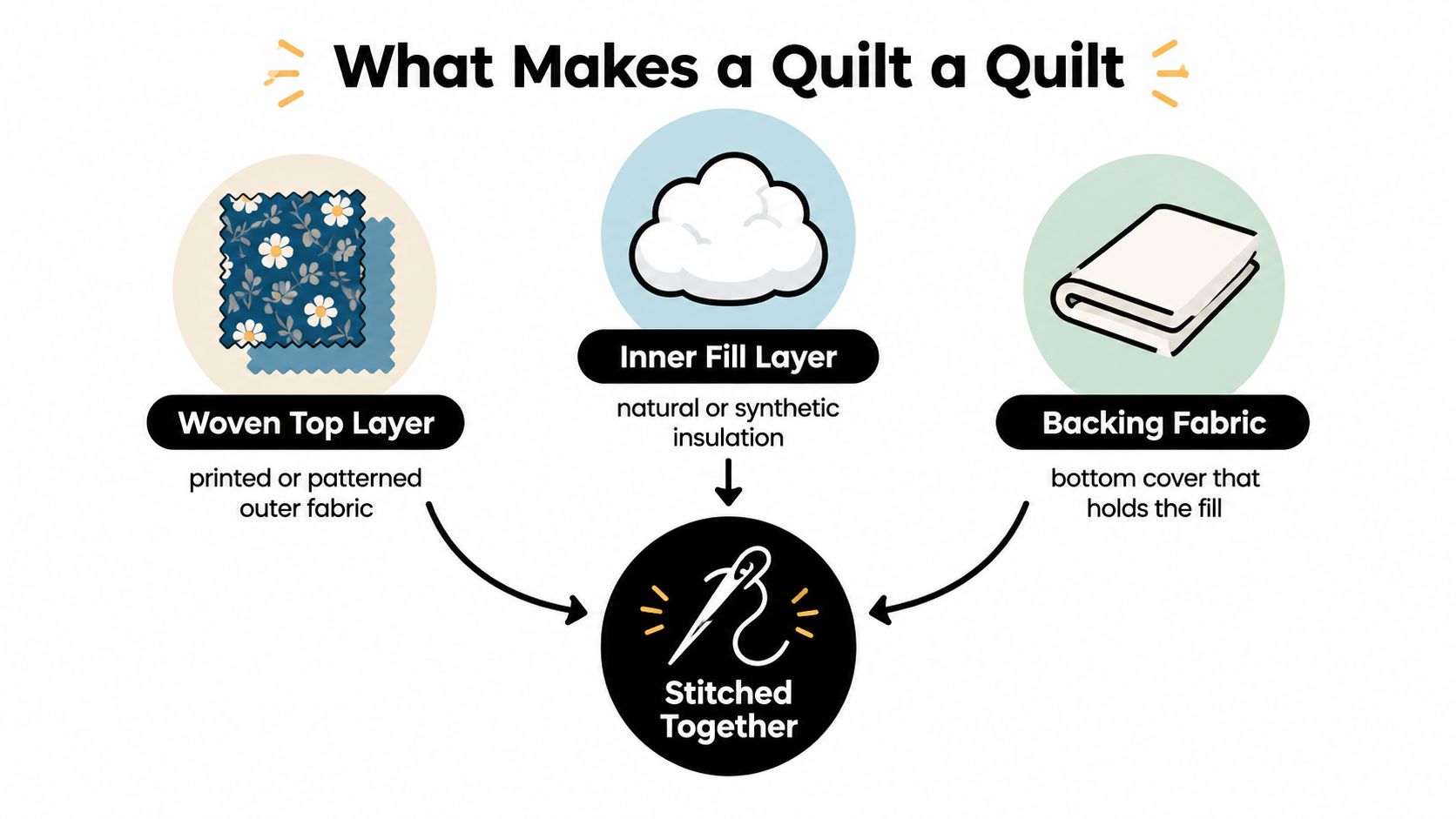
A quilt is simple in construction and easy to misunderstand in practice. It has three parts stitched together: a top fabric, an inner fill, and a backing fabric. The stitching matters because it keeps the fill from shifting and changes how flat or lofty the quilt feels.
The three layers that actually matter
-
Top fabric
This is the visible face. It can be smooth, textured, printed, or pieced. It affects hand feel and style more than warmth. -
Inner fill
This is the insulation layer. Cotton, wool, polyester, and down-alternative all behave differently even when the quilt looks similar on the shelf. -
Backing fabric
This sits underneath and touches the bed. A soft backing can make a lightweight quilt feel more comfortable even when the fill is modest.
GSM is your fastest shortcut
The most useful spec on a quilt is GSM, or grams per square metre. It measures filling density. Bedding guides commonly map about 150 to 250 GSM to cool or summer use, 300 to 450 GSM to warm or all-season use, and 500+ GSM to winter performance, according to Sienna Living's GSM guide for quilts.
That one spec gives you a practical starting point. Not the whole story, but the best starting point.
Here's the quick version:
| Quilt spec | What it tells you | Why it matters |
|---|---|---|
| GSM | Fill density | Main clue for warmth and weight |
| Fill type | Fiber behavior | Changes breathability, loft, and care |
| Stitch pattern | How fill is held | Affects drape, shifting, and flatness |
| Shell fabric | Surface feel | Influences airflow and touch |
A quilt with the right GSM but the wrong fill can still sleep wrong. Use GSM first, then use material to fine-tune.
The fill vocabulary worth knowing
Cotton usually feels breathable and straightforward. It's a strong pick for people who want a lighter, less lofty bed.
Wool regulates temperature well and tends to feel warmer for its weight. It's the serious option if comfort matters more than easy-care convenience.
Polyester is often light, cheap, and easy to wash. It's practical, but it can run warm and feel less refined over time.
Down-alternative usually means synthetic fibers designed to mimic loft. It works for people who want a puffier feel without using down.
The oldest surviving milestones in quilt history also remind you this category has always mixed function and craft. QuiltHistory identifies 1708 as the oldest wholly intact surviving quilt and 1726 as the oldest known American-made quilt, while roller printing in England in 1783 sped fabric production and expanded design possibilities, as summarized in the historical record cited through Britannica's quilting overview. Modern quilts may look softer and cleaner, but the job hasn't changed much. Keep you covered. Keep you comfortable.
Matching GSM to Your Climate and Sleep Style
If you only use one buying filter, use GSM. It's the fastest way to avoid a quilt that feels wrong the first night. Start with warmth needs, not color.
A lot of “all-season” labels are meaningless. A hot sleeper in a mild bedroom and a cold sleeper in a drafty room should not be buying the same weight.
GSM ranges by season and sleeper type
| GSM Range | Best For Season | Bedroom Temp | Sleeper Type |
|---|---|---|---|
| 150 to 200 GSM | Summer or warm-weather use | Warm rooms | Hot sleepers, layered beds, guest rooms in mild climates |
| 200 to 300 GSM | Light shoulder-season use | Mild rooms | Neutral sleepers who dislike heavy bedding |
| 300 to 400 GSM | Broad all-season use | Cool to moderate rooms | Most sleepers who want one quilt to do everything |
| 400+ GSM | Cold-season use | Cold rooms | Cold sleepers, older homes, anyone who hates waking up chilly |
The practical benchmark is 300 to 400 GSM. That range gives you enough warmth to use the quilt as a main cover without turning the bed into a furnace. For hot climates or layered styling, 150 to 200 GSM is the smarter pick.
Place yourself honestly
Ask the annoying but necessary questions.
- Do you kick covers off at night? Stay light.
- Do your feet run cold even in spring? Start warmer.
- Do you keep a duvet nearby anyway? Your quilt should probably be lighter and function as a layer.
- Do you share with someone who sleeps hotter or colder than you? Bias toward the cooler option and add layers selectively.
Most trend coverage talks about how quilts look on a bed. The better question is how they function when you're sleeping under them. Recent design coverage notes that quilts are back in a visible way and often used either as the main cover in warm weather or as an extra layer in colder rooms, as discussed in Country Living's 2026 bedroom trends piece.
For readers shopping lighter options, this guide to lightweight summer quilts is useful if your main problem is overheating.
Why GSM isn't the whole answer
Two quilts can share the same GSM and still feel different. Fill changes the result.
Wool tends to feel warmer at the same fill weight. Cotton usually feels cooler and flatter. Synthetic fills can feel lofty without breathing as well.
That's why I treat GSM as the first cut, not the final pick. Use it to land in the right zone. Then choose the material that suits your sleep style.
Comparing Cotton, Wool, Polyester, and Down-Alternative Fills
If GSM tells you the category, fill type tells you the personality. Quilts stop being interchangeable.
I judge fills on four things: warmth-to-weight, breathability, care burden, and how well they hold up after repeated washing and use.
Quilt fill comparison
| Fill Type | Warmth-to-Weight | Breathability | Care | Avg. Lifespan | Best For |
|---|---|---|---|---|---|
| Cotton | Moderate | High | Usually straightforward | Not specified in verified data | Hot sleepers, everyday use, flatter bed styling |
| Wool | High | High | More demanding | Roughly 8 to 12 years according to Peplos Linen's quilt warmth guide | Cold sleepers, all-season regulation, long-term use |
| Polyester | Moderate for lower weight | Lower than cotton or wool | Easy | Not specified in verified data | Budget buying, guest rooms, easy wash and dry |
| Down-alternative | Moderate to high loft feel | Moderate | Usually machine-friendly | Roughly 5 to 8 years according to Peplos Linen's quilt warmth guide | Allergy-conscious shoppers who want loft |
My blunt take on each fill
Cotton is the easiest recommendation for warm sleepers. It doesn't trap heat the way many synthetic fills do, and it gives the bed that flatter, cleaner look a lot of people want. If you like crisp sheets, open windows, and a cooler sleep surface, cotton is hard to beat.
Wool is the grown-up choice. It costs more and asks more from your care routine, but it's the strongest performer if you want real temperature regulation. Guides also note wool can hit winter performance at roughly 300 to 450 GSM, while cotton is typically cooler at 200 to 300 GSM, based on Peplos Linen's warmth-by-material breakdown.
Polyester is fine when the brief is simple. Need something washable, low-stress, and not precious? Polyester works. I don't pick it for refined comfort, but I do pick it for utility.
Down-alternative sits in the middle. It gives loft without using down and usually keeps care easier than wool. The trade-off is shape retention over time, especially in middle-weight builds.
Best fill by priority
-
For hot sleepers
Cotton wins. -
For cold sleepers
Wool gets the nod first. Down-alternative comes second if you want loft and easier washing. -
For allergy-prone buyers
Down-alternative is the practical call. -
For low-maintenance households
Polyester or down-alternative make the least fuss.
One useful product category here is oversized lightweight quilt sets. For example, SouthShore Fine Linens' oversized quilt options are positioned as lightweight quilts that can work on their own or as a layer, which is the right format for shoppers who care as much about drape as warmth.
Sizing Quilts for Deep Mattresses and Oversized Beds
Fit gets ignored because most bedding copy still assumes a fairly standard mattress profile. Real beds aren't standard anymore. Add a pillow-top, a foam topper, or an adjustable base, and a normal quilt starts looking undersized fast.
A design article from 2026 puts the issue plainly: many quilts won't reach the foot of the bed, which is exactly the frustration shoppers keep running into on larger modern beds, as noted in Domino's 2026 bedroom trends coverage.
Measure these three things
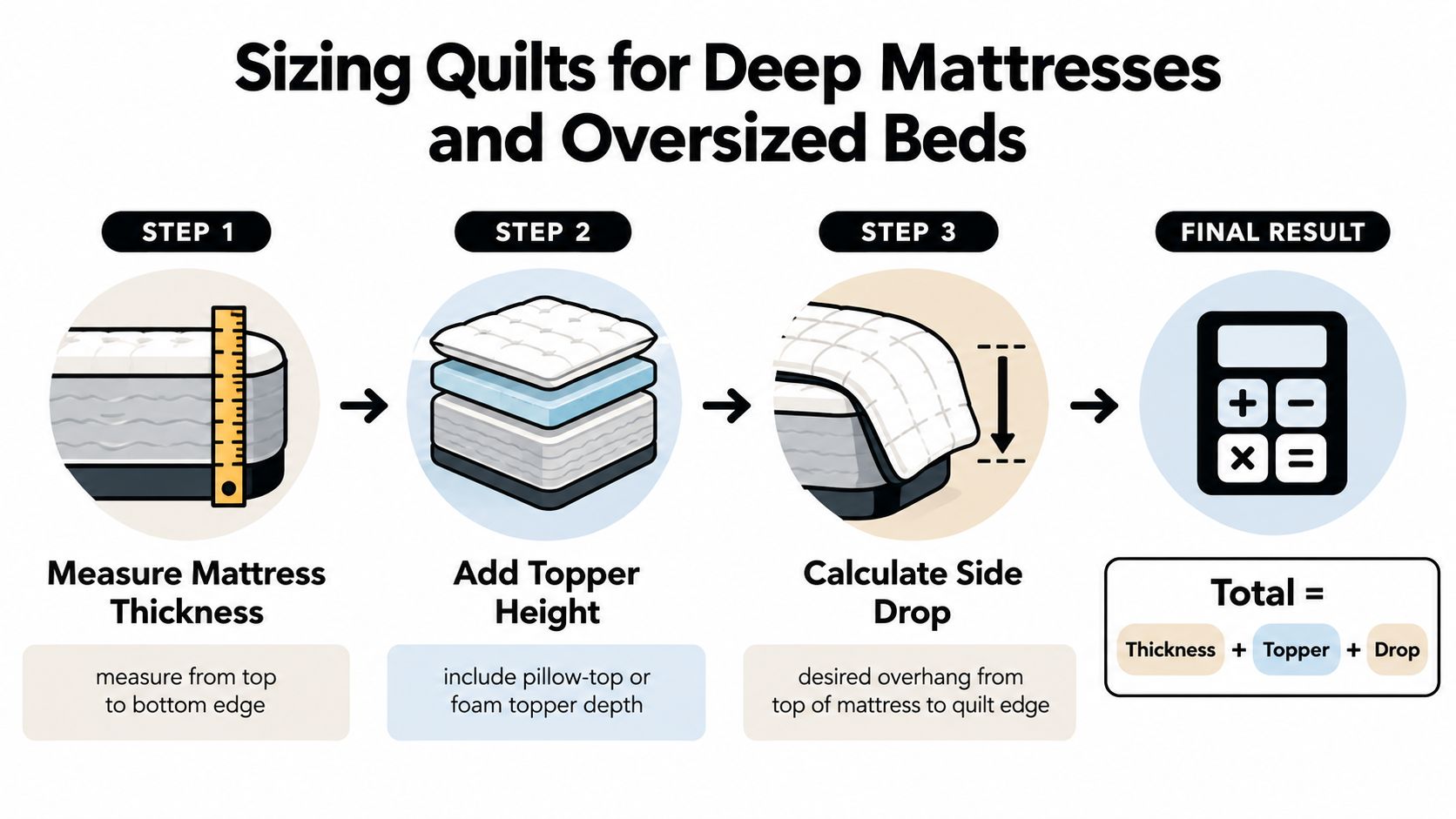
You need three numbers before buying:
- Mattress thickness
- Topper or pillow-top height
- Desired side drop
That third number is where style and function meet. If you want a skimpy modern look, you can live with less drop. If you want real coverage, especially on a shared bed, buy for a fuller overhang.
The sizing method I actually use
Take the mattress thickness. Add any topper height. Then decide how much visible drop you want from the top edge down the side.
That gives you the minimum overhang requirement per side. If your current quilt already feels too short, don't replace it with the same nominal size. Size up if the dimensions allow it.
On deep mattresses, “oversized” isn't indulgent. It's often the first size that fits the bed the way shoppers expect a standard size to fit.
This guide to an oversized quilt for a king bed is worth reading if your current king quilt looks narrow or rides up when two people move around.
Practical fit advice that saves regret
-
Account for post-wash change
Natural fibers can change after the first wash. If a quilt already looks borderline in the package, it's the wrong choice. -
Shared beds need extra width
If one partner rolls and tugs, buy width first. Foot coverage matters, but side theft is what wakes people up. -
Layered styling needs length
If the quilt will sit visibly over other bedding, a short drop looks accidental, not relaxed.
For top quilts for beds, fit is not a minor aesthetic issue. It's part of performance.
Which Quilt Actually Fits Your Situation
General advice is where most bedding guides fall apart. You don't need ten maybe-options. You need one smart default for your situation.
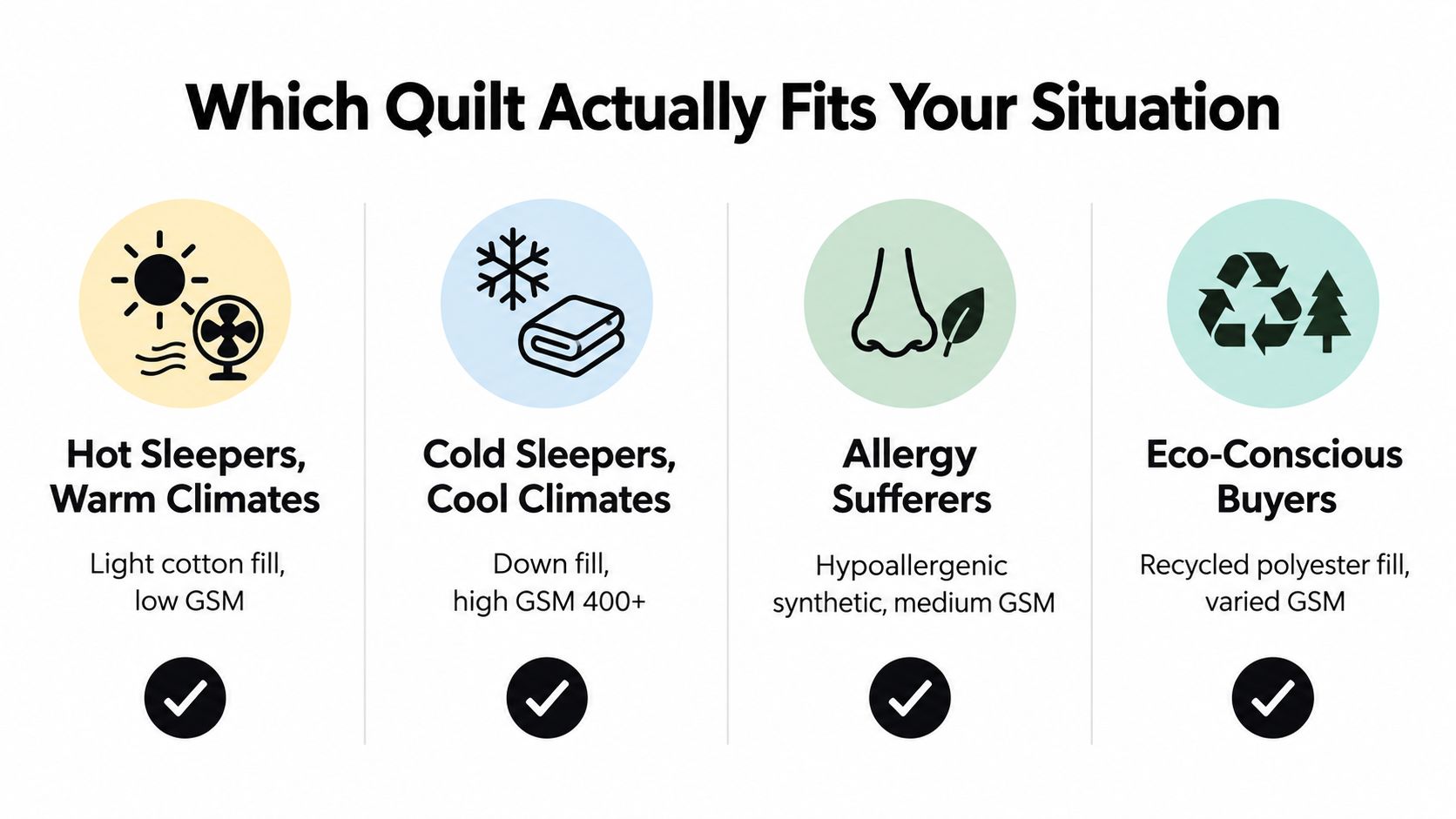
If you sleep hot and the room stays warm
Pick a lightweight cotton quilt in the 150 to 200 GSM range. That's the cleanest answer.
You want breathability first, not plushness. A flatter quilt with a crisp shell will usually sleep better than a puffy synthetic that claims to be light but traps warmth.
If your bedroom runs cold
Go with wool if you want the better long-term answer. If wool care sounds annoying, choose a heavier down-alternative quilt starting around the warm end of the range.
Cold sleepers usually make the mistake of buying a too-thin quilt and compensating with random throws. It's better to start with proper insulation and reduce clutter on the bed.
If it's for a guest room
Use a mid-weight polyester quilt. That's the practical host pick.
Guests vary. Polyester is forgiving, easy to wash, and useful in a room that may sit unused for stretches and then need a quick reset between stays.
If you like layered styling more than heat
Choose a thin cotton quilt and use it as the visible top layer over another bedding piece. This gives texture without making the bed too hot.
That approach also matches where bedroom styling is going. Quilts are being used more visibly on relaxed, textured beds instead of hidden in tightly matched sets.
If allergies are the main issue
Pick a down-alternative quilt with a tightly woven cover. You'll get loft without using down, and care is usually simpler than with natural fills.
The short recommendation list
-
Best for hot sleepers
Lightweight cotton, low GSM -
Best for cold sleepers
Wool first, heavier down-alternative second -
Best for guest beds
Mid-weight polyester -
Best for layered looks
Thin cotton cover-style quilt -
Best for deep mattresses
Any fill you like, but in an oversized cut
Buy the quilt that matches your room, your body temperature, and your mattress depth. That's the right quilt. Everything else is merchandising.
Care and Durability That Protect Your Investment
A good quilt can age well. A neglected one goes flat, bunchy, and tired much sooner than it should. Care isn't glamorous, but it decides whether the quilt still feels good after repeated use.
The habits that matter most
-
Wash by fill, not by habit
Cotton usually handles regular home laundering better than wool. Wool needs more caution. Down-alternative often benefits from gentler cycles to protect loft. -
Dry gently and fully
Damp fill is a fast route to odor and clumping. If the quilt has loft, low heat and time matter more than rushing the cycle. -
Rotate the quilt on the bed
If the same side gets compressed constantly, wear shows unevenly. -
Store it in something breathable
Plastic traps problems. Fabric storage is safer for long idle periods.
For extra help with maintenance, this step-by-step guide on how to wash and store quilts covers the basics well.
When a quilt is done
A quilt is ready to replace when the fill stays clumped, edges wear thin, or odor lingers after proper washing. At that point, cleaning won't restore performance.
The lifespan differences between fills matter here. Wool tends to last the longest, with guides estimating roughly 8 to 12 years, while down-alternative is often estimated around 5 to 8 years and recycled fibers around 5 to 7 years, according to Peplos Linen's quilt durability notes. Those aren't promises. They're reminders that material choice affects long-term value.
The single highest-impact habit is simple: use a washable top layer or cover so you don't have to launder the quilt itself as often.
A Simple Framework for Picking the Right Quilt
If you want the fast version, use this and move on.
Step one: size for the actual bed
Measure mattress depth, add topper height, then choose a quilt with enough extra width and length to create a real drop. If your current quilt barely reaches, stop buying the same size label.
Step two: pick the right warmth band
Use 150 to 250 GSM for hot rooms or summer use, 300 to 450 GSM for broad all-season warmth, and 500+ GSM for winter-level insulation, based on the GSM ranges mapped in Sienna Living's quilt GSM guide.
Step three: choose fill by priority
Cotton for airflow. Wool for regulation and longevity. Polyester for ease and utility. Down-alternative for loft without down.
Step four: be honest about care
If you won't follow the care needs, don't buy the quilt. The wrong maintenance fit ruins a good product fast.
Here's the default advice I'd give most shoppers:
-
Hot sleeper, warm climate
Lightweight cotton quilt -
Cold sleeper, cool room
Wool quilt, or heavier down-alternative if you want easier care -
Guest bed
Mid-weight polyester -
Deep mattress
Oversized dimensions before anything else
That's the buying framework for top quilts for beds. Warmth, fill, fit, and care. In that order.
If you want bedding that solves the fit problem instead of pretending it doesn't exist, SouthShore Fine Linens offers quilt collections built for real beds, including oversized options and lightweight layering styles. If your current quilt runs short, sleeps wrong, or looks lost on a deep mattress, it's worth browsing with those four filters in mind before you buy again.


