
The Complete Summer Cotton Quilt Guide for Cool, Easy Sleep
At 2 a.m., you kick the comforter toward the foot of the bed, open a window, and still feel too warm. The problem may not be that you need less bedding. You may need a layer designed for the actual conditions in your bedroom, rather than a product that just carries a “summer” label.
A summer cotton quilt can be an excellent lightweight top layer, but it isn't automatically cool for every sleeper or climate. The shell, batting, quilting pattern, moisture in the room, mattress depth, and your own heat preferences all affect how it feels. This guide will help you read those details and choose a quilt with confidence.
What a Summer Cotton Quilt Really Is
A hot sleeper usually discovers the difference between bedding categories in the middle of the night. A thick comforter may look beautiful at bedtime, but by morning it's folded over a chair, while the sleeper keeps only a sheet. A well-built summer cotton quilt offers another option, a light layer that provides coverage without the loft of a cold-weather duvet.
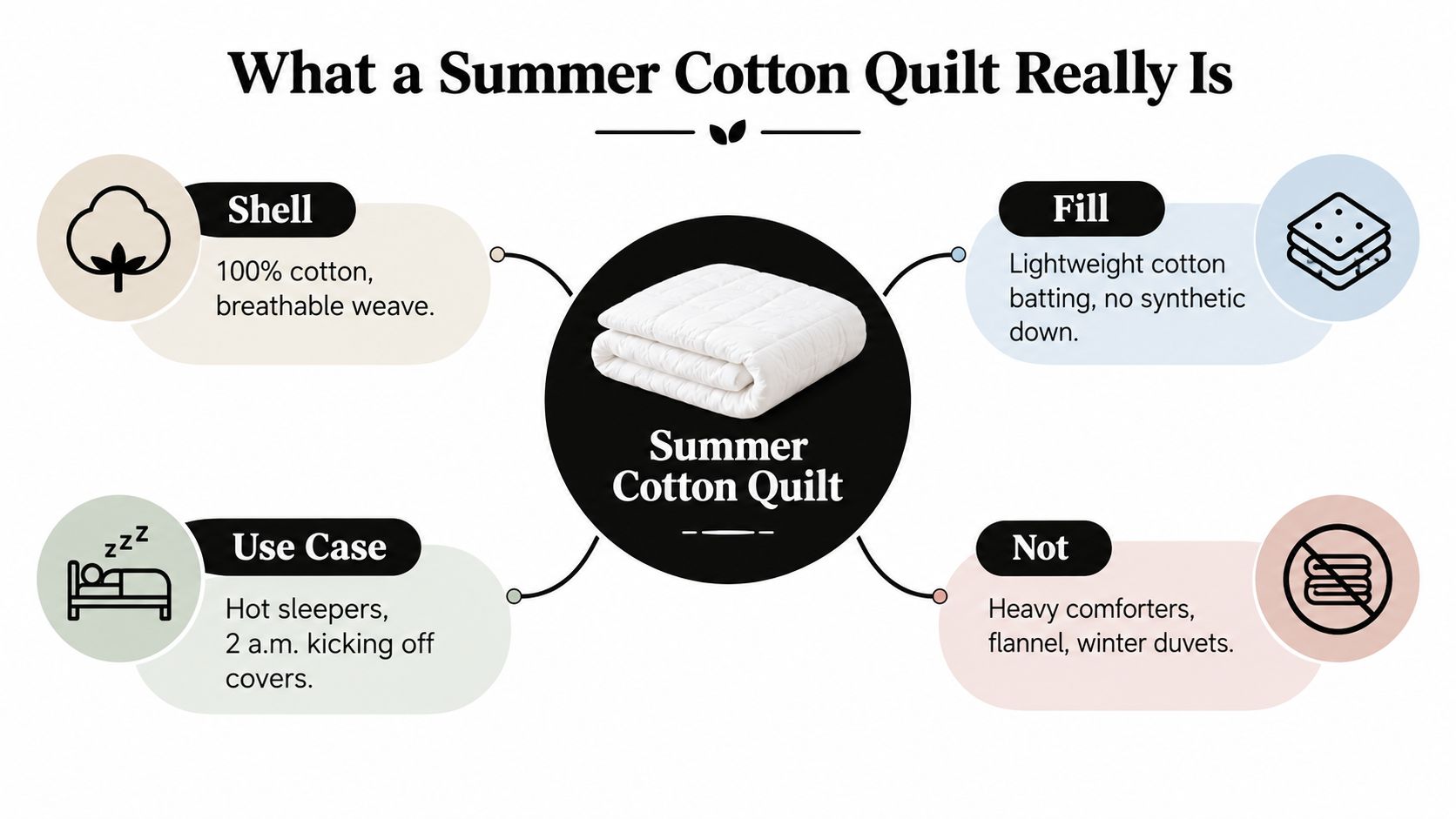
The phrase summer cotton quilt describes a bedding category, not a regulated performance standard. A traditional quilt has a top layer, a middle layer of batting or fill, and a backing, secured with stitching. For warm-weather use, the construction generally uses a breathable cotton shell, a relatively light fill, and a flatter profile than a winter comforter. Some products use cotton batting, while others combine a cotton shell with a different fill, so the product specification matters more than the name on the package.
Cotton also manages moisture in a particular way. Under standard atmospheric conditions, it typically has a moisture regain of approximately 7–11%, meaning it absorbs substantial water vapor from skin and room air before it feels damp, as described in this textile modelling study.
What qualifies and what doesn't
A quilt may deserve the summer label when its materials and construction support a lighter sleep layer. Look for:
- A breathable shell: Cotton fabric with an airy hand and a weave suited to warm conditions.
- Moderate or low fill: Enough batting to create quilted structure, but not so much that the piece behaves like a winter duvet.
- Secure quilting: Stitching that keeps the fill evenly distributed without creating thick, densely packed areas.
- Clear specifications: A stated fabric composition, fill composition, dimensions, and care method.
A coverlet can look similar but may have little or no insulating fill. An all-season quilt may also be marketed for summer only because it has a seasonal color or floral pattern. For a practical comparison of lightweight constructions, see this guide to lightweight summer quilts.
Plain definition: A summer cotton quilt is a quilted, relatively lightweight bed layer whose shell, fill, and stitching are suited to warm-weather sleep. The pattern doesn't make it a summer quilt. The build does.
Why Cotton Became the Standard Summer Quilt Fiber
Cotton became a familiar bedding fiber because it connects farm production, textile manufacturing, and everyday care. The U.S. Department of Agriculture explains that cotton averages about 25% of total worldwide fiber use, and global cotton output reached a record 25.7 million metric tons in the 2021–22 marketing year. That scale supports broad fabric availability and established expertise in spinning, weaving, dyeing, sewing, and finishing cotton household textiles.
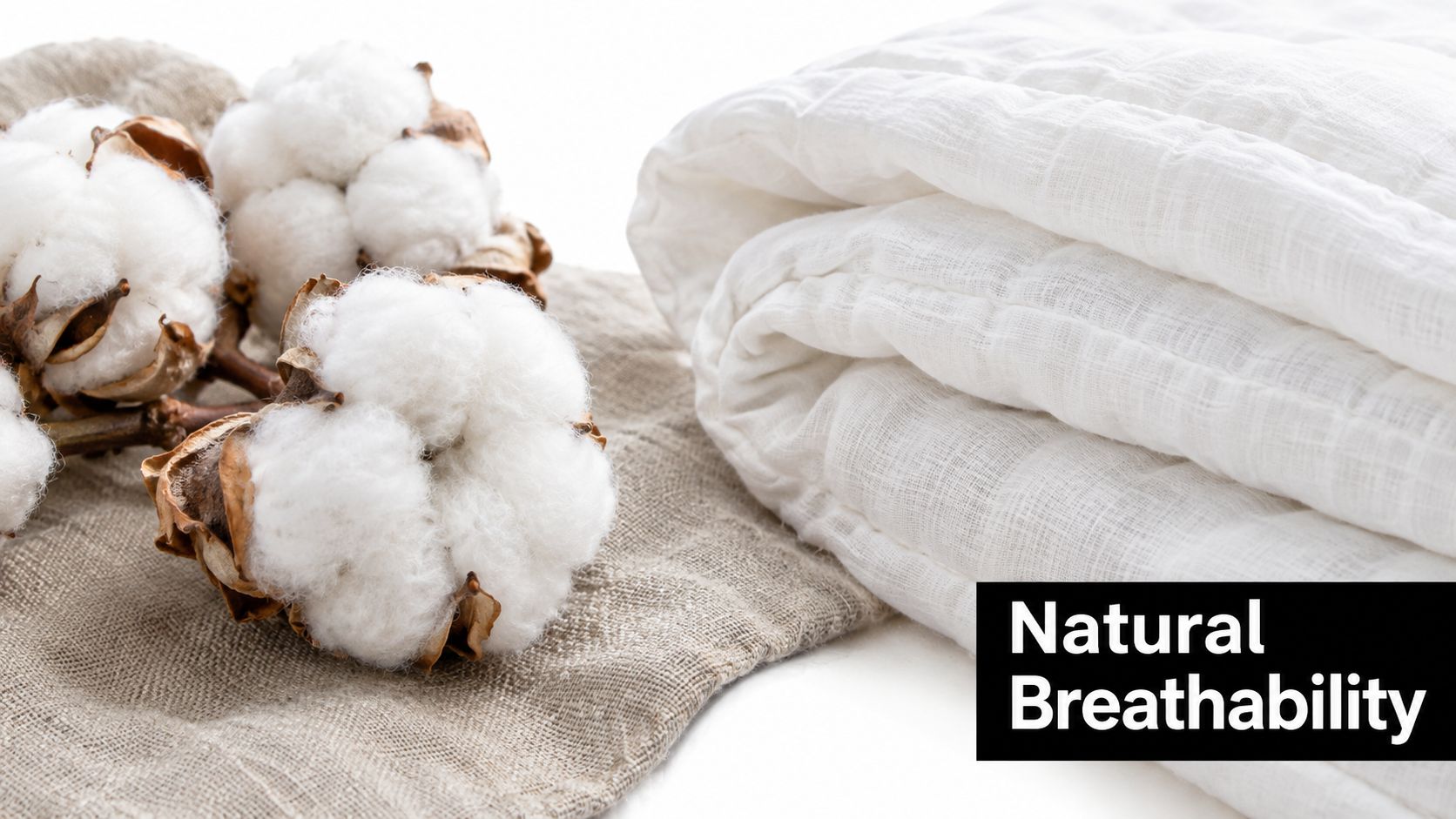
The fiber's behavior matters more at the bedside than its agricultural scale. Cotton absorbs water vapor from skin and surrounding air, which can help a dry sleeper avoid an immediately clammy feel. But absorption isn't the same as rapid drying. In a humid room, a cotton quilt can retain moisture, especially when the fill is dense or the bedding is folded before it has dried completely.
That moisture changes heat transfer. Water conducts heat roughly 25 times more efficiently than air, according to the textile research cited above. A damp quilt can therefore feel less insulating than the same quilt when dry, while also feeling heavier and less fresh. This is why “breathable cotton” isn't a complete buying decision. You also need an appropriate fill weight, air movement, and a drying routine.
From fiber to summer construction
A warm-weather quilt usually works best when the parts support one another:
- Shell weave: A breathable cotton shell can allow air movement and feel less dense against the skin.
- Fill profile: Low or moderate loft keeps the quilt flatter and reduces the amount of heat-retaining material over the body.
- Quilting layout: Evenly spaced stitching prevents batting from migrating and helps avoid bulky zones.
- Finish and sourcing: Certifications such as OEKO-TEX® can help shoppers evaluate chemical safety claims, while responsible sourcing questions address how materials enter the supply chain.
Cotton's soft, familiar feel is useful, but it shouldn't be confused with a guarantee of coolness. A cotton quilt is an engineered thermal layer. If you're also adjusting the fabric against your face, compare the construction and care requirements in this guide to the best pillowcase for hot sleepers.
Summer Cotton Quilt vs Comforter vs Duvet
The easiest way to identify a summer cotton quilt is to compare its construction with the pieces beside it in a bedding aisle. A quilt normally has three joined layers, while a comforter is a lofted filled article and a duvet is a two-piece system consisting of an insert and a removable cover.
A quilt's stitched layers create a flatter, more stable surface. That makes it useful for a sleeper who wants a single washable top layer and doesn't need much loft. A comforter generally offers more puff and visual volume, which can mean more warmth depending on its fill and shell. A duvet gives you the most flexibility because you can change the cover and, in some systems, swap the insert as seasons change.
| Feature | Summer Cotton Quilt | Comforter | Duvet + Cover |
|---|---|---|---|
| Construction | Joined top, fill, and backing | Filled, usually lofted shell | Separate insert and cover |
| Warmth | Usually light to moderate, depending on fill | Ranges from light to heavy | Depends on insert and cover |
| Washability | The complete piece may be washed according to its label | The full comforter may require careful handling | The cover is usually easier to wash than the insert |
| Structure | Flat, stitched, and drapable | Lofted and puffy | Adjustable and changeable |
| Useful for | Hot sleepers and warm rooms | Sleepers who prefer volume | Households that change layers seasonally |
A quilt versus comforter comparison can help if the two terms appear interchangeably on a product page. Check whether the piece includes a separate cover, whether the fill is held in stitched channels or compartments, and whether the listed dimensions describe the insert or the finished bed layer.
Don't confuse the accessories
A coverlet is often a lighter decorative bed covering and may contain little fill. A bedspread is primarily defined by its intended coverage and drape, often extending farther down the bed. A sham is a decorative pillow covering, not a sleeping layer. A summer cotton quilt can serve as a functional top layer, a folded accent at the foot of the bed, or both, but those terms describe different roles.
Reading GSM, Fill Weight, and Shell Construction
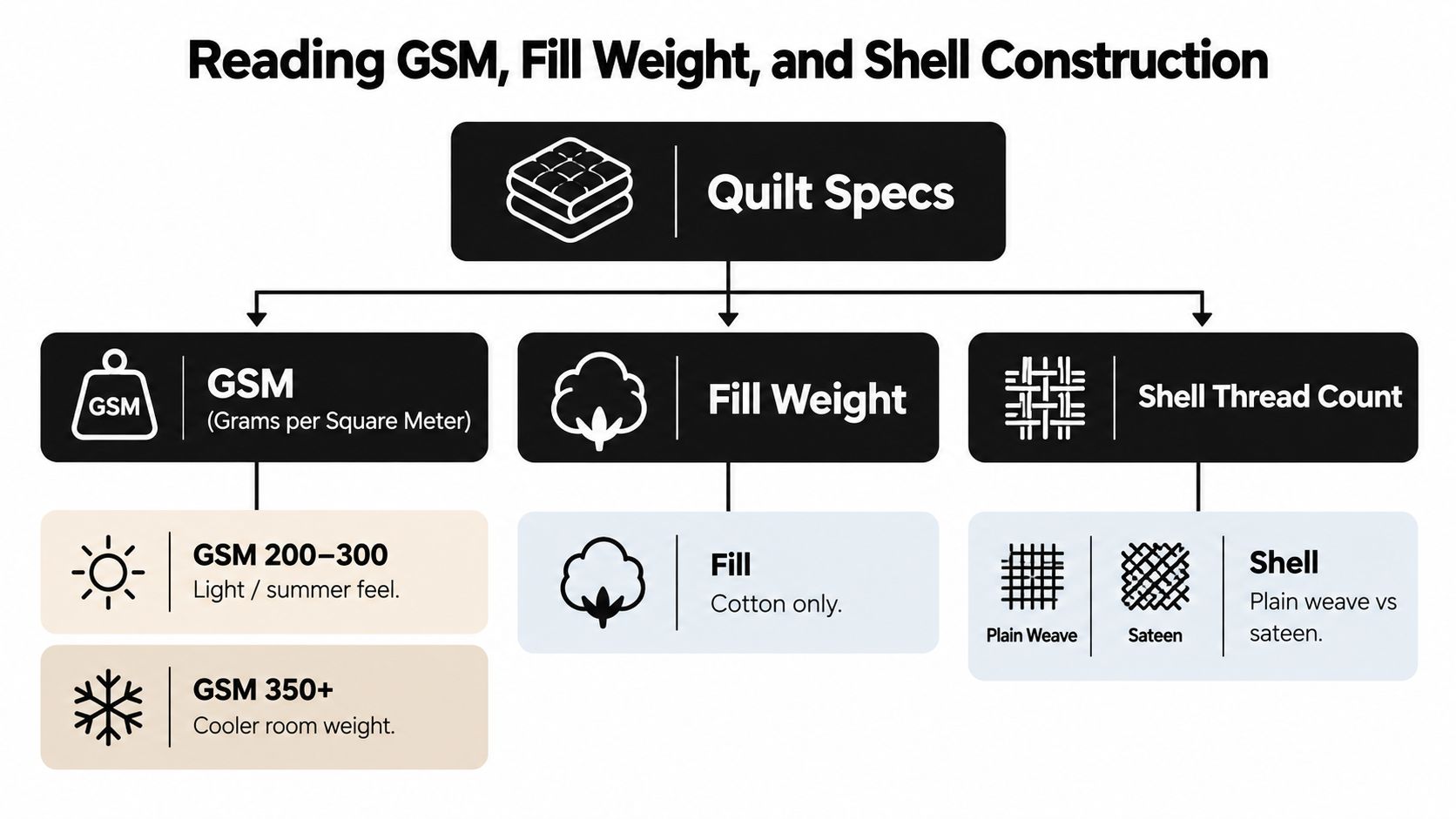
Product pages often list several measurements that look technical but answer simple questions. GSM means grams per square meter, a measure of material weight across a standard area. It isn't a complete warmth rating, because shell fabric, fill type, loft, quilting density, and room conditions also affect performance.
As a broad shopping guide, a 200–300 GSM cotton quilt is generally positioned as a lighter summer option, while a 350+ GSM version is more suited to a cooler room or a sleeper who wants additional coverage. These ranges should guide comparison, not replace the full specification. Two quilts with the same GSM can feel different if one has a lofty batting and the other has a flat, tightly stitched construction.
Read the spec sheet in order
Start with the fill, not the pattern. A cotton-filled quilt may feel flatter and more natural than a high-loft synthetic design, but the label should state whether the batting is cotton, a blend, or another fiber. Then inspect the shell. Percale usually has a crisp, matte hand, sateen has a smoother and slightly lustrous surface, and voile feels especially light and airy. These weave descriptions indicate hand-feel and construction, not guaranteed temperature performance.
Next, consider the quilting:
- Channel quilting creates long parallel sections and can produce a simple, relaxed drape.
- Diamond quilting distributes stitching diagonally and gives the surface a traditional patterned texture.
- Box quilting divides the fill into contained areas, helping it stay in place but potentially creating a more structured feel.
Finally, check the product page for:
- Shell composition.
- Fill composition.
- GSM or fill weight.
- Finished dimensions.
- Quilting pattern and stitching density.
- Care-label instructions.
- Certification or sourcing information, when supplied.
A specification can tell you whether a quilt is plausibly suited to summer. It can't predict exactly how you'll feel at 2 a.m., so match it to your room and sleeping habits rather than treating one number as a verdict.
Matching Your Quilt to Your Bedroom Conditions
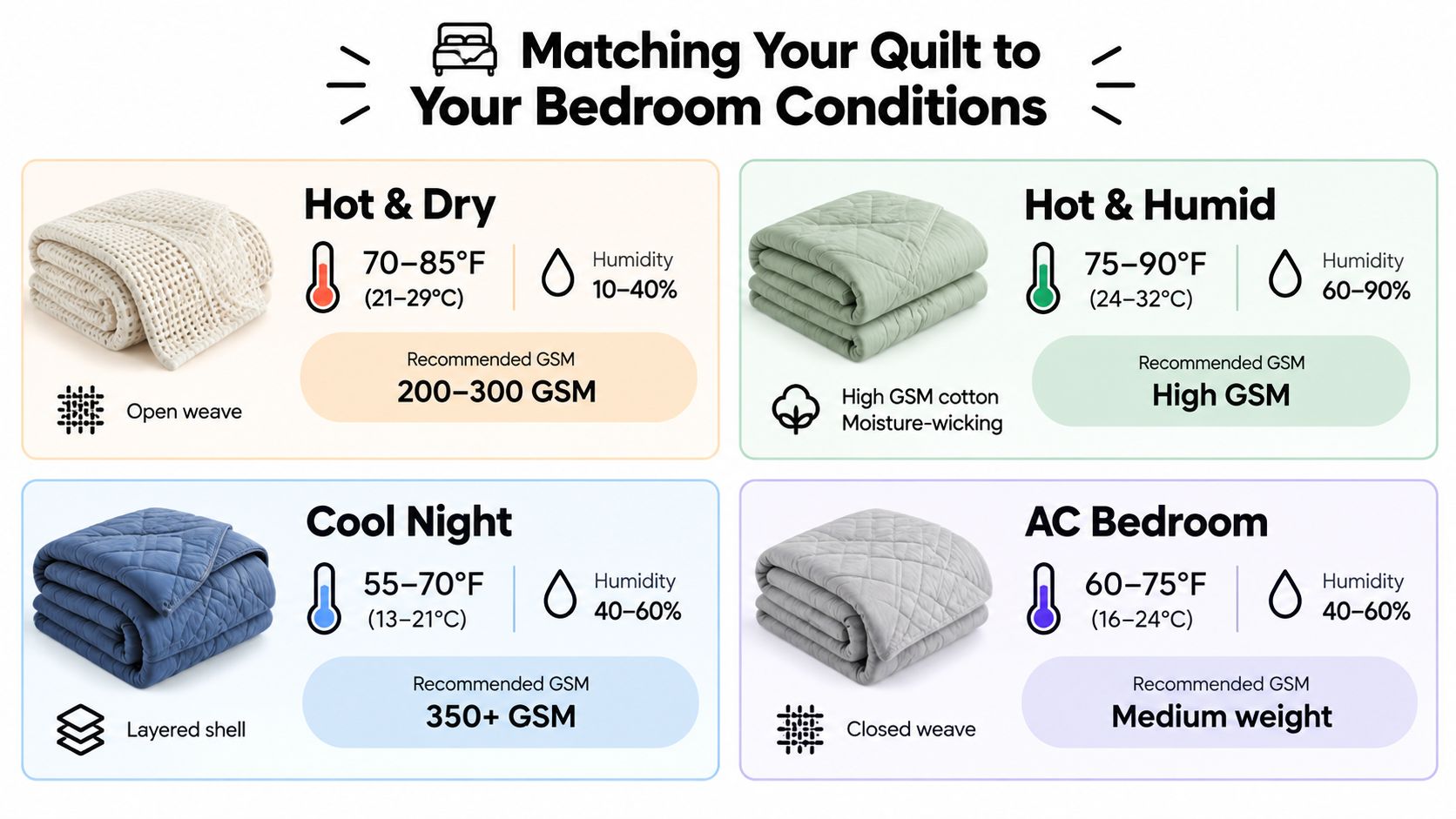
“Summer” should describe the sleep environment, not the calendar. A controlled study of young adults identified approximately 26.1°C and 52% relative humidity as favorable summer conditions, while broader sleep-environment experiments examined temperatures from 23°C to 29°C and humidity from 40% to 80%, as reported in this sleep-environment study.
That range is wide enough to explain why one person praises a quilt as cool while another finds it too warm. A room with active air conditioning behaves differently from an unconditioned bedroom in a humid coastal climate. Your body, mattress, pajamas, sheets, and airflow also participate in the result.
Use the room as your starting point
| Bedroom condition | Starting direction | Layering approach |
|---|---|---|
| Air-conditioned room | Choose a light or moderate quilt based on how cool the room feels overnight | Use it over a sheet, adding a separate blanket only when needed |
| Naturally warm, drier room | Favor a lighter construction and an open-feeling shell | Let the quilt stand alone rather than adding a dense layer |
| Humid room | Prioritize airflow, moderate fill, and complete drying after washing | Avoid storing or folding the quilt while it retains moisture |
| Cool summer nights | Consider a heavier summer construction or a lighter quilt plus blanket | Separate layers make adjustment easier |
A cotton quilt isn't automatically the coolest option for every sleeper. One review of bedding-fiber studies found that goose-down quilts produced longer slow-wave sleep than cotton in one comparison, while other material differences weren't statistically significant. The studies used different temperature and humidity conditions, so the evidence doesn't support a universal winner. It supports a better question, which fill performs acceptably in your room and for your body?
Couples may need different solutions. One partner might use a summer cotton quilt over a flat sheet while the other adds a personal throw or blanket on their side. If your room's temperature is difficult to control, practical cooling services in Mesa can be part of the broader sleep-environment solution, alongside bedding changes.
Bedroom rule: Choose the quilt after you identify the room's overnight temperature, humidity, and airflow. A label can't make those conditions disappear.
Sizing, Layering, and Styling Your Summer Cotton Quilt
A summer cotton quilt should fit the mattress you own, not the mattress size printed on an old sheet set. Measure the mattress width, length, and depth, then decide how much side and foot coverage you want. A low-profile bed can look balanced with a modest drop, while an extra-deep mattress usually needs more finished width to prevent the quilt from appearing undersized.
Check the finished dimensions rather than relying only on “queen” or “king.” Mattress depths vary, and a thick topper or adjustable base changes the visual proportions. Oversized bedding can be useful, but too much fabric may pool on the floor or hide the bed frame.
Build the bed in light layers
For the warmest nights, start with a breathable sheet and use the quilt as the top layer. If you wake cold later, add a separate blanket that can be removed without disturbing the quilt. This works better than buying one heavy piece and trying to regulate temperature by pushing it on and off throughout the night.
During shoulder seasons, fold the quilt across the lower third of the bed or place it at the foot. That preserves its decorative role without forcing the whole surface to carry extra warmth. A neutral sheet gives a patterned quilt room to lead, while a seasonal print can bring color to a simple room without requiring a full bedding change.
Make the proportions intentional
- Pair the scale: Use shams or pillows that relate to the quilt's pattern size.
- Keep the fold clean: A broad, relaxed fold looks more deliberate than a tightly compressed bundle.
- Layer selectively: Combine a quilt, sheet, and one accent throw rather than stacking several bulky covers.
- Check the drop: Make sure both sides hang evenly, especially on an extra-deep mattress.
SouthShore Fine Linens offers oversized quilt collections and 100% cotton sateen quilt sets, including options made with 300-thread-count long-staple, single-ply cotton sateen fabric. Treat those specifications as a starting point, then compare finished dimensions, fill, and care instructions with your own bed.
Caring for a Summer Cotton Quilt So It Lasts
A cotton quilt doesn't wear out only because it gets dirty. Washing chemistry, mechanical action, drying intensity, and storage conditions all influence how the fibers hold up. A Scientific Reports study found that household washing reduced cotton-fiber polymerization by about 15%, while industrial washing reduced it by as much as 80%. Chlorine-based washing produced more than 80% of the relevant decline after only ten chlorine washes.
That evidence doesn't mean you should avoid washing bedding. It means the care routine should respond to actual use. Sweat, allergens, pets, children, humidity, and visible soil all justify cleaning, but a clean guest-room quilt may not need the same treatment as bedding used nightly in a hot climate.
Home laundering
Follow the sewn-in care label first. Use the recommended water temperature and cycle, avoid routine chlorine bleach, and choose a detergent appropriate for the fabric. High dryer heat can place additional stress on cotton, so use a lower setting when the label permits and remove the quilt once it is fully dry.
Don't put a damp quilt directly into a linen closet. Cotton's moisture absorption makes complete drying especially important in humid conditions, because residual moisture can encourage stale odors and unwanted microbial growth.
Commercial and rental use
Short-term rentals and hospitality operations need a more deliberate process. Separate heavily soiled pieces, avoid automatic chlorine treatment unless the product and laundering protocol specifically support it, and inspect seams, binding, and quilting after repeated cycles. A quilt that looks clean can still need retirement when stitching loosens or the fill begins to shift.
Use this linen-closet checklist:
- Wash when soiled: Increase attention when sweat, allergens, pets, or climate require it.
- Choose gentler chemistry: Avoid making chlorine bleach the default.
- Dry completely: Confirm that the center and stitched areas aren't holding moisture.
- Store clean and dry: Fold loosely enough to allow the fabric to remain fresh.
Three habits protect a cotton quilt: wash when soiled, dry thoroughly, and store it clean and dry.
For detailed handling instructions, use this guide to wash and store quilts.
Putting It All Together for Better Summer Sleep
Choosing a summer cotton quilt becomes straightforward when you make three decisions in order.
First, identify the bedroom. Is it air-conditioned, naturally warm, humid, or variable? Second, read the construction. Compare GSM, fill composition, shell weave, and quilting pattern instead of trusting the seasonal name. Third, plan the care routine before you buy. A quilt that fits your climate but can't be dried or laundered appropriately won't remain a comfortable choice.
A common mistake is buying a quilt labeled “summer” without checking its weight. Another is washing it on a rigid schedule even when the bed hasn't become soiled, then exposing it to unnecessarily harsh chemistry or heat. The better approach is responsive. Adjust the bedding to your body and room, wash according to real use, and keep the piece fully dry between seasons.
Humidity deserves attention beyond the quilt itself. Room ventilation, cooling, and moisture control all affect how cotton feels overnight. If you're evaluating whether a humidifier belongs in your sleep routine, this overview of humidifier sleep benefits offers useful context, especially when considering how indoor moisture interacts with personal comfort.
A well-chosen quilt isn't just a decorative finish. It's a flexible layer that helps you stay covered without committing to unnecessary loft, and it can make the bed easier to adjust from one night to the next. The right combination of shell, fill, size, and care turns warm-weather bedding into a practical part of better rest.
SouthShore Fine Linens offers oversized quilt collections and cotton sateen quilt sets designed for layered, refined bedding in real homes. Visit SouthShore Fine Linens to compare quilt dimensions, fabrics, and coordinating essentials for a summer bed that fits your room and your sleep preferences.


