
Oversized California King Bedding Sets That Actually Fit
You've found the perfect California king mattress, added a plush topper, and finally washed the new sheets. Then the fitted sheet starts sliding toward the head of the bed. One corner pops loose when you turn over, the opposite corner goes tight, and the label on the package suddenly feels less useful than the measurements buried in the product description.
That frustration is common with oversized California king bedding sets because fit depends on more than the mattress name. You need to match the bed's length and width, total layered height, fitted-sheet pocket, elastic construction, and duvet dimensions. Once those details line up, the bedding stops fighting the mattress and starts working with it.
Why California King Bedding Has Its Own Size Category
A first-time California king owner orders standard king sheets because the package looks large enough. The fitted sheet covers the mattress top, yet its corners barely reach underneath. Add a mattress protector and a topper, and the elastic loses its hold. Each night, one corner lifts while the opposite side pulls tight.
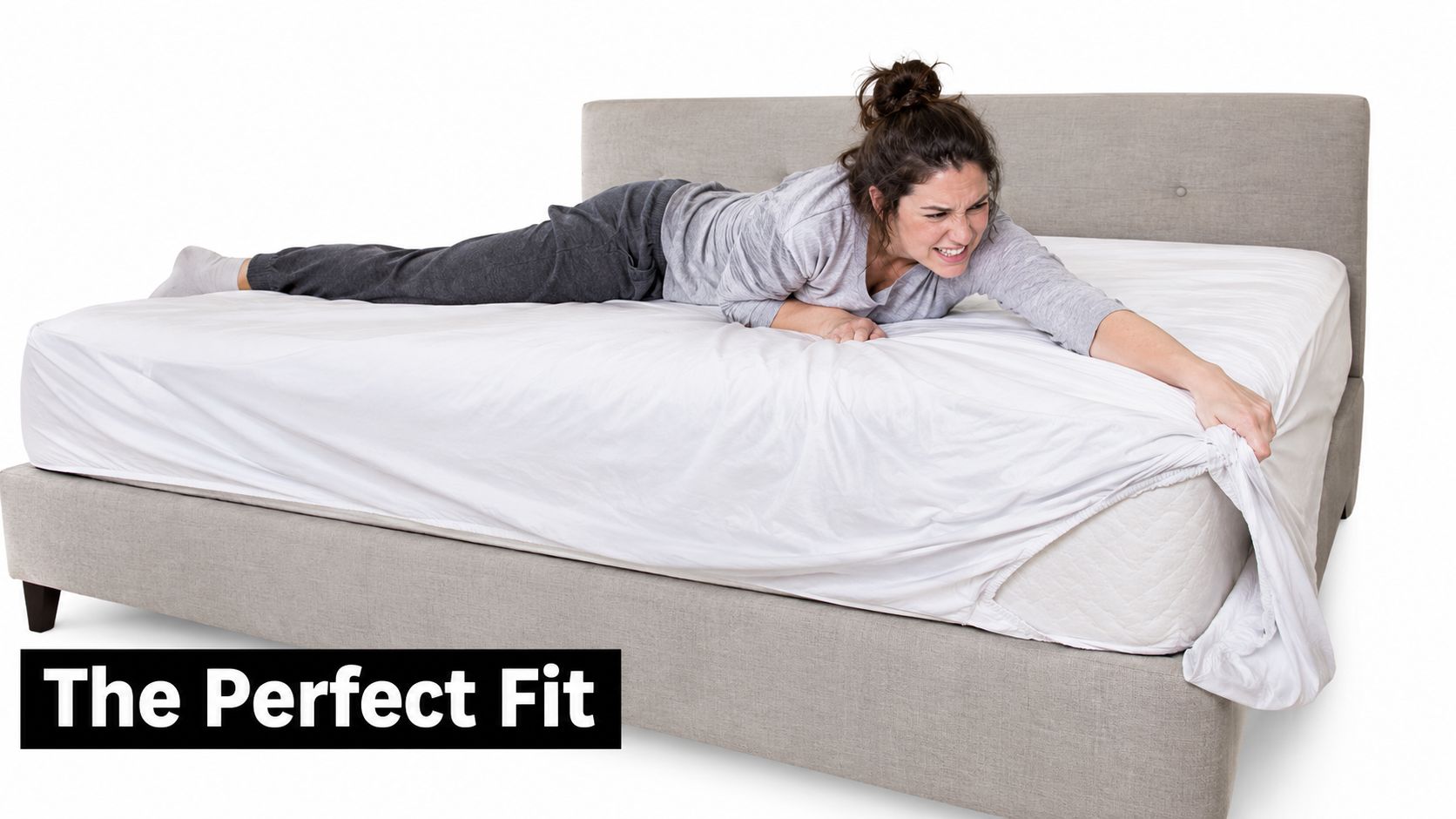
The issue is proportion, not automatically poor sheet quality. Standard king and California king mattresses use different proportions, so the same fitted sheet can distribute tension incorrectly. California king bedding is shaped for a longer, narrower mattress, while standard king bedding favors a wider, shorter one. A pillow top, latex comfort layer, adjustable base, or separate topper adds height and changes how much fabric must tuck beneath the mattress.
Why the category developed
The California king became a distinct U.S. mattress size after World War II. A Los Angeles mattress merchant reportedly introduced a 72-inch-by-84-inch bed for larger homes and taller sleepers. The format later became associated with Hollywood bedrooms before entering mass production. The Los Angeles Times describes the origins and development of the California king. Its history helps explain why it remains a long-and-narrow category rather than a larger version of a standard king.
The difference matters to tall sleepers, couples using thick toppers, and owners of adjustable bases. Renters and hospitality operators can also receive the wrong linens when an order says only “king.”
Practical rule: Treat “king” as a category label, not proof of compatibility.
For an oversized California king bedding set, run one fit test before buying. Add the mattress, protector, and topper heights together. Compare that total with the fitted sheet's pocket depth, then check whether the elastic reaches far enough under all four sides to stay anchored. The top sheet or quilt should also cover the longer foot without borrowing width from a standard king cut.
An oversized Cal king set therefore differs from an oversized standard king set in both footprint and drape. More fabric alone cannot correct the wrong shape. If you are comparing quilts, find your perfect king quilt size by checking finished measurements rather than relying on the word “king.”
California King Dimensions and Why Standard King Falls Short
You discover the problem when the fitted sheet reaches the mattress sides but leaves the foot exposed. The mattress may be labeled “king,” yet the two king categories have different proportions.
A California king measures 72 inches wide by 84 inches long, while a standard king measures 76 inches wide by 80 inches long. The California king is therefore 4 inches narrower and 4 inches longer. The California king dimensions and their relationship to standard king bedding are documented by the Los Angeles Times.
A fitted sheet works like a custom case. It must match the mattress beneath it, including the fabric that folds under the edges. A standard king fitted sheet has more width but less length. On a California king, that extra side fabric can bunch while the shorter corners struggle to reach the foot.
The longer footprint helps taller sleepers, but the narrower width changes how the sheet pulls across the mattress. Add a protector and topper, and the stack becomes higher. The sheet must cover that combined height, reach underneath the mattress, and keep its elastic engaged. If one part of that fit test fails, a sheet can slide toward the center or lift at a corner.
A properly shaped Cal king sheet spreads fabric along the longer sides. An oversized Cal king set also needs a California king footprint, not just more material cut for a standard king. Oversized standard king bedding is wider and shorter, so it can still drape unevenly or leave the foot undercovered.
California King vs Standard King at a Glance
| Dimension | California King | Standard King |
|---|---|---|
| Width | 72 inches | 76 inches |
| Length | 84 inches | 80 inches |
| Main fit priority | Extra length | Extra width |
| Bedding implication | Longer, narrower sheets and covers | Wider, shorter sheets and covers |
The top layers show the difference too. A duvet or comforter that is too short may leave the foot lightly covered. One made for a wider standard king can hang with excess fabric at the sides. Pillow shams and cases may also look mismatched when a set combines both categories.
Base dimensions identify the category. Your full mattress stack, pocket depth, and elastic retention determine whether the fitted sheet stays in place after washing and during use. Test all three before buying to avoid an expensive return.
Measuring Mattress Depth and Pocket Depth
Pocket depth is the height of the fitted sheet's side wall. It isn't the length of the flat sheet and it isn't the thickness listed for the mattress alone. You need to measure the full stack that the fitted sheet must wrap around.
Start at the bottom edge of the mattress and measure to its highest point. Include a pillow top, mattress pad, protector, or topper. Then add a small amount of extra depth so the sheet can tuck beneath the mattress without stretching its elastic to the limit. Bedding specialists commonly recommend choosing a pocket at least 1 to 2 inches deeper than the measured mattress height. House Beautiful explains how deep and extra-deep pockets relate to mattress thickness.
Use the complete bed stack
The practical categories are easy to confuse because retailers use labels differently:
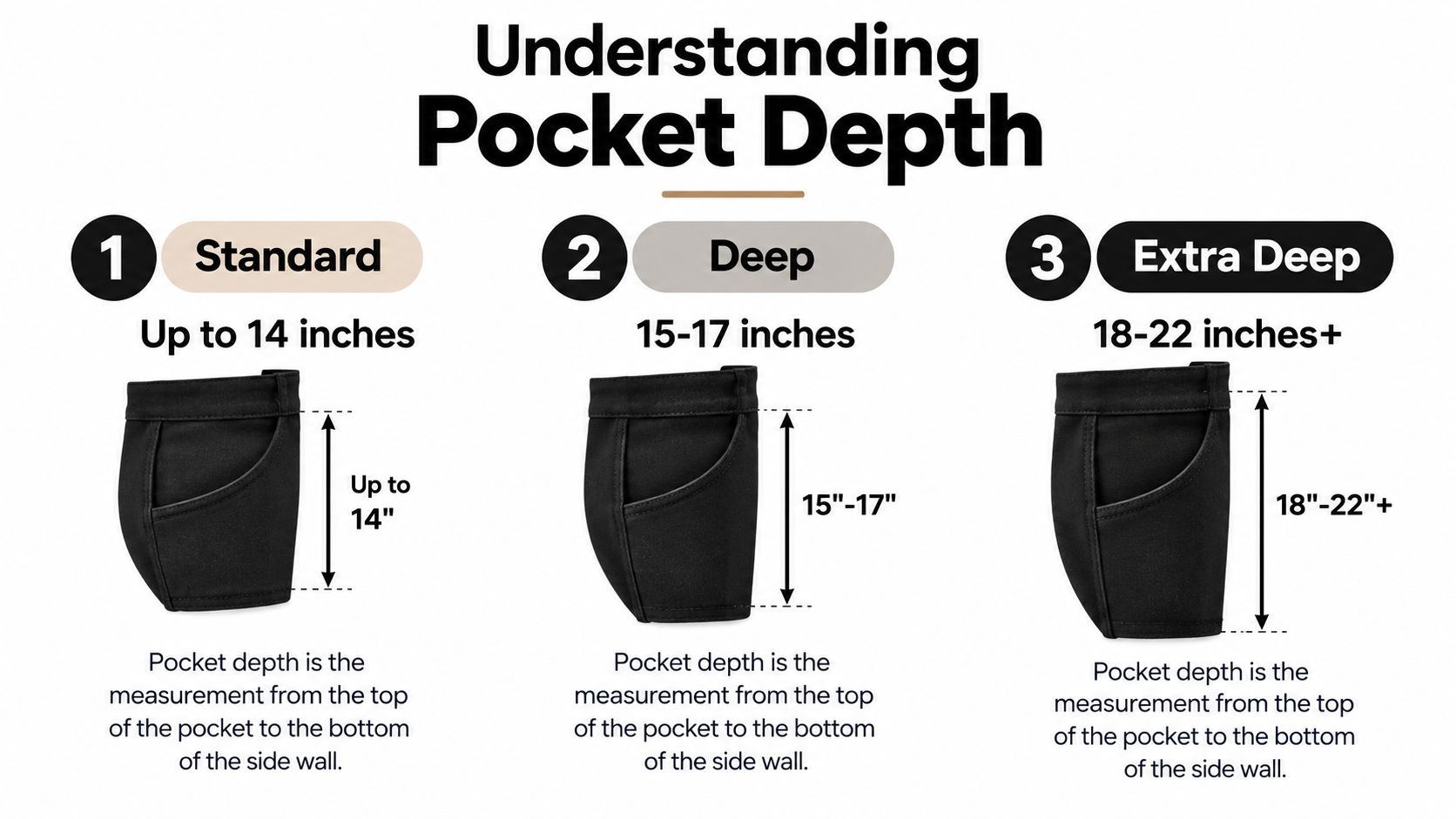
- Standard pocket: generally reaches up to about 14 inches.
- Deep pocket: commonly covers about 14 to 16 inches.
- Extra-deep pocket: often begins around 17 inches and can extend to 22 inches or more.
These ranges overlap across brands, so the listed pocket measurement is more useful than the label. An adjustable base may need a little additional clearance because movement can pull the sheet away from the mattress edge. Elastic quality matters too. A sheet with a strong perimeter band can stay secure where a deeper but loosely finished sheet slips.
For example, measure a 14-inch mattress, add a 3-inch topper, and include a 1-inch protector. The layered height is 18 inches before adding the recommended allowance, placing the bed in the extra-deep category. Confirm the manufacturer's pocket range and allow enough material to tuck underneath rather than choosing a product that only reaches the exact measured height.
Measure with the protector and topper installed, not stripped from the bed. If you're arranging laundering or linen care in a particular location, keep the same complete measurement in your household notes, much as you would when comparing a Surfside service area for a local cleaning appointment. For a detailed measuring reference, use this mattress depth measurement guide before ordering.
Fabric Choices for Oversized Cal King Bedding
Fabric affects more than softness. On an oversized California king, the larger surface creates a heavier wash load and more fabric to fold, dry, and manage. The right choice depends on bedroom temperature, how much wrinkling you tolerate, and whether your laundry setup can handle bulky bedding.
| Fabric | Feel | Breathability | Care Demand |
|---|---|---|---|
| Cotton | Crisp to smooth, depending on weave | Generally breathable | Moderate, with possible wrinkling |
| Microfiber | Soft, brushed, and cozy | Can feel warmer | Usually easy care |
| Bamboo-derived rayon | Silky and fluid | Often chosen for a cooler hand-feel | Follow the care label carefully |
| Linen | Textured and relaxed | Highly suited to warm rooms | Wrinkles naturally and may need gentle care |
Cotton is a flexible starting point. Percale feels lighter and crisper, while sateen feels smoother and more polished. Neither weave is automatically right for every sleeper, so consider whether you prefer a cool, dry hand-feel or a softer surface that drapes closely.
Microfiber can suit a cold bedroom or anyone who wants bedding that dries with relatively little fuss. Its brushed surface feels comfortable, but sleepers who run warm may prefer a more breathable option.
Bamboo-derived rayon offers a smooth, fluid surface and can feel appealing in warm rooms. Check washing instructions because the finished fabric and construction determine how it handles repeated laundering.
Linen brings visible texture and an informal, airy appearance. It wrinkles by design, so it works best when a relaxed look is part of the room. This California king linen sheet guide offers another way to compare the fabric with the longer Cal king format.
Material choice should follow your bedroom, not a thread-count number.
A swatch is useful before committing to a full set. Rub it between your fingers, hold it against your skin, and compare it with the room's usual temperature. A return-friendly retailer or swatch program gives you a safer way to test hand-feel, drape, and care expectations before taking on a full oversized load.
How to Read Oversize Labels and Match Inserts to Covers
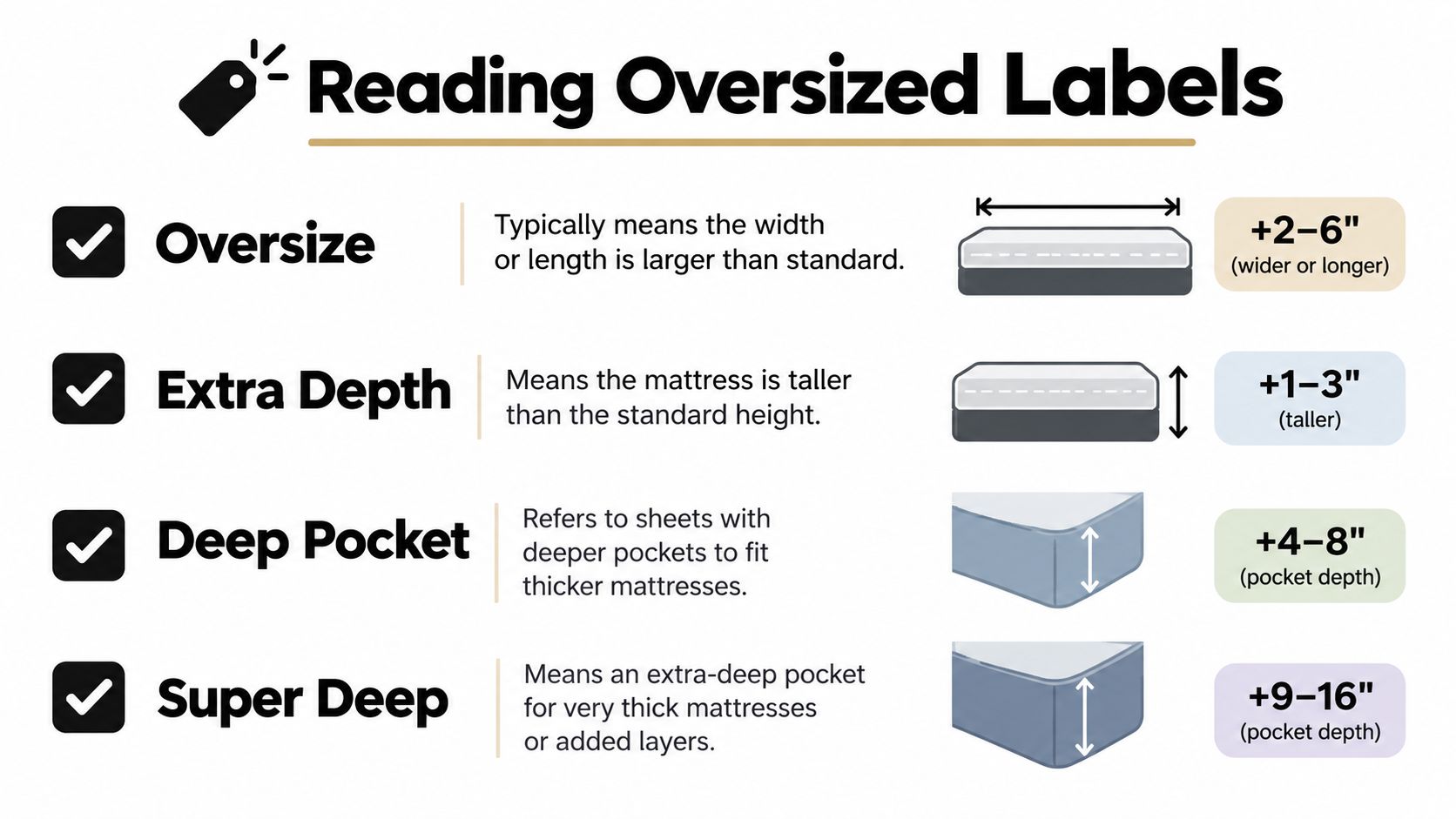
Bedding labels are not consistent enough to make a purchase decision by name alone. “Oversize,” “extra depth,” “deep pocket,” and “super deep” describe a product's intended use, but they don't guarantee the same measurement from one retailer to another.
Use the label as a prompt to find the actual dimensions. For a fitted sheet, compare the listed pocket depth with your measured mattress stack. For a duvet cover, compare the finished width and length with the insert. A cover can be called oversized and still be the wrong shape for a California king if it was cut for a wider standard king.
Read the product page in this order
- Confirm the bed footprint. Look for California king or Cal king, not only king.
- Find the pocket measurement. Match it to your total mattress, topper, pad, and protector height.
- Check the cover dimensions. Oversized California king covers vary, with common examples around 102 by 94 inches, 104 by 94 inches, 106 by 94 inches, and 114 by 100 inches for jumbo versions. The Big Bed Company explains why Cal king duvet and cover dimensions vary across retailers.
- Match the insert to the cover. An insert that is much smaller leaves hollow corners, while an oversized insert in a tight cover creates bunching.
- Look for corner ties. Ties help hold the insert in position, especially when the cover has generous dimensions.
A standard king cover may be wider but shorter than the California king shape requires. An oversized king cover can be wider still, yet that doesn't make it an oversized California king cover. The two categories solve different problems, so don't rotate one casually and assume the proportions will balance.
For more help matching cover and insert measurements, use this duvet cover size guide. The safest purchase has the cover dimensions, insert dimensions, fill profile, and attachment points listed together.
Layering and Care Tips for a Made Bed That Stays Made
Start with the foundation. A deep-pocket fitted sheet should wrap beneath the complete mattress stack, with the elastic gripping the lower edge rather than merely stretching over the side. Add a mattress protector before the top sheet. That barrier helps limit moisture, oils, and friction reaching the sheet and mattress, which is especially useful when the bed includes a thick topper.
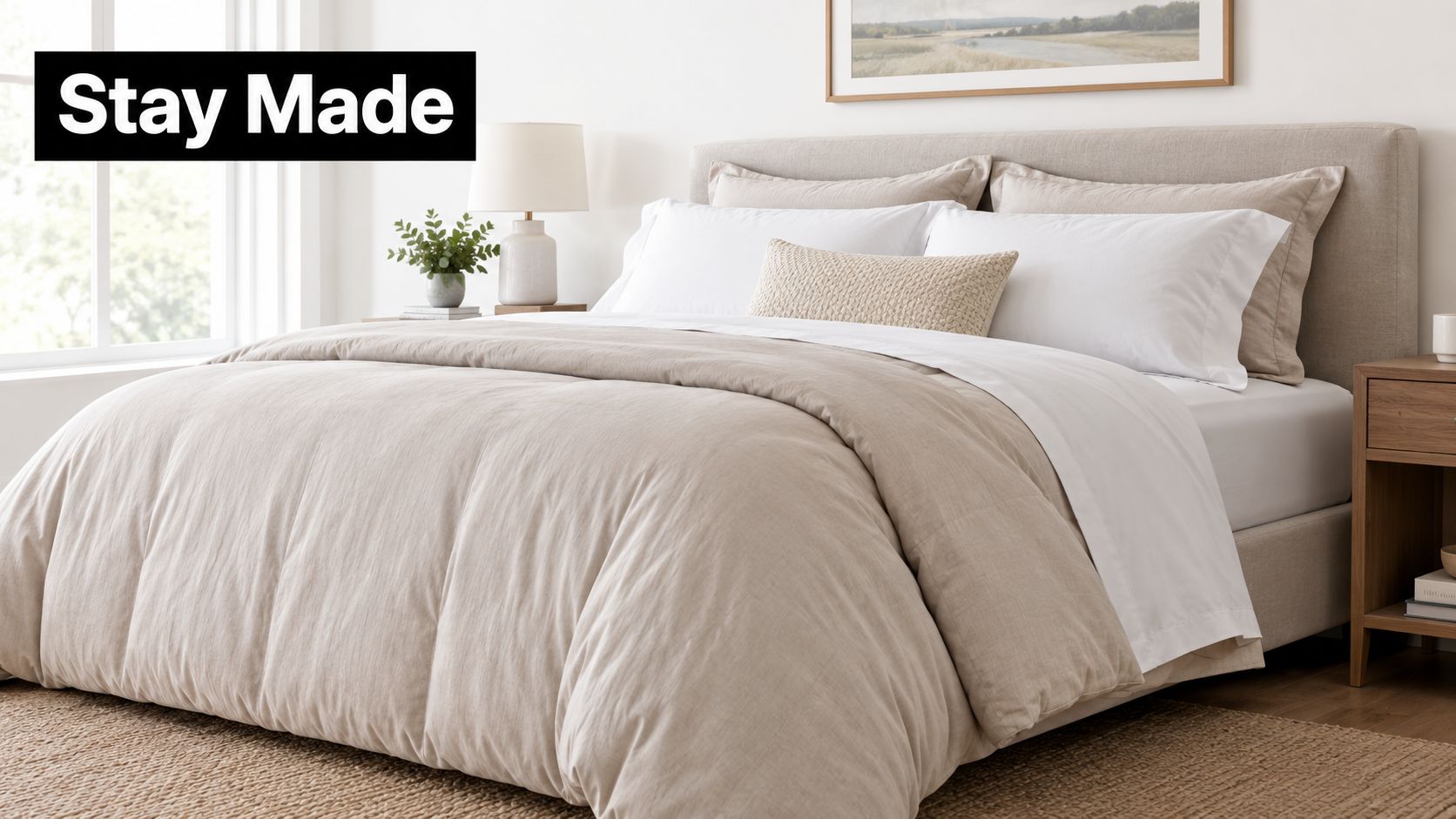
In a styled primary bedroom, the sequence might be a fitted sheet, a top sheet, an oversized California king duvet cover, and a folded throw at the foot. The fitted sheet should do the anchoring work. The top layer should add coverage and visual balance, not compensate for a fitted sheet that is too short.
Wash the large pieces with room to move
California king bedding needs space in the washer and dryer. Cramming a bulky sheet set into a small drum can twist the fabric, strain the elastic, and leave detergent trapped in the folds. Use a large-capacity machine when the care label allows it, and wash oversized pieces separately from heavy towels.
Choose a gentle cycle and the water temperature specified on the label. Remove the bedding soon after the cycle ends so creases don't set into the fabric. Shake each piece before drying or line-drying, then fold it only after it is completely dry.
Once the bed is remade, check the corners by hand. If the elastic has begun to flatten, the band no longer grips the underside, or one corner repeatedly releases, the fitted sheet may be losing retention even if its pocket depth looks correct.
For a more decorative arrangement, this quilt layering guide can help you combine a quilt, duvet, and throw without hiding the fitted foundation.
A useful maintenance habit is to rotate the fitted sheet with a spare about every six months. Rotation spreads washing and stretching across both pieces, while a quick corner check catches slipping before it becomes a nightly annoyance.
Here's a visual demonstration of how bedding layers can be arranged on the bed:
Buying Checklist Before You Add to Cart
A product page should answer the fit questions before you pay. If the dimensions are missing, the set may still look attractive, but you won't know whether it can handle your mattress.
Start with the footprint
Confirm that the mattress is a California king rather than a standard or Eastern king. Don't assume that a package marked “king” includes both shapes. The longer, narrower California king needs its own fitted-sheet cut and correctly proportioned top layers.
Measure the occupied height
Measure the mattress with the topper, protector, and pad in place. Add the recommended allowance, then compare that result with the listed pocket depth. A fitted sheet that meets the exact height with no spare fabric may look secure when empty and release its corners once someone lies down.
Inspect the elastic design
Look for a full-perimeter elastic band or another construction that grips beneath the mattress. Elastic sewn only into the corners can leave the middle of the sheet loose. If product photographs are unclear, check the specifications or contact the retailer before ordering.
Match the duvet components
Compare the cover's width and length with the insert's measurements. Confirm that both are designed for California king proportions. Oversized standard king and oversized California king covers aren't interchangeable, even when both appear under an “oversized” filter.
Check for corner ties and, when available, additional attachment points along the sides. These help keep a lofty insert from drifting away from the cover's corners.
Match fabric to the household
A cool, breathable weave may suit a warm room, while brushed microfiber may feel more comfortable in a cold one. Consider whether your washer and dryer can handle the finished set without crowding. A beautiful fabric that requires impractical care will spend more time in the laundry basket than on the bed.
The same checklist works for online and in-store shopping. Save the mattress measurements, pocket requirement, cover size, insert size, and care instructions in one note. That makes it easier to compare sets without relying on memory or a vague “king” label.
Quick Answers and Final Fit Checklist
Is an oversized California king the same as an oversized standard king? No. A California king is longer and narrower, while an oversized standard king is designed to add coverage around the wider standard king footprint. Swapping them can produce a cover that looks baggy along the sides but still falls short at the foot, or a fitted sheet that pulls unevenly across the corners.
Do toppers and protectors change the pocket-depth requirement? Yes. Measure the mattress, topper, protector, and pad as one stack. A pillow top or topper consumes pocket depth just as surely as the mattress itself, and a protector adds another layer that the fitted sheet must pass over. Measure with the bedding components installed, not after stripping the bed down to the bare mattress.
Can I wash oversized California king sheets in any washer? The bed size doesn't determine washer compatibility by itself, but the large fabric volume needs room to move. Overloading a standard drum can strain elastic, create poor rinsing, and leave the center of the load damp. Use a large-capacity machine or a suitable laundromat machine when the care label and load size require it.
Keep this fit checklist beside the bed
- Confirm the footprint. Verify that the mattress uses California king proportions.
- Measure total lofted depth. Include the mattress, topper, protector, and pad.
- Add pocket-depth slack. Choose a fitted sheet with at least the recommended extra allowance.
- Confirm elastic retention. Look for secure perimeter construction that grips beneath the mattress.
- Verify insert-to-cover dimensions. Match both pieces by actual width and length.
- Match fabric to climate and care capacity. Choose the hand-feel, breathability, and maintenance routine your household can sustain.
The fit-first approach prevents the most expensive mistake, buying a complete set that seems correct by name but fails in use. For oversized California king bedding sets, the mattress footprint identifies the category, the layered depth selects the fitted sheet, and the cover-to-insert measurements determine whether the finished bed looks full rather than uneven.
SouthShore Fine Linens offers King and California King bedding options, including oversized comforter and lightweight quilt sets suited to layered beds. Visit SouthShore Fine Linens to compare clearly labeled California king pieces and choose a set that matches your mattress depth, preferred fabric, and room style.


