
Nautical Quilt Bedding Sets: Complete Buying Guide
You've found the right navy-and-white pattern, compared anchors with stripes, and chosen a set that looks polished in the product photos. Then it arrives and the quilt barely reaches the mattress edge, or the filling shifts after its first wash. With nautical quilt bedding sets, the maritime design is only the beginning. Fit, construction, insulation, and care determine whether the bedding looks considered in a real bedroom and remains useful beyond one summer.
What Nautical Quilt Bedding Sets Actually Are
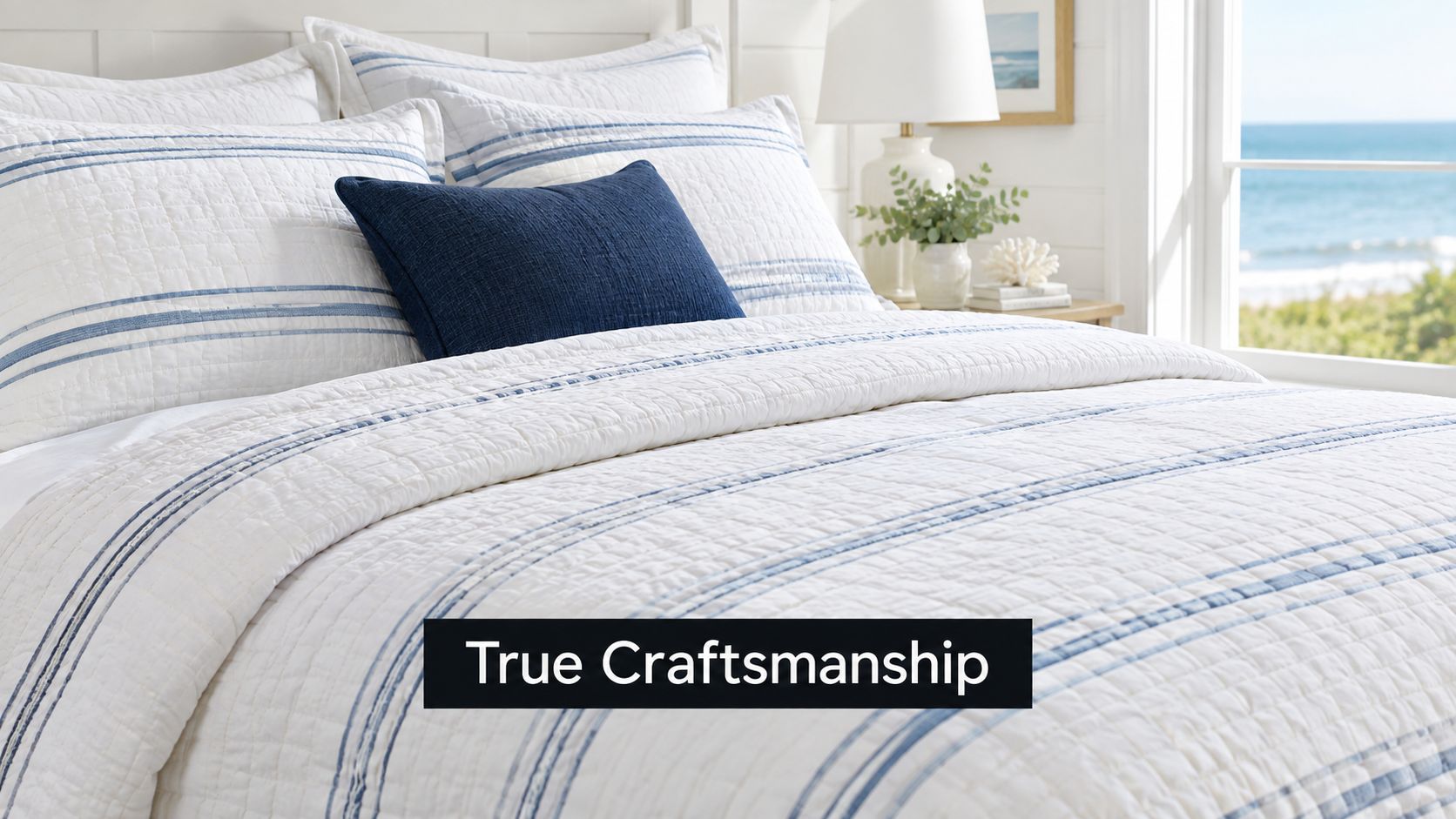
A coastal bedding search can blur several different products together. A printed duvet cover may show sailboats or anchors, while a coverlet may offer a thin decorative layer without much insulation. Nautical quilt bedding sets are different because the quilt is a constructed textile, usually made from a woven top, a filling layer, and a woven backing joined by stitching.
The design may be printed, woven, or pieced into the top layer. Common visual cues include anchors, rope textures, ship wheels, sailboats, lighthouses, and blue-and-white stripes. Some patterns are bold and graphic, while others use small maritime motifs against navy, ivory, gray, or muted coastal colors. The strongest designs suggest the sea without turning the bedroom into a themed display.
The set is more than a decorative cover
A typical set includes the quilt and matching pillow shams, although some collections add sheets or other coordinating pieces. The shams help establish a finished arrangement without requiring you to match every item separately. Before ordering, check the product description carefully because “set” doesn't always mean the same thing from one retailer to another.
For a useful explanation of how these pieces are grouped, compare the terminology in this guide to what a quilt set includes. That distinction matters when you're budgeting, styling a guest room, or preparing a bed for a vacation rental.
Why the maritime look has staying power
The visual language comes from a long history of practical shipboard sleeping systems. Sailors relied on hammocks well before modern bedding, and the Royal Navy adopted them in the 1590s. One historical account says hammocks remained in widespread use for over 350 years, continuing until after the Second World War. Earlier accounts describe sailors before 1492 using sparse basics such as a narrow cushion, a folded sheet, or a small blanket. These details are documented in this history of hammocks and maritime sleeping.
That history helps explain why nautical bedding combines crisp visual order with practical materials. Anchors, ropes, ships, and stripes aren't random decorations. They reflect a naval aesthetic shaped by compact sleeping spaces, standardized equipment, and the need for textiles to function under demanding conditions.
The Three-Layer Construction Behind Every Quilt
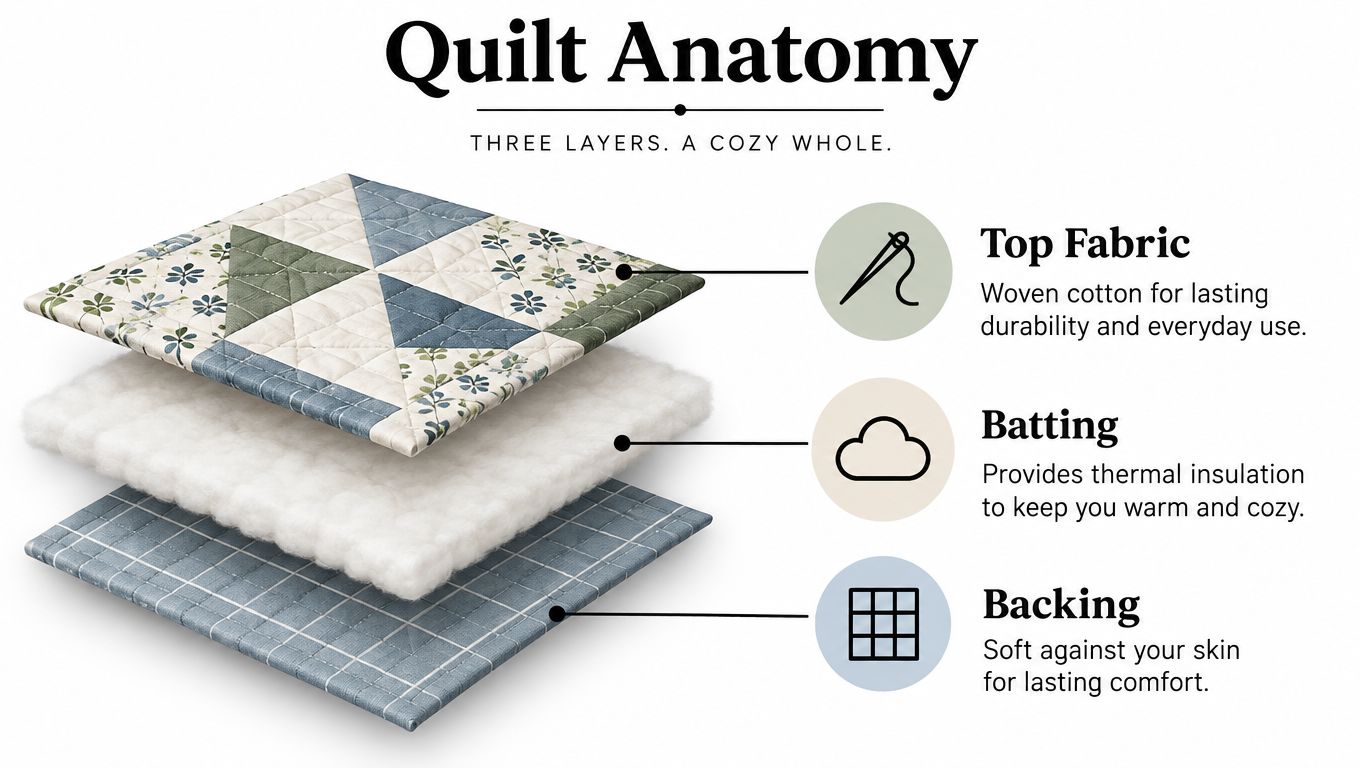
A quilt earns its character from the relationship between three layers. The top fabric supplies the visible pattern, the batting controls much of the warmth and loft, and the backing rests closest to the sleeper. Quilting stitches pass through all three layers, securing them into one flexible piece.
The top fabric carries the visual work
The top layer is where the nautical identity appears. A tightly woven cotton face generally gives stripes cleaner edges, motifs a sharper outline, and the surface a more substantial hand than a loosely woven fabric. Cotton also contributes breathability and a familiar natural feel.
Retail specifications for coastal and nautical-style sets commonly pair 100% cotton faces with either 100% polyester fills or an 80% cotton and 20% polyester fill. Those combinations use cotton for breathability and hand feel, while polyester helps the filling retain loft and dimensional stability. You can compare examples in these coastal bedding product specifications.
Batting determines the bed's feel
Batting is the middle layer. It can be cotton, polyester, or a blend, and its composition affects warmth, weight, loft, and laundering behavior. Cotton batting often feels breathable and relaxed, while polyester can provide a lighter, springier hand and help the quilt keep its shape.
A lightweight nautical quilt works well as a warm-weather cover or as a layer beneath a heavier blanket. A denser or medium-weight construction may suit a bedroom where the quilt needs to contribute more warmth. Don't judge insulation only by thickness. Stitching, fiber type, and the way the quilt drapes all affect how it feels in use.
Backing and stitching complete the structure
The backing provides the surface against the body and helps stabilize the entire piece. A smooth cotton backing can feel cool and breathable, while a blended backing may be selected for easier care or added dimensional stability.
The quilting pattern is functional, not merely ornamental. Each stitched line creates smaller pockets that hold the batting in position and reduce movement during handling and washing. Large open areas may allow filling to migrate, leaving thin zones beside bulky ones. A well-made quilt should feel consistent across its surface and should bend without feeling stiff or board-like.
Textile specialist's rule: Evaluate a quilt as a layered system. A beautiful top pattern can't compensate for poor batting control, weak backing, or stressed seams.
How to Judge Quilt Quality Before You Buy
A nautical pattern can look excellent online and still conceal weak construction. Before buying, check how the materials are identified, how the quilting controls the fill, and how the perimeter is finished. These details matter more to long-term use than a vivid anchor or sailboat print.
Start with the fiber composition
Read the face, fill, and backing specifications separately rather than relying on a broad label such as “cotton quilt.” A cotton face with a polyester-rich fill can suit everyday use because each fiber serves a different purpose. Cotton provides breathability and a familiar hand, while polyester can help the quilt retain loft and resist changes in shape.
A listing that omits the fill leaves important questions unanswered. Without it, warmth, weight, and laundering behavior are difficult to judge. Check the shams as well. They should identify their face fabric and show cleanly finished closures, since a matching set can still contain weaker accessory pieces.
Read the quilting pattern
Inspect the stitching for regular spacing, secure thread, and consistent coverage. Textile and bedding guidance commonly recommends roughly 10 to 12 stitches per inch or tighter for durable quilting, as explained in this quilt construction and care guide. Closer stitching forms smaller sections, helping keep the fill from shifting into thin spots after handling and washing.
Online photographs may not be detailed enough to show stitch spacing. Look for close-up images or ask the seller for them. If you can examine the quilt in person, run your hand over the surface. The texture should remain even, without pronounced lumps, hollow areas, or sudden changes in thickness.
Inspect the perimeter
The edges receive repeated friction when the quilt is pulled across the bed, tucked, folded, and laundered. Binding, a turned edge, or another reinforced finish helps protect the perimeter from fraying. Examine the corners closely because they often receive the most handling.
Use this checklist before purchase:
- Surface consistency: Filling should feel even from the center through the corners.
- Stitch security: Quilting lines should be intact, with no skipped sections or loose thread tails.
- Edge reinforcement: The perimeter should be enclosed or bound, not cut and folded.
- Specification clarity: The listing should state materials, dimensions, included pieces, and care instructions.
A quality nautical quilt does not need to feel heavy or stiff. Look for controlled filling, stable stitching, and an edge finish suited to regular use. These construction checks help distinguish a decorative cover from bedding that can serve through changing temperatures and repeated laundering.
Sizing for Deep Mattresses and Proper Drape
The most attractive nautical quilt can look unfinished if it doesn't cover the mattress properly. Modern beds often have thick mattresses, toppers, platform foundations, or adjustable bases, and a dimension that once looked generous may now leave exposed sheets along the sides.
A useful starting point is the mattress width plus the desired drop on both sides. Independent bedding guidance suggests choosing a quilt about 14 to 22 inches wider than the mattress for a balanced drape, as outlined in this guide to king-size quilt fit. The exact choice depends on whether you want the quilt to end near the mattress edge, cover the foundation, or fall farther toward the floor.
Standard and oversized options
For a king bed, a standard quilt around 106 by 96 inches may be adequate on a lower-profile mattress. It can look short on a deep mattress, particularly if the bed sits high or uses an adjustable base. A dimension of 110 by 100 inches or larger gives more coverage for a deeper setup, though you should still compare the actual mattress width and height with the product dimensions.
| Bed situation | Likely concern | More suitable approach |
|---|---|---|
| Lower-profile king mattress | Standard quilt may drape adequately | Confirm the desired side drop |
| Deep mattress over 14 inches | Sides may expose sheets or foundation | Consider an oversized quilt |
| Adjustable base | Movement can pull fabric upward | Allow extra width and length |
| Tall mattress with topper | Added height reduces visible drop | Measure after the topper is installed |
Measure before choosing the pattern
Measure the mattress from side to side, then measure from the top surface down to the point where you want the quilt to end. Multiply the desired side drop by two and add it to the mattress width. Repeat the process for the length if you want coverage at the foot of the bed.
Don't assume that a king label guarantees a perfect fit. Product naming varies, and a quilt designed for a standard frame may not suit a tall mattress. If you're comparing options, this guide to an oversized quilt for a king bed addresses the coverage issue directly.
A slightly larger quilt often creates a calmer, more finished appearance, but excess fabric can become cumbersome on a narrow bed. The right size is the one that covers your actual sleeping system while preserving a clean line at the sides and foot.
Using Nautical Quilts Beyond the Summer Season
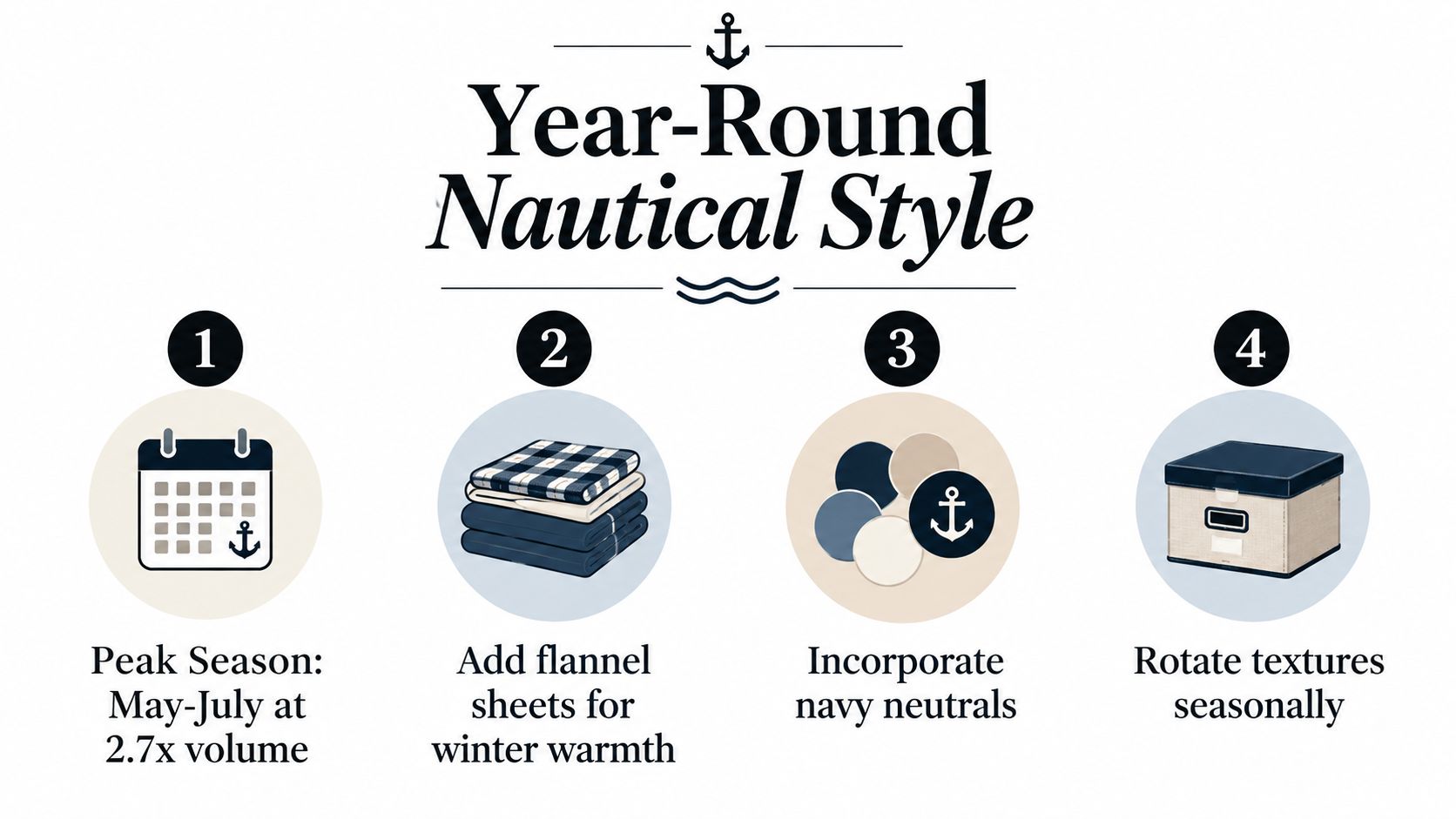
Coastal and nautical bedding often attracts attention as a warm-weather purchase. One market tracker estimates that coastal bedding demand peaks from May through July, reaching 2.7 times the quietest month, with the figures reported in its coastal bedding market overview. That pattern reflects seasonal decorating, moving, vacation-home preparation, and interest in lighter bedding, but it doesn't mean a nautical quilt belongs in storage once temperatures fall.
The most adaptable designs rely on color and texture rather than overt beach graphics. Navy, ivory, slate, sand, and muted blue can sit comfortably with autumn and winter layers. A small anchor pattern or restrained stripe can function much like a geometric print in a traditional bedroom.
Build warmth in layers
A lightweight cotton quilt can serve as the visible top layer over a heavier duvet, comforter, or blanket. This arrangement adds warmth without requiring a thick nautical quilt, and it gives you control over the bed's feel as the room changes temperature.
For cooler nights, pair the quilt with warmer sheets and a medium-weight insulating layer beneath it. Flannel sheets can add a soft seasonal contrast, while navy neutrals and textured throws keep the maritime palette from looking like a summer-only theme. A reversible quilt adds another styling option, especially when one side carries a stronger pattern and the other uses a quieter solid or stripe.
Choose weight by use, not by calendar
A lightweight quilt suits warm rooms, guest beds, and sleepers who prefer minimal insulation. A medium-weight option is more flexible for year-round use because it can stand alone in mild conditions and accept additional layers when the temperature drops.
The same quilt can also serve different roles. Fold it at the foot of the bed in winter, use it as a top layer over a duvet, or move it to a guest room where visitors may have different preferences. This approach turns nautical bedding into a practical textile rather than a seasonal prop.
Care Instructions That Protect Your Investment
Start with the care label, then give the quilt enough space and gentle handling. Use a cold or gentle wash cycle, avoid overloading the machine, and check that the quilt can move freely through the water. A packed drum encourages wrinkling and puts extra strain on stitched panels, binding, and seams.
Use low heat for drying. Textile-care guidance recommends gentle or cold washing and low-heat drying because aggressive heat can cause shrinkage, fiber damage, and seam stress. Remove the quilt promptly when the cycle ends, then smooth it over the bed or fold it neatly before wrinkles set.
For a practical laundering and seasonal-storage reference, follow this guide to washing and storing quilts.
A simple maintenance routine
- Wash gently: Select the mildest cycle allowed by the care label and appropriate for the soil level.
- Dry with restraint: Choose low heat and stop once the quilt is dry instead of reheating it repeatedly.
- Air it occasionally: Line drying or laid-flat drying limits heat exposure and helps retain loft.
- Rotate the quilt: Change its orientation periodically so the foot and side edges do not receive all the wear.
- Store it dry: Fold the quilt only after it is fully dry, and use a breathable storage bag instead of sealed plastic.
Dark navy designs need careful treatment during their first washes. Cold water and prompt drying help maintain contrast between navy motifs and lighter grounds. Harsh treatment, strong agitation, and high heat can weaken stitching or affect the finish, so follow the label before using them.
A correctly sized, well-constructed quilt should become easier to maintain over time. SouthShore Fine Linens offers quilt sets, oversized quilt sets, and printed collections with matching pillow shams, including coastal-inspired designs for nautical bedrooms. Review the dimensions, fabric details, and care instructions before visiting SouthShore Fine Linens to choose a set suited to your mattress and layering plan.


