
Luxury Bedroom Design: A Step-by-Step Guide
You've bought the upholstered headboard, chosen calm wall colors, and arranged the decorative pillows. Yet the room still feels more crowded than luxurious. The bed dominates the floor, the sheets pull loose at the corners, and bright electronics undermine the atmosphere after dark. This is a common result of treating luxury as a collection of expensive-looking objects instead of a coordinated experience.
Luxury bedroom design works when proportion, textile performance, lighting, and maintenance support one another. The room should feel composed without becoming precious, comfortable without looking casual, and visually quiet enough to help you rest. The following approach focuses on the details that make a bedroom feel like a private hotel suite, even when the available space is modest.
Redefining Luxury in the Modern Bedroom
A bedroom can contain beautiful furniture and still feel ordinary. The difference usually appears in the details you notice after the first impression: whether you can move around the bed without hesitation, whether the sheets stay anchored through the night, whether the lighting can shift from reading to sleeping, and whether the surfaces give your eye somewhere to rest.
Consider two versions of the same room. In the first, a large bed sits between overfilled nightstands, several small accessories compete with artwork, and thick decorative layers make the mattress look untidy. In the second, the bed remains the focal point, but the nightstands hold only what you use, storage disappears behind quiet fronts, and the bedding has enough structure to fall cleanly without excess fabric. The second room may contain fewer luxury signals, yet it feels more considered.
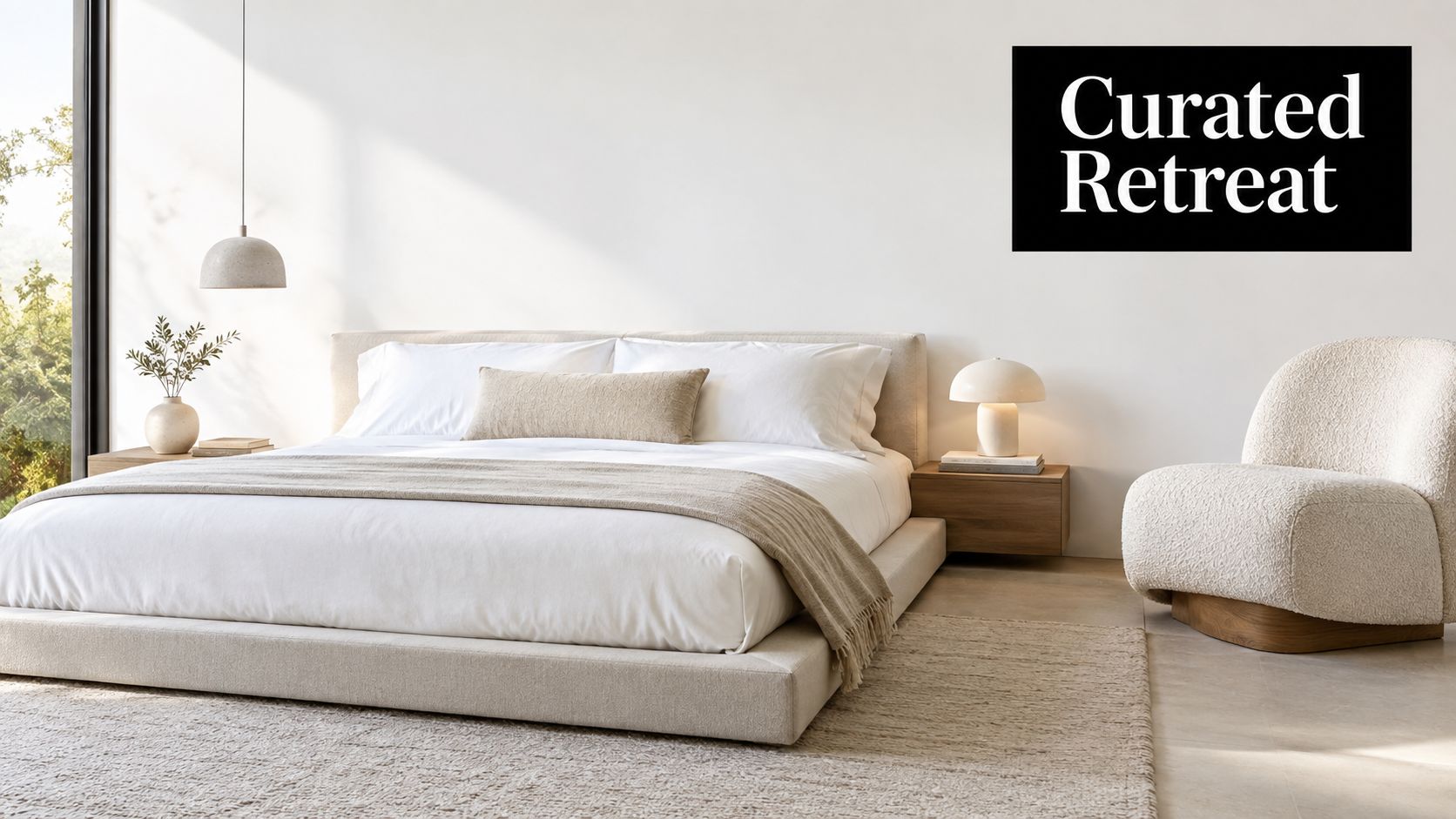
The room should earn its calm
Luxury is not the same as minimalism. A sparse room can feel unfinished if the mattress is uncomfortable, the textiles are mismatched, or the lighting is harsh. The stronger principle is intentionality. Every visible element should either support comfort, improve function, establish proportion, or add a texture that earns its place.
This approach applies in a compact apartment as readily as it does in a large primary suite. A carefully fitted sheet, a concealed charging point, and a well-positioned reading light can contribute more to daily comfort than another decorative object.
For a useful reference on creating a coordinated bed, explore this guide to luxury hotel-style bedding. The hotel effect comes less from ornament than from consistency, tactile quality, and reliable fit.
Practical rule: If an item makes the room harder to clean, harder to navigate, or harder to sleep in, it needs to justify its visual contribution.
Luxury bedding also has a substantial market context. One estimate valued the global luxury bedding market at USD 3.29 billion in 2025, with a projection of USD 4.68 billion by 2034, while North America represented 32.74% of the market in 2025. These figures describe bedding rather than complete bedroom interiors, but they underline why premium textiles are a core part of the luxury-bedroom experience. The market estimate and historical bedroom context are available here.
Planning the Layout for Functional Elegance
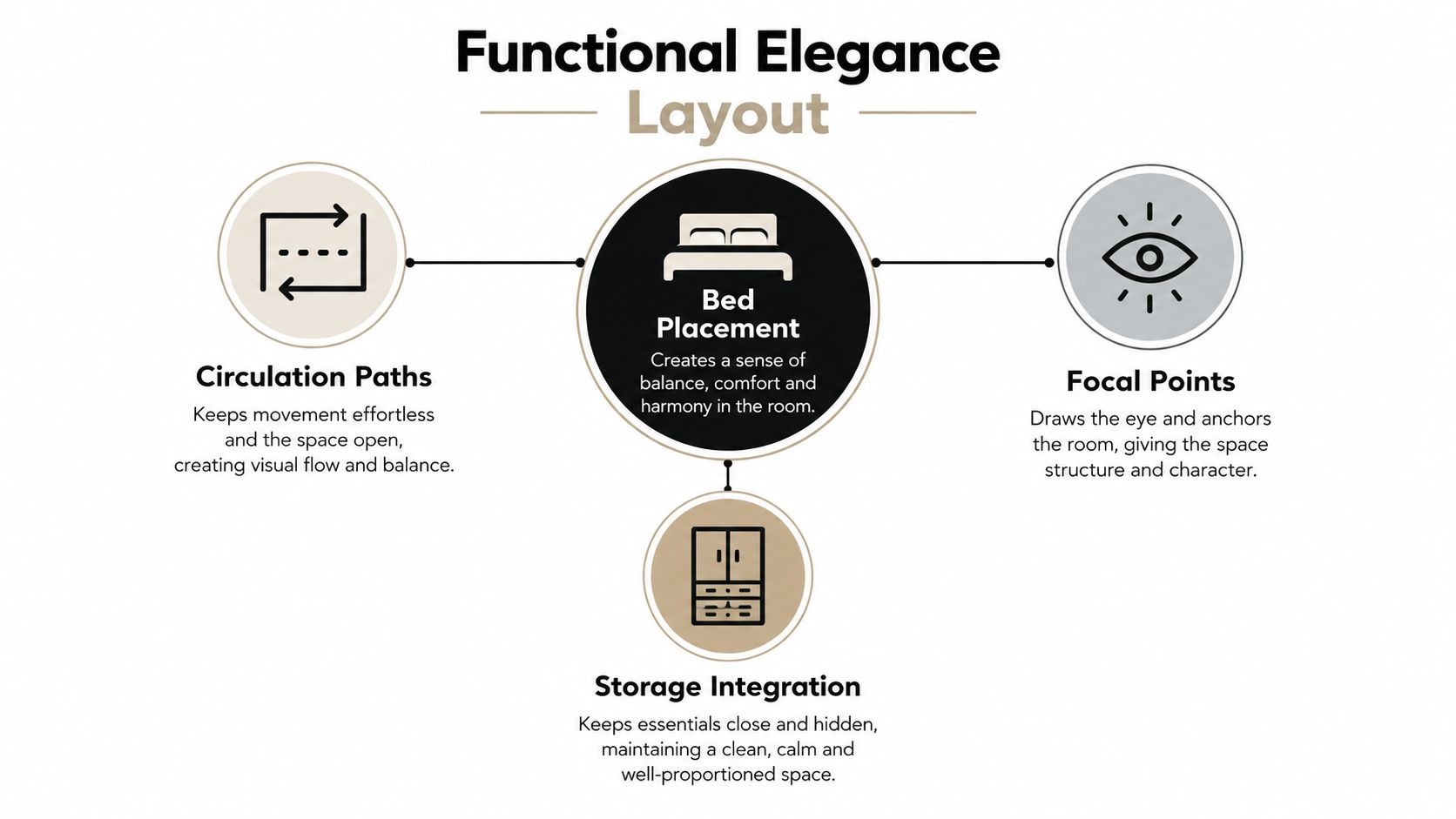
Start with the bed, not the accessories. Its position determines circulation, sightlines, storage access, and the amount of visual weight the rest of the room can carry.
Establish the main route first
Stand at the bedroom entrance and identify the natural path to the bed, wardrobe, bathroom, or window. Keep that route clear. A luxury room shouldn't require you to angle around a bench, squeeze between the mattress and a wall, or move a chair before opening a drawer.
In a smaller room, place the bed where it can act as a focal point without blocking the most useful wall or window. A tall, upholstered headboard may look dramatic in a large suite, but it can overwhelm a compact space. A lower profile bed with a defined headboard often gives the room enough structure while preserving visual breathing room.
Use this sequence:
- Place the bed: Test the bed's visual balance from the doorway and from the position where you enter the room.
- Protect circulation: Keep the principal walking route open and check that doors, drawers, and wardrobe panels can operate fully.
- Assign secondary functions: Add reading, dressing, or work zones only after the sleep zone works on its own.
- Move storage upward or inward: Full-height cabinetry, under-bed drawers, and floating nightstands can reduce floor clutter without adding visual noise.
- Edit the footprint: If a piece creates a narrow passage, replace it with a slimmer alternative rather than accepting an awkward compromise.
Make a small room feel deliberate
A multi-use bedroom needs boundaries, but those boundaries don't have to be bulky. A narrow console can define a work area, a wall-mounted sconce can free a bedside surface, and a curtain or carefully positioned screen can separate dressing from sleeping without creating another large object.
Quiet storage matters because exposed belongings interrupt the sense of retreat. Choose consistent hardware, concealed fronts, and finishes that relate to the wall or flooring. Open shelving can work, but only when its contents are edited and arranged with the same discipline as the bed.
Oversized elements still have a place. A generous headboard or canopy can create architectural focus in a room with sufficient volume, but it shouldn't become a default purchase. In constrained rooms, proportion is the luxury signal. The best arrangement lets the bed feel substantial while leaving enough open space for the room to function easily.
Choosing Colors and Premium Materials
A successful palette gives the room a stable background, then lets materials provide the variation. Warm whites, creams, taupes, and soft grays create a restrained foundation. Natural wood can add depth, while muted metal accents introduce definition without making the room feel showy.
Don't choose a neutral by looking at a small paint card under a retail store's lighting. Test it on the wall and observe it in daylight, evening lamp light, and the dim conditions before sleep. For additional guidance on selecting a bedroom wall color, this color tip from Soca Services Painting offers a useful starting point. The related bedroom color psychology guide can help connect the palette to the mood you want the room to support.
Let texture replace visual clutter
A neutral room becomes flat when every surface has the same finish. It becomes restless when too many finishes compete. Aim for controlled contrast:
- A matte painted wall against a subtly lustrous sateen duvet cover.
- A crisp cotton percale sheet against a softer quilt.
- A natural wood nightstand beside a smooth ceramic lamp.
- A woven throw against a clean, structured coverlet.
The material choice should also account for the way you sleep. Breathable fibers and cooling constructions can support a more comfortable sleep environment, particularly for people who tend to sleep warm. Heavier fabrics may look dramatic, but weight alone doesn't create quality. A textile that traps heat, sheds excessively, or becomes difficult to launder can undermine the sanctuary you're trying to build.
Measure before ordering bedding
Mattress fit is one of the least glamorous parts of luxury bedroom design, and one of the most visible when it goes wrong. A bedding-sizing reference notes that standard sheets are generally sewn for mattresses no more than 9 inches deep, so taller mattresses and topper combinations need purpose-built pockets. The mattress-depth guidance is explained in this bedding-sizing reference.
Measure the mattress width, length, and depth. Then measure the combined height of the mattress and topper rather than choosing sheets from the mattress label alone. Check the fitted sheet's pocket depth, elastic construction, and corner seam placement. If the pocket is too shallow, corners can pop off and the sides of the mattress may show. If it's excessively loose, the surface can wrinkle and lose its crisp appearance.
A refined bed begins with accurate measurements. Decorative layering can't disguise a fitted sheet that doesn't fit.
Mastering the Art of Textile Layering
Layering should create a bed that looks inviting from across the room and feels adaptable at night. The order matters because each layer performs a different job.
Begin with the fitted sheet. It should sit flush against the mattress, with the elastic holding the corners securely rather than straining over them. Add a flat sheet for a smooth, breathable layer, then place the duvet or comforter on top as the principal source of warmth and visual volume.
Build contrast through weight and weave
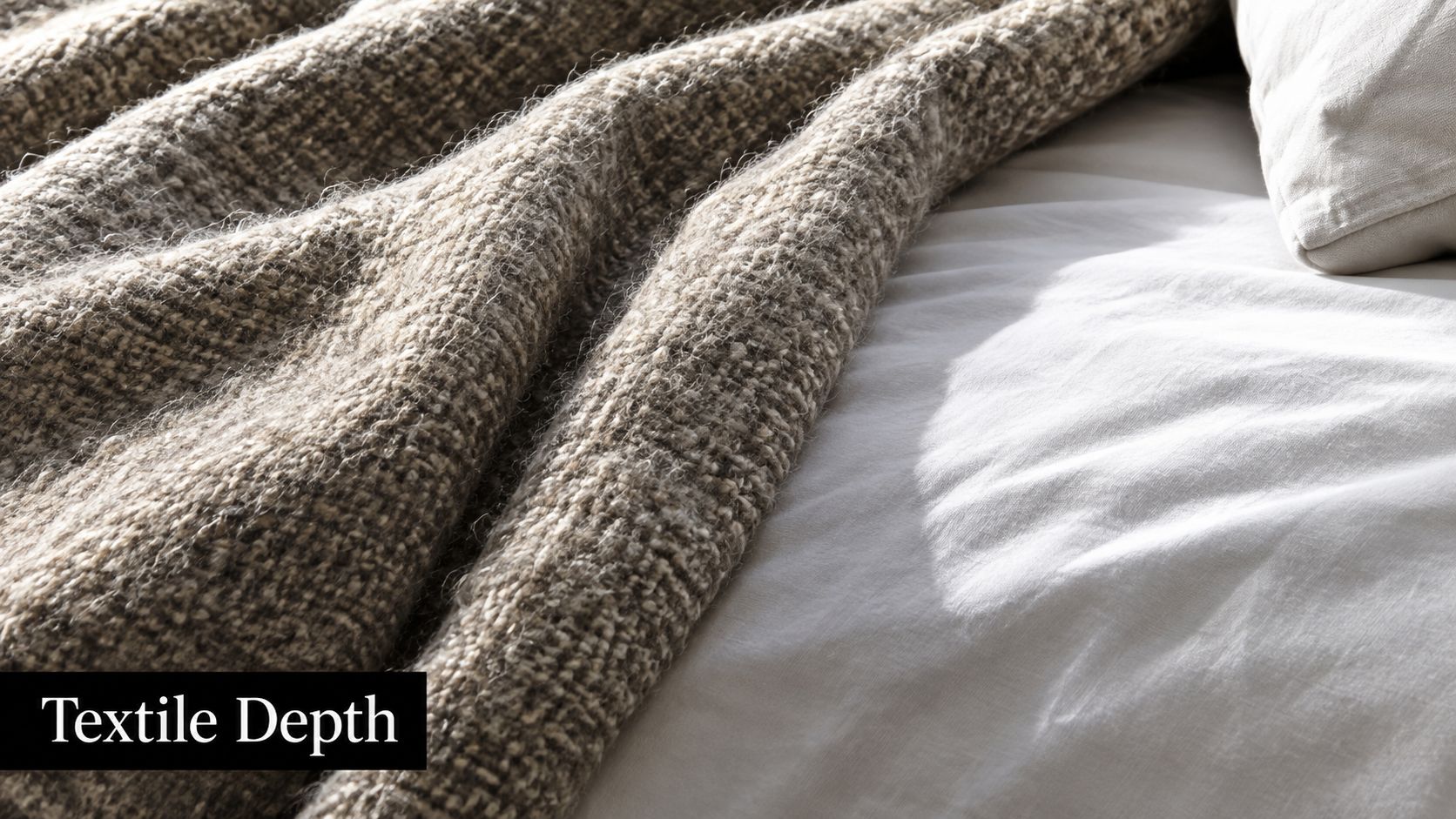
A luxury bed needs more than one texture, but it doesn't need every texture. Combine materials that feel distinct without creating thermal confusion. Percale can provide a crisp, matte foundation, while sateen offers a smoother hand and gentle sheen. A quilt adds structure and a lighter layer for adjustment. A throw at the foot of the bed brings a relaxed note, provided it remains easy to remove.
The most useful arrangement is one you can edit according to temperature. If the room is warm, the quilt or duvet should be easy to fold back without leaving the bed visually incomplete. If you sleep cool, a substantial comforter can supply warmth while the flat sheet preserves a smoother contact layer.
Layer for decisions, not decoration: every additional textile should offer warmth, softness, structure, or an easy way to adjust comfort.
A faux-fur throw can contrast attractively with crisp cotton, but it should remain an accent rather than the surface closest to the body if it feels too warm or difficult to wash. Wool can add tactile depth, while a cotton quilt often gives the bed a more breathable, practical layer.
Material certification adds another decision point. SouthShore Fine Linens notes that many of its textiles are OEKO-TEX® certified, a useful quality consideration for shoppers who want bedding screened against harmful substances. Certification doesn't replace checking fiber content, construction, fit, and care instructions, but it can support a more informed purchase.
Lighting for Rest and Ambiance
Lighting has two jobs in a bedroom. It should make the room beautiful in the evening, then become quiet enough to support sleep. A single bright ceiling fixture rarely handles both roles well.
Use layers instead:
- Ambient light: Concealed perimeter lighting, a shaded ceiling fixture, or a dimmable wall wash can establish the room's overall glow.
- Task light: Bedside lamps or mounted reading lights should illuminate the book without flooding the entire room.
- Accent light: A softly lit artwork, headboard detail, or architectural surface can add depth, but it should be switchable.
- Night control: Cover or remove small electronic indicators, and keep unnecessary light outside the sleeping field.
Choose warm-white bulbs below 3000 K for the evening environment. Sleep-environment guidance recommends keeping light at the eye at 10 lux or less beginning three hours before bedtime, then reducing it to 1 lux or less during sleep. The sleep research and lighting guidance are detailed in this review from Sleep.
Treat darkness as part of the design
Blackout curtains, lined shades, and carefully fitted window treatments can protect the sleep environment while also improving the room's visual finish. Look for gaps at the sides and top, not only the fabric's opacity. A beautiful blind that allows a bright strip of exterior light across the pillow is a performance failure.
The same research links sleeping with a television or light on to a higher prevalence of several poor-sleep dimensions in a U.S. cohort of women, including inconsistent sleep timing, frequent napping, and sleep debt of at least two hours. The broader lesson is practical: decorative lighting isn't automatically harmless just because it looks attractive.
For lower-cost ways to improve brightness and atmosphere before replacing every fixture, review these attainable bedroom updates in Dublin. Paint reflectance, shade selection, and fixture placement can change the room's character without a major renovation.
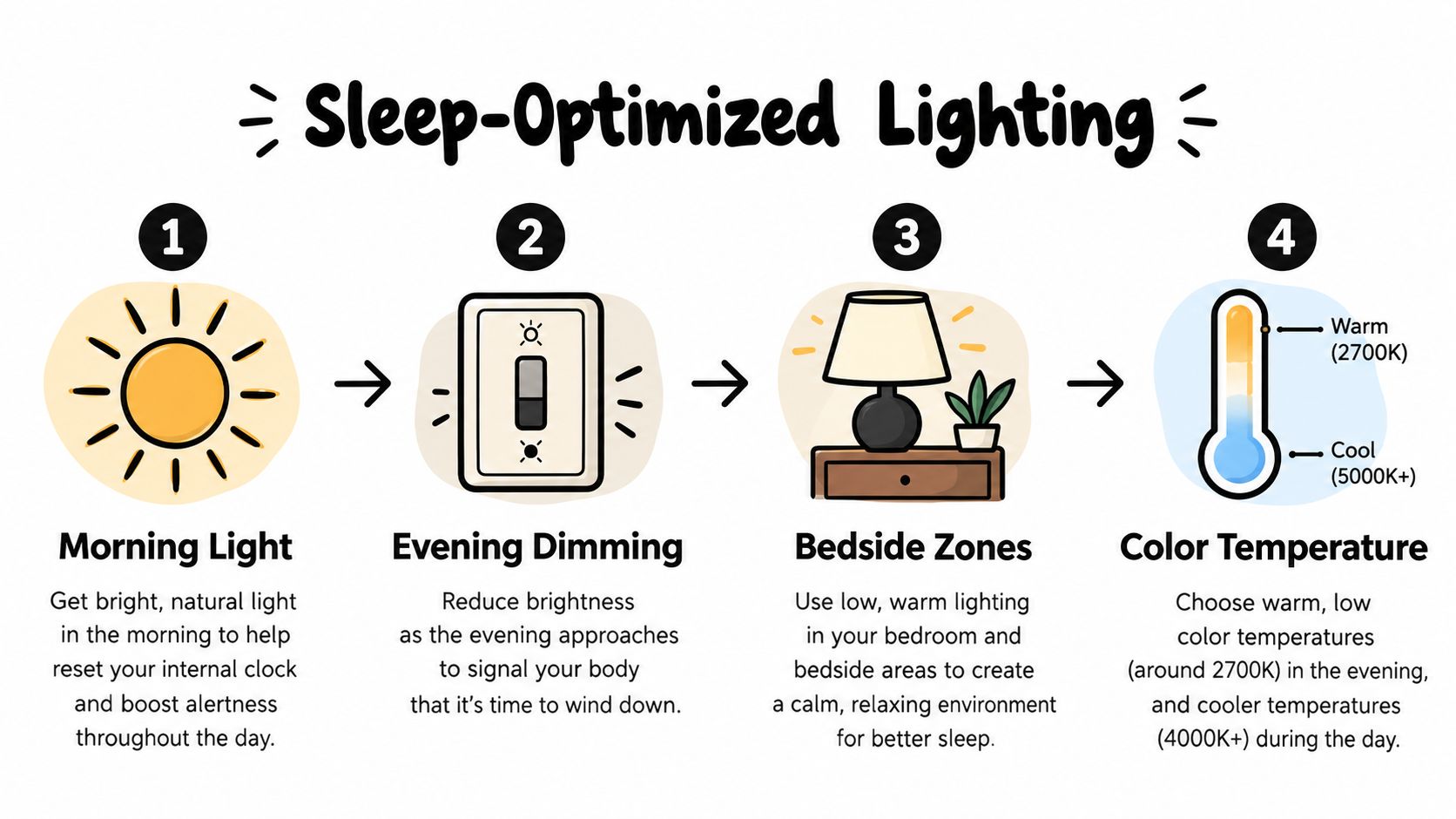
The order of operation matters. Dim the ambient sources before bed, switch off accent lighting, use a focused reading lamp only as needed, and make the final sleep field as dark as possible. If you need illumination overnight, red-light devices can be less disruptive than cool, blue-leaning sources.
Styling, Maintenance, and Smart Shopping
The finished room should look edited rather than empty. One substantial artwork can have more presence than a gallery of unrelated small pieces. A pair of balanced lamps can provide more polish than several accessories scattered across the nightstands. Choose the objects you want to see when you wake up, then remove everything that belongs somewhere else.
A practical buying decision compares immediate appearance with repeated use. Low-cost decorative bedding may look full on the first day but lose its shape quickly, while a well-constructed quilt or comforter can become the stable layer around which the room evolves.
Compare the whole ownership experience
| Feature | Standard Bedroom Basics | Luxury Bedroom Upgrades |
|---|---|---|
| Fitted sheet | Basic pocket depth chosen from the mattress label | Pocket depth selected for the mattress and topper stack |
| Surface feel | One general-purpose weave | Coordinated percale, sateen, quilted, or woven textures |
| Visual arrangement | One comforter used as the complete bed | Fitted sheet, flat sheet, duvet or comforter, and an editable accent layer |
| Storage | Freestanding pieces that occupy floor space | Quiet-front cabinetry, floating pieces, or integrated storage |
| Lighting | One overhead source | Dimmable ambient, focused bedside, and concealed or switchable accent light |
| Care routine | Washing based on convenience | Care instructions followed to protect softness, seams, and shape |
| Longevity | Replacement driven by early wear | Durable foundational textiles chosen for repeated laundering |
Shop for performance, not packaging
Read the care label before buying. Oversized bedding can need a larger-capacity washer or a professional cleaning plan, and a textile that can't be washed or dried appropriately may become an expensive inconvenience. Wash sheets and covers according to the manufacturer's instructions, avoid overloading the machine, and make sure heavy pieces dry completely before storage or use.
A considered care routine is part of the luxury experience. The guide to caring for luxury sheets can help you protect the hand, fit, and finish of premium bedding. Replace decorative pieces only when they no longer perform, not just because a seasonal trend has changed.
For shoppers comparing collections or looking for high-end bedding in Atlanta, evaluate fiber content, construction, pocket depth, return terms, and washability alongside color. SouthShore Fine Linens is one option for oversized bedding, extra-deep-pocket sheets, quilts, duvet sets, and comforters designed for coordinated bedroom layering, with many textiles carrying OEKO-TEX® certification.
Keep the final edit strict
Before calling the room finished, remove one decorative item from each visible surface and check whether the composition improves. Make sure the bed remains easy to enter, the reading light reaches the page, the curtains control exterior light, and every textile can be maintained without special effort that you'll avoid later.
The most convincing luxury is dependable. It appears in a sheet that stays in place, a drawer that opens without obstruction, a lamp that dims smoothly, and a bed that remains inviting after repeated washing. Build those fundamentals first, then add personal details sparingly.
SouthShore Fine Linens offers oversized bedding, extra-deep-pocket sheet sets, quilts, comforters, and coordinated duvet collections for creating a refined bed that fits modern mattresses. Visit SouthShore Fine Linens to choose practical textile layers that bring hotel-style comfort, considered texture, and everyday durability to your bedroom.


