
Hotel Quality Bed Linens: What Actually Makes Them Worth It
Most advice about hotel sheets starts in the wrong place. It tells you to chase the highest thread count you can afford, as if one number can predict how a sheet will feel after months of sleeping, washing, and drying.
It can't.
When people say they want hotel quality bed linens, they usually mean something more specific. They want sheets that feel crisp or smooth on night one, still fit the mattress after repeated washing, and don't turn limp, fuzzy, or misshapen too quickly. Hotels buy for that real-world performance. They don't buy for a flashy number on the front of the package.
Why Hotel Quality Is Not About Thread Count
A high thread count is one of the easiest ways to make an ordinary sheet sound impressive. It gives shoppers a single number to compare, but sheets do not wear, wash, breathe, or fit based on one number alone.
Hotels know that. Their buyers are usually trying to avoid a different problem than retail shoppers. They need linens that feel good on the first night, hold their shape after repeated laundering, and still work on the mattress they are assigned to. A sheet can have a high thread count and still feel stuffy, weaken early, or slip around if the pocket depth is wrong.
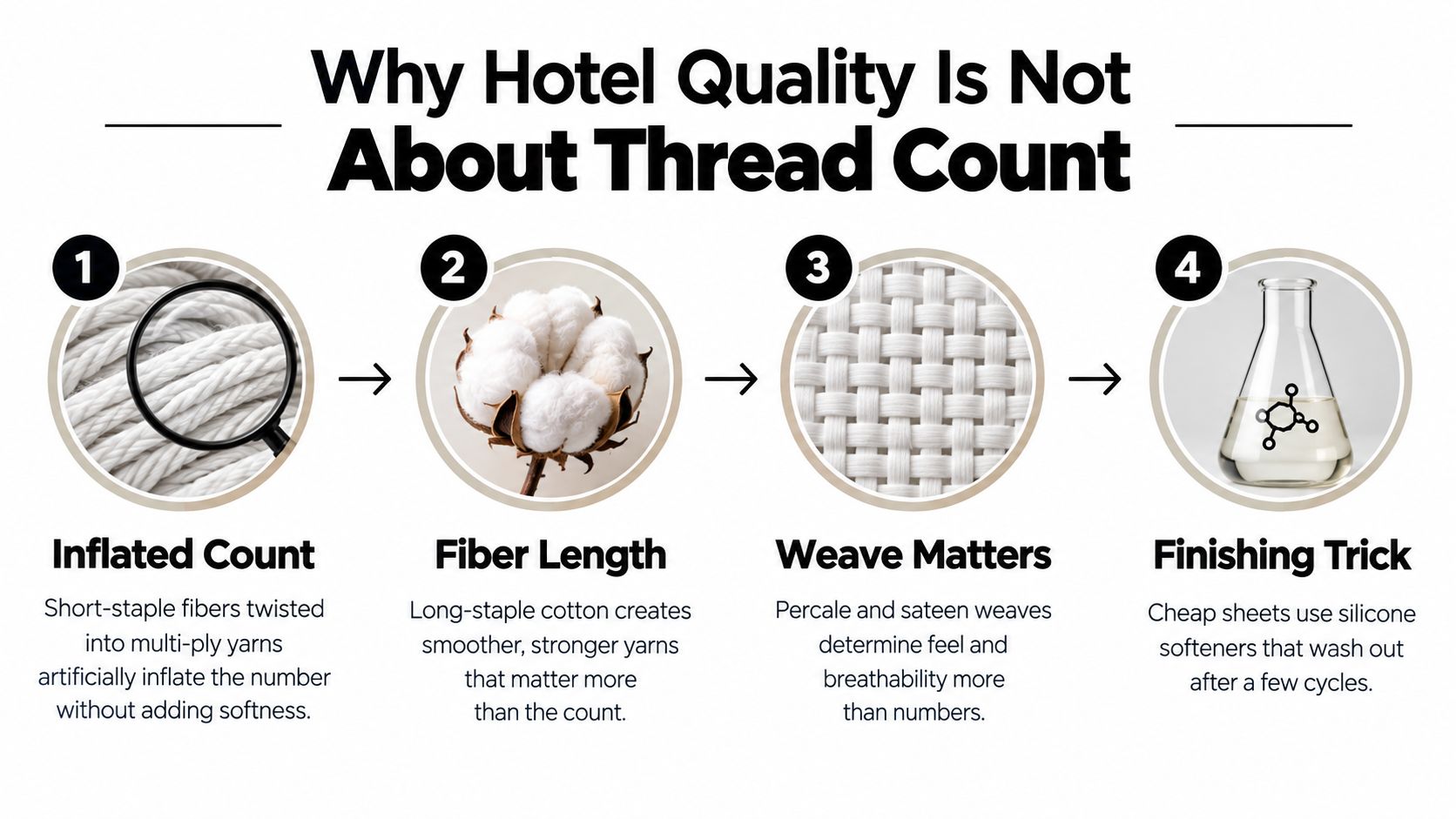
Four things matter more than the headline number
A better way to judge “hotel quality” is to look at the fabric the way a hospitality buyer would.
- Fiber quality affects how the yarn behaves over time. Better cotton fibers usually produce smoother, cleaner, more stable yarns.
- Weave shapes the sleep experience. Two sheets can use similar cotton and feel completely different because the weave changes airflow, texture, and drape.
- Ply and fabric weight often reveal more than a big count on the package. Single-ply construction and a sensible GSM range usually tell you more about honest build quality than inflated thread-count marketing.
- Finish and fit matter in real bedrooms. A softening finish can fade after washing, and a fitted sheet that cannot handle an extra-deep mattress or an adjustable base will never feel polished for long.
If you want a quick refresher on the measurement itself, this plain-language guide on what thread count means in bed sheets explains why the number is easy to misuse.
Why hospitality buyers treat thread count as one spec, not the spec
Commercial bedding is purchased more like workwear than fashion. The fabric has to survive washing, drying, and repeated bed-making without losing too much comfort or structure. That is why hospitality-oriented spec guides often discuss thread count alongside yarn construction, weave, and GSM, instead of treating it as the main predictor of quality, as outlined in this institutional bedding specification guide.
That buying logic helps clear up a common myth. A 600 or 800 thread count sheet is not automatically more luxurious than a well-made 250 to 400 count sheet. In some cases, the higher number comes from counting multi-ply yarns in a way that makes the label look richer than the fabric performs.
The practical takeaway is simple.
Use thread count as a checkpoint, not a shortcut.
Once you start reading “hotel quality bed linens” through that lens, the label makes more sense. The better question is not “What number is highest?” It is “What fabric spec will still feel good, fit correctly, and wash well after real use?”
The Fibers and Weaves Behind the Hotel Feel
If thread count isn't the answer, what creates that familiar hotel-sheet feel? Usually two structural choices do most of the work: the fiber and the weave.
Think of fiber as the raw material and weave as the construction pattern. One affects smoothness and strength at the yarn level. The other affects breathability, drape, and surface feel once the fabric is woven.
Fiber choice changes how the sheet ages
Cotton remains the reference point for many shoppers because it can feel clean, breathable, and familiar. But not all cotton behaves the same. Better fibers usually produce cleaner, stronger yarns, while lower-grade fibers are more likely to fuzz, pill, or feel coarse once the finish wears off.
Single-ply yarns also matter. A sheet made from single-ply yarns often performs better than one that inflates the count through multi-ply construction, because more plies don't automatically mean a stronger fabric. In heavy laundering conditions, the structure of the yarn can matter more than the number printed on the package.
A lower-count sheet made from better yarn can outlast and out-feel a higher-count sheet built to impress in a product listing.
GSM is worth learning too. It stands for grams per square meter, and it tells you how substantial a fabric is. It won't tell you everything, but it often gives a more grounded sense of fabric weight than thread count alone.
Percale and sateen feel different on the bed
Most confusion comes from shoppers comparing sheets that use the same fiber but a different weave. That's why two cotton sheet sets can feel nothing alike.
Here's the simplest way to see it:
| Attribute | Percale | Sateen |
|---|---|---|
| Feel | Crisp, cool, matte | Smooth, silkier, slightly warmer |
| Surface look | Clean and understated | Soft sheen |
| Airflow | Usually more breathable | Usually less airy than percale |
| Drape | Structured | More fluid |
| Best for | Hot sleepers, crisp-bed fans | People who want softness and drape |
Percale is the hotel classic for people who like that fresh, ironed-shirt feeling. Sateen is closer to a polished, drapier fabric that feels smoother right away.
If you're deciding between the two for home use, this breakdown of sateen versus percale sheets lays out the comfort tradeoffs clearly.
Alternatives for specific sleep styles
Cotton isn't the only path. Some shoppers prefer blends or alternatives because they want a particular temperature profile or hand feel.
- Linen tends to feel textured, airy, and relaxed rather than crisp.
- Lyocell or Tencel-style fabrics usually feel smoother and cooler to the touch.
- Blends can help with wrinkle resistance or easier care, though some buyers find that they trade away some breathability.
The key is to choose intentionally. If what you love about hotel quality bed linens is the crisp, structured bed surface, percale is often closest. If what you love is the smoother glide of the fabric, sateen may make more sense.
What Hotel Procurement Actually Specifies
A hotel buyer usually starts with a laundry cart, not a luxury ad.
The question is practical: after constant washing, drying, and remaking, will the sheet still feel good, fit the bed correctly, and avoid early replacement? That mindset changes the whole spec sheet. Instead of chasing the biggest thread count on the label, procurement teams look for fabrics that perform the same way on night one and wash fifty.
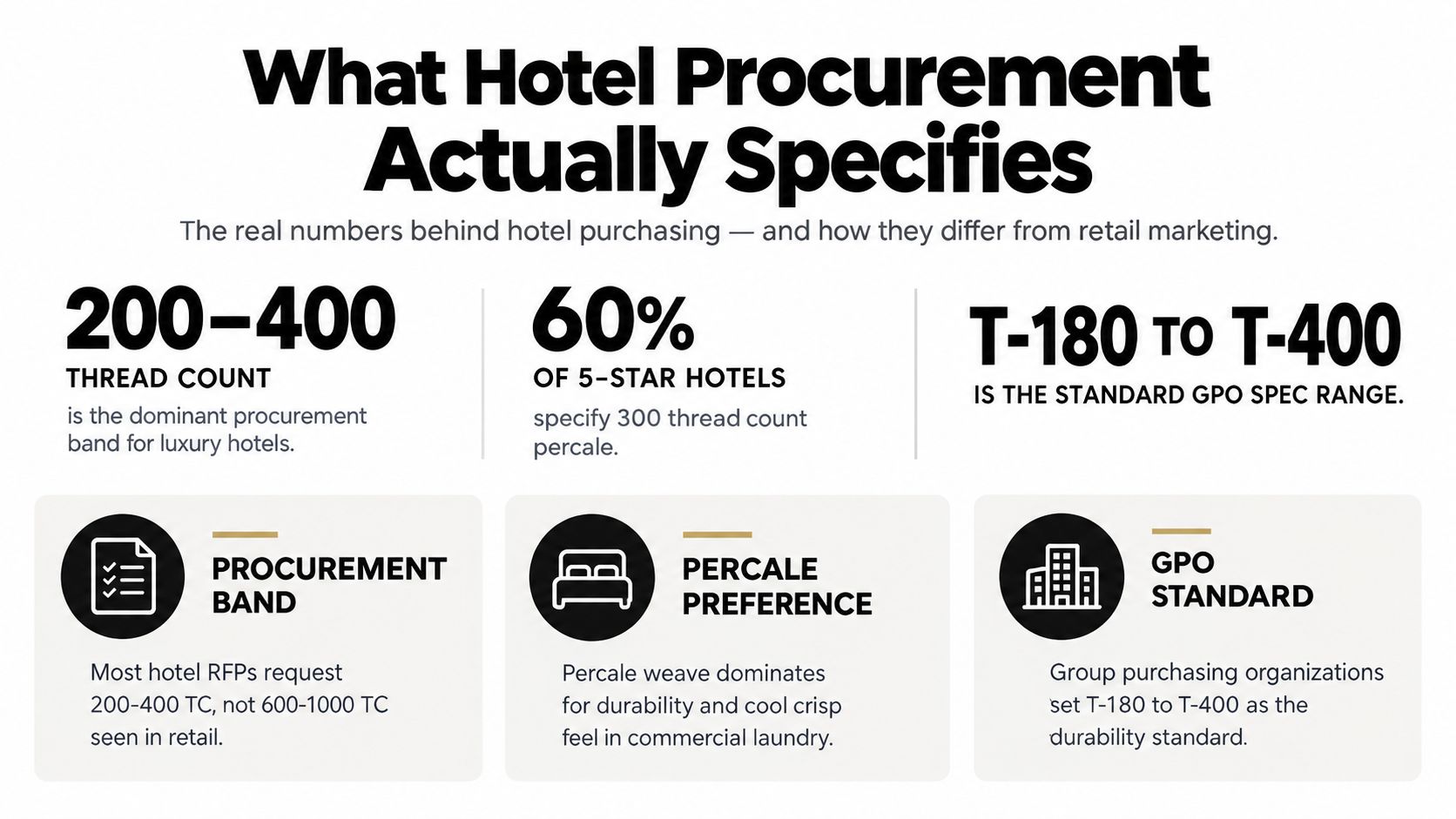
What shows up on a real spec sheet
Hospitality purchasing documents usually read more like maintenance plans than marketing copy. The fabric has to clear a few simple tests.
- Weave is specified first because it shapes the feel and the upkeep. Percale is common where buyers want a crisp hand, easy airflow, and a fabric that does not get overly heavy in the wash cycle.
- Ply and yarn quality matter because the yarn is the building block. Single-ply cotton, often combed or ring-spun, tends to wear more predictably than inflated multi-ply constructions that sound impressive on the package.
- Fabric weight often matters as much as thread count. GSM gives a clearer picture of how substantial the cloth is, much like paper stock tells you more than a glossy cover line.
- Dimensional stability gets close attention because shrinkage changes the fit fast. A sheet that starts out fine but pulls tight after laundering creates corner pop-off, wrinkling, and guest complaints.
- Pocket depth and elastic design matter more than many home guides admit. Hotels using thicker mattresses, toppers, or adjustable bases need fitted sheets that stay anchored instead of creeping loose at the corners.
That last point gets overlooked in retail advice. A beautiful fabric is still frustrating if it twists on an adjustable base or barely stretches over an extra-deep mattress.
What this means for home shoppers
Consumer labels often push one number because it is easy to print and easy to compare. Procurement buyers work more like restaurant owners choosing plates. They care less about the headline and more about whether the item survives daily use without becoming a nuisance.
That is a better model for buying sheets at home. Look for clear information on weave, GSM or fabric weight, ply, and shrinkage control. Then check the fitted-sheet dimensions with the same care you give the fabric itself, especially if your mattress is tall, you use a topper, or your bed bends and moves.
“Hotel quality” usually means consistent performance, not exaggerated specs.
Finishing, Durability, and Certifications That Matter
Finishing is the part of sheet shopping that fools people fastest. A set can feel slick and impressive out of the package, then lose that polished hand after a few washes because the fabric itself was ordinary.
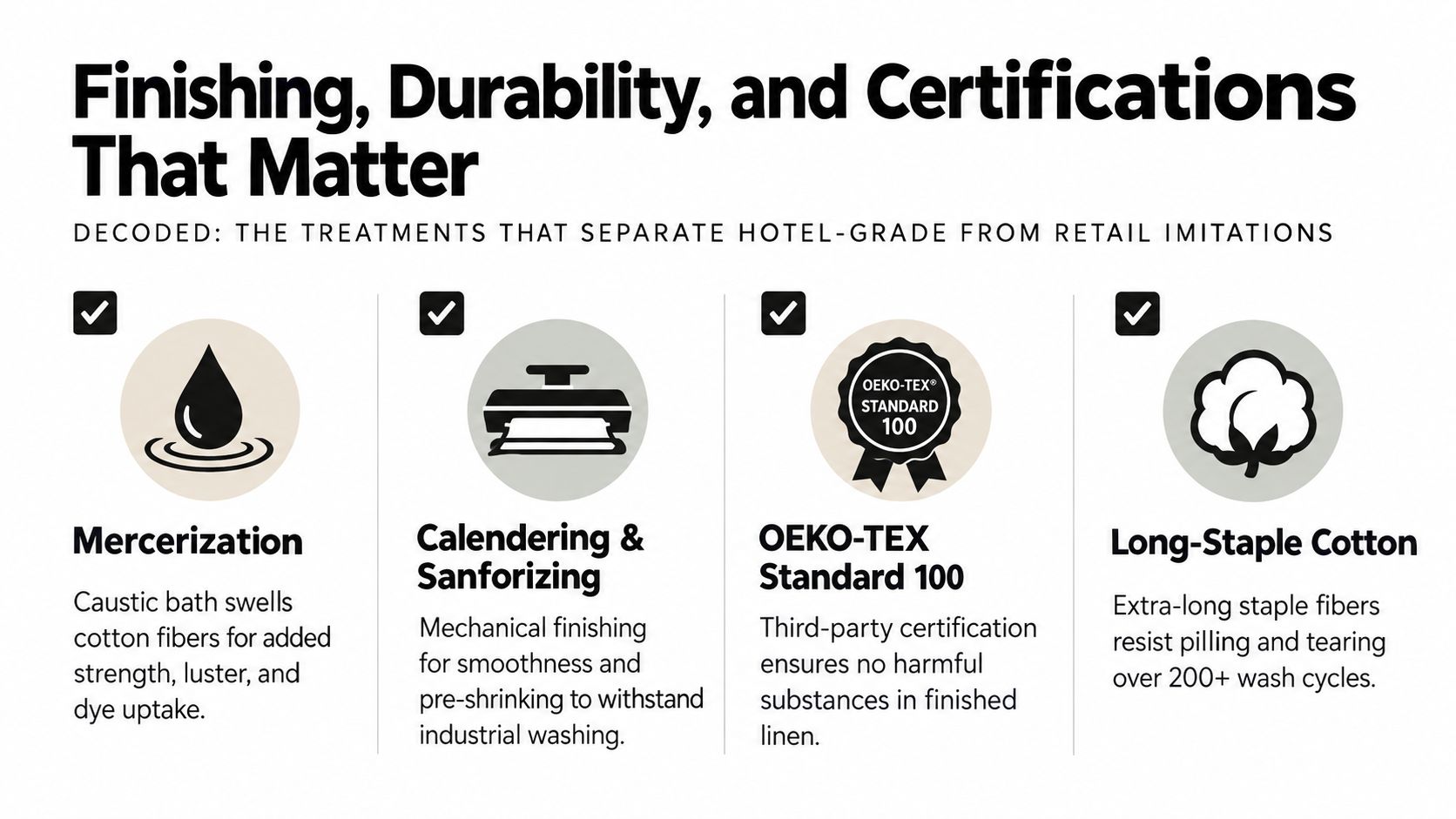
Hospitality buyers pay attention to finishing for a simple reason. The finish affects how the fabric behaves after repeated laundering, not just how it photographs on day one. A good finish supports the cloth. A cosmetic one can wash away, leaving behind stiffness, fuzzing, or a limp feel.
Finishes worth recognizing
A few terms are useful on a product page:
- Mercerization treats cotton to improve strength, dye absorption, and sheen.
- Sanforization pre-shrinks fabric so the size stays more stable after washing.
- Calendering presses the surface mechanically to make it look smoother and more uniform.
These terms are helpful clues, not automatic proof of quality. A plain product page can still hide a well-made sheet, and a flashy one can hide shortcuts. The useful question is whether the brand explains how the fabric was prepared, or only repeats soft-focus words like “luxury” and “ultra-soft.”
Durability shows up in small details
Long-lasting sheets usually reveal themselves in boring places. The yarn quality matters. The stitching matters. The finishing matters. So does whether the brand gives clear, specific information instead of vague branding language.
Check for:
- Single-ply cotton instead of inflated count claims built from multi-ply yarns
- Even stitching at hems and pillowcase openings
- A finish that feels clean rather than heavily coated
- Plain fiber disclosure instead of unclear phrases like “hotel blend”
The easiest analogy is clothing. A dress shirt with neat seams, stable fabric, and honest fiber labeling usually wears better than one that wins you over with a glossy store display. Bed linens work the same way.
Industry testing reflects that focus on repeat laundering. The ASTM textile standards catalog includes wash durability methods used to evaluate how fabrics hold up in use, including tests for dimensional change and surface appearance after laundering, as outlined by ASTM International textile standards. For a home shopper, the takeaway is practical. If a brand says nothing about shrinkage control, pilling resistance, or finish stability, you are filling in the blanks yourself.
Check labels for the boring details. Those details usually predict satisfaction better than the headline claim.
Certifications shoppers often care about
Certifications help with screening, but they answer a narrower question than many shoppers assume. They usually speak to chemical limits, fiber sourcing, or processing standards. They do not tell you whether a sheet will feel crisp, drape smoothly, or stay free of pills.
Two labels you will see often are OEKO-TEX Standard 100 and GOTS. Both can be useful. Neither replaces information about weave, GSM, ply, finish, and wash durability.
Use certifications the way a hotel buyer would use them. As one checkpoint among several.
Buying Checklist and Getting the Fit Right
A lot of sheet disappointment starts with measurement, not fabric quality.
Shoppers often blame the cotton or the weave when the problem is simpler. The fitted sheet is too shallow, the mattress became taller after a topper was added, or the corners pop loose every time an adjustable base bends. Hotel buyers account for those practical details up front because a sheet that fits poorly cannot perform well, no matter how good the fabric is.
It helps to shop with two separate filters in mind. First, check whether the fabric specs match the feel and durability you want. Second, check whether the sheet dimensions match the bed you sleep on today, not the mattress dimensions you remember from the original tag.
Fabric checklist for smarter shopping
Use this list like a spec sheet, not a marketing quiz:
- Fiber content. Look for plain, specific labeling such as cotton, linen, or lyocell. If the product uses terms like percale or sateen, confirm whether those describe the weave rather than the fiber.
- Weave type. Percale usually feels crisper and cooler. Sateen usually feels smoother and a bit heavier. This choice affects day-to-day feel more than thread count headlines do.
- Ply information. Single-ply yarns are often a cleaner signal than inflated thread count claims built from multi-ply math.
- Fabric weight. If GSM is listed, it gives you a more grounded clue about substance and drape.
- Finish and stability. Pre-shrunk or sanforized fabrics can reduce guesswork after washing. Clear certification details can also help with screening.
- Care requirements. A sheet that needs delicate handling may be fine for a guest room and annoying on an everyday bed.
One practical example is SouthShore Fine Linens, which offers oversized and extra-deep-pocket bedding aimed at modern mattress sizes. That kind of fit-first design often matters more in real bedrooms than a vague “hotel collection” label.
Fit checklist for deep mattresses and adjustable bases
Fit works like putting a lid on a container. If the dimensions are close but not quite right, the problem shows up at the corners first.
Measure before you buy, especially if you use a topper, pillow-top, mattress protector, or adjustable base.
- Measure total bed height from the bottom edge of the mattress to the top sleep surface, including any topper.
- Compare that number to pocket depth. Do not rely on the mattress name alone.
- Allow for movement if the bed articulates. Adjustable bases pull on fitted corners, so a little extra depth usually helps.
- Check flat-sheet width if you like a tucked, composed bed. Thick mattresses can make a standard flat sheet feel skimpy fast.
Here's a simple way to organize those checks:
| Bed Size | Standard Mattress (in) | Mattress + Topper (in) | Fitted Pocket Depth (in) | Flat Sheet Overhang per Side (in) |
|---|---|---|---|---|
| Twin | Narrowest common adult bed size | Add topper height to total mattress depth before shopping | Choose a pocket depth greater than your measured bed height | Allow enough extra width for a secure tuck |
| Twin XL | Common for dorms and split adjustable setups | Topper height can change fit more than shoppers expect | Deep pockets often work better with adjustable movement | Extra overhang helps keep the bed looking neat and evenly tucked |
| Queen | The size many sheet guides assume by default | Pillow-tops and hybrids often add noticeable depth | Deep or extra-deep pockets may fit better | More side drop helps create a cleaner tuck |
| King or California King | Width and length differences matter, especially for Cal King | Measure carefully because labels are easy to confuse | Match the fitted shape to the exact mattress type | Check that the flat sheet is wide enough to drape evenly |
Common sizing mistakes
A few errors come up again and again:
- Ordering Twin instead of Twin XL for split-king adjustable setups
- Mixing up King and California King
- Buying a flat sheet that looks large enough on paper but leaves too little fabric to tuck
- Assuming yesterday's pocket depth still works after adding a thick topper or padded protector
If you want the classic hotel bed appearance, keep the layers straightforward. Use a fitted sheet, an optional protector underneath, a flat sheet, then your duvet or coverlet. Add sleeping pillows first and decorative pieces last. That order looks cleaner and makes daily bed-making easier.
Care Habits That Keep Linens Hotel-Fresh
Fresh-looking sheets usually come from routine, not from a luxury label. Hotels stay crisp because they spread wear across multiple sets, wash on a regular schedule, and avoid the small laundry mistakes that make fabric feel tired before its time.
The easiest habit to borrow at home is a simple rotation. As noted earlier, hospitality programs often keep one set on the bed, one ready to use, and one off in care or storage. At home, that approach gives the fabric recovery time between washes and saves you from rushing a load just to remake the bed the same night.
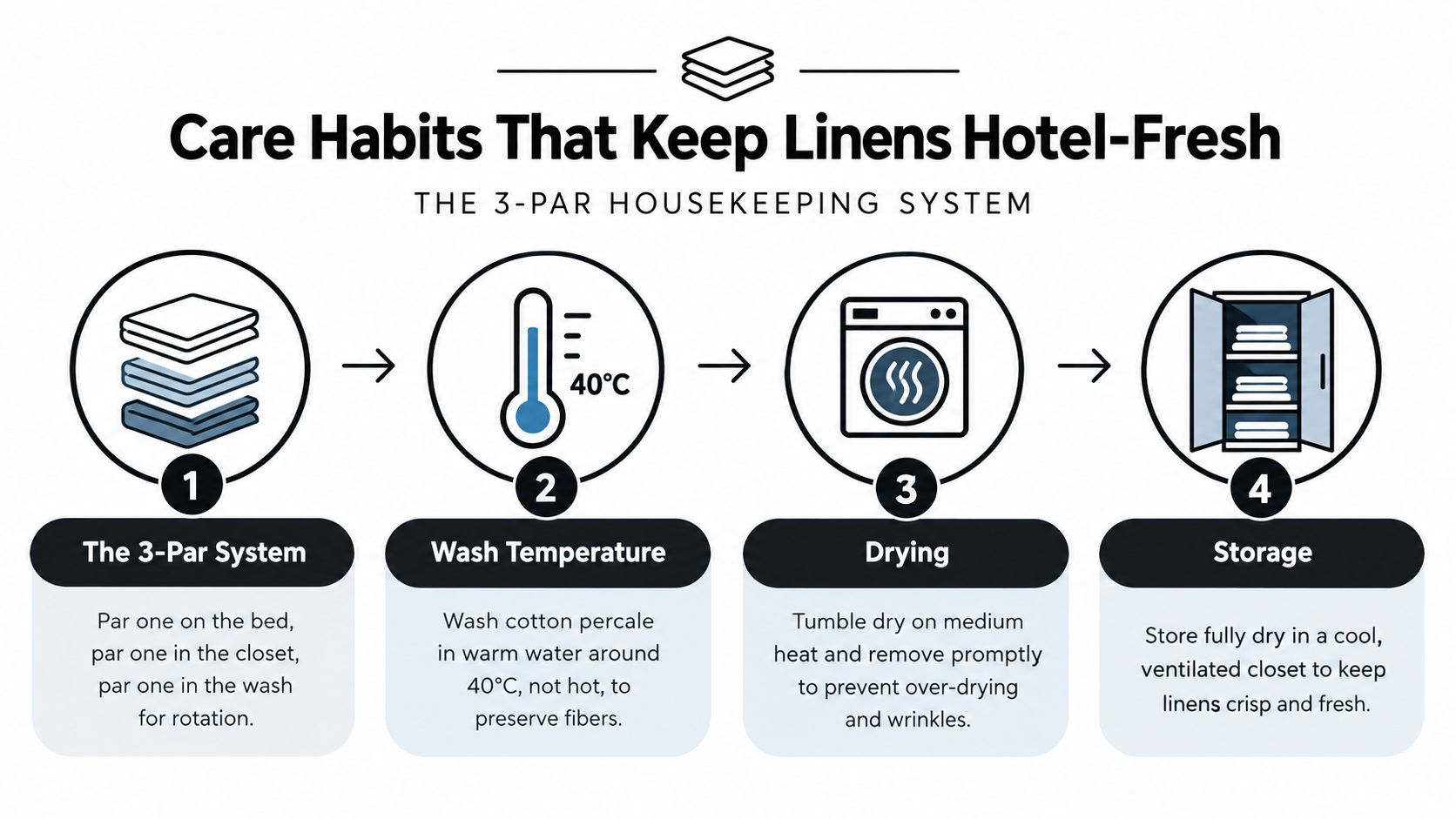
A home version of the hotel rotation
Three sets per bed is a practical target if you have the space.
- One set in use
- One clean set folded and ready
- One set being washed or waiting its turn
That setup works like rotating tires on a car. You are not changing the fabric itself. You are spreading the workload so one set does not absorb every wash cycle, every body oil, and every hot dryer session.
Care also affects feel more than many shoppers expect. A crisp percale can turn rough if it is over-dried. A smoother sateen can lose some of its polished surface if it is washed with rough items like towels or heavy zippered protectors. If you want a clear refresher on temperatures, detergents, and drying, this guide on how to wash bedding properly covers the basics.
Habits that preserve hand feel
The goal is simple. Keep the fibers clean without cooking them.
- Skip fabric softener on cotton if you want breathability and a cleaner, crisper hand.
- Wash sheets separately from heavy items so the fabric does not get abraded by towels, blankets, or hardware.
- Use moderate dryer heat because high heat can make cotton feel papery and shorten the life of elastic on fitted sheets.
- Remove sheets promptly so wrinkles do not set.
- Fold or place them back on the bed soon after drying because that helps the fabric relax with fewer hard creases.
One small habit makes a noticeable difference. Pull sheets from the dryer when they are dry but not baked. Over-drying is one of the fastest ways to make good fabric feel cheaper than it is.
Pillowcases tend to show wear first because they take more frequent contact from skin, hair products, and face care. Turning them inside out before washing can reduce visible surface wear, especially on darker shades and smoother weaves. If you use sheets on an adjustable base, check the fitted corners after each wash as well. Repeated stretching puts stress on the elastic, and catching that early is easier than fighting a sheet that starts slipping off every night.
Matching the Setup to Your Use Case
The right bedding setup depends on how you use the bed. A homeowner, a short-term rental host, and a gift buyer can all want “hotel quality,” but they don't need the same package.
That's where many buying guides fall short. They focus on the style of a hotel bed and ignore the job the linens need to do.
Homeowner setup
A homeowner usually has the most freedom to tune feel by season and preference.
| Homeowner | Short-Term Rental Host | Gift Buyer |
|---|---|---|
| Choose based on comfort first. Percale works well for a cool, crisp bed, while sateen suits shoppers who want more drape. | Choose for repeat care, simpler laundering, and dependable replacement planning. White or light neutral sets are often easier to manage visually. | Choose for presentation, versatility, and broad appeal. Neutral colors and easy-care fabrics reduce the chance of gifting something too specific. |
| Layer for the look you actually enjoy, not the one in a catalog. A fitted sheet, flat sheet, duvet, and a folded throw usually create enough structure. | Keep protectors under each bed setup and store backup sets where turnovers are fast. Fit consistency matters as much as hand feel. | Build a complete-feeling bundle. A fitted sheet, flat sheet, pillowcases, and a duvet cover feels more intentional than a single item. |
| If you're aiming for a polished bedroom, this article on luxury bedding at home gives useful styling context without reducing the whole decision to thread count. | Avoid overcomplicated fabrics if multiple people handle laundry. The easier the care routine, the more consistent the guest experience. | Include care notes if the set has a special weave or finish, especially for wedding or housewarming gifts. |
Short-term rental host setup
Hosts have different priorities. They need bedding that looks fresh, washes predictably, and fits fast between stays. They also need a setup that different cleaners can remake without guesswork.
One procurement guide notes that a good hotel sheet should remain guest-ready for 50 to 70 industrial wash cycles, while another hospitality source says commercial bed linen often needs to withstand 150 to 250+ wash cycles depending on construction and care, as discussed in this hotel sheet procurement guide. For hosts, that's a reminder to think in wash cycles and visible wear, not just in purchase date.
Gift buyer setup
Gift buyers should simplify the choice. Focus on fit, color, and how complete the set feels when opened.
A few practical rules help:
- Neutral colors are safer than trend-driven prints.
- Deeper pockets reduce the chance that the gift won't fit a modern mattress.
- A care card adds value because many recipients don't know how different weaves should be handled.
The best hotel quality bed linens for one person may be the wrong gift for another if the fit is off or the care is too demanding. Good gifting is less about chasing “luxury” and more about making the set easy to live with.
If you're looking for bedding that applies these ideas to real homes, SouthShore Fine Linens offers options built around fit, finish, and everyday durability, including oversized and extra-deep-pocket designs that suit modern mattresses and adjustable setups. Browse their collections if you want a more practical route to a hotel-inspired bed instead of another thread-count promise.


