
Cal King Duvet Insert: How to Choose the Right One
You've bought the longer mattress, ordered a duvet cover that looked right online, and now the insert has arrived. It either disappears inside the cover, leaves the foot of the bed exposed, or bunches into a heavy ridge that makes the whole bed look untidy. That frustration usually isn't caused by the brand. It comes from treating a Cal King duvet insert as a simple size purchase instead of as one part of a complete bedding system.
The right choice depends on four connected decisions: the mattress footprint, the cover's finished dimensions, the insert's fill and construction, and the way you use the bed. Oversized styling, deep mattresses, adjustable bases, warm bedrooms, and frequent washing can all change which insert works best.
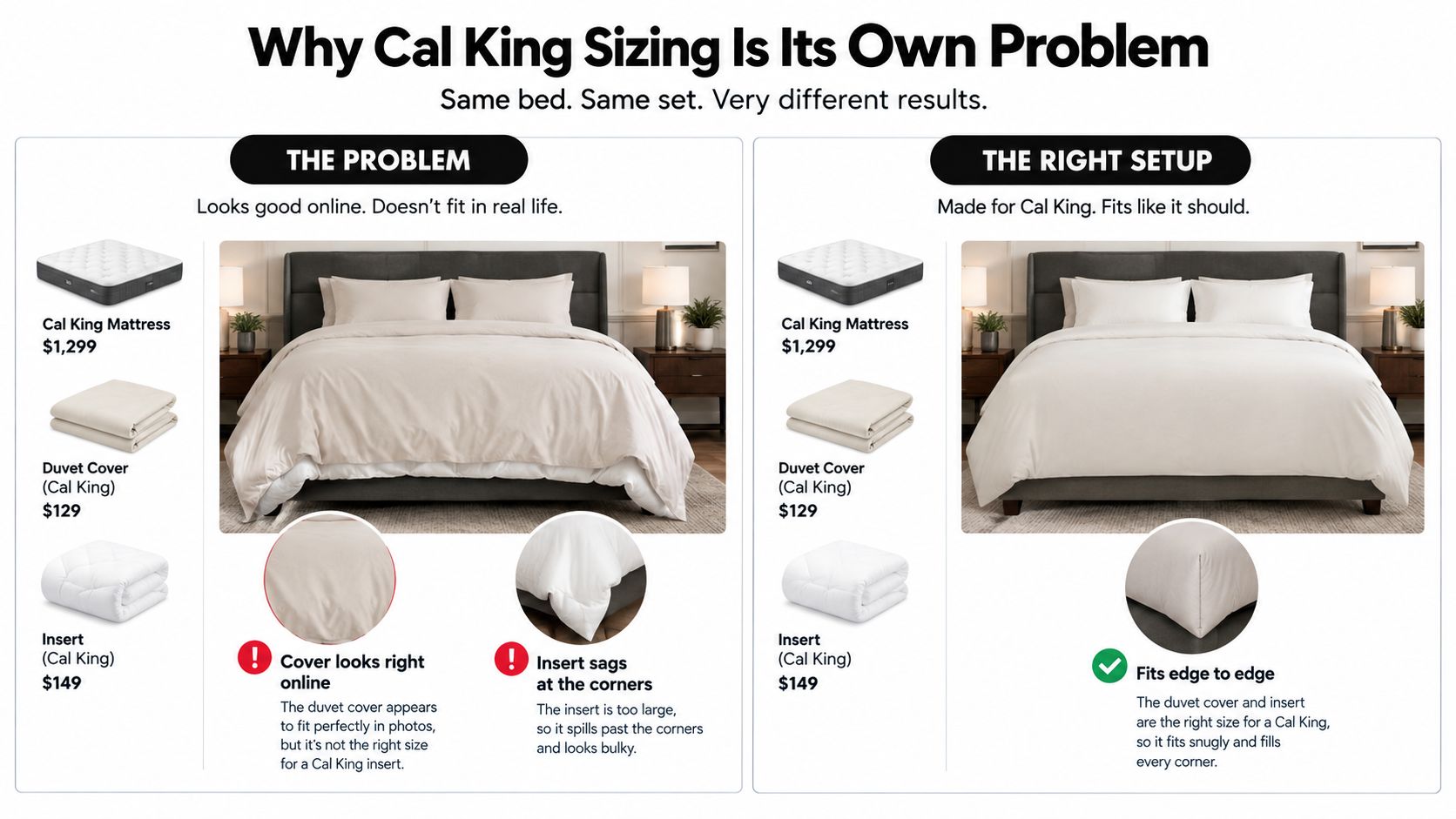
Why Cal King Sizing Is Its Own Problem
The first mismatch is built into the mattress. A California king mattress measures 72 inches wide by 84 inches long, while a standard king measures 76 by 80 inches, giving the Cal King four inches less width and four inches more length. That trade-off is documented in the historical overview of California king sizing, and it explains why a standard king insert can look acceptable across the sides while still coming up short at the foot.
A Cal King mattress has a footprint of 6,048 square inches, calculated from 72 by 84 inches. A standard king covers 6,080 square inches, calculated from 76 by 80 inches. The surface areas are nearly identical, but the shape is different. That shape determines how an insert drapes, where it needs extra length, and whether the cover's corners align with the mattress.
Measure the bed before judging the insert
Start with the mattress, not the label on the package. Record the mattress width, length, and depth, then decide how much side and foot drop you want. A slim, tucked appearance needs less drop than an oversized look that hangs close to the floor.
The mattress measurement gives you the baseline, but it doesn't tell you the insert size by itself. Duvet covers extend beyond the mattress, and the insert must fit the cover before it can drape correctly over the bed. For a broader explanation of king sizing, compare the guidance in this king duvet size reference.
Practical rule: Treat “king” and “California king” as starting labels only. The cover's actual finished width and length are the measurements that control the purchase.
A standard king insert may be wide enough for a Cal King, but its shorter length can leave the foot under-covered. Conversely, an oversized Cal King insert may create dramatic side coverage but drag or pull when used on a shallow mattress. Measure first, choose the desired drape second, and only then compare inserts.
Matching Insert Dimensions to Your Duvet Cover
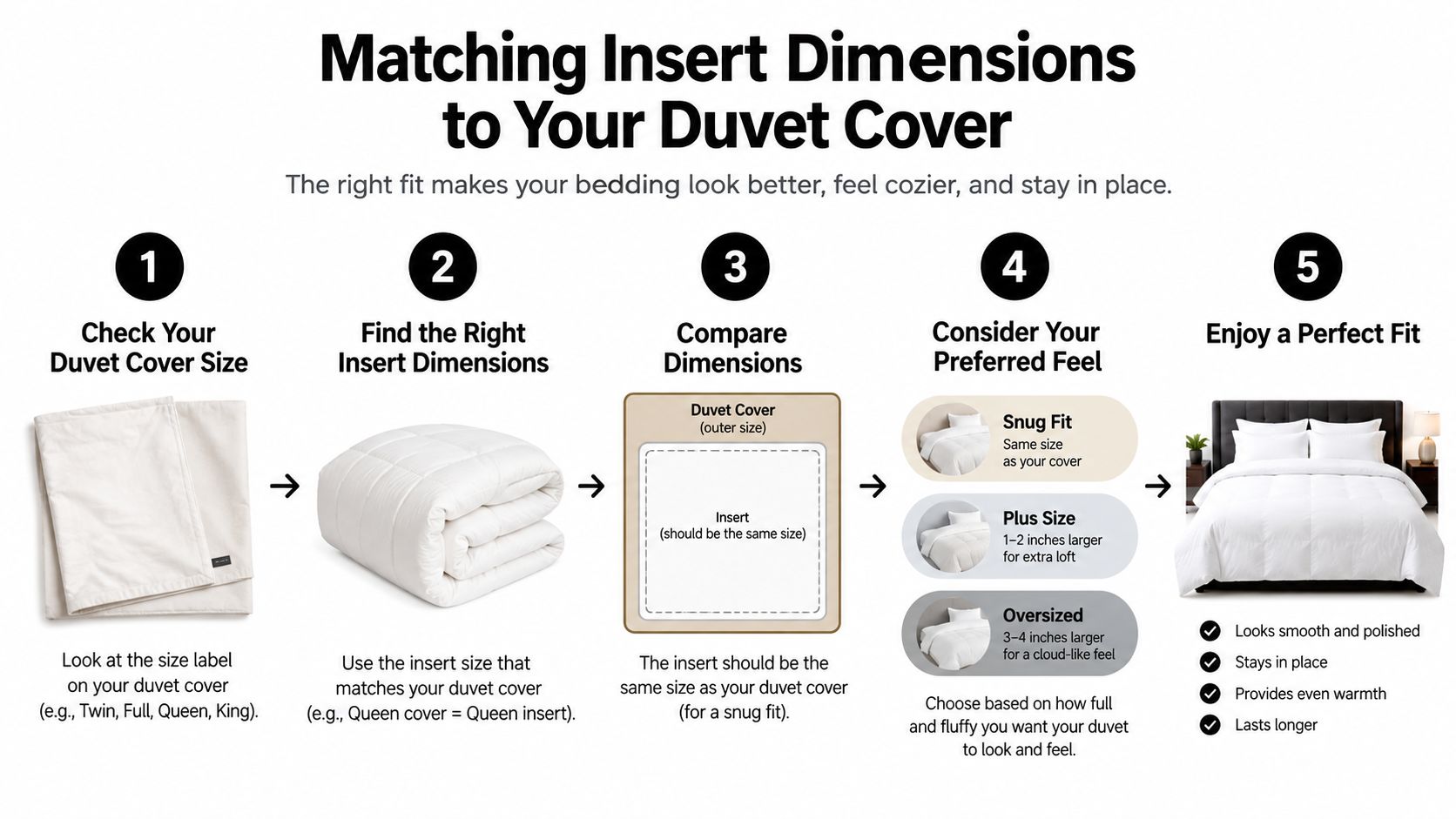
A Cal King insert can fit the bed and still fail inside the cover. The purchase succeeds only when the finished insert and finished duvet cover work as one system. California king products have no universal finished dimensions, so the same size label can produce different corner fill, side coverage, foot coverage, and overnight movement.
Published Cal King insert dimensions range from about 96 by 104 inches to 108 by 114 inches. That range appears in these published Cal King insert dimensions compiled by Down Inc.. Use the figures as a comparison point, not as permission to buy by label alone.
Let the cover control the purchase
Lay the duvet cover flat and measure its interior width and length. Check whether the listing gives finished dimensions or only nominal sizing, since quilting, seams, and finishing can reduce usable space. Compare the insert's width and length in the correct orientation.
Choose an insert about 1 to 2 inches larger than the cover when you want a fuller appearance. The insert's shell construction, fill power, quilting, and loft still affect the result. A lofty insert may need less excess than a flatter, tightly quilted one.
Oversizing is not a shortcut to better coverage. An insert that is too large can compress the corners, form internal folds, and distribute fill unevenly. An undersized insert looks slack and leaves parts of the cover empty. The right match gives the cover enough fullness without forcing the fill against its seams.
Run this compatibility check
- Measure the cover interior. Record width and length rather than relying on the advertised size.
- Compare finished insert dimensions. Follow the measurements when they conflict with the label.
- Check the overfill allowance. Modest excess adds fullness; a larger mismatch can distort loft.
- Confirm the tie layout. Corner loops must meet the cover ties without twisting.
- Choose the intended drape. A shallow, tucked edge requires a different result from a relaxed drop.
An unusual cover may need custom dimensions or attachment points. This guide to how to sew a duvet cover for any bed explains the measurements involved. For a standard cover, compare the finished dimensions with this duvet cover size guide before ordering the insert. That check prevents the common return: a lofty insert bought for its label that cannot fill the cover evenly.
Fill Types and Construction That Change the Feel
A Cal King shell gives the fill more territory to cover, so material and construction become especially noticeable. Down, down alternative, wool, and other synthetic fills don't redistribute in the same way. They differ in loft, weight, moisture handling, washability, and how steadily they hold their shape inside a large cover.

Down is the lightest-feeling route to substantial loft. Bedding research links thermal performance to ambient temperature, filling material, and filling weight, and reports that down can provide higher insulation than silk or wool at comparable fill weights because its structure traps air efficiently. You can review the findings in this research on duvet thermal comfort.
Compare the materials honestly
| Fill Type | Warmth-to-Weight | Washability | Best For |
|---|---|---|---|
| Down | High loft with an airy feel | Often more demanding | Sleepers who want light, lofty insulation |
| Down alternative | Usually denser for comparable fullness | Often practical for routine care | Allergy-conscious homes and active households |
| Wool | Naturally substantial with balanced regulation | Depends on the construction | Sleepers who want moisture management and a gently weighted feel |
| Synthetic fill | Varies by fiber and quilting | Often straightforward | Guest rooms, rentals, and frequent-use beds |
The table is only the starting point. Shell fabric controls airflow and hand feel, while the quilting pattern controls where the fill stays during the night. A breathable shell paired with uneven fill can still create cold or hot areas. A well-distributed synthetic insert may feel more reliable than a poorly constructed premium fill.
Baffle-box construction uses internal fabric walls to keep loft separated and evenly distributed. It generally suits an oversized Cal King insert when you want a fuller, more stable bed. Sewn-through construction anchors the shell directly through the fill, reducing migration but often creating flatter channels at the stitching points.
Match construction to your routine
Choose baffle-box when loft and broad, even coverage matter most. Choose sewn-through when you prefer a flatter profile, a more controlled look, or a design that limits movement between compartments. For a washable family bed, construction and care instructions deserve as much attention as the fill name.
This short video offers another visual look at duvet construction and bedding behavior:
Don't buy “luxury loft” as a specification. Ask what the insert is filled with, how the fill is secured, what the shell is made from, and how the finished product should be washed.
Picking the Right Warmth Rating for Your Room
Warmth is a system decision. The insert interacts with the room temperature, humidity, cover fabric, fill weight, construction, and your own sleep tendency. A lightweight insert can still feel hot if the cover restricts airflow or if the fill bunches into dense pockets.

Start with the sleeper, not the marketing label
Classify the room and sleeper as warm, neutral, or cold. A warm bedroom and a warm sleeper call for lighter insulation and strong airflow. A cold room or cold sleeper may need more loft, but the insert still needs even fill distribution to avoid cold zones.
Then compare fill weight only within the same size category. A heavier Cal King insert contains more material than a smaller insert, so comparing package weights across sizes can mislead you. Look at construction and loft retention as well. Compressed or uneven fill wastes insulation because it removes the air spaces that help bedding retain warmth.
Research on duvet thermal comfort indicates that thermal resistance can rise with down filling weight up to a point and then decline. That makes “heavier is warmer” an unreliable buying rule. Extra material can add mass without delivering proportional comfort.
Use the warmth label as a shortcut, not a verdict:
- Lightweight: Choose it for warm rooms, warm sleepers, or summer use.
- All-season: Choose it when the bedroom stays moderate and you want one adaptable insert.
- Extra warmth: Choose it for colder rooms and cold sleepers, provided the cover remains breathable.
Finally, test the care burden against real use. A guest-room insert may need different priorities from an everyday family bed. Hospitality hosts and active households should favor secure quilting, documented wash performance, and construction that won't collapse after routine care.
Putting the Insert Into the Cover the Right Way
A well-sized insert can still look terrible if it goes into the cover crooked. The fastest method is the inside-out technique, which aligns corners before the cover's fabric gets in the way.
Use the inside-out method
- Lay the duvet cover flat with the opening toward you, then turn it inside out.
- Place the insert on top, matching its width and length to the cover.
- Bring each corner of the insert to the corresponding corner of the cover.
- Tie or fasten the corner loops, starting at the far corners and working toward the opening.
- Reach through the opening, grasp the two far corners, and pull the cover right-side-out over the insert.
- Shake the covered insert gently, then smooth the fill from the foot toward the head.
- Close the buttons, zipper, or flap completely.
The purpose of the ties isn't decoration. They stop the insert from drifting into the foot or twisting sideways as you sleep. If a corner keeps pulling loose, check that the insert loop and cover tie are attached to one another rather than tied around a seam or nearby fabric.
Correct the three common failures
A lumpy foot usually means the insert wasn't pulled fully into the head corners before the cover was turned. A twisted corner often comes from rotating the insert during the flip, so smooth each corner individually after assembly. If the cover has a closure that doesn't reach across the full opening, fasten what is available and redistribute the fill before closing.
The Giorgi Bros. bedding guide is a useful companion when you're comparing comforters, protectors, and other layers. Keep the insert flat while making the bed, because lifting one side too aggressively can pull the fill away from its corner tie.
Solving Common Fit and Loft Problems
A Cal King insert can fit the label and still fail on the bed. Excess size may improve side coverage, but it can also create drag, compress the corners, shift the fill, and leave the cover looking lumpy rather than full.
Start with the cover, not the bed's appearance. A limp cover usually holds an insert that is too small for its interior or too flat for the desired look. Bulging and bunching point to the opposite problem: the insert may be too large, too lofty for the shell, or poorly matched to the cover's width.
Adjust for mattress depth and styling
A deep mattress needs more side drop than a shallow one to create the same finished position. Choose that drop from the mattress depth and the room's styling, rather than automatically selecting the largest available insert. If the duvet already approaches the floor, sizing up can make it drag and obstruct movement around the bed.
For an oversized look, balance the side and foot coverage. The insert should fill the cover and reach the intended edges without pulling the corners so tightly that the quilting loses its loft.
Adjustable bases change the fit while you sleep. Raising the head or foot can make an oversized insert slide, tug on the cover, or pull loose from a weak corner attachment. Secure corner ties, moderate weight, and enough coverage work better than maximum bulk. A loose, heavy insert will migrate as the base changes position.
Use an acceptance check
The assembled duvet should lie flat inside the cover. Check for compressed corners, exposed edges, and heavy bunching before putting it on the bed. The insert should fill the cover's corners without crushing the quilting. If a corner feels tight, size down rather than up.
Run your hands across the cover and locate each corner. Smooth the fill into place, then inspect the side seams. An empty area beside a raised ridge signals a compatibility problem, such as a mismatched shape, construction, or tie position. Shaking the duvet harder will not correct that mismatch.
A final test is movement. Lift and lower an adjustable base, then check whether the insert stays centered and the cover remains evenly filled. If the foot shifts or one side pulls sharply, reduce bulk, improve the corner attachment, or choose an insert with construction suited to the cover.
Care, Washing, and a Pre-Checkout Checklist
Care instructions should influence the purchase before you buy, not after the first spill. A large Cal King insert may challenge a residential washer, especially when the fill becomes heavy with water. Check the manufacturer's washing, drying, and cleaning directions, and don't force an insert into a machine that cannot move it freely.
Use the prescribed water temperature and dryer settings. Allow the insert to dry completely before returning it to the cover, because retained moisture can affect loft and create an unpleasant odor. If the care label calls for professional cleaning, include that ongoing cost and effort in your decision.
For practical stain handling around the rest of the bed, these cleaning tips from Maid in America can help you manage surrounding textiles without treating the duvet insert like ordinary laundry. The guide to washing bedding is also useful when you're setting a repeatable care routine.
Check these details before checkout
- Cover dimensions: Confirm the finished interior width and length.
- Insert dimensions: Match actual measurements, not only “Cal King” labeling.
- Desired drape: Decide how much side and foot coverage you want.
- Fill preference: Choose down, down alternative, wool, or synthetic based on feel and care.
- Warmth level: Match the insert to the room and your sleep tendency.
- Construction: Check whether the quilting supports your preferred loft and stability.
- Care demands: Confirm washing, drying, and professional-cleaning requirements.
- Corner attachments: Verify that the insert loops match the cover's ties.
- Bed movement: For an adjustable base, confirm that the insert won't pull free when the bed changes position.
SouthShore Fine Linens offers California King duvet cover sets with interior corner ties and button or hidden-zip closures, while the duvet insert is purchased separately. That makes the cover's finished dimensions and attachment design especially important when you're pairing it with an insert.
SouthShore Fine Linens focuses on oversized bedding and practical fit details, including California King duvet covers designed to hold separate inserts. Visit SouthShore Fine Linens to compare covers and bedding layers that suit deep mattresses, adjustable bases, and everyday care routines.


